

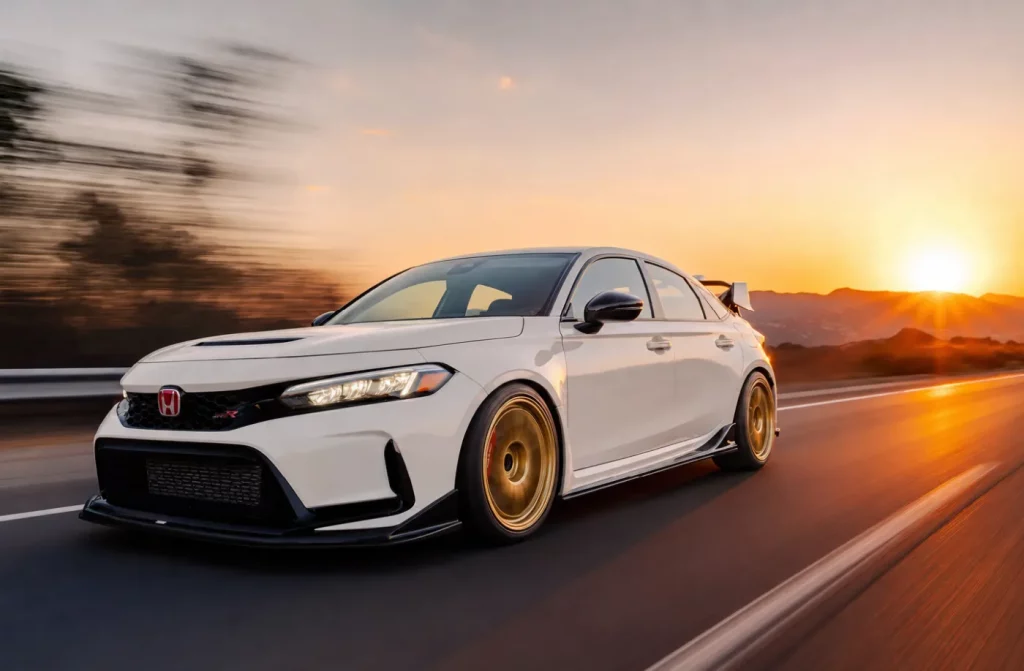
The Honda Civic has undergone a remarkable transformation in size and weight since its introduction in 1972. The first-generation Civic weighed approximately 1,500–1,600 pounds — barely more than a modern golf cart. The 2023 FL5 Civic Type R tips the scales at over 3,180 pounds, more than double that figure. The weight gain spans every generation and body style, driven by safety regulations, structural rigidity requirements, feature content, and platform growth. This article traces the Civic’s curb weight history from the EG hatchback through the FL5 Type R, with data for every generation, body style, and performance trim.
Honda Civic Curb Weight at a Glance
The Honda Civic’s weight has increased significantly over the past three decades. The lightest modern Civic (5th generation EG hatchback) weighed approximately 2,090 pounds. The heaviest Civic ever produced (FL5 Type R) weighs approximately 3,183 pounds — a difference of over 1,090 pounds, or more than 50 percent of the EG’s total weight.
| Generation | Years | Chassis Code | Lightest US Model (lbs) | Heaviest US Model (lbs) |
|---|---|---|---|---|
| 5th | 1992–1995 | EG/EH/EJ | 2,094 (CX Hatch) | ~2,575 (EX Sedan) |
| 6th | 1996–2000 | EJ/EK/EM | ~2,222 (CX Hatch) | ~2,700 (EX Sedan) |
| 7th | 2001–2005 | EM/EP/ES | ~2,405 (DX Sedan) | ~2,744 (EP3 Si) |
| 8th | 2006–2011 | FA/FD/FG | ~2,640 (LX Sedan) | ~2,950 (FA5 Si Sedan) |
| 9th | 2012–2015 | FB/FG | ~2,672 (LX Sedan) | ~2,996 (FB6 Si Sedan) |
| 10th | 2016–2021 | FC/FK | ~2,740 (LX Sedan) | ~3,117 (FK8 Type R) |
| 11th | 2022+ | FE/FL | ~2,877 (LX Sedan) | ~3,183 (FL5 Type R) |
The exact increase depends on which body styles and trims are compared. The lightest EG hatchbacks and the modern Type R are separated by more than 1,000 pounds, but there is no single curb-weight figure for an entire generation.
5th Generation (EG/EH/EJ, 1992–1995) — The Lightweight Benchmark
The 5th-generation Civic is widely regarded as the lightweight benchmark for the nameplate. The EG hatchback, in particular, became a favorite in the tuner community precisely because of its low weight. The Civic CX hatchback (the stripper model with no power accessories, manual windows, and a D15B8 lean-burn engine) weighed approximately 2,090–2,094 pounds. The Civic VX hatchback (with the VTEC-E lean-burn engine) weighed approximately 2,094–2,108 pounds. The Si hatchback (with the D16Z6 SOHC VTEC engine, 125 hp) weighed approximately 2,326–2,390 pounds depending on equipment. The EX sedan weighed approximately 2,575 pounds. The del Sol (a two-seat targa variant built on the EG platform) weighed approximately 2,290–2,400 pounds depending on trim.
The EG Civic’s light weight was achieved through simple construction: thin sheet metal, minimal sound deadening, basic suspension components, and no side-impact door beams in early models. The car was 157 inches long and rode on a 103-inch Wheelbase. The EG’s curb weight became the reference point for the Civic’s subsequent weight gain: every generation since has added weight, and the cumulative increase from the EG hatch to the FL5 Type R is over 1,100 pounds.
| 5th Gen Model | Body Style | Engine | Transmission | Curb Weight (lbs) |
|---|---|---|---|---|
| CX Hatchback | 3-door | 1.5L D15B8 | 5MT | 2,094 |
| VX Hatchback | 3-door | 1.5L D15Z1 | 5MT | 2,108 |
| DX Hatchback | 3-door | 1.5L D15B7 | 5MT | 2,178 |
| Si Hatchback | 3-door | 1.6L D16Z6 | 5MT | 2,326 |
| DX Sedan | 4-door | 1.5L D15B7 | 5MT / 4AT | 2,275 |
| LX Sedan | 4-door | 1.5L D15B7 | 5MT / 4AT | 2,350 |
| EX Sedan | 4-door | 1.6L D16Z6 | 5MT / 4AT | ~2,575 |
| del Sol S | Targa | 1.5L D15B7 | 5MT / 4AT | ~2,290 |
| del Sol Si | Targa | 1.6L D16Z6 | 5MT / 4AT | ~2,400 |
Sources: Honda official specs; NHTSA weight database; ClubCivic.com.
6th Generation (EJ/EK/EM, 1996–2000) — The First Weight Increase
The 6th-generation Civic grew slightly in every dimension and added structural reinforcements for improved crashworthiness. The EK hatchback (CX/DX) weighed approximately 2,200–2,300 pounds. The EM1 Civic Si coupe (B16A2 engine, 160 hp) weighed approximately 2,600–2,612 pounds — a significant jump from the EG Si’s 2,326 pounds and the lightest US-market Si ever produced. The sedan models weighed between 2,300 and 2,500 pounds depending on trim. The HX coupe (with VTEC-E lean-burn engine) was the lightest at approximately 2,250 pounds.
The weight gain from the 5th to 6th generation was approximately 100–200 pounds across most body styles, driven by side-impact door beams, additional sound deadening, and a slightly larger body structure. The EM1 Si coupe’s 2,600-pound curb weight was considered heavy AT the time, but it would be the lightest Civic Si ever produced.
| 6th Gen Model | Body Style | Engine | Transmission | Curb Weight (lbs) |
|---|---|---|---|---|
| CX Hatchback | 3-door | 1.6L D16Y7 | 5MT | ~2,222 |
| DX Hatchback | 3-door | 1.6L D16Y7 | 5MT / 4AT | ~2,310 |
| HX Coupe | 2-door | 1.6L D16Y5 | 5MT / CVT | ~2,250 |
| DX Sedan | 4-door | 1.6L D16Y7 | 5MT / 4AT | ~2,350 |
| LX Sedan | 4-door | 1.6L D16Y7 | 5MT / 4AT | ~2,430 |
| EX Sedan | 4-door | 1.6L D16Y8 | 5MT / 4AT | ~2,500 |
| EX Coupe | 2-door | 1.6L D16Y8 | 5MT / 4AT | ~2,513 |
| Si Coupe (EM1) | 2-door | 1.6L B16A2 | 5MT | ~2,612 |
Sources: Honda official specs; NHTSA weight database; ClubCivic.com.
7th Generation (EM/EP/ES, 2001–2005) — MacPherson Struts and Weight Gain
The 7th-generation Civic introduced the EP3 Si hatchback (K20A3 engine, 160 hp), which weighed approximately 2,744 pounds — 144 pounds heavier than the EM1 Si coupe. The sedan and coupe models (D17 engine family) weighed between 2,400 and 2,600 pounds depending on trim. The EX coupe weighed approximately 2,553–2,590 pounds. The LX sedan weighed approximately 2,465 pounds.
The 7th generation was the first to use MacPherson Strut front suspension (replacing the double-wishbone setup used since the 4th generation), which saved weight but reduced ultimate handling capability. The EP3 Si’s 2,744-pound curb weight was criticized at the time, but it would be the lightest Civic Si of the next three generations.
| 7th Gen Model | Body Style | Engine | Transmission | Curb Weight (lbs) |
|---|---|---|---|---|
| DX Sedan | 4-door | 1.7L D17A1 | 5MT / 4AT | ~2,405 |
| LX Sedan | 4-door | 1.7L D17A1 | 5MT / 4AT | ~2,465 |
| EX Sedan | 4-door | 1.7L D17A1 | 5MT / 4AT | ~2,550 |
| DX Coupe | 2-door | 1.7L D17A1 | 5MT / 4AT | ~2,440 |
| EX Coupe | 2-door | 1.7L D17A1 | 5MT / 4AT | ~2,590 |
| Si Hatchback (EP3) | 3-door | 2.0L K20A3 | 5MT | ~2,744 |
Sources: ClubCivic.com, 7th Gen specs; NHTSA weight database.
8th Generation (FA/FD/FG/FK, 2006–2011) — The Si Returns to Form
The 8th-generation Civic was a major redesign that grew the car significantly. The sedan grew to 176.7 inches long (from the 7th-gen’s 174.8 inches), and the wheelbase increased to 106.3 inches. The FA5 Civic Si sedan (K20Z3, 197 hp) weighed approximately 2,850–2,950 pounds depending on equipment. The FG2 Si coupe weighed approximately 2,850 pounds. The standard sedan models (LX, EX) weighed between 2,640 and 2,800 pounds.
The 8th-gen’s weight gain of approximately 200–300 pounds over the 7th generation was driven by a larger body, additional structural reinforcements for side-impact and frontal crash standards, and increased feature content. The Si model gained the most weight because it received larger brakes, a limited-slip differential, stiffer suspension components, and additional bracing. The 8th-gen Si’s 2,850–2,950-pound curb weight became the new baseline for the performance Civic.
| 8th Gen Model | Body Style | Engine | Transmission | Curb Weight (lbs) |
|---|---|---|---|---|
| LX Sedan | 4-door | 1.8L R18A1 | 5MT / 5AT | ~2,640 |
| EX Sedan | 4-door | 1.8L R18A1 | 5MT / 5AT | ~2,749 |
| LX Coupe | 2-door | 1.8L R18A1 | 5MT / 5AT | ~2,672 |
| EX Coupe | 2-door | 1.8L R18A1 | 5MT / 5AT | ~2,740 |
| Si Sedan (FA5) | 4-door | 2.0L K20Z3 | 6MT | ~2,945 |
| Si Coupe (FG2) | 2-door | 2.0L K20Z3 | 6MT | ~2,877 |
Sources: NHTSA weight database, 2006–2011 Civic 2-DR 2,640 lbs, 4-DR 2,749 lbs; Motor Trend, 2007 Si test.
9th Generation (FB/FG, 2012–2015) — A Minor Weight Reduction
The 9th-generation Civic was a refresh of the 8th-gen platform rather than a ground-up redesign, and Honda made a deliberate effort to reduce weight. The FB6 Civic Si sedan (K24Z7, 201 hp) weighed approximately 2,874–2,996 pounds depending on equipment. Motor Trend’s 2013 Si coupe test car weighed 2,874 pounds. Car and Driver recorded 2,996 pounds for a 2012 Si sedan. The standard sedan models weighed between 2,672 and 2,815 pounds.
The 9th-gen Si was approximately 50–100 pounds lighter than the 8th-gen Si, achieved through a lighter rear suspension design, reduced sound deadening in some areas, and a smaller spare tire. However, the weight reduction was partially offset by additional standard equipment (backup camera, larger touchscreen, additional airbags). The 9th-gen remains the lightest modern Civic Si.
| 9th Gen Model | Body Style | Engine | Transmission | Curb Weight (lbs) |
|---|---|---|---|---|
| LX Sedan | 4-door | 1.8L R18Z1 | 5MT / 5AT | ~2,672 |
| EX Sedan | 4-door | 1.8L R18Z1 | 5MT / 5AT | ~2,815 |
| Si Sedan (FB6) | 4-door | 2.4L K24Z7 | 6MT | ~2,996 |
| Si Coupe (FG4) | 2-door | 2.4L K24Z7 | 6MT | ~2,896 |
Sources: NHTSA weight database, 2012 Civic 4-DR 2,672 lbs, 2013 2,815 lbs; Motor Trend, 2013 Si First Test; Car and Driver, 2012 Si test.
10th Generation (FC/FK, 2016–2021) — The Big Jump
The 10th-generation Civic was a ground-up redesign on a new platform, and the car grew substantially. The sedan grew to 182.3 inches long (5.6 inches longer than the 9th-gen), and the wheelbase increased to 106.3 inches (matching the 8th-gen). The FC1 Civic Si sedan (L15B7, 205 hp) weighed approximately 2,897–2,950 pounds depending on equipment. The FC3 Si coupe weighed approximately 2,897 pounds. The standard sedan models (LX, EX, Touring) weighed between 2,740 and 3,012 pounds. The FK8 Civic Type R (K20C1, 306 hp) weighed approximately 3,117 pounds.
The 10th-gen’s weight gain of approximately 100–200 pounds over the 9th generation was driven by a larger body, more complex Multi-link Rear Suspension, additional structural reinforcements for IIHS small-overlap crash test performance, and increased feature content. The Type R’s 3,117-pound curb weight was the heaviest Civic ever produced at the time, driven by the larger K20C1 engine, larger brakes, adaptive dampers, and additional cooling systems.
| 10th Gen Model | Body Style | Engine | Transmission | Curb Weight (lbs) |
|---|---|---|---|---|
| LX Sedan | 4-door | 2.0L K20C2 | CVT / 6MT | ~2,742 |
| EX Sedan | 4-door | 1.5T L15B7 | CVT | ~2,890 |
| Touring Sedan | 4-door | 1.5T L15B7 | CVT | ~2,924 |
| Si Sedan (FC1) | 4-door | 1.5T L15B7 | 6MT | ~2,950 |
| Si Coupe (FC3) | 2-door | 1.5T L15B7 | 6MT | ~2,897 |
| Type R (FK8) | 5-door | 2.0T K20C1 | 6MT | ~3,117 |
Sources: Car and Driver, 2017 Si 2,897 lbs; Motor Trend, 2017 Si test; Car and Driver, 2017 Type R test; Honda official specs.
11th Generation (FE/FL, 2022+) — Heavier Still
The 11th-generation Civic grew again, with the sedan reaching 184.0 inches long and the wheelbase increasing to 107.7 inches. The FE1 Civic Si (L15CA, 200 hp) weighs approximately 2,952 pounds. The standard sedan models (LX, EX, Sport, Touring) weigh between 2,877 and 3,077 pounds. The FL5 Civic Type R (K20C1, 315 hp) weighs approximately 3,183 pounds.
The 11th-gen Si is approximately 55 pounds heavier than the 10th-gen Si, despite losing the adaptive dampers and gaining a smaller engine (1.5T vs 1.5T, but the 11th-gen uses the L15CA with VTEC on the exhaust cam). The weight gain comes from a larger body structure, additional sound deadening, and more standard equipment. The FL5 Type R is approximately 66 pounds heavier than the FK8 Type R, driven by a larger body, additional structural reinforcements, and more standard equipment.
| 11th Gen Model | Body Style | Engine | Transmission | Curb Weight (lbs) |
|---|---|---|---|---|
| LX Sedan | 4-door | 2.0L K20C2 | CVT | ~2,877 |
| Sport Sedan | 4-door | 2.0L K20C2 | CVT | ~2,926 |
| EX Sedan | 4-door | 1.5T L15CA | CVT | ~3,035 |
| Touring Sedan | 4-door | 1.5T L15CA | CVT | ~3,077 |
| Si Sedan (FE1) | 4-door | 1.5T L15CA | 6MT | ~2,952 |
| Type R (FL5) | 5-door | 2.0T K20C1 | 6MT | ~3,183 |
| Hybrid Sport Touring Sedan | 4-door | 2.0L Hybrid | e-CVT | ~3,252 |
Sources: Motor Trend, 2022 Si test; Car and Driver, 2023 Type R test; Honda official specs.
Si Weight History — The Lightest and Heaviest
The Civic Si has followed a U-shaped weight trajectory. The lightest Si ever produced is the 1999–2000 EM1 coupe at approximately 2,600 pounds. The 5th-gen EG Si hatchback was lighter at approximately 2,326 pounds, but it was not sold as an Si in the US market (the US-market 1992–1995 Si was the coupe with the D16Z6 engine, weighing approximately 2,350 pounds).
The Si gained weight steadily through the 7th and 8th generations, peaked with the 8th-gen FA5 sedan at approximately 2,950 pounds, then dropped slightly with the 9th-gen FB6 to approximately 2,874 pounds. The 10th-gen FC1 Si came in at approximately 2,897 pounds, and the 11th-gen FE1 Si is the heaviest Si ever at approximately 2,952 pounds.
The total weight gain from the lightest US-market Si (1999 EM1 coupe, ~2,600 lbs) to the heaviest (2022 FE1 Si, ~2,952 lbs) is approximately 352 pounds, or 13.5 percent. From the EG Si hatchback (~2,326 lbs) to the FE1 Si, the gain is approximately 626 pounds, or 26.9 percent.
| Si Generation | Chassis | Body Style | Curb Weight (lbs) | Gain from Previous |
|---|---|---|---|---|
| 5th (1992–1995) | EG | Coupe | ~2,350 | — |
| 6th (1999–2000) | EM1 | Coupe | ~2,612 | +262 lbs |
| 7th (2002–2005) | EP3 | Hatchback | ~2,744 | +132 lbs |
| 8th (2006–2011) | FA5/FG2 | Sedan/Coupe | ~2,850–2,950 | +106 to +206 lbs |
| 9th (2012–2015) | FB6 | Sedan | ~2,996 | +46 lbs (sedan) |
| 10th (2017–2021) | FC1 | Sedan | ~2,950 | -46 lbs |
| 11th (2022+) | FE1 | Sedan | ~2,952 | +2 lbs |
Type R Weight History — FK8 vs FL5
The FK8 Civic Type R (2017–2021) weighed approximately 3,117 pounds according to Car and Driver’s test scales. The 2021 Type R Limited Edition, with lighter BBS wheels, reduced sound deadening, and deleted rear wiper and air conditioning, weighed approximately 3,067 pounds — 50 pounds lighter than the standard FK8.
The FL5 Civic Type R (2023+) weighs approximately 3,183 pounds according to Car and Driver’s test scales, an increase of 66 pounds over the standard FK8. The weight gain comes from a larger body structure (the 11th-gen Civic platform is longer and wider than the 10th-gen), additional structural reinforcements, and more standard equipment. The FL5 does not offer a weight-reduction package equivalent to the FK8 Limited Edition.
The total weight gain from the lightest Type R (FK8 LE, ~3,067 lbs) to the FL5 (~3,183 lbs) is 116 pounds. From the EG Civic hatchback (~2,094 lbs) to the FL5 Type R (~3,183 lbs), the gain is 1,089 pounds — more than 50 percent of the EG’s total weight.
Body Style Weight Comparison Within Generations
Within each generation, the coupe is typically 50–100 pounds lighter than the sedan, and the hatchback is typically 50–100 pounds lighter than the sedan. The 10th-generation Si coupe (FC3) weighed approximately 2,897 pounds, while the Si sedan (FC1) weighed approximately 2,950 pounds. The 8th-generation Si coupe (FG2) weighed approximately 2,877 pounds, while the Si sedan (FA5) weighed approximately 2,945 pounds.
The Type R is only available as a hatchback in both FK8 and FL5 generations. The FK8 hatchback body style contributed to its relatively low weight for a performance car with its feature content, as the hatchback body requires less structural reinforcement in the rear than a sedan.
Hybrid Weight — The Heaviest Non-Type-R Civic
The introduction of hybrid powertrains has added significant weight to the Civic lineup. The 2025 Civic Hybrid Sport Touring sedan weighs approximately 3,252 pounds — the heaviest non-Type-R Civic ever produced. The hybrid system adds approximately 300–400 pounds over the non-hybrid 1.5T model due to the battery pack, electric motors, and additional cooling systems.
For comparison, the 2025 Civic Sport (2.0L NA) weighs approximately 2,926 pounds — 326 pounds lighter than the hybrid version. The weight penalty is the primary trade-off for the hybrid’s 49 mpg combined rating and 6.2-second 0-60 time.
What Drove the Weight Gain?
The Civic’s weight gain from approximately 2,094 pounds (EG hatch) to over 3,183 pounds (FL5 Type R) is the result of several factors:
Crash safety regulations: The single largest contributor to weight gain. The 5th-generation Civic had no side-impact door beams, minimal front crush structure, and no requirement for small-overlap protection. Each successive generation added structural reinforcements to meet increasingly stringent NHTSA and IIHS standards. The 10th-generation Civic was specifically designed to earn a Good rating in the IIHS small-overlap front crash test, which required substantial reinforcement of the front structure and A-Pillar area.
Platform growth: The Civic has grown in every dimension. The 5th-gen hatchback was 157 inches long on a 103-inch wheelbase. The 11th-gen sedan is 184 inches long on a 107.7-inch wheelbase. The additional length, width, and height add structural weight before any content is added.
Feature content: The 5th-gen Civic had manual windows, manual locks, no air conditioning in base models, a basic AM/FM radio, and no airbags in early models. The 11th-gen Civic has power windows and locks, automatic climate control, a touchscreen infotainment system, multiple airbags, advanced driver assistance systems (cameras, radar, sensors), and sound deadening materials that add hundreds of pounds.
Engine and drivetrain: The K20C1 engine in the Type R is substantially heavier than the D-series engines in the 5th and 6th generations. The Turbocharger, intercooler, larger radiator, and additional cooling systems add weight. The 6-speed manual transmission in the Type R is heavier than the cable-operated transmissions in earlier Civics.
Suspension and brakes: The Type R’s 13.8-inch two-piece front brake rotors with four-piston Brembo Calipers are substantially heavier than the 10.2-inch solid rotors with single-piston calipers on the 5th-gen Civic. The multi-link rear suspension on the 10th and 11th generations is heavier than the trailing-arm setup on the 5th and 6th generations.
Sound insulation: Modern Civics have significantly more sound deadening material than older models. The FL5 Type R, for example, has additional insulation over the FK8 to reduce road noise and improve cabin comfort. Each pound of sound deadening adds to the curb weight.
Weight-to-Power Ratio by Generation
The weight-to-power ratio is a more meaningful metric than curb weight alone, as it reflects the car’s acceleration potential. The lighter the car and the more powerful the engine, the lower the ratio and the quicker the acceleration.
| Model | Curb Weight (lbs) | Horsepower | Weight-to-Power (lbs/hp) |
|---|---|---|---|
| EG CX Hatch (1992) | 2,094 | 70 | 29.9 |
| EG Si Hatch (1992) | 2,326 | 125 | 18.6 |
| EM1 Si Coupe (1999) | 2,612 | 160 | 16.3 |
| 8th Gen Si (2006) | 2,877 | 197 | 14.6 |
| 9th Gen Si (2012) | 2,996 | 201 | 14.9 |
| 10th Gen Si (2017) | 2,897 | 205 | 14.1 |
| 11th Gen Si (2022) | 2,952 | 200 | 14.8 |
| FK8 Type R (2017) | 3,117 | 306 | 10.2 |
| FL5 Type R (2023) | 3,183 | 315 | 10.1 |
The weight-to-power ratio has improved significantly over the generations despite the weight gain. The EG CX hatchback’s 29.9 lbs/HP ratio is nearly three times worse than the FL5 Type R’s 10.1 lbs/hp. Even the heavy 11th-gen Si has a better weight-to-power ratio (14.8 lbs/hp) than the 9th-gen Si (14.9 lbs/hp) despite being 44 pounds heavier, because the 11th-gen Si’s power-to-weight ratio is slightly better.
Has the Civic Actually Become Slower Because It Got Heavier?
No — the Civic has become significantly faster despite the weight gain. The 0-60 time of the 5th-gen Si was approximately 7.5 seconds. The 11th-gen Si does 0-60 in approximately 6.6 seconds. The FK8 Type R does 0-60 in approximately 4.9 seconds, compared to the EG CX’s 10+ seconds.
The weight gain has been more than offset by increases in horsepower and torque. The weight-to-power ratio has improved from 18.6 lbs/hp (EG Si) to 14.1 lbs/hp (10th-gen Si) and 10.1 lbs/hp (FL5 Type R). The Civic is faster and more capable than ever, despite being heavier.
The Lightest Civic Ever — The 1970s
While this article focuses on the 5th through 11th generations, it is worth noting that the very first Civic (1972–1979) was significantly lighter than any modern Civic. The first-generation Civic weighed approximately 1,500–1,600 pounds, with power ranging from 50 to 70 hp. The 1973 Civic CVCC weighed approximately 1,600 pounds and produced 53 hp — a weight-to-power ratio of approximately 30 lbs/hp, similar to the EG CX hatchback.
The Civic’s weight bottomed out in the 1970s and has been on a steady upward trajectory since the 1980s, with the 5th generation representing the lightest modern Civic before safety regulations and feature content began adding significant weight.
Quick Reference — Civic Curb Weight
☐ 5th Gen (EG, 1992–1995): Lightest CX hatch 2,094 lb — heaviest EX sedan ~2,575 lb
☐ 6th Gen (EK/EM, 1996–2000): Lightest CX hatch ~2,222 lb — heaviest EX sedan ~2,700 lb
☐ 7th Gen (EP/EM, 2001–2005): Lightest DX sedan ~2,405 lb — heaviest EP3 Si ~2,744 lb
☐ 8th Gen (FA/FG, 2006–2011): Lightest LX sedan 2,640 lb — heaviest FA5 Si sedan ~2,945 lb
☐ 9th Gen (FB/FG, 2012–2015): Lightest LX sedan 2,672 lb — heaviest FB6 Si sedan ~2,996 lb
☐ 10th Gen (FC/FK, 2016–2021): Lightest LX sedan 2,742 lb — heaviest FK8 Type R 3,117 lb
☐ 11th Gen (FE/FL, 2022+): Lightest LX sedan 2,877 lb — heaviest FL5 Type R 3,183 lb
☐ Lightest US-market Si: 1999 EM1 coupe, ~2,612 lb
☐ Heaviest US-market Si: 2022 FE1 sedan, ~2,952 lb
☐ Lightest US-market Type R: 2021 FK8 LE, ~3,067 lb
☐ Heaviest US-market Type R: 2023 FL5, ~3,183 lb
☐ Total weight gain (EG CX to FL5 Type R): ~1,089 lb (52% increase)
☐ Total weight gain (EM1 Si to FE1 Si): ~340 lb (13% increase)
☐ Weight-to-power ratio improved: EG Si 18.6 → 11th Gen Si 14.8 → FL5 Type R 10.1 lbs/hp
☐ The Civic has become significantly faster despite the weight gain — 0-60 times have improved by 2+ seconds
☐ Hybrid models are the heaviest non-Type-R Civics — 2025 Hybrid Sport Touring ~3,252 lb
☐ The Civic’s weight gain is driven by crash safety, platform growth, feature content, and sound insulation
☐ The lightest Civic ever was the first generation (1972–1979) at ~1,500–1,600 lb
FAQ — Civic Curb Weight
How much does a Honda Civic weigh?
The weight of a Honda Civic depends on the generation, body style, and trim. The lightest modern Civic (EG CX hatchback) weighs approximately 2,094 pounds. The heaviest Civic (FL5 Type R) weighs approximately 3,183 pounds. Most Civics weigh between 2,700 and 3,100 pounds.
What is the lightest Honda Civic?
The lightest modern Civic is the 1992–1995 EG CX hatchback at approximately 2,094 pounds. The lightest Civic ever made was the first generation (1972–1979) at approximately 1,500–1,600 pounds.
What is the heaviest Honda Civic?
The heaviest Civic is the 2023+ FL5 Type R at approximately 3,183 pounds. The 2025 Civic Hybrid Sport Touring is the heaviest non-Type-R Civic at approximately 3,252 pounds.
How much does a Civic Type R weigh?
The FK8 Type R (2017–2021) weighs approximately 3,117 pounds. The FL5 Type R (2023+) weighs approximately 3,183 pounds. The FK8 Limited Edition weighs approximately 3,067 pounds.
How much does a Civic Si weigh?
The 8th-gen Si (FA5 sedan) weighs approximately 2,945 pounds. The 9th-gen Si (FB6 sedan) weighs approximately 2,996 pounds. The 10th-gen Si (FC1 sedan) weighs approximately 2,950 pounds. The 11th-gen Si (FE1 sedan) weighs approximately 2,952 pounds.
How much heavier is an FL5 than an EG?
The FL5 Type R (3,183 lbs) is approximately 1,089 pounds heavier than the EG CX hatchback (2,094 lbs) — a 52% increase. Compared to the EG Si (2,326 lbs), the FL5 is approximately 857 pounds heavier.
Did the Civic gain weight every generation?
Not every generation. The 9th generation was slightly lighter than the 8th generation (the FB6 Si sedan was approximately 50 pounds lighter than the FA5 Si sedan). However, the long-term trend is upward — the Civic has gained over 1,000 pounds since the 5th generation.
Why did the Civic get heavier?
The Civic gained weight due to crash safety regulations (side-impact beams, airbags, crumple zones), platform growth (the Civic is now nearly 30 inches longer than the 5th-gen), feature content (power windows, infotainment, cameras, sensors), sound insulation, and larger engines and brakes.
Does the Civic’s weight affect performance?
The weight gain has been more than offset by increases in horsepower and torque. The weight-to-power ratio has improved from 18.6 lbs/hp (EG Si) to 14.1 lbs/hp (10th-gen Si) and 10.1 lbs/hp (FL5 Type R). The Civic is faster and more capable than ever despite being heavier.
How much does a Civic Hybrid weigh?
The 2025 Civic Hybrid Sport Touring sedan weighs approximately 3,252 pounds — the heaviest non-Type-R Civic ever produced. The hybrid system adds approximately 300–400 pounds over the non-hybrid 1.5T model.