

I bought my first Civic in 2008. It was a 2006 LX sedan with the R18 and a five-speed manual. I drove it for eight years and 118,000 miles. It taught me how to maintain a car, how to diagnose a cooling leak, and how to accept that 140 horsepower is enough for a commuter. But it never taught me how to drive.
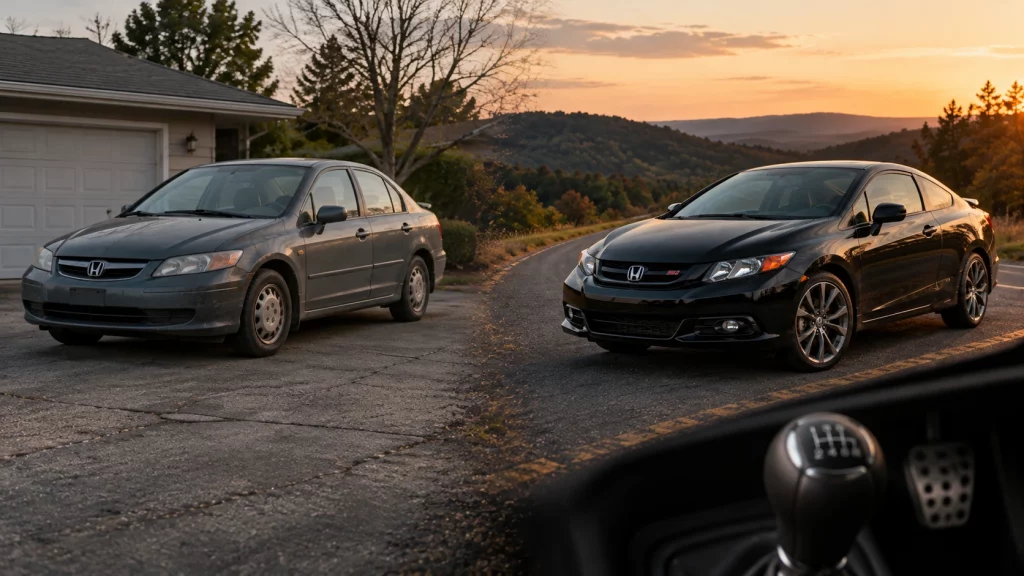
In 2016, I sold that car and bought a 2013 Civic Si Coupe. Sixty thousand miles on the odometer. K24Z7. Six-speed manual with a helical limited-slip differential. Two hundred and one horsepower. One hundred and seventy pound-feet of torque.
This is not a review of the Si. This is not a comparison of spec sheets. This is what happened when I moved from the bottom of the Civic ladder to the middle rung — what I learned about torque, about working a gearbox, and about the difference between a car that gets you there and a car that makes you want to take the long way.
The 2013 Civic Si Coupe uses the K24Z7, a 2.4-liter DOHC i-VTEC four-cylinder rated at 201 hp and 170 lb-ft of torque. It is paired exclusively with a close-ratio six-speed manual and a helical limited-slip differential. The K24Z7 is not a high-revving K20 — it prioritizes mid-range torque over top-end scream. Its biggest limitation for enthusiasts is the integrated exhaust manifold cast into the cylinder head, which eliminates the possibility of a traditional header swap and caps naturally aspirated tuning potential. As a daily driver, it is forgiving, reliable, and genuinely engaging. As a platform for an NA build, it is compromised by design. For buyers who want a practical manual Sport Compact with real torque and a factory LSD, the 9th-gen Si remains one of the best values in the used market.
1. Why I Moved from R18 to K24
The R18 taught me to plan. If I wanted to pass someone on a two-lane road, I had to downshift two gears, wait for the revs to build, and commit to the maneuver before the opportunity closed. The engine made its power high in the rev range, and it made very little of it below four thousand RPM. That is not a criticism. It is a characteristic. The R18 was designed for fuel economy, not for the sensation of acceleration.
By 2016, I wanted something different. Not faster in absolute terms — I was not shopping for a sports car. I wanted a car that responded when I pressed the throttle without requiring a premeditated downshift. I wanted a gearbox with a sixth gear for highway cruising. I wanted the LSD that the Si had and the LX did not.
The 2013 Si Coupe was the logical answer. It was the last year of the 9th-generation Si, which meant it was the last Si before Honda moved to the turbocharged L15B7 in the 10th generation. The K24Z7 was the final naturally aspirated Si engine in America. That mattered to me then, and it matters more now.
I paid $16,500 for a car with 60,000 miles. It was stock. No modifications. No Hondata flash. No intake. No exhaust. The original owner had kept every service record. That mattered more than the badge on the trunk.
2. The K24Z7 — What the Spec Sheet Does Not Tell You
The K24Z7 is a 2.4-liter inline four with dual overhead cams, four valves per cylinder, and Honda’s i-VTEC system. It produces 201 horsepower at 7,000 RPM and 170 pound-feet of torque at 4,400 RPM. The Compression Ratio is 11.0:1. It redlines around 7,000 RPM, which is lower than the K20 engines that Honda enthusiasts mythologize.
| Specification | R18A1 (2006 LX) | K24Z7 (2013 Si) |
|---|---|---|
| Displacement | 1.8L | 2.4L |
| Configuration | SOHC i-VTEC | DOHC i-VTEC |
| Horsepower | 140 hp @ 6,300 RPM | 201 hp @ 7,000 RPM |
| Torque | 128 lb-ft @ 4,300 RPM | 170 lb-ft @ 4,400 RPM |
| Compression Ratio | 10.6:1 | 11.0:1 |
| Transmission | 5-speed manual | 6-speed manual with helical LSD |
| Curb Weight | ~2,700 lb | 2,943 lb |
| EPA Combined | ~29 mpg | 25 mpg |
The numbers tell part of the story. The K24Z7 makes 61 more horsepower and 42 more pound-feet of torque than the R18. But the more important difference is where that torque arrives. The R18’s peak torque came AT 4,300 RPM and fell off quickly. The K24Z7’s peak torque comes at 4,400 RPM, but it produces a broad, usable plateau from about 2,500 RPM onward. That is the difference you feel every day, not just when you are merging onto a highway.
What the spec sheet does not tell you is that the K24Z7 is not a rev-happy engine in the way that Honda’s reputation suggests. The i-VTEC system on this engine is tuned for torque production and emissions compliance, not for a dramatic high-cam crossover. When VTEC engages above 5,000 RPM, you can hear it and feel it, but it is subtle. It does not transform the car. It simply reminds you that the engine is still pulling.
Pro tip: If you are coming from a K20-powered Honda and expecting the K24Z7 to feel like a bigger version of that engine, you will be disappointed. The K24Z7 is a torque engine, not a scream engine. It rewards smooth inputs and early upshifts, not redline clutch dumps. That is not a flaw. It is a different design philosophy.
3. Learning the Six-Speed
The R18’s five-speed was forgiving. The ratios were tall, the shifter was vague but light, and the clutch was soft enough that a beginner could drive it without stalling. The Si’s six-speed is a different instrument.
The first thing I noticed was the weight of the clutch pedal. It is not heavy in absolute terms — this is not a puck clutch in a race car — but it requires more intention than the R18’s. The engagement point is higher and narrower. The first few days, I stalled it twice pulling out of my driveway. I had been driving manual for eight years. The Si humbled me.
The second thing I noticed was the shifter. The throws are short. The gates are defined. There is a mechanical precision to the way the lever clicks into each gear that the R18 never had. Honda’s manual gearboxes have a reputation for excellence, and this one lives up to it. But it also demands that you use it properly. The R18 would tolerate lazy shifts. The Si prefers deliberate ones.
The third thing I noticed was the sixth gear. On the highway at 70 mph, the engine turns about 2,500 RPM. That is not a sporting ratio. That is a fuel-economy ratio. Sixth gear exists to keep the engine quiet and efficient on long trips, not to provide acceleration. If you want to pass someone at highway speed, you downshift to fifth or fourth. That is not a burden. It is an invitation to use the gearbox.
The fourth thing I noticed was the limited-slip differential. The Si comes with a Helical LSD as standard equipment. In dry conditions on a straight road, you will not notice it. In wet conditions, or when exiting a corner under power, you will. The inside wheel does not spin. The car pulls itself through the turn with both front tires contributing. It is not a dramatic effect, but it is a real one. It makes the car feel more planted and more predictable when you are asking a lot of the front tires.
4. What the K24Z7 Taught Me About Torque
The R18 taught me to plan ahead. The K24Z7 taught me to trust the throttle.
In the R18, passing required a calculation. Downshift from fifth to third. Wait for the revs to climb. Commit. In the Si, passing is a decision, not a calculation. At 60 mph in sixth gear, you press the throttle and the car moves. It is not violent. It is not a surge. It is simply the presence of torque where the R18 had none.
This changes the way you drive. You stop thinking about downshifts as mandatory preparation and start thinking about them as optional engagement. You can leave it in sixth and cruise. Or you can drop to fourth and enjoy the sound. The car gives you the choice. The R18 rarely did.
The trade-off is fuel economy. The R18 returned 29–33 mpg in my mixed driving. The Si returns about 25 mpg combined, with 22 city and 31 highway. That is not a dramatic difference in absolute terms, but it is a difference you notice at the pump. The Si requires premium fuel. The R18 did not. That is the cost of the extra displacement and the higher compression ratio.
Another trade-off is weight. The Si Coupe weighs 2,943 pounds. The R18 sedan weighed about 2,700. You feel that extra 240 pounds in low-speed maneuvers and in the way the car changes direction. The Si is not heavy, but it is not featherweight either. It feels substantial in a way that the LX never did.
5. The Integrated Exhaust Manifold — The K24Z7’s Defining Limitation
If you spend any time in 9th-gen Civic forums, you will find the same complaint repeated with varying levels of frustration: the K24Z7 has an integrated exhaust manifold.
What this means, in practical terms, is that the exhaust ports are cast directly into the cylinder head. There is no separate exhaust manifold. There is no flange where a traditional header would bolt on. The exhaust gases exit the head through a single oval port and go directly into the downpipe.
This design was not an accident. Honda did it to reduce cost, speed up Catalytic Converter warm-up, and improve emissions compliance. It also contributes to the engine’s low-end torque characteristics. For a daily driver, it is invisible. You never think about it. The car starts, warms up, and runs cleanly.
For anyone who wants to modify the engine, it is a wall. You cannot install a 4-2-1 header. You cannot install a 4-1 header. You cannot do the traditional bolt-on exhaust modifications that have defined Honda tuning for decades. You can replace the downpipe and the cat-back exhaust, and you can see modest gains from doing so, but the cylinder head itself is the bottleneck.
The aftermarket has responded. Turbocharger kits exist for the K24Z7, and they work well because the integrated manifold simplifies the plumbing for forced induction. But if you want to stay naturally aspirated, the ceiling is low. Intake, downpipe, cat-back, and a Hondata FlashPro tune will give you a car that sounds better and responds more sharply, but it will not transform the power delivery. The K24Z7 is not a K20A2. It is not a K24A2 from a TSX. It is an engine designed for a different purpose.
Important: Do not buy a 9th-gen Si expecting to build a high-revving naturally aspirated monster. The integrated exhaust manifold makes that path expensive and inefficient. If you want big NA power from a K-Series, start with a different engine. If you want a reliable, torquey daily driver with a six-speed and an LSD, the K24Z7 is excellent at that job.
6. What I Liked, and What I Did Not
What I liked:
- The torque. The K24Z7 pulls from 2,500 RPM in a way that makes daily driving effortless. You do not need to downshift for every incline or every merge.
- The gearbox. The six-speed is precise, mechanical, and satisfying. It is one of the best manual transmissions I have owned.
- The LSD. It is transparent in normal driving and genuinely useful when you are pushing the car. It makes the Si feel more capable than its power figures suggest.
- The coupe body. It looks better than the sedan, and it is rarer on the used market. The rear seat is usable for short trips, and the trunk is large enough for groceries or a weekend bag.
- The maintenance costs. The K24Z7 uses a Timing Chain, not a belt. Valve adjustments are not required at the same intervals as the R18. Oil changes are straightforward. Parts are inexpensive. The Si is a cheap car to own.
What I did not like:
- The exhaust note. The integrated manifold and the stock exhaust system make the K24Z7 sound muted and unremarkable. A cat-back helps, but it does not transform the character of the engine.
- The weight. At 2,943 pounds, the Si is not heavy, but it feels heavier than it should in low-speed maneuvers. The R18 sedan felt more agile in parking lots and tight streets.
- The road noise. The Si Coupe is louder on the highway than the LX sedan. The tires contribute, and the coupe body has less sound insulation. It is not unbearable, but it is noticeable on long trips.
- The seats. The Si’s seats are more aggressively bolstered than the LX’s, which is good for spirited driving but less comfortable on long highway stints. After four hours, I wanted a softer seat.
7. Maintenance and Real Costs
I owned the Si from 60,000 miles to 130,000 miles. In that time, I did the following:
| Mileage | Service | DIY Cost | Shop Cost |
|---|---|---|---|
| 60,000 (purchase) | Oil change, filters, inspection | $50 | — |
| 75,000 | Spark plugs (NGK iridium) | $60 | $150 |
| 90,000 | Transmission fluid (Honda MTF) | $40 | $120 |
| 100,000 | Brake pads and rotors (front) | $200 | $500 |
| 110,000 | Rear shocks | $300 | $700 |
| 120,000 | Clutch inspection (OK) | — | — |
The K24Z7 does not require valve adjustments at the same frequency as the R18. It uses hydraulic lifters, which self-adjust. The timing Chain is a lifetime component under normal use. Oil changes are every 5,000 miles with 0W-20 synthetic. The engine is not demanding.
Oil consumption was minimal until about 120,000 miles, at which point I noticed a slight drop between changes. Not enough to require topping off between intervals, but enough to check the dipstick once a month. This is consistent with what other 9th-gen Si owners report. Some cars consume more than others. The K24Z7 is not known for the severe oil consumption issues that affected some earlier K-series engines.
One issue that affected some 2012–2013 Si models was clutch noise and premature clutch wear. Some owners reported squealing or chirping from the clutch when engaging from a stop. My car did not have this issue, but it is worth checking during a test drive. Listen for unusual noises when releasing the clutch pedal. If the clutch feels vague or the engagement point is inconsistent, it may need attention.
8. What I Would Do Differently
If I were buying a 9th-gen Si today, I would do a few things differently.
I would buy the sedan. The coupe looks better, but the sedan is more practical. The rear doors make it easier to use the back seat, and the sedan is only slightly heavier. The difference in daily usability is worth more than the difference in appearance.
I would install a cat-back exhaust immediately. Not for power — there is almost no power to be found in a cat-back on this engine — but for sound and weight. The stock exhaust is quiet and heavy. A quality cat-back makes the car more enjoyable without affecting reliability or emissions compliance in most jurisdictions.
I would skip the intake. On the K24Z7, an intake without a tune provides almost no measurable gain and can introduce undesirable resonance in the cabin. If you want intake sound, buy an exhaust instead. If you want power, buy a Hondata FlashPro and a downpipe. Do not waste money on parts that do not deliver.
I would check the clutch and LSD carefully during the test drive. These are expensive components to replace. A worn clutch or a damaged LSD can cost more than $1,500 to fix. Test the car from a stop on an incline. Listen for noises. Feel for vibration through the clutch pedal. Make sure the LSD engages smoothly in low-speed turns.
9. The Verdict — K24Z7 Is Not for NA Tuning, but It Is an Excellent Daily
The K24Z7 is not a K20A2. It is not a K24A2. It is not the engine that Honda enthusiasts dream about when they talk about VTEC and high redlines and the sound of a naturally aspirated four-cylinder at 8,000 RPM.
It is something else. It is a 2.4-liter engine with a broad torque curve, a timing chain, and an integrated exhaust manifold that makes traditional Honda tuning impossible. It is designed for efficiency, emissions compliance, and daily usability. And at those things, it succeeds completely.
As a daily driver, the 2013 Civic Si Coupe is one of the best cars I have owned. It has enough torque to make commuting effortless. It has a six-speed manual that is a pleasure to use. It has an LSD that makes the car feel more capable than its power figures suggest. It is reliable, cheap to maintain, and practical enough to carry four people and their luggage.
As a project car, it is not the right starting point. If you want to build a high-revving NA engine, buy an older Si with a K20. If you want big power, buy a turbo kit or swap in a different engine. The K24Z7 is not the engine for that path.
But if you want a car that is engaging every day, that rewards smooth inputs and deliberate gear changes, and that does not ask for anything more than regular maintenance, the 9th-gen Si is hard to beat. It is the last naturally aspirated Si. It is the last Si with a K-series engine. And for many owners, that is enough.
FAQ — 2013 Civic Si Coupe and K24Z7
Is the K24Z7 good for tuning?
It is limited for naturally aspirated tuning. The integrated exhaust manifold prevents header upgrades, and the engine lacks exhaust-side VTEC. The best NA modifications are a Hondata FlashPro tune, a downpipe, and a cat-back exhaust. These provide modest gains. For significant power increases, forced induction or an engine swap is required.
What is the difference between K24Z7 and K24A2?
The K24Z7 has an integrated exhaust manifold cast into the cylinder head and lacks exhaust-side VTEC. The K24A2, found in the Acura TSX, has a conventional exhaust manifold and a more performance-oriented VTEC system. The K24A2 has greater tuning potential for naturally aspirated builds.
Is the 2013 Civic Si a good daily driver?
Yes. The K24Z7 produces strong mid-range torque, the six-speed manual is precise and satisfying, and the helical LSD improves traction in corners and wet conditions. Fuel economy is 22 city and 31 highway. Maintenance costs are low, and the engine uses a timing chain rather than a belt.
What should I check when buying a used 9th-gen Si?
Check the clutch for noise or inconsistent engagement. Some 2012–2013 models had clutch issues. Check the LSD for proper operation in low-speed turns. Check oil consumption history. Verify maintenance records. Test drive the car from a stop on an incline and listen for unusual noises.
How does the K24Z7 compare to the R18?
The K24Z7 produces 201 HP and 170 lb-ft versus the R18’s 140 hp and 128 lb-ft. The K24Z7 has a broader torque curve and feels significantly more responsive in daily driving. The trade-off is lower fuel economy (25 mpg combined versus roughly 29 mpg) and a requirement for premium fuel.
Does the 2013 Civic Si require premium fuel?
Yes. The K24Z7 has an 11.0:1 compression ratio and is designed to run on premium fuel. Using regular fuel may cause knock and reduced performance. Honda recommends premium for all Si models.
What is the redline of the K24Z7?
The K24Z7 redlines around 7,000 RPM. Peak power is produced at 7,000 RPM. This is lower than the K20 engines found in earlier Si models, which revved to 8,000 RPM or higher.
Can I turbocharge the K24Z7?
Yes. Turbocharger kits are available, and the integrated exhaust manifold simplifies some aspects of the installation. However, forced induction changes the character of the car and introduces additional maintenance and reliability considerations. It is a different path from NA tuning.
What is the curb weight of the 2013 Civic Si Coupe?
The 2013 Civic Si Coupe weighs 2,943 pounds. The sedan weighs slightly more.
Is the 9th-gen Si reliable?
Yes, generally. The K24Z7 is a robust engine with a timing chain and hydraulic lifters. The most common issues are clutch noise on some 2012–2013 models and minor oil consumption at higher mileage. With regular maintenance, the 9th-gen Si is capable of high mileage.