

My 2018 Civic Si had about 60,000 miles on it when I took it to a track day. The car was essentially stock. I had done the usual maintenance, checked the fluids, and assumed that because it was an Si—a performance variant—it would handle a 15-minute session without drama. It did not. About ten minutes in, the car cut power on the back straight and threw an amber warning light. The session was over. This is what happened, what I got wrong, and what I changed before the next event.
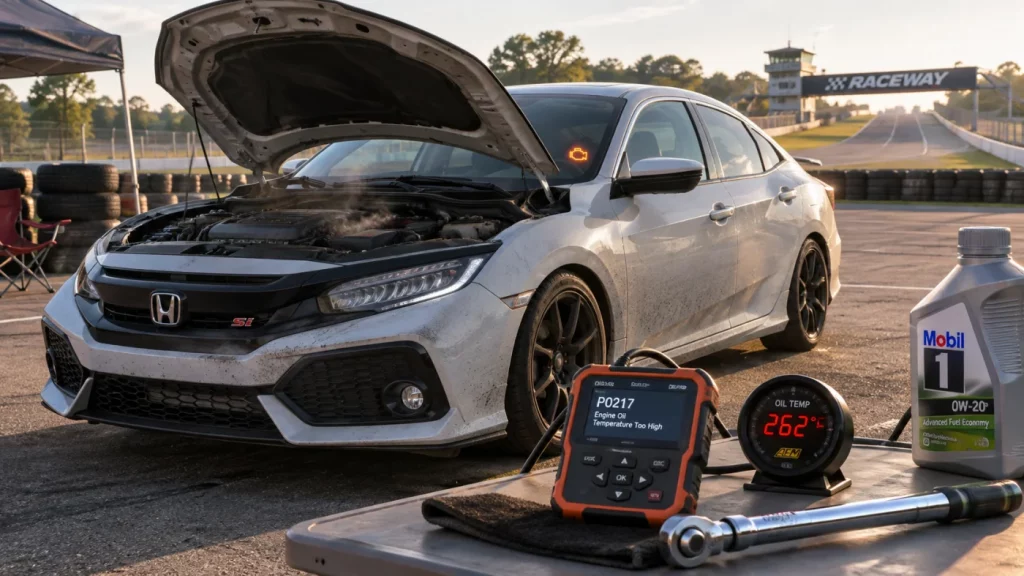
This is not a review of the Si. It is not a comparison against the Type R. It is one owner, one track day, one mistake, and the real diagnostic work that followed. If you are planning to take a 10th-gen Si to the track, the value here is not the story—it is the list of things I wish I had known before I left the paddock.
The 10th-gen Civic Si (L15B7, 6MT) is a capable daily driver but not a track-ready car in stock form. The factory cooling system lacks the oil capacity and dedicated oil cooling needed for sustained high-load lapping, and—critically—the car has no factory oil temperature gauge. My car entered limp mode roughly 10 minutes into a session, pulling boost and throttle response to protect the engine. I confirmed heat as the cause through OBD-II data and addressed it with an oil cooler, an upgraded intercooler, and a dedicated temperature gauge. The fix cost roughly $1,200–$1,500 in parts. The mistake was assuming the Si badge meant track readiness. It does not.
1. The Car and the Track Day Setup
The car was a 2018 Civic Si Sedan with the L15B7 1.5-liter turbocharged four-cylinder and the six-speed manual. At the time of the event, it had approximately 60,000 miles. The engine was stock—no tune, no bolt-ons, no upgraded cooling components. The only non-stock items were the tires, which were a 200-treadwear summer compound, and fresh Brake Fluid. The ambient temperature was in the mid-80s Fahrenheit, which is not extreme, but it was warm enough to matter.
I had owned the car since new and had done every oil change on time. I had read enough forum threads to know that the L15B7 runs hot, but I assumed that a stock car driven at a novice-to-intermediate pace would be fine. That assumption was the first mistake.
2. Everything Felt Normal for the First Ten Minutes
The first few laps were clean. The engine pulled smoothly, the turbo responded predictably, and the brakes held up. The car felt stable and confidence-inspiring. I was not pushing the car to its absolute limit—I was running a moderate pace, focusing on smooth inputs and learning the line.
What I did not realize at the time was that the L15B7 was already accumulating heat. The stock intercooler is a tube-and-fin unit that is prone to heat soak under sustained load. The engine oil, which in the L15B7 has a relatively small capacity, was absorbing heat from the turbo and the cylinder head with no dedicated cooler to shed it. The Coolant temperature gauge on the dashboard remained steady, which gave me a false sense of security. The coolant gauge does not reflect oil temperature, and oil temperature is what triggers the protective logic in the ECU.
| Parameter | What the Dashboard Shows | What Was Actually Happening |
|---|---|---|
| Coolant temperature | Normal, no movement | Within range, but not the limiting factor |
| Oil temperature | Not displayed | Climbing steadily under sustained load |
| Intake air temperature | Not displayed | Rising due to intercooler heat soak |
| Boost pressure | Normal | Still present, but heat was accumulating |
3. The Sudden Power Loss
Around the ten-minute mark, on the back straight, the car cut power. It was not a gradual decline. The throttle pedal went dead, boost disappeared, and the engine dropped to a limp-home state. An amber warning light illuminated on the dashboard. The car did not stall, but it was no longer responding to input.
My immediate thought was that something had failed mechanically—a charge pipe had popped off, or the turbo had let go. I lifted off, shifted to a higher gear, and limped the car back to the paddock. The amber light was the key detail: amber means warning and service soon, not red means stop immediately. But on a track, an amber light and a dead throttle mean the session is over regardless of the color.
I did not continue driving. I did not try to clear the code and go back out. That was the one thing I did right.
4. Figuring Out What Triggered Limp Mode
Back in the paddock, I let the car idle with the hood up for about fifteen minutes. The amber light remained on. I connected an OBD-II scanner and pulled the stored codes. There was no Misfire code, no knock code, no boost deviation code. The ECU had not logged a component failure. It had intervened because a temperature threshold had been crossed.
The L15B7 does not have a dedicated oil temperature sensor that reports to the dashboard, and according to Hondata, the ECU itself does not know oil temperature in the conventional sense. The protective logic relies on a combination of coolant temperature, intake air temperature, and calculated models. The amber light and the power cut were the ECU’s way of saying that the thermal envelope had been exceeded.
I did not have a dedicated oil temperature gauge AT the time, which meant I could not confirm the exact temperature. What I could confirm was the pattern: the car ran fine for ten minutes, the ambient temperature was warm, the intercooler was stock, and there was no mechanical failure. Heat was the only variable that fit.
Pro tip: If you are tracking a 10th-gen Si, do not rely on the coolant gauge to tell you what is happening. The coolant gauge can sit at normal while oil temperature climbs past a safe range. A dedicated oil temperature gauge is not optional if you want to know when to back off.
5. Getting the Car Back Under Control
After the car cooled, I restarted it. The amber light was still on. I drove it gently around the paddock and the light eventually cleared. The car drove home normally. There was no permanent damage, but the track day was effectively over after ten minutes of actual lapping.
The correct response in the moment was exactly what I did: back off immediately, complete a cool-down lap at partial throttle, and pit. Staying off boost and keeping airflow through the radiator allows the oil and coolant to shed heat without shocking the engine. Shutting the car off immediately after a hot session is not ideal because it stops coolant circulation while the engine is still heat-soaked. Idling with the Hood up is the better move.
6. The Fix: What Actually Solves This Problem
I spent the next few weeks researching what other 10th-gen Si owners had done. The consensus on CivicX and from vendors like MAPerformance and SiriMoto was consistent: the stock L15B7 cooling system is not designed for sustained track use, and the first priority is oil temperature management.
I made three changes before the next track day.
First, an oil cooler. I installed a bolt-on kit that added roughly a quart of oil capacity and a dedicated cooler core. The MAPerformance kit uses a Setrab core and includes a 1/8″ NPT port specifically for adding a temperature or pressure sensor—a detail that matters because the car does not monitor oil temperature from the factory. SiriMoto offers a similar kit with a 19-row core and pre-labeled lines for easier installation . Either kit addresses the core problem: the L15B7 needs more oil volume and a way to shed heat under load.
Second, an upgraded intercooler. The stock tube-and-fin intercooler heat soaks quickly on track. A bar-and-plate replacement reduces intake air temperatures and prevents the ECU from pulling timing as aggressively. Injen’s direct-fit unit is a common choice for the 10th-gen Si and requires no modification to the stock piping. This does not solve the oil temperature problem, but it reduces the overall thermal load on the engine.
Third, a temperature gauge. Without a way to see oil temperature, I was still flying blind. I added a gauge that reads from the sensor port on the oil cooler adapter. This is the single most important change for anyone who plans to do more than one track day. You cannot manage what you cannot measure.
| Upgrade | Primary Purpose | Approximate Cost |
|---|---|---|
| Oil cooler kit (MAPerformance or SiriMoto) | Increase oil capacity and shed heat | $570–$650 |
| Upgraded intercooler (Injen or similar) | Reduce intake air temps and heat soak | $600–$1,100 |
| Oil temperature gauge | Monitor the parameter that matters | $100–$300 |
| Total | ~$1,270–$2,050 |
7. Intercooler vs. Oil Cooler: What Actually Helps?
These two upgrades are often discussed together, but they solve different problems. Confusing them leads to wasted money.
An upgraded intercooler lowers the temperature of the compressed air entering the engine. This reduces the risk of knock, allows the ECU to maintain timing, and prevents the power loss associated with heat soak. It does not lower oil temperature. If your car is entering limp mode because oil temperature is too high, an intercooler alone will not fix it.
An oil cooler lowers the temperature of the engine oil. This is the direct fix for oil-temperature-related limp mode. The L15B7 has a small oil capacity from the factory, and adding a cooler with nearly a quart of additional volume helps both temperature stability and oil pressure.
If you can only do one, and your goal is to prevent limp mode on track, the oil cooler is the priority. If you can do both, the intercooler is the companion piece that reduces the overall thermal stress on the engine.
8. What I Learned About the L15B7 on Track
The L15B7 is a good engine. It makes usable torque, it responds well to tuning, and it is reliable in daily driving. But it is not a track engine in stock form. The cooling system is designed for the street, the oil capacity is modest, and the factory does not give the driver the instrumentation needed to monitor the parameters that matter.
The difference between street driving and track driving is not speed. It is sustained load. On the street, you have moments of acceleration followed by periods of cruise. On track, you are at high load and high RPM for minutes at a time. The cooling system never gets a chance to recover. The L15B7 was not designed for that, and no amount of driving skill compensates for hardware that cannot shed heat fast enough.
Important: Do not add a tune or increase boost before addressing cooling. More power creates more heat. On this platform, cooling modifications come before power modifications if track reliability is the goal. A tune on a stock cooling system will simply make the car enter limp mode faster.
9. Final Takeaway: Don’t Ignore the First Warning Signs
The limp mode was not a failure of the car. It was the car doing exactly what it was designed to do: protecting the engine from damage when the thermal envelope was exceeded. The mistake was mine—I assumed that an Si badge and fresh fluids were enough. They were not.
If you are planning to track a 10th-gen Si, budget for cooling before anything else. An oil cooler, an intercooler, and a temperature gauge are the entry fee for reliable lapping. The parts cost roughly $1,200–$2,000 depending on what you choose. The alternative is a track day that ends after ten minutes, or worse, an engine that does not survive the heat.
FAQ — 2018 Civic Si Limp Mode on Track
Why does my 2018 Civic Si go into limp mode on track?
The most common cause is excessive heat under sustained load. The L15B7 has a small oil capacity and no dedicated oil cooler from the factory. When oil temperature exceeds a threshold, the ECU cuts boost and throttle response to protect the engine. Intake air temperature heat soak from the stock intercooler can also contribute. Without a dedicated oil temperature gauge, the driver has no warning before the ECU intervenes.
Does the 10th-gen Civic Si have an oil temperature gauge?
No. The 10th-gen Si does not display oil temperature on the dashboard. The coolant gauge is the only temperature indicator, and it does not reflect oil temperature. According to Hondata, the ECU itself does not know oil temperature in the conventional sense. Adding an aftermarket gauge with a sensor in the oil cooler adapter is the only way to monitor it accurately.
Is an oil cooler necessary for the L15B7 on track?
For sustained track use, yes. The stock cooling system is not designed for the heat generated by repeated high-load laps. An oil cooler kit adds oil capacity and a dedicated heat exchanger, which is the direct solution to oil-temperature-related limp mode. MAPerformance and SiriMoto both offer bolt-on kits for the 10th-gen Civic 1.5T.
Can I do track days in a stock Civic Si?
You can, but the sessions will be short. A completely stock Si on a warm day will likely enter limp mode within 10–15 minutes of hard lapping. If you want to complete full sessions, cooling modifications are required. At minimum, add an oil cooler and a temperature gauge so you can monitor when to back off.
What should I do if my Si enters limp mode on track?
Back off immediately. Do not try to push through it. Complete a cool-down lap at partial throttle to keep airflow through the radiator, then pit. Let the car idle with the hood up for several minutes. Do not shut the engine off immediately after a hot session. Once the car has cooled, restart it and check for warning lights. If the light clears and the car drives normally, you can drive it home, but the track day is over until you address the cooling issue.
Does an intercooler fix limp mode?
Not by itself. An intercooler reduces intake air temperature and heat soak, which helps with power consistency and reduces overall thermal stress. But if the limp mode is triggered by oil temperature, an intercooler alone will not solve the problem. An oil cooler is the direct fix for oil temperature. The two upgrades work best together.
What oil should I use for track days in an L15B7?
Use a high-quality synthetic oil in the viscosity recommended by Honda for your climate and driving conditions. Track use generates more heat, so oil quality and change intervals matter more than on a street-driven car. Some owners run a slightly thicker oil for track days, but this should be done with caution and ideally with oil temperature data to support the decision.
How much does it cost to make a 10th-gen Si track-reliable?
An oil cooler kit costs roughly $570–$650. An upgraded intercooler costs roughly $600–$1,100. A temperature gauge costs roughly $100–$300. Total parts cost is approximately $1,200–$2,000. Labor is extra if you do not install the parts yourself. This does not include tires, brake pads, or fluid changes, which are separate track-day expenses.