

I bought my 2013 Civic Si Coupe in 2016 with 60,000 miles on the odometer. It was stock. No intake. No exhaust. No tune. The original owner had kept every service record, and the car drove exactly the way Honda intended. I told myself I was going to leave it alone.
That lasted about six months.
The first thing I did was what every Honda owner does. I opened a browser and searched for an exhaust header. Not a cat-back. Not an axle-back. A header. The real thing. The part that every K-Series build since the dawn of VTEC has started with. I had owned an R18 before this car. I knew what it felt like to want more top-end. I knew what it felt like to want the engine to breathe.
I typed “K24Z7 header” into Google and hit enter.
What came back was not what I expected. There were no headers. There were downpipes. There were turbo kits. There were forum threads with titles like “why does the K24Z7 have no header” and “integrated exhaust manifold explained.” I clicked the first one. I read it. Then I read another. Then I walked outside, opened the Hood, and looked at the back of the engine for the first time with actual curiosity.
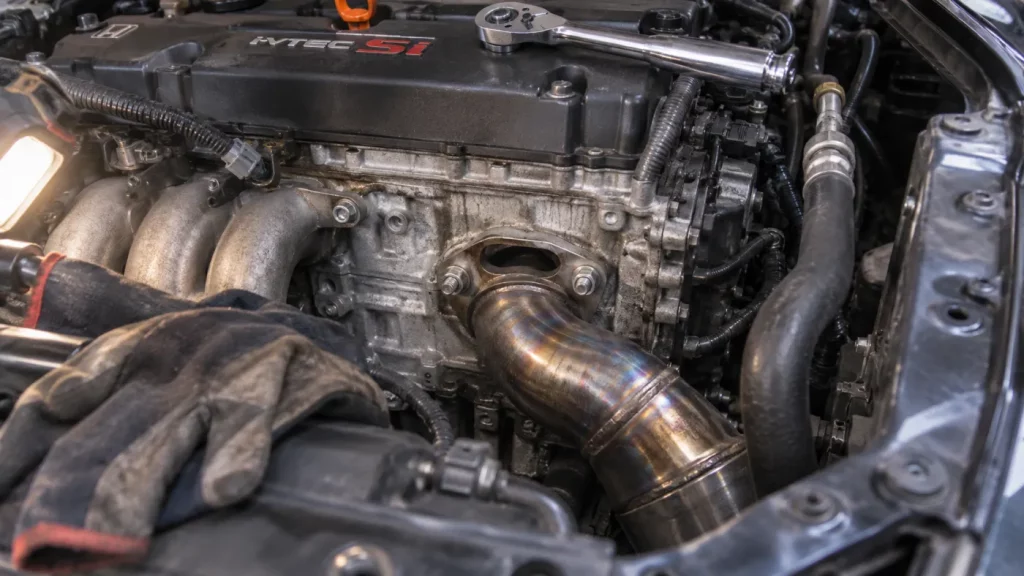
I saw a single oval port. Not four runners. Not a flange where a header could bolt on. Just one opening, cast into the cylinder head itself, with a pipe bolting directly to it.
That was the moment I understood. The K24Z7 was not a K20 with more displacement. It was a different animal entirely. And the thing that made it different was the thing that would define every modification decision I made for the next four years.
The K24Z7 in the 2012–2015 Civic Si does not have a traditional exhaust manifold. The exhaust ports are cast directly into the cylinder head, converging into a single oval outlet. There is no flange for a 4-2-1 or 4-1 header. This design, often called an integrated exhaust manifold or “headifold,” was chosen by Honda for cost reduction, emissions compliance, and faster Catalytic Converter warm-up. The practical consequence is that traditional naturally aspirated header upgrades are impossible. Owners can replace the downpipe and cat-back exhaust, but the cylinder head itself is the bottleneck. The integrated design actually simplifies turbocharger installation, which is why forced induction is the most effective path to significant power. For daily driving, the K24Z7’s mid-range torque and reliability make the integrated manifold a non-issue. For anyone chasing NA power, it is a wall.
1. What the K24Z7 Actually Is
The K24Z7 is a 2.4-liter inline four-cylinder engine produced by Honda for the 2012–2015 Civic Si. It produces 201 horsepower at 7,000 RPM and 170 pound-feet of torque at 4,400 RPM. It uses dual overhead cams, four valves per cylinder, and Honda’s i-VTEC system on the intake side only. There is no VTEC on the exhaust side. The Compression Ratio is 11.0:1. The redline is around 7,000 RPM.
If you are coming from the K20Z3 that powered the previous generation Civic Si, those numbers look familiar. The K20Z3 made 197 horsepower and 139 pound-feet of torque. The K24Z7 makes slightly more horsepower and significantly more torque. But the character of the two engines is completely different. The K20Z3 was a high-revving engine that rewarded aggressive driving. It pulled hardest above 6,000 RPM, and the VTEC crossover was dramatic enough that you could feel it in your back. The K24Z7 is a torque engine. It pulls from 2,500 RPM and does not need to be revved to make progress.
That difference in character is directly connected to the integrated exhaust manifold. The K24Z7 was designed for a different purpose than the K20Z3. It was designed for the 9th-generation Civic, a car that was larger, heavier, and more focused on daily usability than the 8th-generation Si. Honda wanted an engine that felt strong AT low and mid RPM, not one that screamed at the top of the tach. The integrated manifold contributed to that goal by reducing weight, improving packaging, and allowing the catalytic converter to sit closer to the engine for faster warm-up.
| Specification | K20Z3 (2006–2011 Si) | K24Z7 (2012–2015 Si) |
|---|---|---|
| Displacement | 2.0L | 2.4L |
| Horsepower | 197 hp @ 7,800 RPM | 201 hp @ 7,000 RPM |
| Torque | 139 lb-ft @ 6,100 RPM | 170 lb-ft @ 4,400 RPM |
| VTEC | Intake and exhaust | Intake only |
| Exhaust Manifold | Separate, 4-2-1 design | Integrated into cylinder head |
| Header Upgrade Path | Yes, extensive aftermarket | No traditional header possible |
| Redline | ~8,000 RPM | ~7,000 RPM |
2. What “Integrated Exhaust Manifold” Actually Means
On a traditional engine, the exhaust gases exit the cylinder head through four separate ports. Those ports connect to an exhaust manifold, which is a separate piece of cast iron or tubular steel that bolts to the head. The manifold collects the gases from the four runners and funnels them into a single pipe that goes to the catalytic converter and the rest of the exhaust system. On a performance engine, the manifold is often tuned — the length and diameter of the runners are designed to optimize exhaust scavenging at specific RPM ranges. This is why headers exist. A well-designed header can improve flow, reduce backpressure, and increase power.
The K24Z7 does not have that. The exhaust ports are cast into the cylinder head itself. The gases exit the combustion chambers and travel through short passages inside the head before converging into a single oval opening on the rear of the engine. There is no separate manifold. There is no flange. There is no place to bolt a header. The part that bolts to that oval opening is called a downpipe, not a header. It contains the catalytic converter and connects to the rest of the exhaust system.
This design is sometimes called a “headifold” in the enthusiast community. It is not unique to the K24Z7. Honda used similar designs on other engines, and many modern turbocharged engines use integrated exhaust manifolds because they simplify Turbocharger packaging. But in 2012, when the 9th-generation Civic Si launched, it was a shock to the Honda community. The K-series had built its reputation on tunability. The K20A2, the K20Z3, the K24A2 — these were engines that responded well to headers, intakes, and tuning. The K24Z7 was different.
Why did Honda do it? There are three reasons. First, cost. Casting the manifold into the head eliminates a separate part, a Gasket, and the labor to assemble them. Second, emissions. An integrated manifold allows the catalytic converter to be positioned closer to the engine, which means it reaches operating temperature faster. Faster warm-up means lower emissions during cold starts, which is when a disproportionate amount of pollution is produced. Third, packaging. The integrated design is more compact, which frees up space in the engine bay.
None of those reasons have anything to do with performance. And that is the point.
Pro tip: If you are looking at a 9th-gen Civic Si and you see a listing that says “header installed,” be suspicious. There is no traditional header for the K24Z7. What the seller probably means is a downpipe. Ask for photos. A downpipe is a single pipe with a flange that bolts to the back of the head. A header would be four runners converging into a collector. The K24Z7 cannot accept the latter.
3. The Aftermarket Reality — Downpipes, Not Headers
When I realized there was no header available for my car, I did what any frustrated enthusiast does. I started looking for alternatives. The aftermarket had responded to the K24Z7, just not in the way I expected. Instead of headers, companies were selling downpipes.
The stock downpipe on the K24Z7 contains two catalytic converters. It is restrictive. It has tight bends. It is designed to meet emissions standards, not to flow well. Replacing it with an aftermarket downpipe is the first and most impactful exhaust modification you can make on this engine. Companies like RV6, Full-Race, PLM, and Skunk2 all offer downpipe options for the 9th-gen Si.
The options break down into two categories: catted and catless. A catted downpipe retains a high-flow catalytic converter. It keeps the car emissions-compliant in most jurisdictions and reduces the smell of raw fuel in the exhaust. A catless downpipe eliminates the catalytic converter entirely. It flows better and costs less, but it is illegal for street use in many states and will cause the car to fail emissions testing. It also produces a strong fuel smell and a raspy exhaust note that some owners find unpleasant.
I chose a catted downpipe from RV6. The quality was excellent. The install took about two hours on jack stands. The difference was noticeable immediately. The car sounded deeper and more aggressive. The throttle response felt sharper. But the power gain was modest. RV6 advertises around 13 wheel horsepower on a stock car, and that feels about right. It is not a transformation. It is an improvement.
The problem is that the downpipe is bolted to the integrated manifold. The bottleneck is not the downpipe. The bottleneck is the cylinder head itself. No matter how large or free-flowing the downpipe is, the gases still have to pass through the integrated passages in the head before they reach it. Those passages were not designed for high-RPM flow. They were designed for emissions and packaging.
| Modification | Typical Gain (whp) | Cost | Notes |
|---|---|---|---|
| Cat-back exhaust | 5–8 | $600–$1,200 | Sound and weight savings, minimal power |
| Catted downpipe | 10–15 | $400–$700 | Requires tune for best results |
| Catless downpipe | 12–18 | $300–$600 | Not emissions legal, strong fuel smell |
| Intake + FlashPro tune | 10–15 | $800–$1,200 | Intake alone often causes rich codes without tune |
| Full bolt-on + tune | 25–35 | $2,000–$3,000 | Ceiling is still around 220–230 whp |
4. The NA Ceiling — Why Bolt-Ons Do Not Transform This Engine
I spent the next year chasing the naturally aspirated dragon. I added a cat-back exhaust. I installed a cold-air intake. I bought a Hondata FlashPro and loaded a base map. I paid for a dyno tune. I added a rear motor mount to handle the extra vibration. I did everything the forums said to do.
The result was a car that sounded better, responded more sharply, and made maybe 25 more horsepower at the wheels than stock. It was not a slow car. It was not a fast car either. It was exactly what it was designed to be: a Civic Si with bolt-ons.
The ceiling for naturally aspirated K24Z7 power is well-documented in the community. With a full complement of bolt-ons — intake, downpipe, cat-back, and a proper tune — you can expect around 220 to 230 wheel horsepower. That is a meaningful increase over the stock 201 crank horsepower, which typically translates to around 170–180 whp on a dyno. But it is not the kind of gain that changes the character of the car. It is not the kind of gain that makes you forget you are driving a 2.4-liter four-cylinder.
The reason is the cylinder head. The integrated exhaust manifold is not just a packaging decision. It is a flow restriction. The exhaust gases have to navigate short, compromised passages inside the head before they reach the downpipe. There is no way to improve those passages without removing the head and doing extensive port work. And even then, the gains are uncertain. One forum member asked whether porting the integrated manifold would be worth it. The consensus was that the work would be extensive, expensive, and the results would be marginal.
There is also the issue of camshafts. The K24Z7 has VTEC on the intake side only. The exhaust cam is fixed. Aftermarket Camshaft options are virtually nonexistent for this engine. The engine was not designed to be built. It was designed to be driven.
Important: Do not buy a 9th-gen Civic Si expecting to build a high-revving naturally aspirated monster. The K24Z7 is not a K20A2. The integrated exhaust manifold and the lack of exhaust VTEC make that path expensive and inefficient. If you want big NA power from a K-series, start with a different engine. The K24Z7 is excellent at being a daily driver. It is not excellent at being a project car.
5. The Turbo Paradox — Why the Integrated Manifold Actually Helps
Here is the irony that took me a while to appreciate. The same integrated exhaust manifold that makes NA tuning impossible makes turbocharging easier.
On a traditional engine, a turbo kit requires a turbo manifold. This is a separate cast or tubular piece that collects the exhaust gases from the head and routes them to the turbocharger. It is expensive. It is prone to cracking. It is a significant part of the cost and complexity of a turbo build.
The K24Z7 does not need one. The integrated manifold already collects the gases into a single outlet. The downpipe bolts to that outlet. A turbo kit simply replaces the downpipe with a pipe that routes the exhaust gases through the turbocharger instead of the catalytic converter. The packaging is simpler. The path from the exhaust ports to the turbine is shorter, which improves turbo response.
PRL Motorsports developed a turbo kit specifically for the 9th-gen Civic Si that takes advantage of this. Their Stage 2 kit, running on a stock engine with 93-octane fuel and around 13 psi of boost, produces approximately 380 horsepower. That is more than double the naturally aspirated ceiling. Other companies have followed. The K24Z7 has become a popular engine for forced induction because the integrated manifold removes a barrier that normally exists in turbo builds.
I never turbocharged my Si. I sold it before I got that far. But if I had kept it, that is the path I would have taken. The NA route was a dead end. The turbo route was the only route that made sense.
| Path | Power Potential | Cost | Complexity | Reliability |
|---|---|---|---|---|
| Stock | ~170–180 whp | $0 | None | Excellent |
| Full NA bolt-ons + tune | ~220–230 whp | $2,000–$3,000 | Low | Excellent |
| Turbo kit (stock engine) | ~350–400 whp | $5,000–$7,000 | Moderate | Good with proper tune |
| Built turbo | 400+ whp | $10,000+ | High | Depends on build quality |
6. Heat, Smell, and the Daily Driving Reality
One thing I noticed after installing the downpipe was a smell. It was not strong. It was not constant. But after a hard drive, when I parked the car and walked around to the back, there was a faint odor that had not been there before. It was the smell of hot metal and exhaust gases. It was the catalytic converter working harder, or perhaps working less efficiently because it had been moved or replaced.
Other 9th-gen Si owners have reported similar experiences. One forum member described an “overheated hair dryer” smell after pushing the car hard, and others confirmed they had noticed something similar. It is not necessarily a problem. It is a characteristic of the design. The catalytic converter is close to the engine, and when you add a high-flow downpipe, the exhaust temperatures and flow characteristics change. The smell is the system doing its job.
Heat is another consideration. The integrated manifold concentrates exhaust heat in the cylinder head. In normal driving, this is not an issue. The cooling system is designed to handle it. But if you are planning to track the car, or if you live in a hot climate and drive aggressively, it is something to be aware of. The engine bay gets hot. The intake air temperatures rise. The ECU pulls timing to protect the engine. This is normal behavior, but it is worth understanding.
For daily driving, none of this matters. The K24Z7 is a reliable, forgiving engine. It starts every morning. It idles smoothly. It pulls cleanly from low RPM. The integrated manifold is invisible. You only think about it when you open the hood and look for a header that is not there.
7. What I Would Do Differently
If I could go back and modify my 2013 Si again, knowing what I know now, I would make different choices.
I would skip the intake. The K24Z7 does not respond well to intakes without a tune. In fact, installing an intake without recalibrating the mass airflow sensor can cause the engine to run rich and trigger a P0172 code. The stock airbox is not a significant restriction on this engine. The money is better spent elsewhere.
I would start with a downpipe and a tune. The downpipe is the most restrictive part of the stock exhaust system. Replacing it with a high-flow catted downpipe, combined with a Hondata FlashPro tune, provides the best bang for the buck on this platform. It improves sound, response, and power without compromising reliability or emissions compliance.
I would not chase NA power. The ceiling is too low. The cost per horsepower is too high. The engine is not designed for it. If I wanted more power, I would save for a turbo kit or buy a different car.
I would invest in suspension and tires instead. The Si is a front-wheel-drive car with a helical limited-slip differential. It handles well from the factory. But the stock tires are not great, and the stock suspension is tuned for comfort. A set of good tires and a mild suspension upgrade — sway bars, springs, or coilovers — would make the car faster on a back road than any engine modification I made.
8. The Verdict — Is the Integrated Manifold a Dealbreaker?
For some buyers, yes. If you are shopping for a Civic Si because you want to build a high-revving naturally aspirated engine, the K24Z7 is the wrong starting point. The integrated exhaust manifold makes that path expensive and frustrating. You would be better off with an 8th-generation Si and its K20Z3, or a different platform entirely.
For most buyers, no. The K24Z7 is an excellent daily driver engine. It has more torque than the K20Z3. It is more relaxed on the highway. It is cheaper to insure and maintain. The integrated manifold contributes to those characteristics. It reduces weight, improves packaging, and helps the engine meet emissions standards without sacrificing drivability. If you are looking for a reliable, practical, engaging manual Sport Compact, the 9th-gen Si is one of the best values in the used market.
The key is understanding what you are buying. The K24Z7 is not a tuner engine. It is a driver’s engine. It rewards smooth inputs and deliberate gear changes. It does not reward endless modification. If you accept that, the integrated exhaust manifold is not a problem. It is simply a characteristic of the design.
I sold my Si in 2020. I still think about it. Not because it was fast. Not because it was loud. Because it was honest. It did exactly what it was designed to do, and it did it well. The integrated manifold was part of that. It was a compromise, but it was a compromise that made the car better at being a car.
FAQ — K24Z7 Integrated Exhaust Manifold
Does the K24Z7 have an integrated exhaust manifold?
Yes. The 2012–2015 Civic Si’s K24Z7 engine has exhaust ports cast directly into the cylinder head, converging into a single oval outlet. There is no separate exhaust manifold and no flange for a traditional header.
Can I install a header on a K24Z7?
No. There is no traditional header available for this engine because there is no flange to bolt one to. The only exhaust upgrade before the cat-back is a downpipe, which replaces the restrictive stock unit that contains the catalytic converters.
Why did Honda integrate the exhaust manifold into the head?
For cost reduction, emissions compliance, and packaging. The integrated design eliminates a separate part, allows the catalytic converter to sit closer to the engine for faster warm-up, and saves space in the engine bay. Performance was not the priority.
What is the best exhaust modification for a 9th-gen Civic Si?
A high-flow catted downpipe combined with a Hondata FlashPro tune. This provides the most noticeable improvement in sound, response, and power without compromising reliability or emissions compliance. Cat-back exhausts improve sound but offer minimal power gains.
How much power can a naturally aspirated K24Z7 make?
With a full set of bolt-ons — intake, downpipe, cat-back, and a proper tune — you can expect around 220 to 230 wheel horsepower. The integrated exhaust manifold and lack of exhaust VTEC are the limiting factors. Aftermarket camshafts are virtually nonexistent for this engine.
Does the integrated manifold make turbocharging easier?
Yes. The integrated manifold already collects exhaust gases into a single outlet, which simplifies turbo kit packaging. A turbo kit replaces the downpipe with a pipe that routes exhaust through the turbocharger. PRL’s Stage 2 kit produces around 380 horsepower on a stock engine.
Is the K24Z7 reliable?
Yes. The K24Z7 is a robust engine with a Timing Chain and hydraulic lifters. It does not have the severe oil consumption issues of some earlier K-series engines. With regular maintenance, it is capable of high mileage. The integrated manifold is not a reliability concern for stock or lightly modified cars.
Why does my K24Z7 smell like hot metal after driving?
Some owners notice a faint smell after hard driving, especially after installing a high-flow downpipe. This is normal. The catalytic converter and exhaust components get hot, and the smell is the system doing its job. If the smell is strong or accompanied by a check engine light, have the car inspected.
Can I port the integrated manifold for more flow?
It is possible but not practical. Porting the integrated passages in the cylinder head requires removing the head and extensive machine work. The gains are uncertain and the cost is high. Most owners agree that forced induction is a more effective path to power.
Should I buy a 9th-gen Civic Si if I want to modify it?
Only if you are planning to turbocharge it or keep the modifications mild. The K24Z7 is not a good platform for naturally aspirated builds. If you want to build a high-revving NA engine, buy an 8th-gen Si with the K20Z3 or a different platform entirely.