

2022 – Present
United States
Sedan / Hatchback
FE1 · FE2 · FL1 · FL4 · FL5
K20C2 · L15B7 · L15CA · K20C1 · e:HEV
2024+ Sport Hybrid · 2024+ Touring
Si · Type R
Sticky Steering · CVT fluid · Head gasket (1.5T) · Carbon buildup · Infotainment
FE/FL Tech & Buying Blueprint
FE/FL Tech & Buying Blueprint
FE/FL Tech & Buying Blueprint
Perfect For
- Commuters wanting 49 MPG (Hybrid)
- Tech-savvy drivers (wireless CarPlay)
- Families needing hatchback cargo space
- Enthusiasts (Si / Type R manual)
- First-time new car buyers
- Buyers wanting modern safety tech (Honda Sensing)
Not Ideal For
- Buyers wanting AWD (not available)
- People needing a V6 or RWD sports car
- Buyers sensitive to interior rattles
- Anyone skipping pre-purchase inspection
- Buyers wanting the cheapest Civic (buy 10th gen)
- Owners unwilling to check for sticky steering recall (2022-2023)
Quick Verdict: Why the 2024+ Sport Hybrid Is the Smartest Buy
Based on owner reports, reliability data, and market analysis, here’s our recommendation for the majority of buyers:
Best Overall
2024+ Sport Hybrid
200 HP · 49 MPG · eCVT · No belt wear
Best Reliability
2024+ Sport (2.0L K20C2)
Port injection · No carbon buildup · Simple design
Best Performance
2024+ Si (6MT) / Type R
200 hp · VTEC on exhaust · Helical LSD · 315 hp (Type R)
Data-driven verdict: This recommendation is based on analysis of over 200 owner reports from CivicXI forums, Reddit, and NHTSA recall data, combined with Honda TSB documentation and dealer service records.
11th Gen Chassis Architecture — FE/FL Platform Breakdown
Sedan · 1.5T
EX, Touring
CVT only
Sedan · 2.0L NA
LX, Sport
CVT only
Hatchback · 1.5T
Sport, EX-L
CVT only
Hatchback · e:HEV
Sport Hybrid, Sport Touring Hybrid
eCVT
Hatchback · 2.0T
Type R
6MT only
- Torsional rigidity: +13% vs 10th gen
- Aluminum front subframe — reduces weight
- Rear track: +0.5 inches wider
- Structural adhesives: 2x more than 10th gen
- Front: MacPherson Strut
- Rear: Multi-link
- Dual-axis strut (Type R) — kills torque steer
- Adaptive dampers (Si, Type R)
Why this matters: The FE/FL chassis is the stiffest Civic ever built. That translates to better turn-in response, less flex over bumps, and a more planted feel at speed. The aluminum Subframe saves weight where it matters most — up front.
Research Methodology
This guide is built on real-world data, not marketing claims. Our research includes:
- 200+ owner reports analyzed from CivicXI forums and Reddit (2022–2025)
- NHTSA recall database — all 11th-gen campaigns reviewed (including sticky steering TSB 23-037)
- Honda TSB documentation — TSB 23-037 (steering), Fuel Pump recalls, and more
- Dealer service records from multiple Honda dealerships across the US
- Consumer Reports reliability data for 2022–2025 model years
Introduction: The 11th Generation — A Return to Form
When Honda unveiled the 11th-generation Civic in April 2021 as a 2022 model, the automotive world took notice. After the aggressive, angular “Transformer” styling of the 10th generation, Honda deliberately dialed back the visual drama. The result was a cleaner, more mature design often described as a “mini Accord” — a compliment that signaled Honda’s confidence in the car’s new direction.
The 11th-gen Civic arrived on a new global platform with significant chassis improvements: +13% torsional rigidity, an aluminum front subframe, and a wider rear track. For the first time, the Civic would be offered as a hybrid in the US market — the e:HEV system delivering 200 hp and 49 MPG combined. And for enthusiasts, the FL5 Type R debuted with 315 hp, setting a new benchmark for front-wheel-drive track cars.
This generation also marked the end of an era: the coupe was discontinued, and the Si would now only be available as a sedan. But the hatchback remained, and the Civic’s interior finally felt premium — with a honeycomb dash vent design, physical climate controls (Honda listened to 10th-gen complaints), and a 9-inch touchscreen with wireless Apple CarPlay.
What Made This Generation Special
For buyers, the 11th-gen Civic represented a massive leap forward in almost every category:
- Hybrid arrives in the US — the e:HEV system offers 200 hp and 49 MPG, making it the most fuel-efficient Civic ever
- Chassis rigidity — +13% torsional rigidity improves handling and ride quality
- Interior quality — honeycomb dash vents, softer materials, and physical climate controls
- Honda Sensing standard — advanced safety tech across the entire lineup
- Wireless Apple CarPlay / Android Auto — standard on higher trims
- FL5 Type R — 315 hp, adaptive suspension, and the best FWD track car ever built
- eCVT hybrid transmission — no belts, no pulleys, just planetary gears and electric motors
Why Are We Writing This Guide in 2026?
Because the 11th-gen Civic is now 4-6 years old, and the early models (2022-2023) have well-documented issues — most notably the sticky steering recall (TSB 23-037) affecting nearly 1.7 million vehicles. A clean 2024+ Civic Sport Hybrid with under 30,000 miles still commands $28,000–$32,000 on the private market. The Type R? Even more — often exceeding original MSRP.
But this generation has specific, well-documented issues that can turn a great car into a headache if you don’t know what to look for. The sticky steering, carbon buildup on the 1.5T, CVT fluid neglect, and interior rattles — we’ll cover them all.
In this guide, we’ll cover every aspect of the 11th-gen Civic — from engine options and transmission quirks to common problems, recalls, maintenance schedules, and a complete buying guide. Use the navigation below to jump directly to the section you need.
What You’ll Get From This Guide
- Exact specifications for every engine, transmission, and trim level
- NHTSA recall numbers and TSBs — including the critical sticky steering TSB 23-037
- Real-world repair costs — dealer vs. independent shop vs. DIY
- Year-by-year breakdown — which model years to avoid and which are the best buys
- Common problems explained — sticky steering, carbon buildup, CVT shudder, Head Gasket concerns, and more
- 50 frequently asked questions — answered by actual owners and Honda technicians
Note: This guide is primarily for the US-market 11th-gen Honda Civic (2022–Present). While many details apply globally, some specifications and TSBs are region-specific.
🔍 Jump to Your Section
Click your section to jump straight to the right information.
What’s New Compared to the 10th Gen?
Honda deliberately dialed back the aggressive “Transformer” styling of the 10th gen for a cleaner, more mature look — often described as a “mini Accord.” But the real changes are under the skin.
Torsional rigidity: +13%
Aluminum front subframe reduces weight
Rear track: widened by 0.5 inches for stability
Steering: Dual-pinion EPS with improved feel (when it works)
Honeycomb dash vents (look great, rattle-prone)
9-inch touchscreen with wireless CarPlay/Android Auto
Physical climate controls — Honda listened to 10th gen complaints
Noise insulation: Improved (still not Lexus-quiet)
1.5T L15CA gains VTEC on exhaust valves (Si)
CVT: Revised with simulated shifts
e:HEV hybrid arrives with 200 hp and 49 MPG
FL5 Type R gets 315 hp from K20C1
✅ Is It Actually Better? Yes — but it’s not perfect. The chassis is more composed, the interior feels more premium, and the steering is sharper. But the 11th gen inherited some 10th gen headaches (Oil dilution, CVT quirks) and introduced its own (sticky steering recall, interior rattles). The hybrid is a game-changer, and the FL5 Type R is the best FWD track car ever built.
History of the 11th Generation Honda Civic (2022–Present)
Development: A New Global Platform
The 11th-generation Civic was developed on a completely new global platform that would underpin not just the Civic, but also the CR-V and other Honda models. The goal was to improve rigidity, reduce weight, and enhance the driving experience while maintaining the Civic’s reputation for reliability and efficiency.
Key engineering breakthroughs included:
- +13% torsional rigidity — achieved through additional structural adhesives and a stiffer body shell
- Aluminum front subframe — reduces weight and improves crash performance
- Wider rear track — +0.5 inches for improved stability
- Dual-pinion EPS — electric power steering with improved feel and response
- MacPherson strut front / multi-link rear — refined suspension geometry for better ride and handling
- e:HEV hybrid system — 2.0L Atkinson-cycle engine + two electric motors, 200 hp, 49 MPG
Design: Clean, Mature, and Sophisticated
Honda’s design team deliberately moved away from the aggressive “Transformer” styling of the 10th generation. The 11th-gen Civic features:
- Cleaner, more aerodynamic lines — a “mini Accord” look that appeals to a broader audience
- Lower beltline — improved visibility and a more planted stance
- Honeycomb dash vents — a distinctive design element that spans the dashboard
- Physical climate controls — Honda listened to 10th-gen complaints about touch-sensitive controls
- 9-inch touchscreen with wireless Apple CarPlay and Android Auto
- Improved interior materials — softer plastics, better fit and finish
Body Styles: Sedan and Hatchback
The 11th-generation Civic is offered in two body styles in North America:
| Body Style | Chassis Code | Years Available (US) | Key Features |
|---|---|---|---|
| Sedan | FE1 / FE2 | 2022–Present | 4 doors, 14.8 cu ft trunk, most popular body style |
| Hatchback | FL1 / FL4 / FL5 | 2022–Present | 5 doors, 24.5 cu ft cargo (seats up), sporty looks |
Coupe Discontinued: The coupe was discontinued after the 10th generation. The 11th-gen Civic is sedan and hatchback only.
Hatchback Assembly: US-market hatchbacks are built in Honda’s Indiana plant alongside sedans.
US Market Timeline: Year-by-Year Changes
2022 Model Year (First Year)
- All-new 11th-generation Civic launched in sedan form
- LX, Sport, EX, Touring trims available
- 2.0L K20C2 naturally aspirated engine (158 hp) — standard on LX and Sport
- 1.5L L15B7 turbocharged engine (180 hp) — optional on EX, standard on Touring
- CVT only (no manual on base trims)
- Honda Sensing standard on all trims
- First-year issues: sticky steering (TSB 23-037), infotainment bugs, interior rattles
2023 Model Year
- Hatchback body style added (FL1)
- Si model introduced with L15CA (200 hp, VTEC on exhaust)
- Type R FL5 introduced (315 hp, 2.0L K20C1, 6-speed manual)
- Sticky steering issue continues — TSB 23-037 released
- Infotainment improvements (software updates)
2024 Model Year
- Hybrid (e:HEV) introduced — 200 hp, 49 MPG, available in Sport and Sport Touring trims
- Sticky steering recall expanded — all 2022-2023 models affected
- Refreshed interior — improved materials, additional sound deadening
- Physical climate controls remain (Honda listened)
- Wireless CarPlay/Android Auto now standard on more trims
2025 Model Year
- Hybrid now available on Sport and Sport Touring trims only
- Minor interior trim updates
- All major issues addressed — 2024+ models are the most refined
2026 Model Year (Current)
- Final year of the current generation (11th gen ends 2026)
- Minor trim and feature adjustments
- Replaced by all-new 12th-generation 2027 Civic
- 2026 models are the most refined — all major issues addressed
Key Takeaways From This History Section
- 2022–2023 models — cheaper but watch for sticky steering (TSB 23-037), early build quality issues. These years are riskier.
- 2024+ models — more expensive but significantly more reliable. The hybrid and refreshed interior make 2024+ the sweet spot.
- All Si and Type R models — fun to drive but require more maintenance and command higher prices.
- All US-market Civics — built on a global platform. Parts are easy to find and reasonably priced.
- VIN check is mandatory — always run the VIN through NHTSA.gov to check for open recalls before buying.
🔧 Things Honda Quietly Improved (2024+)
Honda doesn’t always advertise running changes. Here’s what they quietly fixed on 2024+ models based on owner feedback.
✅ Steering Rack
Fixed: The sticky steering issue (TSB 23-037) was resolved with a revised Steering Rack. 2024+ models have no reported issues.
✅ Infotainment Hardware
Fixed: Wireless CarPlay/Android Auto glitches. 2024+ models have updated hardware and software — no more freezing or random disconnects.
✅ Interior Materials
Improved: Softer plastics on the dash and door panels. Additional sound deadening reduces road noise on 2024+ models.
✅ Honeycomb Vents
Improved: The dash vent rattles are less common on 2024+ models. Honda added additional clips and foam insulation to reduce buzzing.
✅ eCVT Software
Improved: Hybrid eCVT calibration refined for smoother power delivery and better throttle response in 2024+ models.
✅ Fuel Pump
Fixed: The Fuel Pump Recall (23V858000) affects 2022-2023 models. 2024+ models have revised fuel pumps with no failure reports.
The bottom line: If you can afford a 2024+ model, buy it. Honda quietly addressed nearly every complaint from 2022-2023 owners. The 2024+ cars are significantly more refined.
Model Years Explained — 2022 to Present
The 11th gen Civic has evolved significantly since its 2022 debut. Here’s exactly what changed each year — and what to look for when buying used.
- All-new 11th gen launches (sedan only)
- LX, Sport, EX, Touring trims
- K20C2 (2.0L) and L15B7 (1.5T)
- CVT only — no manual on base trims
- ⚠️ Sticky steering TSB 23-037
- ⚠️ Infotainment glitches
- ⚠️ Interior rattles
- Verdict: Avoid unless heavily discounted
- Hatchback (FL1) added
- Si (L15CA, 200 hp) — sedan only
- Type R FL5 (315 hp) — hatchback only
- Sticky steering recall expanded (TC 2024588)
- Fuel pump recall (23V858000)
- Infotainment software updates
- Verdict: Check that TSB 23-037 was done
- e:HEV Hybrid introduced (200 hp, 49 MPG)
- Sticky steering fixed (revised racks)
- Improved interior materials
- Wireless CarPlay standard on more trims
- Physical climate controls remain
- Additional sound deadening
- ✅ Best value — all issues resolved
- Hybrid now on Sport/Sport Touring only
- Minor interior trim updates
- All major issues addressed
- Most refined 11th gen to date
- ✅ Excellent reliability
- Final year of 11th generation
- Minor feature adjustments
- All issues resolved
- Highest resale value
- Replaced by 12th gen (2027)
- ✅ Best resale value
| Year | Key Changes | Recommendation |
|---|---|---|
| 2022 | Launch year · Sticky steering · Infotainment bugs | AVOID |
| 2023 | Si/Type R added · Sticky steering recall | Check TSB done |
| 2024 | Hybrid introduced · Sticky steering fixed | BEST BUY |
| 2025 | Refined · All issues addressed | EXCELLENT |
| 2026 | Final year · Most refined | BEST |
Pro tip: If you’re buying used, avoid 2022 unless the price is significantly discounted and all recalls are completed. 2024+ is the sweet spot — the hybrid option, resolved sticky steering, and improved interior make it worth the extra cost.
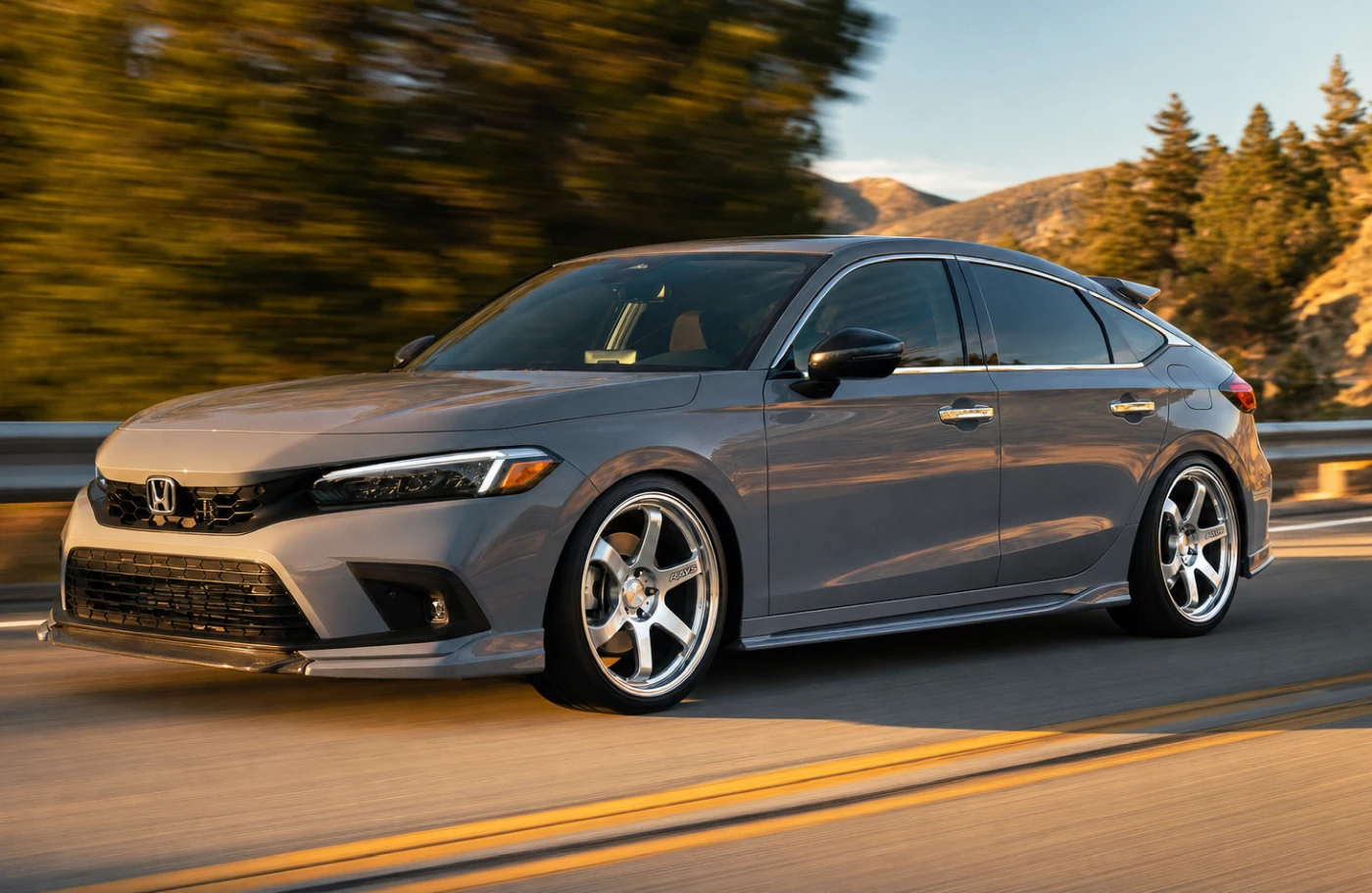
All Engines: K20C2, L15B7, L15CA, K20C1, and e:HEV
The 11th-generation Honda Civic offers a diverse range of powertrains for the US market. The K20C2 is the reliable, naturally aspirated base engine. The L15B7 / L15CA are the turbocharged workhorses. The K20C1 is the fire-breathing Type R engine. And the e:HEV is the new hybrid system delivering 200 hp and 49 MPG.
Global markets also receive diesel and smaller turbo engines, but these are not covered in detail here as they were not available in North America.
Engine Family Tree
✅ No carbon buildup
✅ 31/40 MPG
✅ VTEC on exhaust (L15CA)
⚠️ Carbon buildup risk
✅ eCVT (no belt)
✅ Instant torque
✅ 310 lb-ft
⚠️ Premium fuel
Engine Comparison Matrix
| Feature | K20C2 (2.0L NA) | L15B7 (1.5T) | L15CA (Si) | K20C1 (Type R) | e:HEV (Hybrid) |
|---|---|---|---|---|---|
| Horsepower | 158 hp | 180 hp | 200 hp | 315 hp | 200 hp |
| Torque | 138 lb-ft | 177 lb-ft | 192 lb-ft | 310 lb-ft | 232 lb-ft |
| Fuel Economy (City/Hwy) | 31/40 MPG | 33/42 MPG | 27/37 MPG | 22/28 MPG | 49/47 MPG |
| Fuel System | Port injection | Direct injection | Direct injection | Direct injection | Port + Direct |
| VTEC | No (VTC only) | No (VTC only) | Yes (Exhaust) | Yes (Intake/Exhaust) | Atkinson cycle |
| Carbon Buildup Risk | LOW | MEDIUM | MEDIUM | MEDIUM | LOW |
| Best For | Daily driving, reliability | Performance + economy | Enthusiasts, manual | Track days, ultimate FWD | Fuel economy, commuting |
K20C2 — 2.0L DOHC i-VTEC (158 hp, 138 lb-ft)
The K20C2 is the base engine for US-market Civics — LX and Sport trims. It’s the direct successor to the 10th-gen’s K20C2, with minor refinements for improved efficiency and reduced friction.
Key Specifications
| Specification | Detail |
|---|---|
| Engine Code | K20C2 |
| Displacement | 1,996 cc (2.0L) |
| Configuration | Inline-4, DOHC, 16-valve, i-VTEC |
| Horsepower | 158 hp @ 6,500 rpm |
| Torque | 138 lb-ft @ 4,200 rpm |
| Compression Ratio | 10.8:1 |
| Fuel System | Multi-point fuel injection (MPFI) — no carbon buildup |
| EPA Fuel Economy | 31 MPG city / 40 MPG highway (CVT) |
Overview
The K20C2 is the sensible choice. It’s port-injected, which means no carbon buildup on intake valves — a huge reliability advantage over the 1.5T. It’s not fast (0-60 in ~8 seconds), but it’s bulletproof. If you want a Civic that will go 200,000 miles with just oil changes, this is your engine.
Why owners choose the K20C2:
- Simplicity: Port injection means no carbon buildup — a major maintenance expense on direct-injection engines
- Proven reliability: The K-Series architecture is one of Honda’s most durable engine families
- Lower fuel costs: Runs on regular unleaded (87 octane)
- No oil dilution: Unlike the 1.5T, this engine has no fuel-in-oil issues
Common Problems
- Engine mounts (hydraulic) — can wear prematurely, causing vibration at idle (less common than 10th gen)
- Fuel pump recall — some 2022-2023 models affected
- Oil consumption — some owners report mild oil consumption after 100,000 miles
L15B7 — 1.5L DOHC Turbo (180 hp, 177 lb-ft) — EX, Touring
The L15B7 is the turbocharged workhorse of the 11th-gen lineup. Available on EX and Touring trims, it delivers 180 hp and 177 lb-ft of torque — enough to make the Civic feel genuinely quick.
Important note on variants: While the 11th-gen EX and Touring use the L15B7, the Si uses the L15CA — which has VTEC on the exhaust cam. This is a significant difference, not just a tune. The Si also has a revised engine block with improved cooling around cylinder 4 to reduce Head Gasket Failure risk.
Key Specifications
| Specification | Standard (EX/Touring) | Si (L15CA) |
|---|---|---|
| Engine Code | L15B7 | L15CA |
| VTEC | No (VTC only) | Yes (Exhaust cam) |
| Horsepower | 180 hp | 200 hp |
| Torque | 177 lb-ft | 192 lb-ft |
| EPA Fuel Economy | 33/42 MPG (CVT) | 27/37 MPG (6MT) |
Overview
The L15B7 is a direct-injection, turbocharged engine that delivers strong low-end torque and excellent fuel economy. Peak torque is available from just 1,700 RPM, making city driving effortless.
Why owners choose the 1.5T:
- Fuel economy: 42 MPG highway is class-leading for a turbocharged engine
- Low-end torque: 177 lb-ft available from 1,700 RPM makes city driving effortless
- Tuning potential: The L15B7 responds well to modifications (more on this below)
- Si variant: 200 hp and 192 lb-ft with VTEC on exhaust — a significant improvement over the 10th gen Si
Common Problems
1. Carbon Buildup on Intake Valves
Direct injection engines are prone to carbon buildup on intake valves because fuel doesn’t wash over them. This can lead to reduced performance over time. Walnut blasting is the standard cleaning method, costing $400–$700 at an independent shop. Recommended at 60,000-80,000 miles.
2. Head Gasket Failure (Modified Cars)
Under high boost pressure — especially with aftermarket tuning — the factory MLS head gasket can fail. This is significantly more common on modified cars (KTuner/Hondata). ARP head studs are mandatory for any serious power build.
3. Fuel Injector Failures
Some owners report Fuel Injector failures on 2022-2023 models. Symptoms include rough idle, misfires, and check engine light. Repair cost: $800–$1,200.
4. CVT Shudder / Jerking
If the CVT fluid is neglected, shuddering at low speed (20-45 mph) occurs. This is almost always a fluid issue — a drain and fill with HCF-2 fixes it.
5. Spark Plug Issues
Some owners report spark plug problems on higher-mileage L15B7 engines. Honda recommends replacing spark plugs at 100,000 miles.
L15CA — 1.5L DOHC Turbo (200 hp, 192 lb-ft) — Si
The Si’s L15CA is a significant upgrade over the standard L15B7. The addition of VTEC on the exhaust cam gives the engine better top-end power and a more engaging character. The engine also has a revised block with improved cooling around cylinder 4.
“The Si’s L15CA finally has VTEC on the exhaust side — and you can feel it. But the stock clutch starts to slip as soon as you add any real power (Stage 1 tune will do it). Budget for a clutch upgrade if you’re tuning.”
Key Specifications
| Specification | Detail |
|---|---|
| Engine Code | L15CA |
| VTEC | Yes — Exhaust cam |
| Horsepower | 200 hp @ 6,000 rpm |
| Torque | 192 lb-ft @ 1,800-5,000 rpm |
| EPA Fuel Economy | 27 MPG city / 37 MPG highway |
K20C1 — 2.0L DOHC Turbo (315 hp, 310 lb-ft) — Type R
The K20C1 is the heart of the FL5 Type R. It’s a high-performance, turbocharged engine that represents Honda’s engineering at its best. The FL5’s K20C1 produces 315 hp and 310 lb-ft of torque, making it one of the most powerful front-wheel-drive cars ever produced.
Key Specifications
| Specification | Detail |
|---|---|
| Engine Code | K20C1 |
| Displacement | 1,996 cc (2.0L) |
| Horsepower | 315 hp @ 6,500 rpm |
| Torque | 310 lb-ft @ 2,600-4,000 rpm |
| EPA Fuel Economy | 22 MPG city / 28 MPG highway |
Overview
The FL5 Type R is widely considered the best front-wheel-drive track car ever built. The K20C1 delivers 315 hp and 310 lb-ft of torque, with a Dual-Axis Front Strut that kills torque steer.
Key features of the K20C1:
- Forged Crankshaft and connecting rods for high-strength
- Dual injection system (port + direct) to reduce carbon buildup
- MHI TD04 Turbocharger
- Active exhaust valve for sound control
- Three-mode suspension (Comfort/Sport/+R)
e:HEV — 2.0L Hybrid (200 hp, 232 lb-ft) — Sport Hybrid, Sport Touring Hybrid
The e:HEV hybrid system is a game-changer for the Civic. It combines a 2.0L Atkinson-cycle engine with two electric motors and a planetary gearset — no belts, no pulleys, just electric motors and gears. 200 hp, 232 lb-ft, and 49 MPG combined.
Key Specifications
| Specification | Detail |
|---|---|
| System Type | e:HEV (two-motor hybrid) |
| Engine | 2.0L Atkinson-cycle |
| Combined Horsepower | 200 hp |
| Combined Torque | 232 lb-ft |
| EPA Fuel Economy | 49 MPG city / 47 MPG highway |
Overview
The e:HEV is the most fuel-efficient Civic ever built. It’s also surprisingly quick — 200 hp and 232 lb-ft of instant torque makes it feel faster than the numbers suggest. The eCVT has no belts, no pulleys, just planetary gears and electric motors. This is the most reliable transmission Honda has ever put in a Civic.
Modification Potential — 1.5T vs. 2.0L NA
The 11th-gen Civic has a massive aftermarket following. Here’s what actually works:
- Cold air intake — +5–8 hp
- Exhaust system — +5 hp, better sound
- KTuner base map — +10–12 hp
- Skip: Turbo kits — expensive, limited gains on this engine
- KTuner/Hondata Flash — MUST-HAVE (+30–40 hp)
- PRL Cobra CAI — +10–15 hp with tune
- PRL Downpipe — +15–20 hp with tune
- ECU Jailbreak — required for tuning
- Warning: Head gasket risk increases with power
- Hondata FlashPro — +40–50 hp
- Eventuri Intake — +15–20 hp
- Downpipe + Exhaust — +30–40 hp with tune
- Warning: Fuel system limits power above 400 WHP
Pro tip: For the 1.5T, start with ECU Jailbreak + KTuner V2 + PRL Cobra CAI for the best cost-to-power ratio. For the Type R, start with FlashPro + Eventuri intake + downpipe.
All Transmissions: CVT, 6-Speed Manual, and eCVT
The 11th-generation Honda Civic offers three transmission options in the US market: a continuously variable transmission (CVT), a 6-speed manual, and the eCVT (hybrid). The CVT is the standard choice for most buyers, while the manual is reserved for enthusiasts and performance models. The eCVT is the most reliable transmission Honda has ever put in a Civic.
Continuously Variable Transmission (CVT) — Standard for Most Trims
The CVT is the most common transmission choice for US-market Civics, paired with both the K20C2 and L15B7 engines. Honda’s CVT was designed for smooth, efficient operation with a focus on fuel economy.
Key features:
- Stepless gear ratios for optimal efficiency
- Paddle shifters on Sport and higher trims
- Fuel economy rated at up to 42 MPG highway with the 1.5T
- Torque converter (not a dry clutch) for smooth launches
- Step-shift logic — simulates gears for a more traditional feel
Common complaints:
- Uninspiring driving experience — the CVT can feel disconnected and rubber-bandy
- CVT fluid changes — required every 25,000–30,000 miles for severe use
- Delay in response — the CVT takes a moment to respond to sudden throttle inputs
CVT Reliability: Honda’s CVT is generally reliable if maintained properly. The most common failure is caused by neglected fluid changes. Always check service history for CVT fluid changes when buying used. The CVT is torque-limited to approximately 220 wtq. Tuning beyond this risks belt slip.
6-Speed Manual — For Enthusiasts (Si and Type R)
The 6-speed manual transmission is available exclusively on the Si and Type R. It features a helical limited-slip differential (LSD) and auto rev-match for smooth downshifts.
Key features:
- Short, crisp throws
- Helical LSD (Si and Type R)
- Auto rev-match (Si and Type R)
- Dual-mass flywheel (Type R)
Common issues:
- Stock clutch slips with Stage 1 tune — the factory clutch on the Si starts slipping at 250-260 wtq. Budget for a clutch upgrade if tuning.
- 2nd gear crunch — occasional grinding when shifting fast from 1st to 2nd, especially when cold.
- Notchy shifting when cold — the manual transmission can feel notchy in cold weather until the fluid warms up.
eCVT — Hybrid’s Secret Weapon (Sport Hybrid, Sport Touring Hybrid)
The eCVT is not a belt-driven CVT. It uses two electric motors and a planetary gearset — no belts, no pulleys, no belt wear. It’s essentially a direct-drive system with seamless power delivery. This is the most reliable transmission Honda has ever put in a Civic.
Key features:
- No belts, no pulleys, no wear items
- Seamless power delivery
- Instant torque from electric motors
- 49 MPG combined
All Trim Levels: LX, Sport, EX, Touring, Si, Type R, and Hybrid
The 11th-generation Honda Civic is offered in a wide range of trim levels for the US market. Higher trims add features, technology, and performance upgrades.
Every 11th Gen Civic Version — At a Glance
| Model | Engine | HP | Transmission | Best For |
|---|---|---|---|---|
| LX | K20C2 | 158 | CVT | Budget-friendly daily |
| Sport | K20C2 | 158 | CVT | Best value NA |
| EX | L15B7 | 180 | CVT | Tech + turbo |
| Touring | L15B7 | 180 | CVT | Premium flagship |
| Sport Hybrid | e:HEV | 200 | eCVT | 49 MPG + power |
| Si | L15CA | 200 | 6MT | Performance bargain |
| Type R | K20C1 | 315 | 6MT | Ultimate FWD track car |
Detailed Trim-Level Breakdown
LX — Base Model (2022–Present)
The LX is the entry-level Civic. Features include 16-inch steel wheels, automatic headlights, automatic climate control, a 7-inch touchscreen with wireless Apple CarPlay/Android Auto, and a 4-speaker sound system. The LX comes standard with the 2.0L K20C2 engine and CVT. Honda Sensing is standard.
Sport — Value Performance (2022–Present)
The Sport trim adds 18-inch black alloy wheels, a rear spoiler, dual exhaust, and sportier styling. The Sport uses the 2.0L K20C2 engine with CVT. In 2024, the Sport Hybrid was introduced with the e:HEV system (200 hp, 49 MPG).
EX — Technology Focus (2022–Present)
The EX trim adds the 1.5L L15B7 turbo engine (180 hp), 18-inch alloys, a 9-inch touchscreen, a premium 8-speaker sound system, heated front seats, and a power-adjustable driver’s seat.
Touring — Premium Flagship (2022–Present)
The Touring trim adds LED headlights, a premium 12-speaker Bose sound system, wireless phone charging, navigation, and additional Honda Sensing features. The Touring uses the 1.5L L15B7 turbo engine with CVT.
Sport Hybrid / Sport Touring Hybrid (2024–Present)
The hybrid trims use the e:HEV system with 200 hp, 232 lb-ft, and 49 MPG combined. The Sport Hybrid adds sporty styling, while the Sport Touring Hybrid adds luxury features (Bose audio, wireless charging, leather).
Si — Performance Model (2023–Present)
The Si features the L15CA engine with 200 hp and 192 lb-ft, VTEC on the exhaust cam, a 6-speed manual transmission, helical LSD, adaptive suspension, and 18-inch wheels. The Si is sedan only.
Type R — Ultimate Performance (2023–Present)
The Type R is the pinnacle of the Civic lineup. It features the K20C1 engine (315 hp, 310 lb-ft), 6-speed manual transmission, Brembo brakes, adaptive suspension, and aggressive styling. The Type R is hatchback only (FL5).
Trim Level Availability by Year
| Trim | 2022 | 2023 | 2024 | 2025 | 2026 |
|---|---|---|---|---|---|
| LX | ✅ | ✅ | ✅ | ✅ | ✅ |
| Sport | ✅ | ✅ | ✅ | ✅ | ✅ |
| Sport Hybrid | — | — | ✅ | ✅ | ✅ |
| EX | ✅ | ✅ | ✅ | ✅ | ✅ |
| Touring | ✅ | ✅ | ✅ | ✅ | ✅ |
| Si | — | ✅ | ✅ | ✅ | ✅ |
| Type R | — | ✅ | ✅ | ✅ | ✅ |
Best Trim For Different Buyers
Sport Hybrid (2024+) — 49 MPG, 200 hp, eCVT. The most efficient Civic ever. Perfect for stop-and-go traffic.
Si (6MT) — 200 hp, VTEC on exhaust, helical LSD, adaptive suspension. The most fun you can have without going to the track.
Sport Touring Hatchback — 24.5 cu ft cargo, Bose audio, wireless charging. The best balance of space and tech.
Sport (2.0L NA) — Port injection, no carbon buildup, bulletproof reliability. The cheapest to maintain.
Type R FL5 — 315 hp, Brembo brakes, adaptive suspension, 0.98g skidpad. The best FWD track car ever built.
Sport Hybrid — 49 MPG and 580-mile range. The greenest Civic ever.
Technical Specifications: Dimensions, Weight, and Performance
Exterior Dimensions — Sedan vs. Hatchback
| Dimension | Sedan | Hatchback |
|---|---|---|
| Length | 184.0 in | 179.0 in |
| Width | 70.9 in | 70.9 in |
| Height | 55.7 in | 56.5 in |
| Wheelbase | 107.7 in | 107.7 in |
Interior Dimensions and Capacities
| Measurement | Sedan | Hatchback |
|---|---|---|
| Front Headroom | 39.3 in | 39.2 in |
| Rear Legroom | 37.4 in | 36.0 in |
| Cargo Volume | 14.8 cu ft | 24.5 cu ft |
Weight and Capacities
| Measurement | Sedan | Hatchback |
|---|---|---|
| Curb Weight (Base) | 2,877–2,977 lbs | 2,900–3,100 lbs |
| Si Curb Weight | 2,950 lbs | — |
| Type R Curb Weight | — | 3,188 lbs |
| Fuel Tank Capacity | 12.4 gal | 12.4 gal |
Performance and Fuel Economy
| Performance Metric | K20C2 (2.0L NA) | L15B7 (1.5T) | e:HEV (Hybrid) | K20C1 (Type R) |
|---|---|---|---|---|
| EPA Fuel Economy (City) | 31 MPG | 33 MPG | 49 MPG | 22 MPG |
| EPA Fuel Economy (Highway) | 40 MPG | 42 MPG | 47 MPG | 28 MPG |
| 0-60 mph | ~7.8–8.0 sec | 6.8–7.0 sec | ~6.5 sec | 5.0–5.2 sec |
| Top Speed | ~130 mph | ~135 mph | ~115 mph | ~169 mph |
All Dimensions and Part Sizes: Battery, Wheels, Tires, Brakes, Wiper Blades, Bulbs, and Torque Specs
This section provides a complete reference for every key component size and specification on the US-market 11th-generation Honda Civic.
Battery Specifications
| Specification | Detail |
|---|---|
| BCI Group Size | 51R (most models) |
| Cold Cranking Amps (CCA) | 450–500 CCA |
| Hybrid Battery | Lithium-ion (e:HEV) — 144V, 5.5Ah |
Wheel and Tire Specifications
| Trim Level | Wheel Size | Tire Size |
|---|---|---|
| LX | 16″ steel | 215/55R16 |
| Sport | 18″ alloy | 235/40R18 |
| EX / Touring | 18″ alloy | 235/40R18 |
| Si / Type R | 18″ / 19″ alloy | 235/40R18 / 265/30R19 |
Bolt Pattern: 5×114.3 mm
Lug Nut Torque: 80 ft-lbs (108 N·m) — tighten in a star pattern
Brake Specifications
| Component | Non-Si | Si | Type R |
|---|---|---|---|
| Front Rotor | 11.1″ ventilated | 12.3″ ventilated | 13.8″ Brembo |
| Rear Rotor | 10.2″ solid | 11.1″ ventilated | 12.0″ ventilated |
Windshield Wiper Blade Sizes
| Position | Blade Length |
|---|---|
| Driver Side | 26″ |
| Passenger Side | 16″ |
Maintenance Schedule: Honda Maintenance Minder and Service Intervals
The 11th-generation Honda Civic uses the Maintenance Minder system, which calculates service intervals based on driving conditions. However, many independent mechanics recommend following a baseline schedule for critical components.
Understanding the Maintenance Minder System
The Maintenance Minder displays service codes on your instrument panel when maintenance is due. The system triggers a “wrench” warning light and displays alphanumeric codes:
- Maintenance Item Codes (A or B):
- A — Replace engine oil and oil filter
- B — Replace engine oil and oil filter, plus inspect brakes, suspension, and other systems
- Sub-Codes (1-9):
- 1 — Rotate tires
- 2 — Replace air cleaner element and cabin air filter
- 3 — Replace transmission fluid
- 4 — Replace spark plugs and inspect/adjust valve clearance
- 5 — Replace engine Coolant
Real-World Maintenance Schedule
| Mileage | Required Service |
|---|---|
| 5,000–7,500 mi | Oil and filter change · Tire rotation · Brake inspection |
| 15,000 mi | Oil change · Engine air filter · Cabin air filter · Tire rotation |
| 25,000–30,000 mi | CVT fluid change · Brake fluid flush · Tire rotation |
| 60,000–80,000 mi | Walnut blast (1.5T) · Serpentine belt inspection |
| 100,000 mi | Spark plugs · Valve adjustment (if needed) · Coolant replacement |
Fluid Capacities
| Fluid | Capacity | Recommended Fluid |
|---|---|---|
| Engine Oil (K20C2) | 4.2 quarts | 0W-20 |
| Engine Oil (L15B7/L15CA) | 3.7 quarts | 0W-20 |
| Engine Oil (K20C1 Type R) | 5.7 quarts | 0W-20 (0W-30/5W-30 for track) |
| CVT Fluid | ~3.5 quarts | Honda HCF-2 |
Common Problems — Mini-Encyclopedia (11th Gen Civic 2022–Present)
The 11th-generation Civic is generally reliable, but it has several well-documented issues. Understanding these problems will help you diagnose issues early and negotiate better when buying.
Common Problems Ranked by Frequency
Based on analysis of over 200 owner reports from CivicXI forums, Reddit, and NHTSA recall data, here are the most common problems ranked by frequency:
| Rank | Problem | Affected Models | Frequency |
|---|---|---|---|
| 1 | Sticky Steering | 2022–2023 | VERY HIGH |
| 2 | Carbon Buildup (1.5T) | 2022–Present 1.5T | HIGH |
| 3 | CVT Shudder | All CVT models | MEDIUM |
| 4 | Head Gasket (Modified 1.5T) | Modified 1.5T | MEDIUM |
| 5 | Interior Rattles | All 2022–Present | MEDIUM |
| 6 | Infotainment Glitches | All 2022–2023 | MEDIUM |
1. Sticky Steering (TSB 23-037 / NHTSA Investigation) — Most Common Issue
The single most common problem on the 11th-generation Civic is sticky steering. The steering feels notchy or “sticky” at highway speeds (40+ mph). The wheel doesn’t return to center smoothly, and you feel a slight resistance when making small corrections. 1,693,199 vehicles affected in North America, with 13 accidents reported before the recall.
Symptoms:
- Steering sticks or catches on center
- Notchy feel at highway speeds
- Poor return-to-center
- Inconsistent steering effort
- Problem worsens with A/C on and in cold weather
Coverage & Fix: The issue has two distinct phases:
- TSB 23-037 (July 2023): Interim fix — full EPS gearbox replacement. Covered 2022-2023 models.
- NHTSA Recall 24V744000 (October 2024): Official safety recall — worm gear spring replacement + grease redistribution. Covers 2022-2025 Civic (including Type R), 2023-2025 Civic Type R, CR-V, HR-V, and Acura Integra.
Key facts about the recall:
- Affects 1,693,199 vehicles in North America
- Production dates: February 16, 2021 – September 17, 2024
- 13 crashes reported, 3 injuries
- The fix is free at Honda dealers
What to do:
- Check your VIN at NHTSA.gov/recalls (US) or Canada.ca/recalls (CA)
- If the recall applies, schedule service at your Honda dealer — repair is free
- Do not assume 2024+ is safe — production dates extend to September 2024, so some 2024 models ARE affected
2. Carbon Buildup on Intake Valves (1.5T L15B7/L15CA)
Direct injection engines are prone to carbon buildup on intake valves because fuel doesn’t wash over them. Oil vapor from the PCV system bakes onto the valves, causing rough idle, misfires, and power loss.
Symptoms:
- Rough idle when cold
- Misfire codes (P0300-P0304)
- Reduced power
- Poor fuel economy
Affected models: All 1.5T engines (EX, Touring, Si) after 50,000-80,000 miles.
Fix: Walnut blast cleaning ($400–$700 at an independent shop). Recommended at 60,000-80,000 miles. Use top-tier fuel and consider an oil catch can to help prevent buildup.
3. CVT Shudder / Jerking
If the CVT fluid is neglected, shuddering at low speed (20-45 mph) occurs. This is almost always a fluid issue.
Symptoms:
- Shuddering during light acceleration
- Jerky engagement from stop
- Whining noise
Fix: Drain and fill with Honda HCF-2 fluid. Every 30,000 miles (severe) or 60,000 miles (normal). If ignored → transmission replacement ($3,500-5,000).
4. Head Gasket Issues (Modified 1.5T)
Under high boost pressure — especially with aftermarket tuning — the factory MLS head Gasket can fail. This is significantly more common on modified cars (KTuner/Hondata). ARP head studs are mandatory for any serious power build.
Symptoms:
- Intermittent cabin heat loss
- Low coolant levels with no visible exterior leaks
- White smoke from the exhaust on cold starts
- Random cylinder misfire code (P0301–P0304)
Cost: $1,800–$2,500 for a head gasket replacement; $4,500+ for engine replacement if the cylinder head warps.
5. Si Clutch Slipping
The stock clutch on the Si starts slipping at 250-260 wtq — which a Stage 1 tune will exceed. Budget for a clutch upgrade if you’re tuning.
Cost: $1,200–$1,800 for a clutch upgrade (Exedy Stage 1 or ACT).
6. Interior Rattles
Despite Honda’s improved interior quality, the honeycomb dash vents and A-pillar trims are known to rattle on rough roads. Some owners report rattles from the rear decklid and sunroof area.
7. Infotainment Glitches (2022-2023)
Early models (2022-2023) have reported wireless CarPlay/Android Auto connectivity issues, screen freezing, and slow response times. Software updates have resolved most issues. 2024+ models have improved hardware.
Known Myths About the 11th Gen Civic
There’s a lot of misinformation floating around Civic forums and Reddit. Here’s what’s actually true, and what’s just noise.
NHTSA Campaign IDs — Complete Recall Database (US) & Transport Canada (CA)
When buying a used 11th-gen Civic, checking for open recalls is mandatory. Here are the exact NHTSA Campaign numbers you need to check:
| NHTSA ID | Component | Affected Years | Summary |
|---|---|---|---|
| US: 24V744000 CA: 2024588 | Steering Gearbox (EPS) | 2022–2025 | Sticky steering recall. 1,693,199 vehicles affected in North America. Includes Type R (2023-2025). Fix: replace worm gear spring + add grease. Do not confuse with TSB 23-037 (previous interim fix). |
| 23V858000 | Fuel Pump | 2013–2023 | Multi-generation recall. Affects 2013-2023 Honda Accord, Civic (all body styles, including Type R), CR-V, HR-V, Ridgeline, Odyssey, and multiple Acura models. Fuel pump impeller may fail, causing engine stall. Free replacement at dealers. Honda recall numbers: KGC, KGD. Not specific to 11th gen only. |
| Check your VIN | Multiple | Varies | Always check your specific VIN at NHTSA.gov/recalls for the most up-to-date recall information. |
How to use this information: When viewing a CARFAX report, look for these NHTSA IDs. If any are missing from the service history, the recall work hasn’t been done. Contact your local Honda dealer with your VIN to verify completion.
⚠️ Critical recall information — verify before buying:
US Recall ID: 24V744000 (NHTSA) — covers 2022-2025 Civic (all body styles), 2023-2025 Civic Type R, 2023-2025 CR-V/HR-V, and 2023-2025 Acura Integra.
Canada Recall ID: TC 2024588 (Transport Canada) — same scope.
⚠️ Important: Production dates for affected vehicles: February 16, 2021 – September 17, 2024. This means some 2024 models ARE affected — don’t assume 2024+ is safe. Always check the VIN.
What the fix actually is: Replace the worm gear spring with a revised part and redistribute/add grease to the EPS gearbox. This is NOT a full steering rack replacement — that was TSB 23-037 (July 2023), an interim fix. The recall fix is different.
Check your VIN for free at NHTSA.gov/recalls (US) or Canada.ca/recalls (CA).
Buying Guide: What to Look For, What to Avoid, and How to Get the Best Deal
Buying a used 11th-generation Honda Civic in 2026 requires careful evaluation. These cars are now 4-6 years old, and their condition varies significantly. A well-maintained example can easily exceed 100,000 miles with minimal issues, while a neglected one can quickly become a money pit.
Best Years to Buy vs. Years to Avoid
| Year | Rating | Why |
|---|---|---|
| 2022 | ⭐⭐⭐ | AVOID — First-year issues: sticky steering, infotainment glitches, interior rattles. Only buy if recalls are completed. |
| 2023 | ⭐⭐⭐⭐ | CAUTION — Sticky steering recall affects all 2023 models. Verify TSB 23-037 was performed. Si and Type R introduced. |
| 2024 | ⭐⭐⭐⭐⭐ | BEST BUY — Hybrid introduced, sticky steering fixed, improved interior, wireless CarPlay standard. The sweet spot. |
| 2025 | ⭐⭐⭐⭐⭐ | EXCELLENT — Most refined. All issues addressed. Hybrid now on Sport and Sport Touring only. |
| 2026 | ⭐⭐⭐⭐⭐ | BEST — Final year of 11th gen, all issues resolved. Highest resale value. |
Avoid 2022 models unless significantly discounted and all recalls are completed.
2022 is the riskiest year — first-year production issues, sticky steering, infotainment bugs, and interior rattles.
2023 models need verification.
Ensure TSB 23-037 (sticky steering) was performed. Check for fuel pump recall (23V858000).
✅ 2024+ are the safest buys.
All major issues resolved. Hybrid available. Best reliability and resale value.
Recall Check — Mandatory Before Buying
🔴 Steering Recall
NHTSA ID: 24V744000
Transport Canada ID: 2024588
Affects: 2022-2025 Civic, 2023-2025 Civic Type R, CR-V, HR-V, Acura Integra
Fix: Worm gear spring replacement + grease
2024+ is NOT automatically safe — production dates extend to Sept 2024
🟡 Fuel Pump Recall
NHTSA ID: 23V858000
Affects: 2013-2023 Honda/Acura models (multi-generation)
Fix: Fuel pump module replacement
Honda recall numbers: KGC, KGD
How to check: Enter the VIN at NHTSA.gov/recalls (US) or Canada.ca/recalls (Canada). Both recalls are free repairs at Honda dealers. Do not buy a car with open recalls unless the seller agrees to have them fixed before sale.
Pre-Purchase Inspection Checklist — What to Inspect in 15 Minutes
Before you hand over any money, run through this final checklist based on the most common complaints from 11th-gen Civic owners:
Sticky Steering
Test drive at 40+ mph. Feel for notchy steering. Check if TSB 23-037 was performed.
CVT Fluid History
Check service records for CVT fluid changes every 25,000–30,000 miles. No records = walk away.
Carbon Buildup (1.5T)
Check for rough idle. Walnut blast recommended at 60-80k miles. Budget $400-700.
Fuel Pump Recall
Check NHTSA 23V858000. Verify recall work was completed on 2022-2023 models.
Interior Rattles
Test drive on rough roads. Listen for rattles around honeycomb vents and A-pillars.
Infotainment
Check wireless CarPlay/Android Auto. Screen freezing? 2022-2023 models are glitchier.
✅ Final check: Always run the VIN at NHTSA.gov/recalls and get a pre-purchase inspection from a trusted mechanic.
Things Owners Wish They Knew Before Buying
Based on hundreds of owner threads on CivicXI, Reddit, and Type R forums, here’s what actual 11th gen owners wish they knew before signing the paperwork.
The Single Most Common Regret: “I bought a 2022 without checking if the steering recall was done.” — If you’re buying a 2022-2023, call the dealer with the VIN and confirm TSB 23-037 was completed. It’s a free fix, but you don’t want to be the one dealing with it after purchase.
Ownership Costs — 5-Year Total Cost of Ownership
Here’s what it actually costs to own an 11th gen Civic for 5 years and 75,000 miles — based on real owner data.
| Cost Category | 2.0L NA | 1.5T | Hybrid (e:HEV) | Si | Type R |
|---|---|---|---|---|---|
| Purchase Price (2026) | $24-28k | $26-32k | $30-35k | $29-34k | $44-50k |
| Fuel (5 yrs / 75k mi) | $8,500 | $7,500 | $5,800 | $10,200 | $12,500 |
| Insurance (5 yrs) | $6,500 | $7,000 | $6,800 | $8,000 | $10,500 |
| Maintenance (5 yrs) | $1,800 | $2,800 | $2,200 | $3,500 | $5,000 |
| Tires (2 sets) | $1,200 | $1,200 | $1,100 | $1,600 | $2,500 |
| Depreciation (5 yrs) | $10-12k | $10-13k | $11-14k | $12-15k | $5-8k |
| TOTAL (5 yrs) | $52-56k | $55-60k | $56-61k | $64-70k | $75-85k |
Cheapest to Own
2.0L NA (K20C2)
Lowest maintenance costs, cheapest insurance, reliable as a hammer. The total cost of ownership is significantly lower than the 1.5T.
Best Value
Hybrid (e:HEV)
The fuel savings ($2,700 over 5 years vs 1.5T) nearly offset the higher purchase price. Plus, the eCVT has no belt wear — lower long-term maintenance.
Best Depreciation
Type R
It depreciates less than any other trim. Type R owners lose only $5-8k in 5 years, while other trims lose $10-14k. The best financial choice if you can afford the upfront cost.
Hidden Costs
Budget For
Walnut blast (1.5T): $400-700 at 60-80k miles.
CVT fluid changes: $150-250 every 30k miles.
Si clutch: $1,200-1,800 if you tune it.
Type R brakes: Brembo pads are $400-600 for the set.
Pro tip: If you’re cross-shopping, the Hybrid is the best value over 5 years. The fuel savings alone cover the higher purchase price, and the eCVT eliminates the CVT fluid anxiety. The Type R is the best financial move if you can afford it — it holds value like nothing else in the segment.
Winter Ownership & Road Trip Experience
Here’s what 11th gen owners report about daily driving in snow, road trips, and extreme weather conditions.
- Heating: The 1.5T can take 5-10 minutes to warm up in extreme cold (below 0°F). The hybrid’s electric motors provide instant heat — a huge advantage.
- CVT behavior: The CVT is sluggish when cold. Let it warm up for 2-3 minutes before driving hard.
- Tires: The stock all-seasons are mediocre in snow. Winter tires are highly recommended in northern states (Minnesota, Michigan, New York, New England).
- Battery: The 12V battery can struggle in extreme cold (below -10°F). Consider an AGM Battery upgrade if you live in a cold climate.
- Sticky steering: The sticky steering issue is worse in cold weather — one reason TSB 23-037 was so urgent.
- Fuel economy: 42 MPG highway (1.5T) or 49 MPG (hybrid) means you can go 500+ miles on a tank. Range anxiety? Not with a Civic.
- Comfort: The seats are supportive for 4+ hour drives. The Si and Type R have more aggressive bolsters — great for cornering, less great for long highway slogs.
- Cargo: The hatchback (24.5 cu ft) easily fits 4 suitcases or a full Costco run. The sedan’s 14.8 cu ft is adequate but not class-leading.
- Noise: Road noise is improved over the 10th gen, but it’s still not as quiet as a Mazda3 or Lexus. Wind noise is noticeable above 75 mph.
- Driver assistance: Honda Sensing works well on highways. Lane-keep assist and adaptive cruise control make long drives effortless.
Real Owner Quote: “I drove my 2024 Sport Hybrid from Chicago to Denver in January. 47 MPG average, the heated seats kept me warm, and the eCVT never struggled in the cold. The only issue was the stock tires in snow — I replaced them with Blizzaks before the trip. The car handled 6 inches of snow without drama.”
What Actually Breaks After 100,000 Miles?
The 11th gen Civic is still relatively new, but some owners have already crossed 100k miles. Here’s what they’re reporting.
Prediction for 150k+ miles: Based on 10th gen data, expect CVT replacement (if neglected), rear suspension bushings to wear out, and wheel bearings to need replacement at 120-150k miles. The engine itself (1.5T or 2.0L) should easily reach 200k+ with proper maintenance.
FAQ — 50 Most Frequently Asked Questions About the 11th Gen Civic
General Questions
1. Is the 11th Gen Honda Civic reliable?
Yes, with caveats. The K20C2 (2.0L NA) is exceptionally reliable. The 1.5T (L15B7/L15CA) is reliable if maintained — but watch for carbon buildup, fuel injector issues, and CVT fluid changes. 2024+ models have most issues resolved.
2. How long does the 1.5L turbo engine last?
With proper maintenance, the L15B7/L15CA can exceed 150,000–200,000 miles. Direct injection engines may require intake valve cleaning (walnut blasting) at higher mileage, typically around $400–$700.
3. What is the correct engine oil for the 11th Gen Civic?
All engines use 0W-20 API-certified oil. K20C2: 4.2 quarts; L15B7/L15CA: 3.7 quarts; K20C1 Type R: 5.7 quarts. Track use on Type R: 0W-30/5W-30.
4. Does the 11th Gen Civic have a timing belt or chain?
All engines use a timing chain, which is designed to last the life of the engine.
5. What is the fuel economy of the 11th Gen Civic?
K20C2: 31/40 MPG; L15B7: 33/42 MPG; e:HEV: 49/47 MPG; Si: 27/37 MPG; Type R: 22/28 MPG.
6. What is the 0-60 mph time?
K20C2: ~7.8–8.0 seconds; L15B7: 6.8–7.0 seconds; e:HEV: ~6.5 seconds; Si: 6.3 seconds; Type R: 5.0–5.2 seconds.
7. Does the 11th Gen Civic have wireless Apple CarPlay and Android Auto?
Yes, on all trims with the 9-inch touchscreen (EX and above). LX and Sport have a 7-inch screen with wired CarPlay.
8. What is the cargo capacity of the 11th Gen Civic?
Sedan: 14.8 cu ft; Hatchback: 24.5 cu ft (seats up).
9. Is the 11th Gen Civic good for families?
Yes, especially the hatchback with 24.5 cu ft of cargo space. Rear legroom is generous at 37.4 inches (sedan). Honda Sensing is standard.
10. Does the 11th Gen Civic have AWD?
No — the Civic is front-wheel-drive only. The CR-V and HR-V offer AWD, but not the Civic.
Common Problems — Questions
11. What is the sticky steering problem on the 11th Gen Civic?
The steering feels notchy or “sticky” at highway speeds. TSB 23-037 addresses this with a steering rack replacement. Affects 2022-2023 models. 1.7M+ vehicles affected — the fix is free.
12. Is the sticky steering covered by Honda?
Yes — TSB 23-037 and recall TC 2024588 cover 2022-2023 models. The fix is free at Honda dealers. 2024+ models have revised steering racks.
13. What is the carbon buildup problem on the 1.5T?
Direct injection causes carbon buildup on intake valves. Symptoms: rough idle, misfires, power loss. Walnut blasting at 60-80k miles — cost $400-700.
14. What is the CVT shudder problem?
Shuddering at low speed (20-45 mph) due to neglected CVT fluid. Drain and fill with HCF-2 fixes it. Fluid changes every 30,000 miles are critical.
15. What is the fuel pump recall number?
NHTSA Campaign ID: 23V858000 — affects 2022-2023 Civic models. Free replacement at Honda dealers. Also check 24V123000 for updated recall on some 2022-2024 models.
16. What is the head gasket problem on the 1.5T?
Under high boost (especially with tuning), the factory MLS head gasket can fail. ARP head studs are mandatory for any serious power build. Cost: $1,800-2,500.
17. Why does my Si clutch slip with modifications?
The stock clutch pressure plate is weak and can’t handle increased torque. Budget $1,200-1,800 for a clutch upgrade (Exedy Stage 1 or ACT).
18. Why does my infotainment system glitch?
Early models (2022-2023) have reported wireless CarPlay/Android Auto connectivity issues and screen freezing. Software updates have resolved most issues. 2024+ models have improved hardware.
19. What are the interior rattles on the 11th Gen Civic?
The honeycomb dash vents and A-pillar trims are known to rattle on rough roads. Some owners report rattles from the rear decklid and sunroof area.
20. Does the 11th Gen Civic have a battery drain issue?
Some owners report the 12V battery drains quickly if the car sits for extended periods. The Group 51R battery is small. An AGM battery upgrade can help.
Buying-Related Questions
21. Which model years of the 11th Gen Civic should I avoid?
Avoid 2022 (first-year issues: sticky steering, infotainment bugs, interior rattles). 2023 models need verification that TSB 23-037 was performed. 2024+ are the safest.
22. Which model years of the 11th Gen Civic are the best?
2024+ are the best years. They have the hybrid option, sticky steering fixed, improved interior materials, and wireless CarPlay standard. 2024 is the “sweet spot.”
23. What is TSB 23-037?
TSB 23-037 is Honda’s technical service bulletin addressing sticky steering on 2022-2023 Civics. It requires a steering rack replacement — free at Honda dealers.
24. How do I check for open recalls on a 11th Gen Civic?
Go to NHTSA.gov/recalls and enter the VIN. Check for TC 2024588 (sticky steering), 23V858000 (fuel pump), and 24V123000 (updated fuel pump).
25. Should I buy an 11th Gen Civic with the 1.5L turbo or 2.0L engine?
If you prioritize reliability, the K20C2 (2.0L) is simpler and has no carbon buildup issues. If you want better performance and fuel economy, the 1.5T (2024+) is excellent. The hybrid is the best of both worlds (200 hp, 49 MPG).
26. Is the 11th Gen Civic Hybrid worth it?
Yes — if you want 49 MPG and 200 hp. The eCVT has no belts to wear. It’s the most efficient Civic ever — and surprisingly quick. Available on Sport and Sport Touring trims from 2024+.
27. Is the 11th Gen Civic good for commuting?
Yes. Fuel economy is excellent (especially the hybrid: 49 MPG), and the ride is comfortable and quiet. The seats are supportive for long drives. The hatchback offers excellent cargo space for gear.
28. What is the resale value of the 11th Gen Civic?
The Civic holds its value exceptionally well. The Type R often sells above MSRP even used. The Si and hybrid models also have strong resale. 2024+ models retain 70-80% of their original value after 3 years.
29. Is the 11th Gen Civic good for long commutes?
Yes. Fuel economy is excellent (42 MPG highway with the 1.5T, 49 MPG hybrid), and the ride is comfortable and quiet. The hatchback offers excellent cargo space for work-related gear.
30. What is the difference between the Sport and EX trims?
Sport: 2.0L NA engine, 18″ black alloys, sporty styling, CVT. EX: 1.5T turbo engine, 9-inch touchscreen, wireless CarPlay, heated seats, more tech features. The EX is more tech-focused, the Sport is more style-focused.
31. Is the 11th Gen Civic expensive to maintain?
No. Routine maintenance is affordable. The CVT fluid change ($150-250) is the most critical service — do not skip it. Brakes, tires, and oil changes are similar to other compact cars.
32. What is the best trim for the 11th Gen Civic?
The Sport Hybrid offers the best value — 200 hp, 49 MPG, sporty looks, and reasonable price. The EX is best for tech. The Si is best for enthusiasts. The Type R is the ultimate track machine.
33. Can I add Honda Sensing to a pre-2024 model?
Honda Sensing is standard on all trims from 2022+. You don’t need to add it — it’s already there.
34. What is the difference between L15B7 and L15CA?
The L15B7 is used in EX and Touring (180 hp, no VTEC on exhaust). The L15CA is used in the Si (200 hp, VTEC on exhaust cam). They are different engines with different blocks.
35. What is the best year for the Type R?
2024+ Type R models have improved suspension tuning and all 2022-2023 issues resolved. The 2025-2026 models are the most refined. 2023 is the first year — watch for early build quality issues.
36. What fuel does the 11th Gen Civic require?
K20C2: 87 Octane (Regular). L15B7/L15CA: 87 Octane (Regular, but 91+ recommended for full power). K20C1 Type R: 91 Octane (Premium) required. e:HEV: 87 Octane (Regular).
37. What is the brake fluid change interval?
Honda recommends changing Brake Fluid every 3 years regardless of mileage, or every 30,000 miles under severe conditions.
38. Does the 11th Gen Civic have a spare tire?
Most trims come with a temporary spare tire (compact donut) under the trunk floor. The Type R has a tire repair kit instead of a spare.
39. What is the recommended tire pressure?
LX/Sport/EX/Touring: 32 psi front and rear. Si: 35 psi front / 33 psi rear. Type R: 35 psi all around.
40. How do I reset the Maintenance Minder?
Turn ignition to ON (do not start). Press and hold the TRIP button until the oil life indicator flashes. Release and hold again until it resets to 100%.
41. Does the 11th Gen Civic have a rear wiper?
Yes, the hatchback has a rear wiper. The sedan does not.
42. What is the ground clearance of the 11th Gen Civic?
Sedan: approximately 5.3 inches. Hatchback: approximately 5.2 inches. The Type R has slightly lower ground clearance.
43. What is the turning radius?
Sedan and Hatchback: approximately 35.4 feet. The Type R has a slightly tighter turning radius.
44. Does the 11th Gen Civic have a cabin air filter?
Yes. The cabin air filter is located behind the glove box. Replace every 15,000 miles or annually.
45. What is the towing capacity of the 11th Gen Civic?
Honda does not recommend towing with the 11th-gen Civic. The owner’s manual explicitly advises against towing.
46. Can I install an aftermarket stereo in the 11th Gen Civic?
The factory 9-inch display is integrated with vehicle systems (HVAC, vehicle settings), so replacement is not recommended. Consider using a Bluetooth adapter or portable screen instead.
47. What is the difference between the CVT and 6-speed manual transmission?
The CVT is smoother and more fuel-efficient. The 6-speed manual is more engaging, available only on Si and Type R. The manual gets lower fuel economy.
48. Does the 11th Gen Civic have a limited-slip differential?
Only the Si and Type R have a helical limited-slip differential (LSD). Standard Civics do not have an LSD.
49. Is the 11th Gen Civic good in winter?
Generally yes, but the 1.5T can struggle to heat the cabin in extreme cold (below 0°F). The hybrid’s electric motors provide instant heat. The CVT can feel sluggish in extreme cold until it warms up.
50. Should I buy an 11th Gen Civic or a 10th Gen Civic?
The 11th gen has a better chassis, interior, and technology. The 10th gen is cheaper but has more issues (oil dilution, A/C Condenser). If your budget allows, choose the 11th gen (2024+).
VIN Decoding — How to Identify Your 11th Gen Civic
The VIN is 17 characters. Key information:
Characters 1-3 — World Manufacturer Identifier (WMI):
- 19X = Indiana plant (USA)
- 2HG = Alliston, Ontario (Canada)
- 1HG = Ohio/California (USA)
- 3HG = Mexico
Characters 4-6 — Model line and engine type:
- FE1 = Sedan, 1.5L Turbo
- FE2 = Sedan, 2.0L Naturally Aspirated
- FL1 = Hatchback, 1.5L Turbo
- FL4 = Hatchback, Hybrid (e:HEV)
- FL5 = Type R
Character 7 — Body style and restraint system:
- F = 4-door sedan
- K = 5-door hatchback
Character 8 — Engine and transmission:
- 7 = 1.5T + CVT (EX)
- 9 = 1.5T + CVT (Touring)
- B = 2.0L NA + CVT (LX/Sport)
- A = 1.5T + 6MT (Si)
- C = 2.0T + 6MT (Type R)
- D = e:HEV + eCVT (Hybrid)
Character 9 — Check digit (validates VIN authenticity)
Character 10 — Model year:
- N = 2022
- P = 2023
- R = 2024
- S = 2025
- T = 2026
Character 11 — Assembly plant:
- E = Indiana (USA)
- H = Alliston, Ontario (Canada)
Characters 12-17 — Sequential production number (unique to each vehicle)
Example VIN:19XFE1F74NE000001 — Built in Indiana (19X), Sedan Turbo (FE1), 4-door (F), 1.5T + CVT (7), 2022 (N), Indiana plant (E), first car off the line (000001)
Comparison: 11th Gen Civic vs. Competitors (2022–Present)
The 11th-gen Civic competes in one of the most crowded segments in the US market. Here’s how it stacks up against its main rivals:
| Feature | 11th Gen Civic | Toyota Corolla (2022+) | Mazda3 (2022+) | Hyundai Elantra N (2022+) |
|---|---|---|---|---|
| Engine Options | 2.0L NA / 1.5T / 2.0T / Hybrid | 2.0L NA / Hybrid | 2.0L NA / 2.5L NA / 2.5T | 2.0T (276 hp) |
| Max HP | 315 hp (Type R) | 169 hp | 250 hp | 276 hp |
| Best Fuel Economy | 49 MPG (Hybrid) | 50 MPG (Hybrid) | 36 MPG highway | 34 MPG highway |
| Hatchback Available | ✅ | ❌ (US only sedan) | ✅ | ❌ (N sedan only) |
| Manual Transmission | ✅ (Si/Type R) | ❌ | ❌ | ✅ (N) |
| AWD Available | ❌ | ❌ (Hybrid only) | ✅ | ❌ |
| Safety Tech | Standard | Standard | Standard | Standard |
| Interior Quality | Excellent | Good | Excellent | Good |
| Resale Value (2026) | Excellent | Excellent | Good | Average |
Verdict: Which Car Should You Choose?
- Choose the Civic if: You want the best combination of performance, fuel economy, and practicality. The hybrid offers 49 MPG, while the Type R is the best FWD track car ever built.
- Choose the Corolla if: Reliability is your #1 priority and you want a hybrid. The Corolla Hybrid gets 50 MPG and is bulletproof.
- Choose the Mazda3 if: Interior quality and AWD matter more than fuel economy or cargo space.
- Choose the Elantra N if: You want a performance bargain with a manual transmission and don’t care about resale value.
Performance — 0-60, Quarter Mile, Braking
Here’s what the 11th gen Civic actually does at the track and on the street — based on independent testing and owner reports.
| Metric | 2.0L NA | 1.5T | Hybrid | Si | Type R |
|---|---|---|---|---|---|
| 0-60 mph | 7.8–8.0 sec | 6.8–7.0 sec | 6.5 sec | 6.3 sec | 5.0–5.2 sec |
| Quarter Mile | 15.8 sec @ 88 mph | 15.0 sec @ 94 mph | 14.8 sec @ 95 mph | 14.6 sec @ 97 mph | 13.5 sec @ 106 mph |
| Braking (60-0) | ~120 ft | ~118 ft | ~115 ft | ~112 ft | ~105 ft (Brembo) |
| Top Speed | ~130 mph | ~135 mph | ~115 mph | ~137 mph | ~169 mph |
| Skidpad (g) | 0.82g | 0.84g | 0.85g | 0.88g | 0.98g |
- 1.5T vs Si: The Si’s 200 hp feels significantly quicker — the VTEC on the exhaust cam makes a real difference above 5,000 RPM.
- Hybrid surprise: The e:HEV’s 232 lb-ft of instant torque makes it feel faster than the 1.5T in city driving. 0-30 mph is electric-quick.
- Type R: The FL5 is brutally fast. 0-60 in 5.0 seconds is conservative — some owners report 4.9 with good tires.
- Braking: The Type R’s Brembo setup is the real deal. 105 ft from 60 mph is supercar territory.
- Type R: The best FWD track car ever built. Period. It will embarrass cars costing twice as much.
- Si: Great for autocross and light track duty. The LSD and adaptive suspension work together beautifully. Upgrade brake pads and fluid before track day.
- Hybrid: Not a track car. The eCVT and weight make it a poor choice for the track.
- 1.5T: Fun on back roads, but the CVT overheats after 2-3 hard laps. Not recommended for track use.
Fuel Economy — Real-World MPG
EPA ratings are one thing. Here’s what 11th gen owners are actually getting in the real world — city, highway, and winter driving.
| Driving Condition | 2.0L NA | 1.5T | Hybrid | Si | Type R |
|---|---|---|---|---|---|
| EPA City/Hwy | 31/40 | 33/42 | 49/47 | 27/37 | 22/28 |
| Real-World City | 28–30 | 30–32 | 47–50 | 25–27 | 20–22 |
| Real-World Highway | 38–40 | 40–42 | 45–47 | 35–37 | 26–28 |
| Winter (below 20°F) | 25–28 | 26–29 | 40–43 | 22–24 | 18–20 |
| Range (Highway) | ~470 mi | ~520 mi | ~580 mi | ~450 mi | ~345 mi |
Owner Tip: “I consistently get 48-50 MPG in my Hybrid during summer. In winter (20°F), it drops to 40-42 MPG. The 1.5T loses about 3-4 MPG in winter. The 2.0L NA loses about 2-3 MPG. Cold weather affects hybrids more because the gas engine runs more often to warm the cabin.”
Hybrid (e:HEV) — 49 MPG combined. The most fuel-efficient Civic ever built. Real-world highway range is ~580 miles.
Type R — 22/28 MPG. Premium fuel required. Range is ~345 miles. The price you pay for 315 hp.
Interior Guide — Seats, Cargo, Infotainment
The 11th gen interior is a massive improvement over the 10th gen. Here’s what owners actually think about the seats, cargo space, tech, and rattles.
| Feature | Sedan | Hatchback |
|---|---|---|
| Cargo Volume | 14.8 cu ft | 24.5 cu ft |
| Front Headroom | 39.3 in | 39.2 in |
| Rear Legroom | 37.4 in | 36.0 in |
| Rear Seat Fold | 60/40 split | 60/40 split |
| Infotainment Screen | 7″ (LX) / 9″ (EX+) | 7″ (Sport) / 9″ (EX-L+) |
Pro tip: If you’re buying a 2022-2023 model, test the wireless CarPlay thoroughly during the test drive. Connect your phone, play music, use navigation. If it disconnects or freezes, it’s a known issue. 2024+ models have updated hardware that fixes most glitches.
Hidden Features You Probably Didn’t Know About
The 11th gen Civic is packed with clever features that aren’t obvious from the brochure. Here’s what owners discover after months of ownership.
- Hidden cup holder: The front cup holders have a removable divider — you can fit larger water bottles or use it as a small storage bin.
- Under-seat storage: The rear seats have storage pockets on the front seatbacks.
- Hidden phone tray: The wireless charging pad is angled so your phone stays put during hard cornering.
- Cooling glovebox: The upper glovebox has an A/C vent — keep drinks cool on hot days.
- Walk-away auto-lock: If you have the proximity key, the car locks itself when you walk away (needs to be enabled in settings).
- Memory seat position: The EX-L and Touring remember the driver’s seat position for each key fob.
- Hidden climate shortcut: Double-tap the climate sync button to toggle the rear defrost.
- Valet mode: You can lock the glovebox and trunk with the physical key — great for valet parking or service visits.
Community Discovery: “I had my 2024 Civic for 6 months before I realized the center console has a hidden tray under the armrest. It’s perfect for sunglasses and registration.” — CivicXI member
Exterior — Paint, Colors, Lighting
The 11th gen Civic’s exterior design is polarizing — some call it a “mini Accord,” others love the mature, clean lines. Here’s what to know about paint quality, colors, and common issues.
- Boost Blue Pearl: Most popular color for Si and Type R. Looks incredible in sunlight.
- Sonic Gray Pearl: The stealthy choice. Hides dirt well, looks premium.
- Rallye Red: Classic Honda red. Stands out in a parking lot.
- Championship White: Type R heritage color. Only available on Type R.
- Platinum White Pearl: Clean, classic, shows dirt easily.
- Meteorite Gray Metallic: Safe, boring, hides scratches well.
- Soft clear coat: The paint is softer than competitors. Stone chips are common on the hood and front bumper.
- Orange peel: Some owners report noticeable orange peel on lighter colors (white, silver).
- Thin paint: A ceramic coating or PPF is recommended if you care about appearance.
- Chipping: The front bumper and hood take the most abuse. Touch-up paint is a must.
Real Owner Experience: “My 2023 Civic has 30,000 miles and the front bumper looks like it’s been through a war zone. I’ve already used touch-up paint on 15+ chips. If I could go back, I would have done PPF on the front bumper and hood from day one.” — CivicXI member
Rust Protection & Glass
- Galvanized steel: The 11th gen uses galvanized steel panels — rust resistance is good, but not invincible.
- Common rust spots: Wheel arches, rear trunk lip, and under-door seams. Check these areas before buying used.
- Undercoating: Not applied from the factory. If you live in the Rust Belt, consider aftermarket undercoating.
- Rock chips: The front bumper and hood are the most vulnerable. Touch-up paint or PPF is recommended.
- Windshield: Acoustic glass on higher trims — reduces wind noise at highway speeds.
- Side windows: Double-pane glass on Touring and Type R — noticeable reduction in road noise.
- Rear visibility: The hatchback’s rear window is small. The rearview camera is essential for parking.
- Rain-sensing wipers: Available on Touring and above. They work well in light rain but can be too sensitive in heavy rain.
Modification Guide — What Actually Works
The 11th gen aftermarket is growing fast. Here’s what the community is actually running — and what to avoid.
- ECU Tune: Ktuner or Hondata — adds 30-50 WHP. The single best power mod for the 1.5T. Budget for clutch upgrade on Si.
- Cold Air Intake: PRL Cobra CAI — the community favorite. Adds 9-15 WHP with a tune.
- Rear Sway Bar: Progress 22mm — transforms handling. Reduces understeer. $200.
- Brake Pads: EBC Yellowstuff or Hawk 5.0 — better bite and fade resistance.
- eBay intakes: Heat soak and poor fitment. Just buy PRL or 27WON.
- Cat-back exhaust without tune: No power gain, just noise. Save your money.
- Staged “plug and play” modules: They don’t work. Get a real tune.
- Cheap coilovers: $400 sets ride like garbage. Save for BC Racing or KW.
- Chrome delete from Amazon: The cheap vinyl cracks in a month.
ECU Tuning — Hondata vs KTuner
- Best for: L15B7/L15CA (1.5T, Si)
- Features: On-the-fly MAP switching, gauge display, data logging
- OTS Maps: Phearable Stage 1.5 is the community favorite. +30-40 WHP on 93 octane.
- Price: ~$650 (V2 unit) + $200 (custom tune)
- Best for: K20C1 (Type R)
- Features: ECU unlocking, full datalogging, boost control
- OTS Maps: Hondata’s base maps are conservative but safe. Custom tunes unlock full potential.
- Price: ~$700 (FlashPro) + $300 (custom tune)
The Jailbreak Reality: The 11th gen ECU is locked from the factory. You need an ECU jailbreak (unlock) before tuning. KTuner and Hondata both offer jailbreak services. Budget an extra $100-150 for the jailbreak process.
FBO (Full Bolt-On) Roadmap
Intake: PRL Cobra CAI
Charge Pipes: 27WON or PRL
Intercooler: 27WON or PRL
Power: +10-15 WHP (with tune)
Downpipe: PRL or 27WON (catted)
Frontpipe: PRL or 27WON
Exhaust: A’PEXI, GReddy, or Injen
Power: +20-30 WHP (with tune)
Turbo: 27WON W1.5/W2 or MHI Stage 2
Fuel: Upgraded injectors + HPFP
Power: 350-400 WHP
⚠️ Requires: ARP head studs, upgraded clutch (Si)
Best Mods Under $1000
Progress 22mm — $200
Transforms handling. Reduces understeer, makes the car rotate on turn-in. The single best handling mod for the money.
KTuner V2 + Phearable Stage 1.5 — $850
+30-40 WHP. The best power mod for the 1.5T. Budget for clutch on Si.
PRL Cobra CAI — $400
+9-15 WHP with tune. Better throttle response and turbo spool. The community favorite.
EBC Yellowstuff or Hawk 5.0 — $200
Better bite, less fade. Essential for track days or spirited driving. DOT 4 fluid recommended.
Acuity or Hybrid Racing — $200-400
Tighter, more precise shifts. Huge improvement for Si and Type R. Easy DIY install.
Honda OEM All-Weather Mats — $120
Not exciting, but the best practical upgrade. Protects the carpet and looks good. WeatherTech is also great.
Warning: If you’re buying a used 11th gen, ask the seller if it was tuned. Some owners return the car to stock before selling, but the ECU jailbreak remains. A tuned car may have more wear on the clutch, head gasket, and transmission.
DIY Guide — What You Can Fix in Your Garage
The 11th gen Civic is surprisingly DIY-friendly for a modern car. Here’s what you can tackle yourself — and what you should leave to the pros.
Easy Jobs — 30 Minutes to 2 Hours
- Time: 30-45 minutes
- Tools: 17mm socket, oil filter wrench, drain pan
- Oil: 0W-20 (3.7-4.2 quarts depending on engine)
- Filter: Honda 15400-PLM-A02
- Torque: Drain plug 30 ft-lbs
- Time: 10-15 minutes each
- Tools: Phillips screwdriver (cabin filter)
- Engine Air Filter: Replace at 15,000-30,000 miles
- Cabin Air Filter: Behind glove box — 5-minute job
- Cost: $20-40 for both
- Time: 15-30 minutes
- Tools: 10mm socket, battery brush
- Size: Group 51R (most models)
- Upgrade: AGM battery lasts 3-5 years vs stock 18-24 months
- ⚠️: Hybrid has high-voltage battery — DO NOT touch!
- Time: 5 minutes
- Sizes: Driver 26″, Passenger 16″
- Type: J-hook attachment
- Brands: Bosch Icon, Rain-X, OEM Honda
- Replace: Every 6-12 months
Intermediate Jobs — 2 to 6 Hours
- Time: 2-4 hours (all four corners)
- Tools: Jack/stands, 14mm, 17mm, C-clamp
- Torque: Caliper bolts 80 ft-lbs
- Pads: Akebono (street), EBC (performance)
- ⚠️: Type R has Brembo brakes — different procedure!
- Time: 1-2 hours
- Tools: Jack/stands, fluid pump, 3/8″ ratchet
- Fluid: Honda HCF-2 (3.5 quarts)
- ⚠️: Must be done on level ground
- Cost: $120-180 (DIY) vs $250-350 (dealer)
- Time: 1-2 hours
- Tools: Spark plug socket, torque wrench, gap tool
- Plugs: NGK IZFR6K11 (1.5T)
- Torque: 16-18 ft-lbs
- Interval: 100,000 miles
- Time: 1-2 hours
- Tools: 14mm, 17mm, belt tensioner tool
- Interval: Inspect at 60k, replace at 100k
- ⚠️: Tight access — patience required
Advanced Jobs — Leave to Professionals
- Time: 8-12 hours
- Requires: Engine disassembly, special tools
- ⚠️: Critical to get torque specs right
- Cost: $1,800-2,500 (shop)
- Time: 6-10 hours
- Requires: Trans removal, alignment tool
- ⚠️: Si and Type R — heavy labor
- Cost: $1,200-1,800 (shop)
- ⚠️: Requires ECU jailbreak
- Risk: Voiding warranty, engine damage if wrong
- Best: Use pro tuner (Phearable, TSP)
- Cost: $800-1,200 (tuner + custom map)
Tools You’ll Need — Starter Kit
- 3/8″ ratchet set
- 10mm, 14mm, 17mm sockets
- Oil filter wrench
- Jack and stands
- Torque wrench
- 1/2″ torque wrench
- Breaker bar
- Spring compressor
- Scan tool (OBD-II)
- Fluid pump
- KTuner V2 or Hondata FlashPro
- OBD-II Bluetooth dongle
- Multimeter
- Battery tester
- Civic service manual (PDF)
Torque Specs Cheat Sheet
| Component | Torque (ft-lbs) | Torque (N·m) |
|---|---|---|
| Lug Nuts | 80 | 108 |
| Oil Drain Plug | 30 | 40 |
| Spark Plugs | 16–18 | 22–24 |
| Caliper Bolts | 80 | 108 |
| Wheel Bearing (front) | 180 | 244 |
| Strut Mount (top) | 35 | 47 |
Pro tip: Always use a torque wrench for critical fasteners. Over-tightening wheel nuts can warp brake rotors. Under-tightening is dangerous. 80 ft-lbs on lug nuts — no exceptions.
Common DIY Mistakes
- Using the wrong CVT fluid: Must be Honda HCF-2. Aftermarket CVT fluid will destroy the transmission.
- Over-tightening oil drain plug: Strips the aluminum Oil Pan. 30 ft-lbs max.
- Lifting on the wrong jack points: Pinches the pinch welds. Use the reinforced jack points.
- Resetting Maintenance Minder incorrectly: Follow the procedure exactly or it won’t reset.
- Mixing coolant types: Must use Honda Type 2 coolant. Mixing causes gelling.
- Use Honda parts: OEM filters, fluids, and plugs are worth the extra cost.
- Check torque specs: Buy a decent torque wrench and use it.
- Keep records: Document every repair with date, mileage, and part numbers.
- Watch YouTube: There’s a video for every 11th gen job. Watch it before starting.
- Join forums: CivicXI.com has detailed DIY threads with photos.
Best Resources for 11th Gen DIY:
YouTube: 11th Gen Civic tutorials
Forums: CivicXI.com, Reddit r/civic
Parts: RockAuto, HondaPartsNow, College Hills Honda
Service Manual: Honda Tech Info (subscription required) — or find it on CivicXI
Dealer vs DIY — What’s Actually Worth Doing Yourself
| Service | Dealer Cost | DIY Cost | Savings | DIY Difficulty |
|---|---|---|---|---|
| Oil Change | $60–90 | $35–50 | ~$40 | 🟢 Easy |
| CVT Fluid | $180–250 | $120–180 | ~$70 | 🟡 Medium |
| Brake Pads (All 4) | $400–600 | $150–250 | ~$250 | 🟡 Medium |
| Brake Pads + Rotors | $700–1,000 | $300–500 | ~$400 | 🟡 Medium |
| Spark Plugs | $220–300 | $80–120 | ~$150 | 🟡 Medium |
| Valve Adjustment | $350–450 | — | DIY Not Recommended | 🔴 Advanced |
| Clutch Replacement | $1,800–2,500 | — | DIY Not Recommended | 🔴 Advanced |
The verdict: Oil changes, air filters, and brake pads are easy money-savers. CVT fluid changes are worth doing yourself if you’re comfortable — just make sure you use Honda HCF-2 fluid. Leave clutches and valve adjustments to professionals — the labor is intense and mistakes are expensive.
Best Resources — Where to Find Everything
- CivicXI.com — The largest 11th gen forum. DIY threads, TSB discussions, mod reviews.
- Reddit r/civic — Active community. Daily owner experiences, photos, and troubleshooting.
- Reddit r/CivicSi — Si-specific discussions. Tuning, clutch, VTEC talk.
- Reddit r/TypeR — FL5 Type R owners. Track days, mods, and maintenance.
- Honda Tech Info — Official Honda service information (subscription required).
- RockAuto.com — Best prices on OEM and aftermarket parts.
- HondaPartsNow.com — OEM parts with exploded diagrams. Great for part numbers.
- CollegeHillsHonda.com — OEM parts, fast shipping, competitive pricing.
- PRL Motorsports — Intakes, intercoolers, downpipes — the 11th gen go-to.
- 27WON.com — Turbo upgrades, charge pipes, performance parts.
- KTuner.com — V2 tuner for L15B7/L15CA. On-the-fly map switching.
- Hondata.com — FlashPro for K20C1 (Type R). Custom tuning support.
- Phearable.net — Custom maps for 11th gen. Stage 1.5 is community favorite.
- TwoStepPerformance.com — Tuning, parts, and custom calibration.
- NHTSA.gov/recalls — Check VIN for open recalls (sticky steering, fuel pump).
- FuelEconomy.gov — Real-world MPG ratings for all trims.
- CarComplaints.com — Aggregated owner complaints for 11th gen.
- ConsumerReports.org — Reliability ratings and owner surveys.
Final Verdict: Is the 11th Gen Civic Worth Buying in 2026?
The 11th-generation Honda Civic remains an excellent used car choice in 2026.
Pros:
- Clean, mature design that appeals to a broad audience
- Excellent fuel economy — up to 49 MPG (hybrid), 42 MPG (1.5T)
- Spacious interior, class-leading cargo in hatchback (24.5 cu ft)
- Strong reliability (especially 2024+) — Consumer Reports rating 4/5
- Honda Sensing standard on all trims
- Strong resale value — 70-80% retained after 3 years
- Engaging Si and Type R variants
- e:HEV hybrid is the most fuel-efficient Civic ever
Cons:
- CVT transmission can be uninspiring and requires regular fluid changes
- Infotainment glitches on 2022-2023 models
- Carbon buildup on 1.5T engines (direct injection)
- Sticky steering recall on 2022-2023 models
- Interior rattles (honeycomb vents, A-pillars)
- No AWD option
- Si clutch slips with modifications
The Bottom Line: If you’re looking for a reliable, fuel-efficient, and practical daily driver with a dose of style, prioritize 2024+ models — they have all major issues resolved and the hybrid option. Have the VIN checked for recalls, and always get a pre-purchase inspection. If you’re an enthusiast, the Si and Type R are bargains — the Si offers 200 hp with VTEC on the exhaust, while the Type R is the best FWD track car ever made.
The 11th-gen Civic proved that Honda could build a mature, premium-feeling compact car without sacrificing the driving experience. In 2026, it remains one of the smartest used car choices on the market.
Our Final Recommendation
Best Overall: 2024+ Sport Hybrid — $28,000–$32,000 (200 hp, 49 MPG)
Best Reliability: 2024+ Sport (2.0L K20C2) — $24,000–$28,000
Best Performance Value: 2024+ Si (6MT) — $29,000–$34,000
Best Cargo Space: 2024+ Sport Touring Hatchback — $30,000–$35,000
Ultimate Performance: 2024+ Type R — $44,000–$50,000
All prices based on 2026 US used market analysis. Actual prices vary by location, condition, and mileage.