

Every Civic owner with a 1.5-liter turbo eventually asks the same question. You’ve spent a few hundred dollars on a tune. The car feels transformed. The torque hits harder, the throttle response is sharper, and suddenly your daily driver feels like something much quicker. Then you see a Type R at a meet, or on the highway, and the question hits you: how close am I, really?
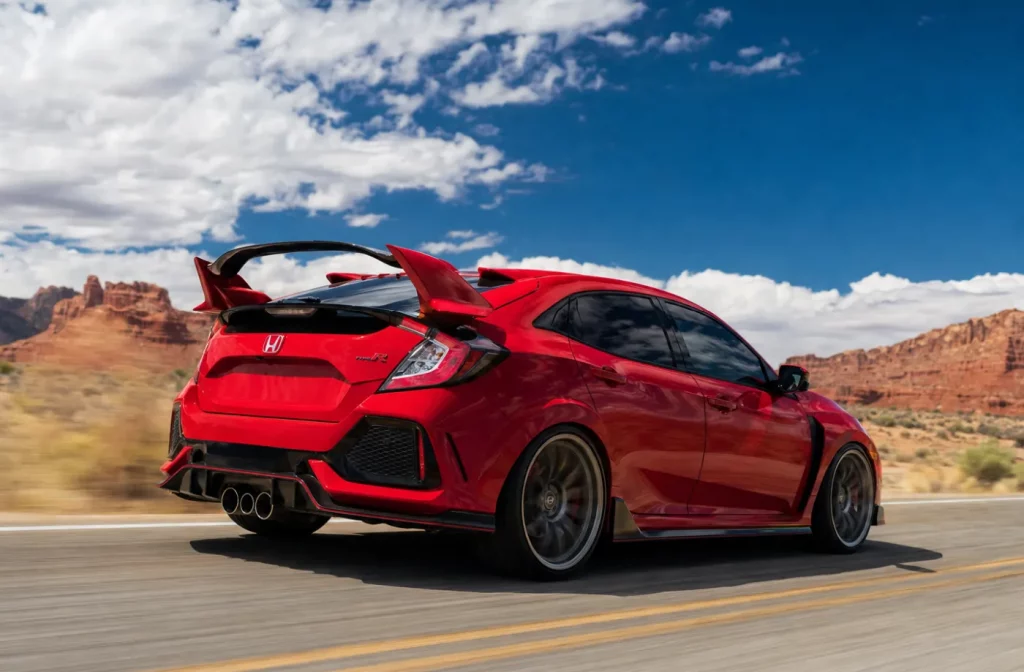
The internet is full of dyno sheets, YouTube races, and forum threads claiming that a tuned 1.5T Civic can hang with — or even beat — a stock Civic Type R. Some of those claims are true, in very specific situations. Most of them ignore the full picture. And none of them tell you what it actually costs to get there — in money, time, and reliability.
This isn’t a comparison about which car is better. It’s a breakdown of what a tuned 1.5T Civic can actually do against a stock Type R, what it costs to get there, and where the gap between them remains impossible to close.
A tuned 1.5T Civic can approach a stock Type R in straight-line acceleration for far less money — but horsepower alone doesn’t turn a regular Civic into a Type R. The Type R’s chassis, brakes, suspension, cooling, and resale value remain fundamentally superior. The tuned 1.5T is a power bargain; the Type R is a complete performance system.
The $10,000 Question
Let’s start with the money. A used 10th Gen Civic 1.5T can be purchased for significantly less than a used FK8 Type R. The gap varies by market, mileage, and condition, but it’s real — often $10,000 to $15,000 or more between a clean 1.5T and a comparable Type R.
That price difference is the entire premise of this comparison. If you buy the cheaper car, how much of that savings do you need to spend to make it as fast as the expensive one? And once you spend the money, do you actually end up with a car that performs like a Type R — or just a faster version of the car you started with?
A stock FK8 Type R, on a typical dyno, produces roughly 290–306 wheel horsepower and 290–305 lb-ft of wheel torque depending on the dyno and conditions. That’s the baseline you’re trying to reach. A stock 1.5T Civic produces significantly less — approximately 170–190 wheel horsepower depending on the model and transmission.
The gap is substantial. But the 1.5T responds to modifications in ways that the naturally aspirated engines of the past never could.
| Setup | Approx. WHP (Dynojet) | Approx. WTQ (Dynojet) | Notes |
|---|---|---|---|
| Stock 1.5T (Non-Si) | ~175–190 | ~190–210 | Baseline, varies by year and fuel |
| Stock FK8 Type R | ~290–306 | ~290–305 | |
| Stage 1 Tuned 1.5T | ~210–230 | ~240–270 | ECU calibration only |
| FBO 1.5T (93 octane) | ~240–255 | ~270–295 | Intake, intercooler, downpipe, exhaust |
| FBO + E30 1.5T | ~260–280 | ~290–310 | Ethanol blend, flex fuel sensor |
| Drop-in Turbo 1.5T | ~300+ | ~300+ | Significant hardware upgrade |
Note: All dyno figures vary significantly by dyno type, fuel quality, temperature, and individual car health. These are representative ranges, not guaranteed numbers.
Start With the Right Civic: Not Every 1.5T Is Equal
Before we go any further, we need to acknowledge that not every 1.5T Civic is the same starting point. The platform matters, and it matters a lot.
Non-Si 1.5T (EX, EX-T, Sport, Sport Touring):
This is the most common starting point. It’s the cheapest entry, and the 1.5T engine responds well to modifications. But the drivetrain is a limitation. Most of these cars have a CVT, which has a torque limit that you will hit quickly. The manual versions exist but are rarer. The chassis and suspension are tuned for daily driving, not performance.
Civic Si 1.5T:
This is a completely different starting point. The Si has a six-speed manual transmission, a helical limited-slip differential, a Sport-tuned suspension, and larger brakes. It’s the best platform for a serious 1.5T build. But it’s also more expensive to buy, and it already competes in a different performance bracket.
CVT vs Manual:
The CVT is a hard limit for power builds. The belt starts to slip AT around 220–240 lb-ft of wheel torque. That’s a ceiling you will hit quickly with even a moderate tune. The manual transmission can handle significantly more power, though the stock clutch will become a weak point.
For the purposes of this comparison, we’re focusing primarily on the manual-transmission 1.5T Civic — both Si and non-Si — because that’s where the real power potential exists. The CVT cars are also capable of substantial improvement, but they’re not chasing the same power targets as the manual builds.
Stage 1 vs Stock Type R: The First Surprise
A simple ECU calibration transforms the 1.5T Civic. In one documented dyno comparison, a 2017 Civic EX-T 6MT showed:
- Stock: ~187 WHP / ~200 WTQ
- Ktuner Starter 21: ~203 WHP / ~250 WTQ
- TSP Stage 1: ~219 WHP / ~258 WTQ
That’s a significant gain — over 30 wheel horsepower and nearly 60 lb-ft of torque from a simple flash. The car feels completely different. The mid-range torque is dramatically improved, and the throttle response is sharper.
But Stage 1 still doesn’t make the 1.5T a competitor to the Type R in peak power. The stock FK8 is making 80–100 more wheel horsepower. The gap is still enormous.
However, the tuned 1.5T feels Type R fast in everyday driving. The torque comes on early, the car surges forward, and the driver might genuinely believe they’re close. The dyno says otherwise.
- Stock: ~187 WHP / ~200 WTQ
- Stage 1: ~219 WHP / ~258 WTQ
- +32 WHP, +58 WTQ from tune alone
- Massive mid-range improvement
- Still far from Type R power
- ~290–306 WHP
- ~290–305 WTQ
- 80–100 WHP advantage
- Linear power delivery
- Built for sustained performance
The $1,000 Build: Tune and Tires
If you have $1,000 to spend on a 1.5T Civic, here’s what you do:
- KTuner V2 or Hondata FlashPro: ~$650
- Better tires: ~$350–400
That’s it. The tune unlocks the power, and the tires help you use it. The car will be significantly quicker than stock, and the difference in daily driving will be dramatic.
But you’re still not catching a Type R. The power gap is too large, and the traction limitations of a front-wheel-drive car with 235-section tires are real.
The $3,000 Build: Where Things Get Serious
With a $3,000 budget, you can start addressing the limitations:
- KTuner V2 or Hondata: ~$650
- Cold air intake: ~$400
- Intercooler: ~$600–800
- Downpipe: ~$600
- Better tires: ~$800
This gets you into the 240–255 WHP range on 93 octane, with peak torque approaching 290 lb-ft. The car is genuinely fast for a FWD compact. In a straight line, especially from a roll, it can give a stock Type R a real challenge.
But bolt-ons without a tune aren’t magic. In one published FBO baseline on a Type R, the bolt-on hardware alone — without tuning — delivered only a small increase over stock power; the custom calibration was where the real gains appeared. This same principle applies to the 1.5T: the tune is the brain of the build, and without it, the hardware is just weight.
Can a Tuned 1.5T Actually Make Type R Power?
Yes — but define “Type R power.”
A well-sorted drop-in turbo build on a 1.5T can reach the 300 WHP mark. In one recent test, a PRL 11th Gen 1.5T with full bolt-ons, a drop-in turbo upgrade, and tuning on 93 octane produced 308 WHP and 304 WTQ. On an E26 blend, it produced 341 WHP and 318 WTQ.
That’s a specific, well-documented build, and it shows what’s possible. But it’s not a Stage 1 result, it’s not cheap, and it’s not a straightforward path.
Yes, a built-and-tuned 1.5T can reach stock FK8 wheel-power territory. But it doesn’t reach it with a laptop and an intake.
Power Is Only Half the Story
Suppose you do it. You spend the money, you build the motor, you add the turbo, and you hit 300 WHP on the dyno. Your 1.5T Civic now matches the stock Type R’s peak power.
On paper: tie.
In reality: completely different cars.
The Type R was engineered as a complete system. The power is part of that system, but so is the chassis, the suspension, the brakes, the cooling, the aero, and the transmission. The 1.5T Civic was engineered as a daily driver. You can add power to it, but you’re adding power to a chassis that wasn’t designed for it.
Handling: Where the Type R Starts Destroying the Math
This is where the comparison falls apart for the tuned 1.5T. The Type R receives:
- A wider track for more grip and stability
- Dual-axis front suspension that eliminates torque steer
- Adaptive dampers that adjust on the fly
- An aggressive alignment from the factory
- Wide performance tires (265-section on the FK8, 265/30R19 on the FL5)
- Brembo four-piston front brakes
- Engineered cooling for sustained track use
- Aerodynamics that produce functional downforce
- A body shell with additional structural reinforcements
The regular 1.5T Civic gets a chassis designed for 174–180 horsepower, narrower tires, a less aggressive suspension, and brakes that are adequate for daily driving but not for track use.
You can tune horsepower overnight. You can’t bolt on an entire Type R chassis for $500.
The Hidden Cost: Trying to Build a Type R
Let’s be honest about what it takes to make a 1.5T Civic perform like a Type R in all conditions — not just on a dyno or in a straight line.
| Upgrade | Why You Need It | Approx. Cost |
|---|---|---|
| ECU calibration | More power | $650 |
| Intercooler | Heat management under load | $600–800 |
| Cold air intake | Airflow | $400 |
| Tires | Traction | $800 |
| Brake pads/rotors | Repeated stopping | $500–1,000 |
| Suspension upgrades | Cornering control | $800–2,000 |
| Clutch upgrade | Manual torque capacity | $1,200–1,800 |
| LSD | Putting power down | $1,200–1,800 |
| Cooling upgrades | Track reliability | $500–1,500 |
The uncomfortable question: at what point should you have just bought the Type R?
The $5K Build vs Type R
With $5,000 to spend, you can:
- Add the ECU calibration
- Add the intake, intercooler, and downpipe
- Add a set of good tires
- Add some suspension components
- Maybe upgrade the brakes
You’ll have a very fast 1.5T Civic. But you won’t have a Type R. The chassis, the brakes, the cooling, the suspension geometry, the LSD, the resale value — none of those come with the bolt-ons.
$5,000 doesn’t turn a Civic EX-T into a Type R. It turns it into a very fast regular Civic. Those are different things.
Straight-Line Performance: Where the Tuned 1.5T Can Fight Back
In straight-line conditions, the tuned 1.5T is most dangerous. From a roll — especially in the 40–80 mph range — a well-tuned 1.5T with a manual transmission and good tires can genuinely challenge a stock Type R.
Why? The smaller turbo spools quickly. The torque comes on hard in the mid-range. The car is lighter than the Type R. And the power-to-weight ratio of a 250-whp 2,900-pound Civic is closer to a 300-whp 3,100-pound Type R than the peak power numbers suggest.
The 1.5T Civic punches above its weight in roll racing. The Type R is better from a standing start, better at high speeds, and better in every situation that requires more than just a straight line.
Traction: The Problem Your Dyno Doesn’t Show
A dyno sheet shows peak power. It doesn’t show what happens when you try to use that power on the street. A 1.5T Civic with 260 WHP and 300 WTQ is making more torque than the front tires can handle, especially in first and second gear.
The result is wheelspin, torque steer, and traction control intervention. The car is fast on the dyno, but on the street, it struggles to put the power down.
The Type R, with its wider tires, more sophisticated suspension, and better geometry, uses its power more effectively. Even when both cars make similar peak numbers, the Type R gets more of that power to the ground.
The CVT Problem
If you’re starting with a CVT-equipped 1.5T Civic, the ceiling is lower. The CVT has a torque limit — roughly 220–240 lb-ft at the wheels — and once you exceed that, the belt slips and the transmission overheats.
You can still make a CVT 1.5T significantly faster. A simple tune and an intercooler upgrade will transform the car. But you cannot chase Type R power levels with a CVT. The transmission isn’t designed for it, and pushing it too hard will result in expensive repairs.
If you’re building a 1.5T to chase the Type R, you need the manual transmission.
Reliability: The Part Nobody Wants to Talk About
The stock Type R is expensive, but it’s also a complete, engineered system. The motor, the cooling, the brakes, the transmission — everything is designed to work together at the factory power level. The warranty provides additional protection.
The tuned 1.5T is making more power than the factory designed for. The cylinder pressure is higher. The heat is greater. The clutch is stressed. The transmission is under more load. The fuel system is working harder.
Some tuned 1.5T Civics run for years without issues. Others experience failures. The risk is real, and the cost of a major failure can erase any savings from buying the cheaper car.
Peak horsepower isn’t always what kills a drivetrain. A huge low-RPM torque spike can be much harder on components than a high-RPM horsepower peak. One of the reasons experienced tuners sometimes limit mid-range torque is to protect the transmission, clutch, and rods — a detail that straight-line dyno numbers don’t always show.
Daily Driving: Which One Is Actually Better?
The tuned 1.5T Civic can be a better daily driver for many people. It’s cheaper to buy, cheaper to insure, more comfortable, and less attention-grabbing. With a moderate tune, it’s genuinely quick and still reliable. The fuel economy is better, and the ride is more compliant.
The Type R is more demanding. The ride is firmer, the fuel economy is worse, and the attention from other drivers is constant. But it’s also more rewarding when you push it hard.
The Type R is the better performance car. The tuned 1.5T may be the better car to live with every day.
The Sleeper Factor
There’s something appealing about a tuned 1.5T Civic that looks like traffic but moves like a much faster car. The sleeper aspect is real — you can surprise people who expect a slow economy car.
The Type R looks like a Type R. Everyone already knows what it is. The element of surprise is gone.
If you want to fly under the radar while moving quickly, the tuned 1.5T has an advantage.
What Happens on Track?
This is where the gap becomes a canyon. A 300-whp 1.5T Civic may have Type R power, but it does not have Type R stamina.
On a road course, the brakes will fade, the engine will heat soak, the tires will degrade, and the suspension will struggle. The Type R was designed for this. The regular Civic was not.
A 300-whp Civic 1.5T may have Type R power. It does not automatically have Type R stamina.
Three Builds, One Type R
| Car | Power Goal | Cost to Modify | Character |
|---|---|---|---|
| Stage 1 Civic 1.5T | ~210–230 WHP | Low (~$650) | Quick daily |
| FBO 1.5T | ~240–255 WHP | Medium (~$2,500–3,500) | Strong street build |
| Drop-in Turbo 1.5T | ~300+ WHP | High ($5,000+) | Serious project |
| Stock FK8 Type R | ~290–306 WHP | $0 mods | Complete performance car |
Note: Dyno figures vary by setup, fuel, and conditions. These are representative ranges based on published owner results.
When the Tuned Civic Makes More Sense
Choose the tuned 1.5T if you already own the Civic, you don’t want to change cars, you want a sleeper, straight-line street acceleration is your priority, you’re willing to build the car gradually, and you understand the risks of tuning.
When You Should Just Buy the Type R
Buy the Type R if you want track capability, you don’t want to build the entire package yourself, brakes and chassis matter to you, you want factory engineering, and you care about resale value.
Final Thought
A tuned Civic 1.5T can embarrass a stock Type R in very specific situations — especially from a roll on the highway. But the moment the road adds braking, repeated corners, heat, or a full track session, horsepower stops being the whole conversation.
The tuned 1.5T is a power bargain. The Type R is a complete performance system.
If you want the cheapest path to straight-line speed, build the 1.5T. If you want a complete, track-ready performance car that holds its value, buy the Type R.
FAQ — Tuned 1.5T vs Stock Type R
Can a tuned Civic 1.5T beat a Type R?
In specific situations, yes. A well-tuned 1.5T with bolt-ons can be competitive with a stock Type R from a roll, especially in the 40–80 mph range. But the Type R is faster from a standing start, faster at high speeds, and vastly superior in handling, braking, and track performance. The 1.5T can be quicker in narrow situations; the Type R is quicker in almost every other scenario.
How much power does a tuned Civic 1.5T make?
A Stage 1 tuned 1.5T typically makes 210–230 wheel horsepower and 240–270 lb-ft of wheel torque. With full bolt-ons on 93 octane, that increases to 240–255 WHP and 270–295 WTQ. With ethanol, it can reach 260–280 WHP. With a drop-in turbo, it can exceed 300 WHP. These are typical ranges, not guarantees.
Is it worth tuning a Civic 1.5T?
Yes — the 1.5T responds exceptionally well to tuning. A simple ECU calibration adds 30+ wheel horsepower and 50+ lb-ft of torque, dramatically improving the car’s responsiveness and mid-range power. It’s the best value modification you can make.
Does a tuned 1.5T Civic have Type R handling?
No — the Type R has a wider track, dual-axis front suspension, adaptive dampers, Brembo brakes, and a more rigid chassis. The regular Civic’s chassis is designed for daily driving, not track performance. Even with suspension modifications, the 1.5T Civic cannot match the Type R’s handling package.
Can a CVT Civic 1.5T be tuned to beat a Type R?
No — the CVT has a torque limit of approximately 220–240 lb-ft at the wheels. A tuned 1.5T with a CVT can be significantly faster than stock, but the transmission limits the power you can safely run. If you want to chase Type R power levels, you need the manual transmission.
What’s the most cost-effective way to make a 1.5T Civic fast?
A simple ECU calibration (KTuner or Hondata) with a good set of tires is the best value. It dramatically improves the car’s performance for under $1,000. Beyond that, an intercooler and a custom calibration are the next best steps.
Is a tuned 1.5T Civic reliable?
A properly tuned 1.5T with a conservative calibration and good maintenance can be reliable for many miles. Aggressive tunes, poor fuel quality, and lack of maintenance increase the risk of failure. The Type R’s components are designed for its power level from the factory; the 1.5T’s components are not.
Why is the Type R more expensive than a tuned 1.5T?
The Type R is more expensive because it includes the full package: a more powerful and robust engine, a stronger transmission, better brakes, better suspension, better cooling, a more rigid chassis, and stronger resale value. You’re paying for engineering, not just peak horsepower.
Should I build a 1.5T Civic or buy a Type R?
Build the 1.5T if you already own the car, you want a straight-line street build, you’re willing to accept the limitations, and you enjoy the process of modifying a car. Buy the Type R if you want a complete performance car with track capability, strong resale value, and factory engineering.
What’s the most expensive part of building a 1.5T Civic?
The hidden costs add up: clutch upgrades for manual cars, LSD installation, brake upgrades, suspension work, and cooling upgrades. The power itself is relatively cheap; making the car handle the power is where the money goes.