

Engine oil capacity is one of the most frequently mislooked-up specs in Civic ownership. The number on the oil cap is not always the number you need — capacity changes between drain-and-fill and full dry fill, and it changes again depending on whether you replace the filter. This reference covers every production engine used in the U.S.-market Honda Civic from the 7th generation (2001) through the 11th generation (2022–2026), with oil specification, viscosity, and filter part numbers included.
How Honda Measures Oil Capacity
Honda publishes two oil capacity figures in its service manuals: drain and refill (with filter replacement) and dry fill (engine completely empty, used after a rebuild or engine replacement). The drain-and-refill figure is what you use for every routine oil change. The dry fill figure is higher because residual oil remains in the oil passages, VTC actuator, and head after a normal drain. Always use the drain-and-refill figure for routine service. Overfilling by even 0.5 qt causes aeration, oil foaming, and accelerated wear on the main bearings.
Honda specifies 0W-20 full synthetic for all engines from the 8th generation onward. The 7th gen D17 series was originally spec’d for 5W-20, but Honda later revised the recommendation to 0W-20 for improved cold-start protection. The L15B7 and K20C1 are particularly sensitive to oil quality due to their direct-injection design and high-pressure Fuel Pump operation — use Honda Genuine Motor Oil or a full synthetic meeting API SN or SP and ILSAC GF-5 or GF-6 standards.
7th Generation (2001–2005) — D-Series and K-Series
The D17 family has two distinct capacities depending on trim. The LX and DX use the D17A1, which holds 3.4 qt with filter. The EX, HX, and Si coupe use the D17A2 or D17A6, which hold 3.7 qt with filter. Do not use a single figure for all 7th gen D17 engines — the difference is real and confirmed in the Honda service manual.
| Engine | Application | Drain & Refill (w/ filter) | Dry Fill (overhaul) | Viscosity | OEM Filter |
|---|---|---|---|---|---|
| D17A1 | 2001–2005 LX, DX sedan/coupe | 3.4 qt (3.2 L) | 4.0 qt (3.8 L) | 5W-20 (0W-20 acceptable) | 15400-PLM-A02 |
| D17A2 / D17A6 | 2001–2005 EX, HX sedan/coupe | 3.7 qt (3.5 L) | 4.0 qt (3.8 L) | 5W-20 (0W-20 acceptable) | 15400-PLM-A02 |
| K20A3 | 2002–2005 Si hatchback (EP3) | 4.4 qt (4.2 L) | 5.6 qt (5.3 L) | 5W-20 (0W-20 acceptable) | 15400-PLM-A02 |
8th Generation (2006–2011) — R-Series and K-Series
| Engine | Application | Drain & Refill (w/ filter) | Dry Fill (overhaul) | Viscosity | OEM Filter |
|---|---|---|---|---|---|
| R18A1 / R18A4 | 2006–2011 LX, EX sedan/coupe | 3.9 qt (3.7 L) | 4.4 qt (4.2 L) | 0W-20 full synthetic | 15400-PLM-A02 |
| K20Z3 | 2006–2011 Si sedan/coupe (FG2/FA5) | 4.4 qt (4.2 L) | 5.0 qt (4.7 L) | 0W-20 full synthetic | 15400-PLM-A02 |
The R18A1 holds 0.5 qt less than the K20Z3 despite being a larger displacement engine. This is because the K20 family uses a larger oil pan and a higher-volume Oil Pump to support its higher-revving design and VTEC system. The K20Z3 at 7,800 rpm requires more oil volume in circulation at any given moment than the R18 at 6,500 rpm.
9th Generation (2012–2015) — R-Series and K-Series
| Engine | Application | Drain & Refill (w/ filter) | Dry Fill (overhaul) | Viscosity | OEM Filter |
|---|---|---|---|---|---|
| R18Z1 | 2012–2015 LX, EX sedan/coupe | 3.9 qt (3.7 L) | 4.4 qt (4.2 L) | 0W-20 full synthetic | 15400-PLM-A02 |
| K24Z7 | 2012–2015 Si sedan/coupe | 4.4 qt (4.2 L) | 5.0 qt (4.7 L) | 0W-20 full synthetic | 15400-PLM-A02 |
The 9th gen Si K24Z7 holds the same 4.4 qt drain-and-refill capacity as the 8th gen K20Z3 despite having 356 cc more displacement. The K24 Oil Pan volume is similar to the K20 because the engine was designed to share the same chassis packaging constraints. The K24Z7 is also the last Civic Si engine to use port injection, which means it does not suffer from the intake valve carbon buildup issues that affect the 10th and 11th gen turbocharged Si engines.
10th Generation (2016–2021) — R-Series, L-Series Turbo, and K-Series Turbo
| Engine | Application | Drain & Refill (w/ filter) | Dry Fill (overhaul) | Viscosity | OEM Filter |
|---|---|---|---|---|---|
| R20A3 | 2016–2021 LX sedan/coupe | 4.4 qt (4.2 L) | 4.9 qt (4.6 L) | 0W-20 full synthetic | 15400-PLM-A02 |
| L15B7 | 2016–2021 EX, EX-L, Touring sedan/coupe; Sport, EX, EX-L, Touring hatchback | 3.7 qt (3.5 L) | 4.2 qt (4.0 L) | 0W-20 full synthetic | 15400-PLM-A02 |
| K20C2 | 2017–2021 Si sedan/coupe | 4.4 qt (4.2 L) | 5.0 qt (4.7 L) | 0W-20 full synthetic | 15400-PLM-A02 |
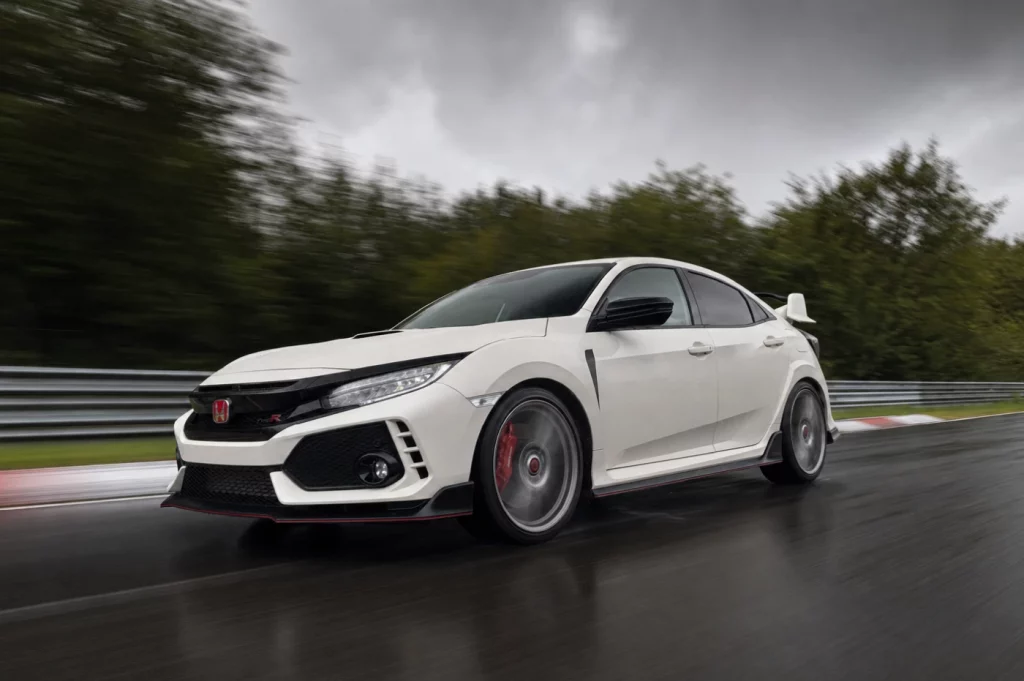
| K20C1 (FK8) | 2017–2021 Type R FK8 | 5.7 qt (5.4 L) | 7.0 qt (6.6 L) | 0W-20 full synthetic | 15400-PLM-A02 |
The L15B7 holds only 3.7 qt — the smallest oil capacity of any Civic engine since the D17. This is a known concern for owners who do extended oil change intervals. The L15B7 is also the engine most documented for oil dilution in cold climates: fuel from direct injection and short-trip driving contaminates the oil, and a small sump means the dilution ratio rises faster than it would in a larger-capacity engine. Honda’s Maintenance Minder system accounts for this, but owners in cold climates who do frequent short trips should not rely solely on the Minder and should change oil at 5,000-mile intervals regardless of indicator status.
The K20C1 FK8 holds 5.7 qt with filter — the largest capacity of any non-hybrid Civic engine. Per the Honda FK8 service manual, the at-oil-change-with-filter figure is 5.4 L (5.7 US qt); the without-filter figure is 5.0 L (5.3 US qt). The full overhaul dry fill is 6.6 L (7.0 US qt). The Type R‘s larger oil pan and baffling require more volume to maintain adequate oil pressure during sustained high-lateral-g cornering and track use.
11th Generation (2022–2026) — R-Series, L-Series Turbo, e:HEV Hybrid, and K-Series Turbo
| Engine | Application | Drain & Refill (w/ filter) | Dry Fill (overhaul) | Viscosity | OEM Filter |
|---|---|---|---|---|---|
| R20A3 | 2022–2025 LX sedan | 4.4 qt (4.2 L) | 4.9 qt (4.6 L) | 0W-20 full synthetic | 15400-PLM-A02 |
| L15B7 | 2022–2026 Sport, EX, EX-L, Touring sedan; Sport, EX, EX-L, Touring hatchback | 3.7 qt (3.5 L) | 4.2 qt (4.0 L) | 0W-20 full synthetic | 15400-PLM-A02 |
| L15B7 (Si tune) | 2022–2025 Si sedan | 3.7 qt (3.5 L) | 4.2 qt (4.0 L) | 0W-20 full synthetic | 15400-PLM-A02 |
| LFA (e:HEV) | 2025–2026 Sport Hybrid, Sport Touring Hybrid sedan | 3.6 qt (3.4 L) | 4.0 qt (3.8 L) | 0W-20 full synthetic | 15400-PLM-A02 |
| K20C1 (FL5) | 2023–2026 Type R FL5 | 5.7 qt (5.4 L) | 7.0 qt (6.6 L) | 0W-20 full synthetic | 15400-PLM-A02 |
The 11th gen Si uses the same L15B7 block as the standard Sport and EX trims, which means it shares the same 3.7 qt oil capacity. This is a meaningful difference from the 10th gen Si (K20C2, 4.4 qt) and the 9th gen Si (K24Z7, 4.4 qt). Owners upgrading from a previous-generation Si should not assume the same capacity applies. The 11th gen Si’s smaller sump makes oil change interval discipline more important, not less.
Master Oil Capacity Reference — All Generations
| Engine | Gen | Drain & Refill (w/ filter) | Dry Fill (overhaul) | Viscosity | Turbo |
|---|---|---|---|---|---|
| K20C1 FK8 / FL5 | 10th / 11th | 5.7 qt | 7.0 qt | 0W-20 | Yes |
| K20A3 / K20Z3 / K20C2 | 7th / 8th / 10th | 4.4 qt | 5.0–5.6 qt | 0W-20 | No / No / Yes |
| K24Z7 | 9th | 4.4 qt | 5.0 qt | 0W-20 | No |
| R20A3 | 10th / 11th | 4.4 qt | 4.9 qt | 0W-20 | No |
| R18A1 / R18Z1 | 8th / 9th | 3.9 qt | 4.4 qt | 0W-20 | No |
| L15B7 (standard / Si) | 10th / 11th | 3.7 qt | 4.2 qt | 0W-20 | Yes |
| LFA (e:HEV hybrid) | 11th | 3.6 qt | 4.0 qt | 0W-20 | No |
| D17A2 / D17A6 (EX/HX) | 7th | 3.7 qt | 4.0 qt | 5W-20 / 0W-20 | No |
| D17A1 (LX/DX) | 7th | 3.4 qt | 4.0 qt | 5W-20 / 0W-20 | No |
Oil Change Interval Recommendations by Engine
Honda Maintenance Minder system (8th gen onward): The Maintenance Minder calculates oil life based on engine temperature cycles, RPM history, cold starts, and idle time. It is not a mileage counter. Under ideal conditions (highway driving, warm climate, consistent operating temperature), it may not trigger until 7,500–10,000 miles. Under severe conditions (short trips, cold climate, frequent idling), it may trigger at 3,000–5,000 miles. The system is accurate for most drivers but has known limitations for L15B7 owners in cold climates where Oil dilution occurs faster than the algorithm accounts for.
D17 series (7th gen): No Maintenance Minder. Change every 5,000 miles with full synthetic or every 3,000 miles with conventional oil. These engines are old enough that most are past 150,000 miles — AT that mileage, 5,000-mile intervals with a UOA (used oil analysis) every other change is the most cost-effective approach.
R18 / R20 series (8th, 9th, 10th, 11th gen): Follow Maintenance Minder. Maximum recommended interval with full synthetic: 7,500 miles. Port injection means no oil dilution concern. These are low-stress engines that respond well to consistent intervals.
L15B7 (10th and 11th gen): Follow Maintenance Minder but cap at 5,000 miles in cold climates or if the vehicle is used primarily for short trips under 10 miles. The small 3.7 qt sump means any oil dilution or contamination reaches a critical concentration faster than in a larger-capacity engine. Use Honda Genuine 0W-20 or a full synthetic meeting API SP and ILSAC GF-6A. Do not use 5W-30 or heavier viscosity — the L15B7 oil pump and VTC system are calibrated for 0W-20 flow characteristics.
K20C1 Type R (FK8 and FL5): Honda recommends 5,000-mile intervals for track use and Maintenance Minder for street use. For owners who track the car, change oil before every track day regardless of Minder status. The 5.7 qt capacity (with filter) provides more buffer than the L15B7, but the K20C1 runs significantly higher oil temperatures under sustained high-RPM use. A quality full synthetic 0W-20 with a high HTHS (high-temperature high-shear) rating is the correct choice — Mobil 1 0W-20, Honda Genuine 0W-20, or Pennzoil Platinum 0W-20 are all appropriate.
OEM Filter and Drain Plug Specifications
| Component | Spec / Part Number | Notes |
|---|---|---|
| OEM oil filter (all gens) | 15400-PLM-A02 | Fits D17, R18, R20, K20, K24, L15B7, K20C1, K20C2. Honda uses the same filter housing across all Civic engines. Aftermarket equivalents: Fram PH6607, Mobil 1 M1-110, Wix 57356. |
| Drain plug thread | M14 × 1.5 | All Civic generations 7th through 11th. Drain plug part number: 90009-PH1-000. |
| Drain plug torque — 7th gen LX / DX (D17A1) | 33 lb-ft (45 N·m) | D17A1 only (LX, DX, VP). Confirmed in Honda service manual and Honda-Tech DIY documentation. |
| Drain plug torque — 7th gen EX / HX / Si (D17A2, D17A6, K20A3) | 29 lb-ft (39 N·m) | EX, HX, and EP3 Si. Same torque spec as 8th and 9th gen. |
| Drain plug torque — 8th and 9th gen (R18, K20Z3, K24Z7) | 29 lb-ft (39 N·m) | Confirmed via Honda service data (OilsR.Us / Honda source). Replace crush washer at every change. |
| Drain plug torque — 10th and 11th gen (L15B7, R20A3, K20C2, K20C1) | 30 lb-ft (40 N·m) | Confirmed via Motivx Tools factory spec and multiple Honda service sources. Do not exceed — aluminum oil pan threads strip easily. |
| Oil filter torque | Hand-tight + 3/4 turn | Honda does not specify a torque value for the spin-on filter. Hand-tight plus 3/4 turn is the Honda service manual procedure. Do not use a filter wrench to tighten. |
| Crush washer | 94109-14000 | Replace at every oil change. Reusing a deformed crush washer is the most common cause of drain plug seepage on Civics. Cost: under $2 each at any Honda dealer. |
Oil Capacity — Quick Reference:
☐ Always use the drain-and-refill figure for routine oil changes, not the dry fill figure. Overfilling by 0.5 qt causes oil aeration and bearing wear.
☐ 7th gen D17 capacity varies by trim: D17A1 (LX/DX) = 3.4 qt with filter; D17A2/D17A6 (EX/HX) = 3.7 qt with filter. Do not use a single figure for all 7th gen D17 engines.
☐ Largest oil capacity: K20C1 Type R (FK8 and FL5) at 5.7 qt drain-and-refill with filter (5.4 L per Honda service manual). Without filter: 5.3 qt. Full overhaul dry fill: 7.0 qt. Smallest: D17A1 at 3.4 qt.
☐ All Civic engines from the 8th gen onward specify 0W-20 full synthetic. The 7th gen D17 was originally 5W-20 but 0W-20 is acceptable and preferred in cold climates.
☐ The same OEM oil filter (15400-PLM-A02) fits every Civic engine from the 7th gen through the 11th gen. Aftermarket equivalents: Fram PH6607, Mobil 1 M1-110, Wix 57356.
☐ Drain plug torque is NOT the same across all generations. 7th gen LX/DX (D17A1): 33 lb-ft. 7th gen EX/HX/Si and 8th–9th gen: 29 lb-ft. 10th–11th gen: 30 lb-ft. Replace crush washer (94109-14000) at every change.
☐ L15B7 owners in cold climates: cap oil change intervals at 5,000 miles regardless of Maintenance Minder status. Oil dilution from direct injection and short-trip driving concentrates faster in the 3.7 qt sump than the algorithm accounts for.
☐ The 11th gen Si uses the L15B7 block and holds only 3.7 qt — significantly less than the 10th gen Si (K20C2, 4.4 qt) and 9th gen Si (K24Z7, 4.4 qt). Do not assume capacity carries over between Si generations.
☐ Type R FK8 and FL5 owners who track the car: change oil before every track day regardless of Minder status. Use a full synthetic 0W-20 with high HTHS rating (Mobil 1, Honda Genuine, or Pennzoil Platinum).
☐ The e:HEV hybrid LFA engine holds 3.6 qt — the smallest capacity of any 11th gen engine. The Atkinson cycle design and lower operating RPM reduce oil stress, but the small sump still requires consistent change intervals.
☐ Honda does not specify a torque value for the spin-on oil filter. The correct procedure is hand-tight plus 3/4 turn. Do not use a filter wrench to tighten — overtightening deforms the Gasket and makes the next removal difficult.
☐ The K20Z3 (8th gen Si) and K24Z7 (9th gen Si) both hold 4.4 qt despite the K24 having 356 cc more displacement. The K24 oil pan volume matches the K20 due to shared chassis packaging constraints.