

⚠️ The Non-Serviceable Bus Bar Fuses
This is a key 11th gen specific electrical consideration that is not covered in standard fuse references.
The 11th gen Civic has non-serviceable “bus bar” fuses in the under-Hood fuse box. They appear as thick metal plates and are soldered directly to the circuit board. If one of these fails, the entire fuse box assembly must be replaced — not just the fuse.
Do NOT attempt to pry, pull, or remove these bus bar fuses. In the vast majority of cases, the issue is a standard fuse or relay. If the vehicle has no electrical power and the battery is confirmed good, the cause is almost certainly the main relay or a loose battery connection — not the bus bar fuses.
11th Generation — Civic (2022–2025) FE/FL
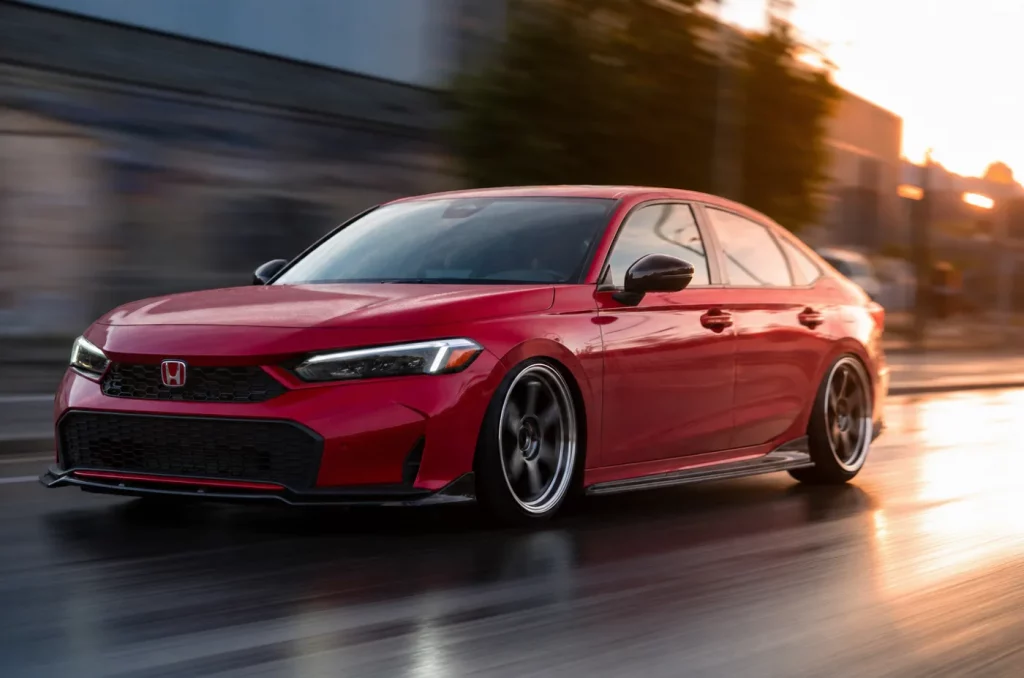
Your 11th gen Civic (FE1 sedan, FE2 coupe, FL1 hatchback, FL5 Type R) has two fuse boxes: one in the passenger compartment (under the driver’s side dashboard) and one in the engine compartment (passenger side Fender).
Key considerations: Honda redesigned the electrical architecture for the 11th gen. The under-hood fuse box now has non-serviceable bus bar fuses — if they fail, the entire box requires replacement. The BCM (Body Control Module) is also sensitive, similar to the 10th gen. The interior fuse box is now more accessible than on previous generations.
Quick Reference — Where to Find the Fuse Boxes
| Location | Position | Notes |
|---|---|---|
| Under-Hood (Engine Bay) | Passenger side fender, behind the air filter box | Appears similar to the 10th gen, but internal construction is different. Non-serviceable bus bar fuses are soldered in — do not attempt to remove them. The cover clips are functional but can be fragile in cold weather. |
| Under-Dash (Interior) | Under the steering column, left side — behind a plastic cover panel | Improved access — the cover flips down with a simple latch, making it easier to access than older generations. |
Passenger Compartment Fuse Box (Under-Dash)
Location: Under the dashboard, driver’s side — behind the cover panel, left of the steering column. The cover flips down with a latch for easier access.
Most commonly blown fuses on the 11th gen:
| № | Amps | Circuit Protected | Common Failure |
|---|---|---|---|
| 11 | 20 A | Front Cigarette Lighter / 12V Power Outlet | 🔌 The most commonly blown fuse across generations. Phone chargers, dashcams, and tire inflators are common causes. The 11th gen uses the same 20A rating as the 10th gen. |
| 10 | 20 A | Center Console Power Outlet | Same as #11 — if the armrest 12V socket is inoperative but the front outlet works, this is the likely fuse. |
| 6 | 15 A | Fuel Pump | ⛽ Engine cranks but does not start? This remains a common no-start fuse to check first. |
| 3 | 7.5 A | Smart Entry / Keyless Access / Push-Button Start | 🔑 Key fob not recognized? This is the first fuse to check. If blown, the vehicle may not start even with a good key battery. |
| 4 | 10 A | Airbag / SRS Control | ⚠️ SRS light illuminated? If this fuse blows, the airbag system is disabled. Inspection is recommended. |
| 9 | 10 A | Turn Signals / Hazard Lights | Turn signals inoperative? Check this fuse first. |
| 16 | 15 A | Radio / Display Audio | 📻 Infotainment screen inoperative? Check this first. The 11th gen head units draw significant power and may blow this fuse. |
| 7 | 7.5 A | Door Locks / Security System | If the key fob does not lock/unlock and the battery is confirmed good — check this fuse. |
Engine Compartment Fuse Box (Under-Hood)
Location: Passenger side fender, behind the air filter box.
⚠️ IMPORTANT: This fuse box contains non-serviceable bus bar fuses. Do not attempt to remove them.
These are the higher-amperage fuses and relays — cooling, ABS, EPS, and the main battery fuse.
| № | Amps | Circuit Protected | Common Failure |
|---|---|---|---|
| Bus Bar (Non-Serviceable) | 80 A / 100 A | Main Battery Fuse (SOLDERED — DO NOT ATTEMPT REMOVAL) | ⛔ Do not attempt to remove these. They are soldered to the circuit board. If one fails, replace the entire fuse box. In the majority of cases, a “dead car” is caused by a faulty main relay or loose battery connection — not these. |
| 4 | 30 A | Radiator Fan | 🌡️ Engine overheating in traffic? If this fuse blows, the fan will not operate. The 1.5T and 2.0L engines both run hot — address this promptly. |
| 2 | 30 A | Condenser Fan | Works in conjunction with the radiator fan. If both are inoperative, check the A/C relay. |
| 1 | 70 A | Electric Power Steering (EPS) | 🔄 Heavy steering feel? This fuse or the EPS module may be the cause. If the fuse is intact, the EPS motor may require inspection — a known issue on early 11th gen vehicles. |
| 3 | 15 A | ACG (Alternator / Generator) | 🔋 Important circuit. If this fuse blows, the battery will not charge. The vehicle may run until the battery is depleted. Check this if the battery light is illuminated but the alternator tests good. |
| 12 | 15 A | Ignition Coils | 🔥 Misfire or rough idle? This fuse protects all four coils. Check it if misfire codes are present. |
| 15 | 30 A | ABS Pump (VSA) | If the ABS light is illuminated and the pump does not prime, check this fuse. The ABS module on the 11th gen is more reliable than the 10th gen but should still be verified. |
| 6 | 15 A | Honda Sensing (Camera / Radar) | 📷 Adaptive cruise control, lane-keep assist, or collision warning not functioning? Check this fuse. The 11th gen’s Honda Sensing system is sensitive to voltage fluctuations. |
Important Notes — 11th Gen Specific Electrical Issues
⚠️ The Non-Serviceable Bus Bar Fuse Consideration
This is a key 11th gen specific electrical consideration that is not covered in standard fuse references.
The under-hood fuse box contains bus bar fuses that are soldered directly to the PCB. They appear as thick metal plates with no visible amp rating. If one of these “fuses” fails, it cannot be replaced individually — a complete new under-hood fuse box assembly from Honda is required, which costs $400-600 plus labor.
Diagnosis: If the vehicle has absolutely no electrical power (no dash lights, no crank, no door chime) and the battery is fully charged — the issue is almost always the main relay or a loose/corroded battery terminal, not the bus bar fuses.
Recommended approach: Verify battery terminals first. Then check the main relay (under-hood fuse box). Only after ruling these out should the bus bar fuses be considered — and if they have failed, replacement of the entire fuse box is required.
💡 BCM Reset — Still Applicable on the 11th Gen
The BCM (Body Control Module) on the 11th gen is sensitive, similar to the 10th gen. If windows, locks, wipers, or push-button start exhibit intermittent issues — disconnect the negative battery terminal for 10-15 minutes to reset the system.
Procedure: Disconnect the negative terminal, wait 10-15 minutes, reconnect, start the vehicle, and allow it to idle for 2-3 minutes without touching the accelerator pedal. This resets the BCM and resolves most electrical glitches. If the issue persists, inspect individual fuses.
🔧 The ELD (Electronic Load Detector) — Parasitic Drain
The 11th gen Civic has a known issue with the ELD (Electronic Load Detector) in the under-hood fuse box. The ELD monitors electrical load and regulates Alternator output. When it fails, it can cause parasitic battery drain — the battery may discharge overnight without an apparent cause.
Symptom: The battery is discharged each morning. The battery has been replaced, but the issue persists. The A/C relay is functional. The alternator tests good.
Fix: The ELD is integrated into the under-hood fuse box. If it fails, the entire fuse box must be replaced — similar to the bus bar issue. A Technical Service Bulletin (TSB) exists for this on some 11th gen models. Consult with a dealer before purchasing parts.
Complete Fuse Chart — 11th Gen Civic (2022–2025)
Passenger Compartment Fuse Box (Under-Dash)
| № | Amps | Circuit Protected |
|---|---|---|
| 1 | 10 A | Accessory (12V Power Outlet — some trims) |
| 2 | 10 A | Passenger Seat Heat |
| 3 | 7.5 A | Smart Entry / Keyless Access / Push-Button Start |
| 4 | 10 A | SRS (Airbag) Indicator / Control |
| 5 | 10 A | SRS (Airbag) Control — Backup |
| 6 | 15 A | Fuel Pump |
| 7 | 7.5 A | Door Locks / Security System |
| 8 | 10 A | Interior Illumination / Dome Light |
| 9 | 10 A | Turn Signals / Hazard Lights |
| 10 | 20 A | Center Console 12V Outlet (Armrest) |
| 11 | 20 A | Front Cigarette Lighter / 12V Outlet |
| 12 | 10 A | Instrument Panel / Gauges |
| 13 | 10 A | Heated Steering Wheel |
| 14 | 10 A | Driver Seat Heat |
| 15 | 7.5 A | TPMS (Tire Pressure Monitoring System) |
| 16 | 15 A | Radio / Display Audio (Infotainment) |
| 17 | 10 A | Honda Sensing (Camera / Radar) |
| 18 | 10 A | Electric Parking Brake (EPB) |
| 19 | 10 A | Adaptive Cruise Control (ACC) / LKAS |
| 20 | 15 A | Windshield Wiper / Washer |
| 21 | 15 A | Rear Window Defroster (Coil) |
| 22 | 7.5 A | Blind Spot Information System (BSI) |
| 23 | 15 A | Accessory Socket — Rear (Hatchback only) |
| 24 | 10 A | USB Charging Ports (Front) |
| 25 | 10 A | USB Charging Ports (Rear) |
Engine Compartment Fuse Box (Under-Hood)
| № | Amps | Circuit Protected |
|---|---|---|
| Bus Bar | 80 A / 100 A | Main Battery Fuse (NON-SERVICEABLE — soldered) |
| 1 | 70 A | EPS (Electric Power Steering) |
| 2 | 30 A | Condenser Fan |
| 3 | 15 A | ACG (Alternator / Generator) |
| 4 | 30 A | Radiator Fan |
| 5 | 20 A | Headlight High Beam (Left) |
| 6 | 15 A | Honda Sensing (Radar Module) |
| 7 | 20 A | Headlight High Beam (Right) |
| 8 | 7.5 A | Daytime Running Lights (DRL) Module |
| 9 | 15 A | Ignition Coils |
| 10 | 15 A | Transmission Control Unit (TCU) — CVT |
| 11 | 15 A | Fuel Injectors (Main Power) |
| 12 | 15 A | Ignition Coils (Backup) |
| 13 | 20 A | Horn |
| 14 | 15 A | Windshield Washer Pump |
| 15 | 30 A | ABS Pump (VSA) |
| 16 | 15 A | ABS Control |
| 17 | 15 A | Starter Motor (Solenoid) |
| 18 | 30 A | Heater / Blower Motor (HVAC) |
| 19 | 15 A | O2 Sensor (Heater) — Front |
| 20 | 15 A | Headlight Low Beam (Right) |
| 21 | 15 A | O2 Sensor (Heater) — Rear |
| 22 | 7.5 A | Engine Control (ECU) — Sense Power |
| 23 | 15 A | Headlight Low Beam (Left) |
| 24 | 15 A | Backup Lights (Reverse) — Under-hood relay |
| 25 | 7.5 A | A/C Compressor Clutch (MG Clutch) |
| 26 | 15 A | Fuel Pump (Relay Power) |
| 27 | 20 A | Tail Lights / Parking Lights |
| 28 | 15 A | Rear Wiper (Hatchback only) |
| 29 | 30 A | Front Heated Windshield (if equipped) |
❓ 11th Gen Civic Fuse Box — Frequently Asked Questions
1. Where is the 11th gen Civic interior fuse box located?
Under the dashboard on the driver’s side, left of the steering column, behind a plastic cover panel. The cover flips down with a latch for easier access compared to older generations.
2. Where is the 11th gen Civic engine bay fuse box located?
On the passenger side fender (right side for LHD), behind the air filter box. The cover has clips — open carefully, as they may be fragile in cold weather.
3. Which fuse is for the cigarette lighter on an 11th gen Civic?
Fuse #11 (20A) in the interior fuse box for the front outlet, and fuse #10 (20A) for the center console outlet. If the 12V outlets are inoperative, check these first.
4. Which fuse is for the fuel pump on an 11th gen Civic?
Fuse #6 (15A) in the interior fuse box. If the engine cranks but does not start, this is the primary fuse to check.
5. Which fuse is for the radio / infotainment on an 11th gen Civic?
Fuse #16 (15A) in the interior fuse box. If the 9-inch display is inoperative or the audio system will not power on, check this first.
6. What are the non-serviceable bus bar fuses in the under-hood box?
The 11th gen Civic has bus bar fuses that are soldered directly to the PCB in the under-hood fuse box. They cannot be replaced individually — if one fails, the entire fuse box assembly must be replaced ($400-600). Do not attempt to remove them.
7. Why does my 11th gen Civic have no power at all?
If the vehicle has absolutely no electrical power (no dash lights, no crank, no door chime) and the battery is fully charged — check the battery terminals first (corrosion can occur quickly on the 11th gen). Then check the main relay in the under-hood fuse box. These are far more likely causes than the non-serviceable bus bar fuses.
8. Why does my 11th gen Civic battery keep dying overnight?
A common cause is the ELD (Electronic Load Detector) failure in the under-hood fuse box, which can cause Parasitic Drain. A TSB exists for this on some 11th gen models. Also verify the A/C relay — it may still stick closed (similar to earlier generations).
9. What is the main fuse amperage on an 11th gen Civic?
The main battery fuse is rated AT 80 A on base trims and 100 A on higher trims (including Type R). It is non-serviceable and soldered into the under-hood fuse box. Do not attempt to remove it.
10. Does the 11th gen Civic have a fuse for the Honda Sensing system?
Yes — fuse #17 (10A) in the interior fuse box and fuse #6 (15A) in the under-hood box power the camera and radar. If adaptive cruise control, lane-keep assist, or collision warning systems are inoperative, check these fuses first.
11. Why did my windows, locks, and wipers all stop working at the same time?
This is likely a BCM glitch — similar to the 10th gen. Disconnect the negative battery terminal for 10-15 minutes to reset it. This resolves most electrical glitches on the 11th gen. If the issue recurs, a BCM software update from the dealer may be required.
12. Where is the fuse for the rear wiper on a hatchback?
Fuse #28 (15A) in the under-hood fuse box. This fuse is only present on hatchback models — sedans do not have a rear wiper.
13. What does the “ACG” fuse protect on the 11th gen?
The ACG fuse (#3, 15A) protects the alternator/generator circuit. If this fuse blows, the battery will not charge while the engine is running. The vehicle may run until the battery is depleted. Check this if the battery light is illuminated but the alternator tests good.
14. Can I replace a blown fuse with a higher amp fuse on the 11th gen?
No. Installing a higher-amperage fuse is a fire hazard. If a 15A or 20A fuse continues to blow, there is a short circuit or faulty component — not a fuse issue. The root cause should be diagnosed and repaired.
15. Where is the fuse puller stored on the 11th gen Civic?
The fuse puller is stored inside the under-hood fuse box — clipped into the cover. If missing, needle-nose pliers can be used.
💡 Pro Tip: The under-hood fuse box on the 11th gen is expensive to replace ($400-600) if the non-serviceable bus bar fuses fail or the ELD fails. Protect it from water and corrosion — keep the cover secured at all times and inspect for battery acid leaks that could damage the PCB.
Sources: Honda factory service manual, owner’s manual, and verified against real-world owner experience from 11th Gen Civic forums. Fuse assignments may vary by trim and market. Always verify with your owner’s manual.