

The 9th-generation Honda Civic Si (2012–2015) introduced the K24Z7 engine, a 2.4-liter naturally aspirated four-cylinder rated at 201 hp at 7,000 rpm and 170 lb-ft at 4,400 rpm at the crank. The engine was a significant departure from the high-revving K20Z3 found in the 8th-gen Si. The K24Z7 traded the K20’s 8,000+ rpm redline for 500 cc of additional displacement, a broader torque curve, and more usable power for daily driving. But the engine also introduced compromises: an integrated exhaust manifold cast into the cylinder head, intake-only i-VTEC (no exhaust VTEC), and a cylinder head design that the aftermarket would come to regard as the engine’s primary bottleneck.
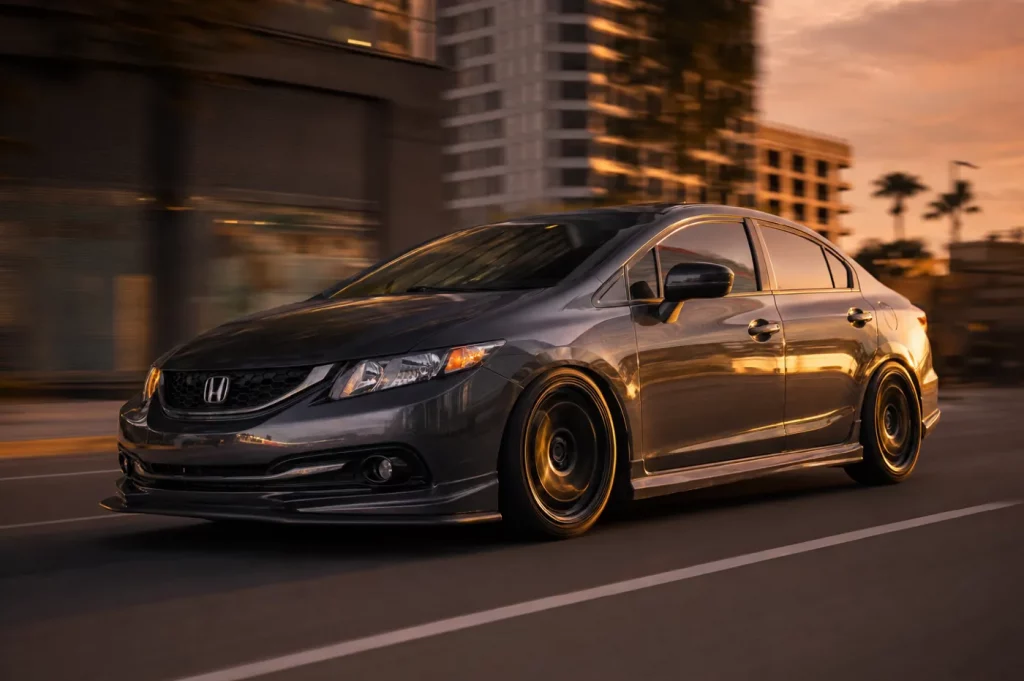
This article documents dyno-verified output at every stage of modification, from a factory-stock K24Z7 through bolt-ons, Hondata FlashPro tuning, Camshaft upgrades, and extreme naturally aspirated builds.
K24Z7 Dyno Results at a Glance
There is no single “stock WHP” number for the K24Z7. Different dynos, weather, correction factors, and transmission types produce different results. The table below shows observed results from published dyno tests and community data.
| Setup | Typical WHP Range | Typical WTQ Range | Fuel |
|---|---|---|---|
| Stock | 170–178 | 150–157 | 91–93 |
| Bolt-ons (no tune) | ~182–188 | ~164–170 | 91–93 |
| FBO + FlashPro tune | 200–215 | 165–175 | 93 |
| FBO + Skunk2 Stage 1 cams | 225–235 | 175–180 | 93 |
| FBO + Skunk2 Stage 2 cams | 230–250 | 180–185 | 93 |
| K20Z3 head swap + cams + header | 266–271 | ~202 | 93 |
These are observed ranges from published dyno results, not guaranteed results for every car. The most meaningful comparison is the delta on the same dyno.
Stock Output: What the K24Z7 Delivers to the Wheels
The factory-rated 201 hp at the crank translates to approximately 170–177 whp on a typical Dynojet chassis dynamometer, depending on the specific dyno, correction factors, ambient temperature, and how aggressively the ECU has adapted its fuel trims. Early-production 2012 models with low mileage have been documented as low as 171 whp on a Dynapack (Bisimoto testing, 11 miles on odometer) and as high as 177.8 whp on a Dynojet (owner baseline, CivicX). Older compilation data from the 9th Gen Civic Forum shows stock baseline figures ranging from 140 whp to 177 whp depending on the dynomometer brand and shop, with Dynojets typically returning 170–177 whp and Mustang or Dynapack dynos reading lower. (Sources: CivicX forum, 2012 Si baseline thread, 2013; 9thCivic.com, TOV dyno test, 2011; 9thGenCivic.com, official dyno results thread)
The torque output is where the K24Z7 separates itself from the K20Z3. Peak torque of approximately 150–157 wtq arrives by 4,400 rpm and holds flat through the midrange, whereas the 8th-gen Si makes approximately 130–135 wtq at the wheels and requires sustained high rpm to accelerate. The K24Z7’s 2.4-liter displacement produces a fat torque curve that peaks at roughly 150–157 wtq on the Dynojet and trails off gradually through 6,800 rpm. The stock redline is 7,000 rpm, and the engine pulls noticeably harder from 2,500–6,000 rpm than any previous naturally aspirated Civic Si engine. (Source: 9thCivic.com, TOV dyno test, 2011)
| Configuration | WHP | WTQ | Dyno Type | Source |
|---|---|---|---|---|
| Stock (2012, 11 miles) | 171 whp | 157 wtq | Dynapack | Bisimoto Engineering |
| Stock (2012, broken in) | 177.8 whp | 150.8 wtq | Dynojet | CivicX forum owner |
| Stock (TOV test car) | ~175 whp | ~155 wtq | Dynojet | Temple of VTEC |
| Stock (various dynos) | 140–177 whp | ~130–160 wtq | Multiple | 9thGenCivic compilation |
Important architecture note: The K24Z7 uses an integrated exhaust manifold cast into the cylinder head. There is no bolt-on header in the traditional K-Series sense; the exhaust manifold is part of the head casting, and the first replaceable exhaust component is the downpipe, which bolts to the head casting downstream of the integrated manifold section. This design saves weight and manufacturing cost but limits the engine’s ability to breathe at high rpm compared to a traditional header-equipped K-series. The K24Z7 also lacks VTEC on the exhaust camshaft, which further restricts high-rpm power potential compared to the K20Z3, which had VTEC on both cams.
Hondata FlashPro: Tune on a Completely Stock Car
The Hondata FlashPro is the primary engine management solution for the K24Z7, providing access to adjust fuel maps, ignition timing, VTEC engagement, VTC (variable valve timing), cam phasing, rev limit, and speed limiter. Unlike the KTuner used on the 10th-gen Civics, the K24Z7 ecosystem is exclusively Hondata.
The Hondata ReFlash (a flash of the stock ECU without the full FlashPro unit, approximately $495) was the first option available for the 2012 Si, and early results were disappointing. One owner documented a Dynojet baseline of 177.8 whp and 150.8 wtq, followed by the ReFlash producing 179.8 whp and 150.8 wtq — a net gain of 2 whp and 0 wtq. Hondata subsequently updated the calibration, claiming 5–15 wtq gains across the midrange and 20 peak hp on cars with bolt-on modifications, but the early ReFlash left many owners underwhelmed. (Source: CivicX forum, “My 12′ Si Baseline AND Hondata ReFlash Dyno Results,” Mar 2012)
The full FlashPro system ($695–795) with a custom dyno tune delivers more substantial results on an otherwise stock car. Owners report a tuned stock Si making approximately 185–190 whp on 93 octane, with peak torque rising to approximately 155–160 wtq. The primary benefit is not peak power but powerband improvement: the tuner advances ignition timing in the midrange, optimizes cam timing through VTC, and removes the factory rev limiter at 7,000 rpm to extend to 7,400–7,600 rpm. The car pulls harder from 3,500 rpm onward and does not sign off as early near redline. VTEC engagement is typically lowered from the factory engagement point to approximately 4,800–5,200 rpm, making the cam profile change more noticeable and extending the high-lift powerband.
Bolt-Ons Without Tuning: A Trap
The downpipe (the first replaceable exhaust component after the integrated manifold section of the head) does add power without tuning, approximately 10–12 whp, because it removes one of the two catalytic converters and reduces backpressure downstream of the head. This is the one bolt-on that works without recalibration, though a downstream O2 sensor defouler or CEL delete is typically required. (Source: 9thGenCivic.com, numerous downpipe review threads)
Full Bolt-Ons + Tune (Intake, Downpipe, Exhaust, FlashPro)
The standard bolt-on recipe for the K24Z7 consists of a cold air intake (PRL, Injen, AEM), an aftermarket downpipe (RV6 2.5-inch or 3-inch catless/catted, Skunk2 3-inch catless), and a cat-back exhaust (Invidia Q300 or N1, Skunk2, GReddy). The combination requires a FlashPro tune to unlock the gains, and without the tune the car runs lean, misfires, and produces less power than stock.
A broader survey of owner-reported results shows that a fully bolted and tuned 9th-gen Si typically lands AT 195–210 whp on a Dynojet. Trap speeds at the drag strip (99–101 mph) confirm approximately 200–210 whp. On a Mustang or Dynapack dyno that reads lower, the same cars show 185–195 whp. The best documented non-cam, non-head-swap FBO cars reach approximately 210–215 whp on a Dynojet with 93 octane and an aggressive custom tune. The limiting factor is the integrated exhaust manifold in the R40 cylinder head: the cast-in manifold runners are restrictive and cannot be replaced without swapping the entire cylinder head. (Sources: 9thGenCivic.com, power package dyno results, 2015; CivicX forum, official dyno thread)
| Configuration | WHP | WTQ | Gain over Stock | Source |
|---|---|---|---|---|
| Hondata ReFlash only | ~180 whp | ~151 wtq | +2 whp / +0 wtq | CivicX owner (2012) |
| SRI + DP + exhaust + FlashPro tune | 193 whp | 173 wtq | +18 whp / +23 wtq | CivicX owner (2014) |
| CAI + DP + exhaust + FlashPro tune | ~200–210 whp | ~165–175 wtq | +25 to +35 whp | Community consensus |
| FBO + aggressive custom tune (93 oct) | 210–215 whp | ~175 wtq | +35 to +40 whp | Best documented FBO |
The RBC Intake Manifold Swap
The factory plastic intake manifold on the K24Z7 is designed for midrange torque and fuel economy, with long, narrow runners that favor low-end response over high-rpm flow. Swapping to an RBC intake manifold (from the 8th-gen Civic Si or Acura TSX) is a common modification for owners seeking more top-end power.
The RBC manifold has larger plenum volume and shorter, wider runners that flow significantly more air above 5,500 rpm. The swap requires a PRL adapter plate (because the K24Z7’s cylinder head intake ports are angled differently than the K20-based manifold was designed for), Coolant line bypass if the manifold is not modified for the factory coolant routing, and a longer throttle cable or adapter.
Community dyno results show the RBC manifold adds approximately 5–10 whp on a tuned FBO K24Z7, with the gains concentrated above 5,500 rpm. The manifold does not add much peak power on its own but extends the powerband by allowing the engine to breathe more effectively at high rpm. For cam-equipped builds, the RBC manifold is considered mandatory because the stock manifold becomes a significant restriction above 6,000 rpm. (Source: 9thGenCivic.com, RBC manifold review threads)
Cams: Drop-In and Full Builds
Aftermarket camshafts are the next step beyond FBO for the K24Z7, but the options are limited compared to the K20Z3. The R40 cylinder head has a unique valvetrain layout, and most K-series camshafts designed for K20A/Z3/Z1 or K24A2 heads are not compatible without modification.
Skunk2 Ultra Stage 1 (drop-in, stock valve springs): These cams are designed as a true drop-in replacement that works with factory valve springs. Skunk2 claims 20–30 HP gains on naturally aspirated engines, with peak power shifted approximately 1,000 rpm higher. Intake lift is 0.485 inches with 243 degrees duration; exhaust lift is 0.445 inches with 232 degrees duration. They require 91+ octane fuel and a FlashPro tune. These are the most common cam upgrade for owners who want a noticeable power gain without opening up the valvetrain. (Source: Skunk2 Racing, Ultra Series Stage 1 product page)
Skunk2 Ultra Stage 2 (requires upgraded valve springs): More aggressive profiles with 13.08 mm intake lift (0.515 inches) and 251 degrees duration on the VTEC lobe. Skunk2 claims 25–50 hp gains on naturally aspirated engines and up to 75+ hp on forced induction. Peak power shifts approximately 1,500 rpm higher. These require aftermarket valve springs and retainers (Skunk2 Alpha or Supertech). (Source: Skunk2 Racing, Ultra Series Stage 2 product page)
4Piston R40 drop-in cams: In 2022, 4Piston Racing announced pre-orders for R40-specific drop-in camshafts in two stages. Stage 1 uses stock components; Stage 3 (Stage 2 in their naming) requires upgraded valve springs. A 9th-gen owner building a full NA K24Z7 with 4Piston Stage 3 cams, RBC intake manifold, RV6 downpipe, full valvetrain, and ported components expected 240+ whp on 93 octane and 250+ on ethanol, with 4Piston claiming the built engine with the R40 head could reach 290 whp on 93 octane with 13:1 compression pistons and rods. (Source: CivicX forum, K24Z7 NA build thread, 2026)
K24Z7/K20Z3 head swap: The highest-output documented naturally aspirated 9th-gen Si builds abandon the R40 head entirely in favor of a K20Z3 cylinder head from an 8th-gen Si. The Z3 head flows substantially better, offers a traditional bolt-on exhaust manifold (header) rather than the K24Z7’s integrated casting, and provides dual VTEC (exhaust and intake cam control). A JD Performance build in Puerto Rico using a K24Z7 block with a K20Z3 head, Hytech header, SVM cams, and ported intake manifold produced 266 whp and 202 wtq on 93 octane, later revised to 271 whp on the same fuel. This is the ceiling for naturally aspirated K24Z7-based builds without forced induction. (Source: CivicX forum, K24Z7/K20 head swap build, 2015)
| Cam/Head Setup | WHP | WTQ | Required Upgrades |
|---|---|---|---|
| FBO + FlashPro (no cams) | 200–215 whp | 165–175 wtq | FlashPro, CAI, DP, exhaust |
| + Skunk2 Stage 1 cams | ~225–235 whp | ~175–180 wtq | Stock valve springs OK |
| + Skunk2 Stage 2 cams | ~230–250 whp | ~180–185 wtq | Valve springs + retainers |
| + 4Piston Stage 3 cams (93 oct) | ~240–250 whp | ~180–190 wtq | Valvetrain, RBC IM, tuning |
| 4Piston built R40 (13:1 pistons) | ~290 whp (claimed) | N/A | Full build, rods, pistons, cams |
| K20Z3 head swap + cams + header | 266–271 whp | 202 wtq | Full head swap, custom header |
Cam-only and built-engine estimates are based on manufacturer claims and owner build threads. Results vary significantly based on tuning, supporting modifications, and dyno variation.
The K24Z7 Bottleneck: The R40 Cylinder Head
The K24Z7’s cylinder head, designated R40, is the most significant limitation for naturally aspirated power production. The integrated exhaust manifold restricts flow substantially more than a traditional tubular exhaust manifold. Port matching and smoothing the integrated runners has been documented by owners but requires the cylinder head to be removed and the casting modifications to be performed by an experienced machinist. The lack of exhaust VTEC means the exhaust camshaft cannot vary its lift profile, which limits the engine’s ability to scavenge effectively at high rpm.
The intake manifold is also a restriction. The factory plastic intake manifold is designed for midrange torque and fuel economy rather than peak power. Swapping to a ported RBC manifold (from the 8th-gen Civic Si or Acura TSX) is a common modification in cam-equipped builds. The RBC manifold flows more volume above 5,500 rpm and shifts the powerband upward.
For reference, an 8th-gen Civic Si (K20Z3) with full bolt-ons and a tune typically produces 200–210 whp, similar to what the K24Z7 achieves, despite having 500 cc less displacement. The difference is that the K20Z3 achieves this output with a higher redline (8,000+ rpm) and a more peaky powerband, whereas the K24Z7 delivers its power earlier and with more torque everywhere. The K24Z7 does not make more peak power than the K20Z3 despite its displacement advantage because its cylinder head and exhaust camshaft restrict flow at high rpm.
Cost per WHP: Where the Value Is
FlashPro + custom dyno tune ($700–1,000): Approximately 10–15 whp gain on an otherwise stock car, plus drivability improvements, raised rev limiter, and the ability to calibrate for future modifications. Cost per whp: approximately $65–90. The value is not in the peak power gain but in enabling every future modification.
FBO + tune ($2,200–3,000): FlashPro ($695–795), cold air intake ($300–400), downpipe ($350–550), cat-back exhaust ($500–800), custom tune ($300–500). Total gain of approximately 30–40 whp over stock. Cost per whp: approximately $60–85.
Skunk2 Stage 1 cams + FBO + tune ($3,400–3,900): Adds approximately $800–1,200 for the camshafts plus labor for installation ($400–700). Total gain of approximately 50–60 whp over stock. Cost per whp: approximately $60–70.
K20Z3 head swap + cams + header ($5,000–7,500+): Requires a used K20Z3 head, aftermarket header, cams, valvetrain, custom tuning, and substantial labor. Total gain of approximately 90–95 whp over stock (266 whp versus 175 whp). Cost per whp: approximately $55–80, but the result is a fundamentally different engine that revs higher and produces power differently than the stock K24Z7.
Powerband Comparison: K24Z7 vs K20Z3 vs K24Z7 Built
The stock K24Z7’s torque curve is its defining characteristic. Peak torque of approximately 150–157 wtq arrives by 4,200 rpm, and the engine maintains 140+ wtq from 3,500 rpm to approximately 6,000 rpm. Horsepower peaks around 6,500–6,800 rpm and then declines toward the 7,000 rpm redline. The engine feels strong and responsive in daily driving without needing to be revved hard.
A fully bolted and tuned K24Z7 raises peak torque to approximately 170–175 wtq, with the torque curve holding stronger through the midrange. The FlashPro tune extends the useful rpm range to 7,400–7,600 rpm, adding approximately 200–400 rpm of usable power at the top end. The car accelerates harder from 3,500 rpm to redline, but the fundamental character does not change: it is still a torquey midrange engine that signs off earlier than a K20.
A cam-equipped K24Z7 with a ported RBC manifold shifts the torque peak upward. The engine loses some low-end torque below 4,000 rpm but gains substantial power from 5,500 rpm to the new 7,600–8,000 rpm redline. Peak power moves higher in the rev range, and the VTEC crossover becomes a more noticeable event. The trade-off is that the car requires more revving to move quickly and loses some of the effortless midrange torque that defines the stock K24Z7 experience.
The head-swapped K24Z7/Z3 hybrid at 266+ whp represents the ceiling of naturally aspirated K24Z7-based power. The torque curve shifts upward substantially, peak torque arrives higher in the rev range (approximately 5,500–6,000 rpm), and the engine pulls hard to 8,000+ rpm. It is a different engine character entirely: it sounds and revs like a K20 but with the displacement of a K24.
Why the Power Curve Matters More Than Peak WHP
A common mistake when evaluating K24Z7 modifications is focusing exclusively on peak horsepower. The 9th-gen Si’s engine character is defined by its torque curve, and modifications that improve the powerband often produce more meaningful gains than those that simply raise the peak number.
The documented 193 WHP / 173 WTQ bolt-on car gained only 18 WHP at peak, but the powerband was transformed. The tune resolved a misfire and hesitation issue at low rpm, adding 53 WTQ at 1,700 rpm. That gain at 1,700 rpm is far more noticeable in daily driving than the 18 WHP peak gain.
When evaluating camshaft upgrades, the peak gain may be modest (10–15 WHP), but the engine may hold 10–15 additional WHP across a 1,000–1,500 rpm range. That sustained gain is what makes the car faster, not the peak number.
Quick Reference — K24Z7 Dyno Results
☐ Stock K24Z7 WHP on Dynojet: 170–178 (varies by dyno, weather, fuel)
☐ Hondata ReFlash only: ~180 WHP — early versions added almost nothing
☐ FBO + FlashPro tune (93 oct): 200–215 WHP / 165–175 WTQ
☐ FBO + RBC intake manifold: +5–10 WHP above 5,500 rpm
☐ Skunk2 Stage 1 cams + FBO + tune: ~225–235 WHP / ~175–180 WTQ
☐ Skunk2 Stage 2 cams + FBO + tune: ~230–250 WHP / ~180–185 WTQ
☐ 4Piston R40 cams + full build: ~240–250 WHP (93 oct) / ~250+ WHP (ethanol)
☐ K20Z3 head swap + cams + header: 266–271 WHP / ~202 WTQ — ceiling of NA K24Z7
☐ Bolt-ons without a tune produce almost no gain — the ECU compensates
☐ The K24Z7’s integrated exhaust manifold is the primary power bottleneck
☐ The R40 cylinder head lacks exhaust VTEC, limiting high-rpm flow
☐ RBC intake manifold swap is mandatory for cam-equipped builds
☐ A well-tuned FBO K24Z7 makes peak power at ~6,500–6,800 rpm
☐ FlashPro extends the rev limiter to 7,400–7,600 rpm
☐ Skunk2 Stage 1 cams are drop-in — no Valve Spring upgrade required
☐ Skunk2 Stage 2 cams require upgraded valve springs and retainers
☐ 4Piston Racing offers R40-specific drop-in cams (Stage 1 and Stage 3)
☐ K20Z3 head swap is the most expensive but highest-output NA K24Z7 build
☐ The K24Z7 makes more torque everywhere than the K20Z3 but less peak power
☐ Dyno numbers are not directly comparable across different dynos and conditions
FAQ — K24Z7 Dyno Results
How much WHP does a stock K24Z7 make?
A stock K24Z7 typically produces 170–178 WHP on a Dynojet, depending on the specific dyno, weather, and fuel. The factory crank rating is 201 hp. Drivetrain loss through the 6-speed manual is approximately 10–15 percent.
How much WHP does an FBO K24Z7 make?
An FBO K24Z7 (intake, downpipe, exhaust, RBC manifold) with a FlashPro tune on 93 octane typically produces 200–215 WHP and 165–175 WTQ. The gain over stock is 30–40 WHP.
What is the bottleneck on the K24Z7?
The R40 cylinder head with its integrated exhaust manifold is the primary bottleneck. The cast-in manifold restricts exhaust flow, and the lack of exhaust VTEC limits high-rpm power. Swapping to a K20Z3 head is the most effective way to overcome this limitation.
Do aftermarket cams add power to a K24Z7?
Yes — Skunk2 Stage 1 cams add 10–20 WHP with stock valve springs. Skunk2 Stage 2 cams add 15–30 WHP but require upgraded valve springs and retainers. 4Piston R40 cams are also available for the K24Z7.
Does the RBC intake manifold add power?
The RBC manifold adds 5–10 WHP on a tuned FBO K24Z7, with the gains concentrated above 5,500 rpm. For cam-equipped builds, the RBC manifold is considered mandatory because the stock manifold becomes a restriction above 6,000 rpm.
Can a K24Z7 make 250 WHP naturally aspirated?
Yes — with Skunk2 Stage 2 cams, RBC intake manifold, full bolt-ons, and a custom tune on 93 octane, a K24Z7 can reach 230–250 WHP. With 4Piston R40 cams and a built bottom end, 250+ WHP is achievable. The ceiling is approximately 271 WHP with a K20Z3 head swap.
Is a tune worth it on a stock K24Z7?
A FlashPro tune on a stock K24Z7 adds approximately 10–15 WHP and significantly improves throttle response, VTEC engagement, and drivability. The real value is enabling future modifications and raising the rev limiter to 7,400–7,600 rpm.
Does the K24Z7 have VTEC?
Yes — but only on the intake camshaft. The K24Z7 does not have exhaust VTEC, which is one of the reasons it does not rev as high or make as much top-end power as the K20Z3.
What is the best tune for a K24Z7?
The Hondata FlashPro is the standard engine management solution for the K24Z7. A custom dyno tune or e-tune from a reputable tuner is the best option. Off-the-shelf calibrations (like the early Hondata ReFlash) are a starting point but do not maximize power for a specific car.
Why do different dynos show different WHP?
Dynojet, Mustang, Dynapack, and Dyno Dynamics dynos use different measurement methods and calibration. Weather, altitude, correction factors, and the specific dyno unit all affect the number. Direct comparisons between different dynos are not reliable — compare gains on the same dyno instead.