

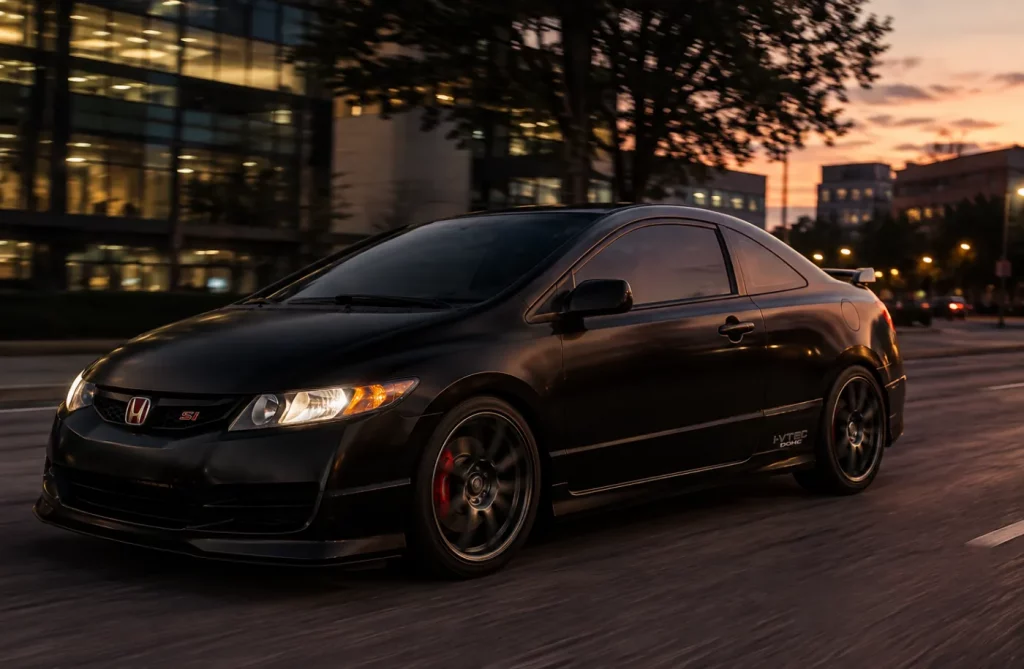
The 8th generation Civic Si, sold from 2006 to 2011 in coupe (FG2) and sedan (FA5) form, is the car that cemented the K-Series reputation in the US market. The K20Z3 produced 197 hp at 7,800 rpm and 139 lb-ft at 6,100 rpm — numbers that look modest today but came from a naturally aspirated 2.0-liter that revved to 8,000 rpm, with i-VTEC switching to a high-lift cam profile at 5,800 rpm. Fifteen years after the first examples hit the road, these cars are now passing through their second or third owners, often with 150,000 to 200,000 miles. The data from long-term owners tells a consistent story: the K20Z3 engine is one of the most reliable four-cylinders Honda ever built, but the chassis and transmission have known weak points that determine whether a car is worth buying today. Sources: RPM Army 170,000-mile owner report (August 2017), AmpAuto K20 reliability guide, 8thCivic forum data, Honda TSB 08-020.
The Engine — K20Z3 Long-Term Report
The K20Z3 is the primary reason the 8th gen Si is still sought after. The engine uses a timing chain (no replacement interval), i-VTEC on both intake and exhaust cams, and a cast-iron block with aluminum head. It is an Interference Engine, which means timing chain failure is catastrophic, but the chain itself is robust and rarely fails. The only chain-related concern is the tensioner, which can develop a rattling noise on cold start on high-mileage cars. A tensioner replacement runs $300–$600 at a shop. Source: AmpAuto.
The 170,000-mile owner report from RPM Army documented zero engine problems. No sensors failed, the engine never consumed abnormal oil, and the original clutch was still functioning AT 170,000 miles. The owner described the car as “very reliable” and noted it never left him stranded. A separate forum thread from a 2007 Si sedan owner who crossed 300,000 miles reported oil consumption increasing at that mileage — consistent with normal ring and valve seal wear rather than a design defect. Source: RPM Army, 8thCivic forum.
Valve adjustments. The K20Z3 uses solid mechanical lifters, not hydraulic. Honda specifies inspection and adjustment every 110,000 miles. The reality is that many 8th gen Sis have never had a valve adjustment in their entire life, especially second- and third-owner cars. At 110,000 miles without adjustment, the valves tighten up, causing ticking noise, reduced power, and eventually burnt exhaust valves. The consensus among experienced owners is to perform the adjustment every 60,000–80,000 miles if the car is driven hard. Cost at a shop: $200–$400. DIY is straightforward with a Feeler Gauge and basic tools. A skipped valve adjustment is the most common reason a K20Z3 develops problems. Source: AmpAuto, 8thCivic forum.
VTEC solenoid gasket leak. A small oil weep from the VTEC spool valve Gasket on the front of the head is common on all K20 variants. The symptom is a small drip on the front of the engine and an oily exhaust manifold area. The fix is a $10 gasket and 30 minutes of labor. This is not a serious problem but an easy one to miss during a pre-purchase inspection. Source: AmpAuto.
Motor mounts. The factory mounts are fluid-filled and wear out by 100,000–150,000 miles, especially on cars that have seen track time or aggressive driving. Symptoms are excessive engine movement, vibration at idle, and a clunking noise during hard acceleration or shifting. Replacement cost per mount: $200–$600. Polyurethane aftermarket mounts (Hasport, Innovative) are popular but transmit more NVH into the cabin. Source: AmpAuto, 8thCivic forum.
Oil consumption. The K20Z3 is not known for excessive oil consumption when properly maintained. However, on high-mileage cars (200,000+ miles) that have never had valve adjustments or have been run on long intervals between oil changes, consumption can reach a quart every 1,000–2,000 miles. This is ring and seal wear, not a design issue. The 300,000-mile 2007 Si owner reported that consumption had increased noticeably at that mileage. Source: 8thCivic forum.
The Transmission — The 3rd Gear Problem
The 6-speed manual in the 8th gen Si (part number C602) has a well-documented weakness: the 3rd gear synchronizer. Honda issued TSB 08-020 in April 2008 to address grinding when shifting into 3rd gear, the transmission popping out of 3rd gear, or difficulty engaging 3rd gear. The TSB applied to 2006–2008 model year vehicles. The RPM Army owner had his transmission completely disassembled and rebuilt under warranty within the first 20,000 miles for this exact issue — and reported that it shifted “like butter” ever since, with no further problems up to 170,000 miles. Source: Honda TSB 08-020, RPM Army.
The 3rd gear synchro issue is most common on 2006–2008 cars. Later models (2009–2011) appear to have improved synchros from the factory, though individual failures still occur. On the used market, this is the single most important test: the 1-2-3 upshift and the 3-2 downshift should be smooth with no grind. A transmission rebuild for the 3rd gear synchro runs approximately $1,500–$2,500 at a specialist shop, or $3,000–$4,000 at a dealer. A 2006 Si owner reported at 160,000 miles that he had just replaced the entire transmission and clutch, which indicates that high-mileage cars may eventually need a full transmission overhaul regardless. Source: 8thCivic forum.
Clutch life. The factory clutch typically lasts 80,000–120,000 miles under normal driving. Tracked or aggressively driven cars see shorter life. The throwout bearing whine is the early warning sign. A replacement clutch kit runs $400–$600 in parts, with labor adding $400–$900 depending on the shop. Source: AmpAuto, 8thCivic forum.
Chassis and Body
Paint and clear coat. The 8th gen Si has notoriously thin paint. Clear Coat Failure on the roof, hood, and rear bumper is the most common cosmetic complaint across all model years. The fading typically starts at the roof edges and spreads. Honda issued a paint warranty extension for some affected vehicles, but coverage has long expired. A full respray of the affected panels runs $800–$2,000 depending on quality and color. The RPM Army 170,000-mile car had clear coat flaking on the rear bumper and rust beginning on the rear quarter panels. Source: 8thCivic forum, RPM Army.
Dashboard cracks. The dashboard material is prone to cracking on cars that have spent significant time in hot climates. This is purely cosmetic — no functional issue — but replacement dashes are hard to find and expensive. A sunshade is essential for preservation. Source: 8thCivic forum.
Rear tire wear. The factory rear camber settings are aggressive for handling and cause accelerated inner tire wear on the rear axle. The rear control arms are non-adjustable from the factory. The RPM Army owner installed aftermarket adjustable rear control arms to fix this. Aftermarket camber arms run $150–$300 and eliminate the problem entirely. Non-Si 8th gen Civics share the same rear suspension design and have the same tire wear pattern. Source: RPM Army.
Rear wheel bearings. There was a TSB/recall for rear Wheel Bearing seals that allowed water and debris ingress, leading to premature bearing noise. The RPM Army owner needed one rear bearing replacement. A replacement bearing at a shop runs $200–$400 per side. Source: RPM Army.
Rust. The rear quarter panels, particularly the aft end near the bumper, and the rear wheel wells are the most common rust points. This affects cars in northern/snow-belt states more severely. The RPM Army 170,000-mile car had rust forming on the rear wheel wells by 2017. Source: RPM Army.
Maintenance and Cost Summary
| Component | Typical Interval | Cost Range | Notes |
|---|---|---|---|
| Valve adjustment | 60K–80K mi (110K per Honda) | $200–$400 | Most skipped maintenance item. Burnt valves if ignored past 110K |
| Clutch replacement | 80K–120K mi | $800–$1,500 | Throwout bearing whine is early warning. Original clutch lasted 170K in one report |
| 3rd gear synchro repair | TSB 08-020 covers 2006–2008 | $1,500–$4,000 | Most critical pre-purchase test. Smooth 1-2-3 shift required |
| Motor mounts | 100K–150K mi | $200–$600 per mount | Polyurethane upgrades add NVH |
| VTEC solenoid gasket | As needed (small weep) | $10–$50 | Common leak spot, cheap fix |
| Cam chain tensioner | High mileage only | $300–$600 | Cold-start rattle is symptom. Interference engine — do not ignore |
| AC compressor clutch | 120K+ mi | $400–$800 | No cold air with normal refrigerant pressure = clutch failure |
| Rear wheel bearings | 100K+ mi | $200–$400 per side | TSB for seal failure. Listen for humming from rear |
| Rear camber arms | One-time upgrade | $150–$300 | Aftermarket fix for aggressive factory camber. Prevents inner tire wear |
Model Year Differences
The 8th gen Si ran from 2006 to 2011 with no powertrain changes. The K20Z3 output remained at 197 HP throughout. The differences are in features and which version of the known problems you get:
2006–2007. Highest risk for 3rd gear synchro issues. First two model years also had more paint and clear coat complaints. The 2006 model has the highest NHTSA complaint count of the generation. Some early 2006 cars had VTC actuator rattle. These are the cheapest on the used market but require the most scrutiny.
2008. The year TSB 08-020 was published, which means Honda was addressing the 3rd gear issue during production. Cars built after the TSB date (April 2008) may have improved synchros from the factory. Paint and dashboard crack risk remains.
2009–2011. These are the most refined 8th gen Sis. The synchro issue is less common. The 2009 model received a subtle front grille and bumper revision. The 2010–2011 models are the rarest and most expensive, particularly the FA5 sedan. Paint quality improved slightly but is still thin compared to competitors. Dashboard material remained the same.
The Used Market Verdict
The 8th gen Si at 15+ years old occupies a specific position. The K20Z3 engine is genuinely bulletproof with basic maintenance — no timing belt, no Oil dilution, no direct-injection carbon buildup, no turbocharger failure risk. A properly maintained example will reach 200,000 miles on the original clutch and engine without major repairs. The RPM Army car at 170,000 miles and the 300,000-mile car reported by a forum owner both support this.
The risks are concentrated in three areas: the transmission (3rd gear synchro), the body (paint, clear coat, rust on northern cars), and skipped maintenance (valve adjustment, motor mounts, fluid changes). A car with a smooth 1-2-3 shift, good paint, and proof of valve adjustments within the last 60,000 miles is a strong buy at almost any price under $10,000. A car with a grind into 3rd gear, peeling clear coat, and no maintenance records is a parts car unless you are prepared for $3,000–$5,000 in immediate repairs.
| Category | Assessment | 15-Year Score |
|---|---|---|
| Engine reliability | K20Z3 is one of Honda’s best. Chain-driven, no known catastrophic failure pattern | A+ |
| Transmission | 3rd gear synchro is a known weak point. Otherwise good. Rebuild is expensive | B- |
| Paint / body | Thin clear coat, roof/hood failure common. Dash cracking. Rust on northern cars | C+ |
| Maintenance costs | Low if valve adjustments done. Valve adjustment is the critical and most skipped item | B+ |
| Daily driving | 8,000 rpm redline, firm ride, dated but functional interior. No modern safety tech | B |
| Enthusiast value | Last high-revving NA Si sold in the US. Prices rising for clean examples | A |
Quick Reference
☐ K20Z3: 197 hp at 7,800 rpm, 139 lb-ft at 6,100 rpm, 8,000 rpm redline. Timing Chain, no replacement interval
☐ Valve adjustment every 60,000–80,000 miles is the single most important maintenance item. Skipping it causes burnt exhaust valves
☐ 3rd gear synchro is the #1 transmission concern. Test 1-2-3 upshift and 3-2 downshift before buying. TSB 08-020 covers 2006–2008 models
☐ Original factory clutch lasted 170,000 miles in a documented owner report. Typical life is 80,000–120,000 miles
☐ VTEC solenoid gasket leak is common but cheap to fix ($10 gasket, 30 minutes)
☐ Motor mounts wear out by 100,000–150,000 miles. Clunking under acceleration is the symptom
☐ Paint and clear coat failure on roof and Hood is the most common cosmetic issue. Full respray: $800–$2,000
☐ Dashboard cracking is common on cars exposed to hot climates. Use a sunshade
☐ Rear tire wear from factory camber is fixable with aftermarket adjustable control arms ($150–$300)
☐ Rear wheel bearing failure has a known TSB. Listen for humming from the rear at highway speed
☐ 2009–2011 models are the most refined and least likely to have 3rd gear issues. 2010–2011 are the rarest
☐ 2006–2008 models: budget for potential transmission work ($1,500–$4,000) unless the synchro is confirmed good
☐ Rust-prone areas: rear quarter panels, rear wheel wells. Check northern/snow-belt cars carefully
☐ The K20Z3 has never left documented owners stranded. The engine itself is not the weak point on this car
☐ Clean, maintained examples are appreciating. Prices for sub-100K mile FA5 sedans have crossed the $12,000–$15,000 mark in 2025–2026