

The 9th-generation Civic Si (2012–2015) represents the end of an era — the last Civic Si ever sold with a naturally aspirated engine. Its K24Z7 2.4-liter i-VTEC four-cylinder makes 201 horsepower at 7,000 RPM and 170 lb-ft of torque at 4,400 RPM. It requires premium fuel and delivers its power in a linear, rising crescendo typical of Honda’s K-Series architecture. The 10th-generation Si (2017–2020) switched to an L15B7 1.5-liter turbocharged four-cylinder producing 205 horsepower at 5,700 RPM and 192 lb-ft of torque at 2,100 RPM — a 13% torque advantage that arrives at half the engine speed. Both cars are manual-only, both have limited-slip differentials, and both command a premium over their non-Si counterparts on the used market. But the cost to own each generation diverges significantly once insurance premiums and maintenance schedules enter the picture.
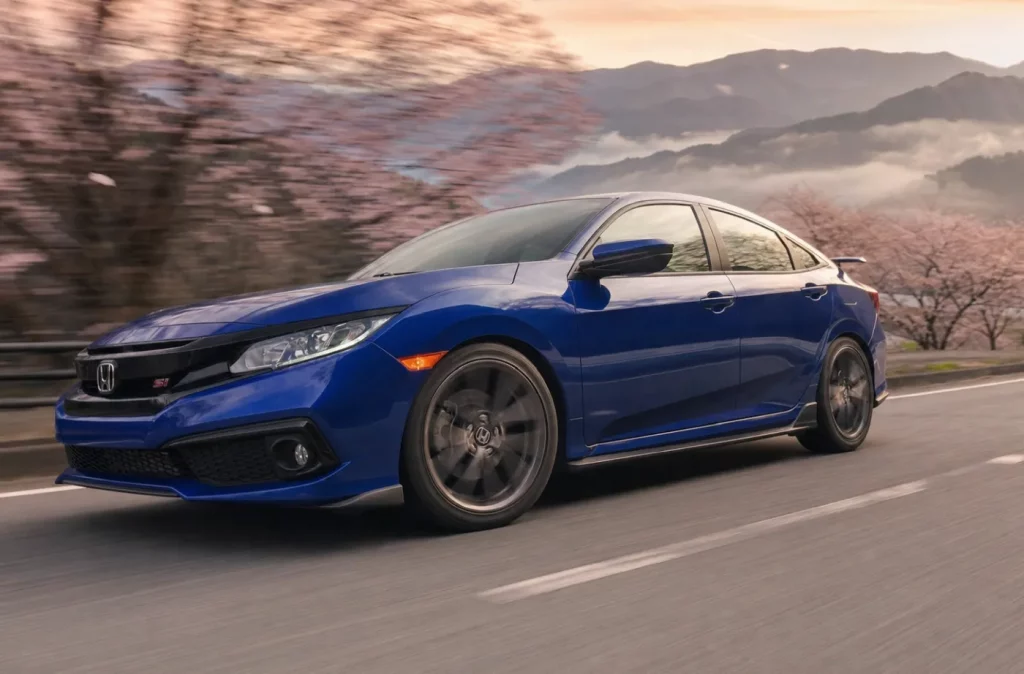
This comparison uses a 40-year-old married male driver with a clean record, full-coverage insurance with $500 deductibles, and 13,000 miles per year. Insurance data comes from Insuraviz and Insurance.com. Maintenance estimates use RepairPal, AmpAuto, Honda official TSBs, Honda Service Manuals, and owner-reported forum repair costs from CivicX and 9thgencivic.com as of mid-2026.
The Two Si Philosophies: NA vs Turbo
The 9th-generation Civic Si (2012–2015) represents the end of an era — the last Civic Si ever sold with a naturally aspirated engine. Its K24Z7 2.4-liter i-VTEC four-cylinder makes 201 horsepower at 7,000 RPM and 170 lb-ft of torque at 4,400 RPM. It requires premium fuel and delivers its power in a linear, rising crescendo typical of Honda’s K-series architecture. The 10th-generation Si (2017–2020) switched to an L15B7 1.5-liter turbocharged four-cylinder producing 205 horsepower at 5,700 RPM and 192 lb-ft of torque at 2,100 RPM — a 13% torque advantage that arrives at half the engine speed. Both cars are manual-only, both have limited-slip differentials, and both command a premium over their non-Si counterparts on the used market. But the cost to own each generation diverges significantly once insurance premiums and maintenance schedules enter the picture.
Insurance Costs: The 10th Gen Penalty
Insurance is the single largest cost gap between the two generations. The 10th-gen Si carries higher comprehensive and collision premiums because it is a newer, more expensive car to repair. Its turbocharged engine, more complex electronics, and higher replacement parts cost all factor into insurance risk models. The 9th-gen Si benefits from its age — it has depreciated to a valuation bracket where full-coverage insurance costs less even before considering that its naturally aspirated engine is cheaper to rebuild or replace.
| Generation | Model Year Range | Annual Insurance (40-yr, Clean Record) | Monthly Equivalent | 5-Year Total |
|---|---|---|---|---|
| 9th Gen Si | 2012–2015 | $1,384–$1,438 | $115–$120 | $6,920–$7,190 |
| 10th Gen Si | 2017–2020 | $2,203–$2,413 | $184–$201 | $11,015–$12,065 |
| Difference | — | +$819–$975 | +$68–$81 | +$4,095–$4,875 |
The 10th-gen Si costs roughly $820–$975 more per year to insure than a comparable 9th-gen Si — a 59–68% premium. Over a five-year ownership period, that gap totals $4,095–$4,875. This is the most predictable and unavoidable cost difference between the two cars. Insurance rates by provider vary significantly: for a 2019 Si, GEICO averages $1,781 and State Farm $1,917, while Allstate charges $2,545 and Farmers $3,591 (Insurance.com/Prachi Singh, 2025). For a 2013 Si, Insuraviz data shows GEICO AT approximately $1,400 across the Civic line, with Si-specific rates running $1,384–$1,438.
Rates climb more steeply for younger drivers: a 25-year-old with a clean record pays ~$3,123 on a Civic Si (CarEdge, 2026). At age 30 it drops to ~$2,433, and by 40 it settles at ~$2,192 for the Si as a model line. The 9th-gen car benefits here because its lower replacement value produces a lower base premium regardless of the driver’s age.
Routine Maintenance Costs
Both Si generations require premium fuel and share similar basic service intervals — oil changes every 7,500–10,000 miles, Brake Fluid every three years, coolant at 60,000–100,000 miles. The differences emerge from engine architecture: the 10th gen’s turbocharged direct-injection L15B7 adds services that the 9th gen’s port-injected K24Z7 does not need.
| Service Item | Interval (Miles) | 9th Gen Si (K24Z7) | 10th Gen Si (L15B7) |
|---|---|---|---|
| Oil change (premium synthetic) | 7,500–10,000 | $60–$120 | $60–$120 |
| Spark plugs | 100,000 (MM code 4) | $150–$250 | $180–$260 |
| Transmission fluid (manual) | 30,000–60,000 (MM code 3) | $100–$150 | $100–$150 |
| Brake pads (one axle) | 40,000–60,000 | $150–$300 | $180–$350 |
| Brake pads + rotors (one axle) | 40,000–60,000 | $350–$600 | $400–$700 |
| Valve adjustment | 60,000–80,000 (MM code 4) | $330–$600 | Not required |
| Walnut shell carbon cleaning | 60,000–80,000 | Not needed | $400–$900 |
| Coolant exchange | 60,000–100,000 (MM code 5) | $120–$200 | $120–$200 |
| Annual average (incl. routine) | — | $350–$500 | $400–$550 |
Annual routine maintenance averages $350–$500 for the 9th-gen Si and $400–$550 for the 10th-gen Si (FlipCars, 2026). The 9th gen’s K24Z7 needs a valve adjustment every 60,000–80,000 miles — a $330–$600 job that requires a cold engine and around 2–3 hours of labor (9thgencivic.com forum reports). The 10th gen does not require this service, as the L15B7 uses hydraulic lash adjusters.
But the 10th gen requires walnut shell blasting every 60,000–80,000 miles to remove carbon buildup from the intake valves — a direct-injection side effect that does not exist on the 9th gen’s port-injected K24Z7. A professional walnut blast runs $400–$900 depending on the shop and region (Tedious Auto Repair, Chico CA; AmpAuto estimates $500–$900). This is the 10th gen’s single most expensive recurring maintenance item that the 9th gen avoids entirely.
Known Problems and Unexpected Repairs
Each generation has its own failure patterns. The 9th gen’s K24Z7 is a mature, naturally aspirated engine with a well-documented track record, while the 10th gen’s L15B7 is a first-generation turbocharged direct-injection platform that went through several revisions over its production run.
9th Gen Si — K24Z7 Known Issues
Oil Consumption (2012 models, TSB 12-069): The most significant K24Z7-specific problem. Early 2012 production units could consume 1 quart per 1,000 miles, which Honda’s official position classified as “normal” (TSB 12-069). The affected engines required Piston ring replacement to resolve. This issue was largely corrected on 2013–2015 production, and the K24Z7 is otherwise considered one of Honda’s most reliable four-cylinders (AmpAuto, 2026).
Timing Chain Tensioner Rattle (TSB 13-072): A cold-start rattle resembling a loose alternator bearing, caused by the Timing Chain tensioner losing oil pressure overnight. Honda released a redesigned tensioner part. Repair cost: $600–$1,200 depending on whether the chain and guides are replaced simultaneously.
VTC Actuator Rattle: A separate cold-start rattle at the variable timing control actuator, common across K-series engines from 2003–2015. Repair cost: $400–$900 for the updated part and labor.
Valve Cover / Front Crank Seal Leaks: Minor oil seepage at high mileage (150K+). Repair cost: $200–$500 each. Routine aging, not a design defect.
10th Gen Si — L15B7 Known Issues
Oil Dilution (TSB 18-114, 19-032, Class Action Settlement): The defining problem of the 10th-gen turbo platform. Fuel condenses in the crankcase during cold starts and short trips, raising the oil level above the max mark and causing a fuel smell in the oil. Honda settled a class action in September 2020 (Judge Brasel, D. Minn.) covering 2016–2018 Civics in 21 cold-weather states, providing extended powertrain warranty coverage and a $250 claim cap for diagnostic oil changes. The 2019 refresh brought revised piston rings, a new thermostat, updated ECM mapping, and a redesigned heater valve. The Si’s L15B7 is affected but usually less severely than the base L15B7 because Si drivers tend to operate the engine at higher RPM, burning off accumulated fuel. Symptoms: dipstick reading above the max mark, misfire DTCs P0300–P0304, fuel system too rich DTC P0172. Honda extended camshaft and Rocker Arm coverage to 6 years/unlimited miles under the warranty extension program (NHTSA TSB MC-10158743-0001, April 2019).
Carbon Buildup on Intake Valves: The L15B7 is direct-injection only — no port injectors to wash fuel across the intake valves. Carbon deposits accumulate from PCV oil mist, causing rough idle, misfires, and power loss by 80,000–100,000 miles. Cleaning via walnut shell blasting: $400–$900. Some owners mitigate this with oil catch cans ($150–$400), which intercept PCV oil vapor before it reaches the intake valves (Tedious Auto Repair, 2026; AmpAuto, 2026).
Weak Clutch / Premature Wear: Documented premature clutch failure on 2017–2020 Si models, with owners reporting slip as early as 1,000–12,000 miles (CivicX forum). Replacement cost: $2,500–$3,000 at dealership rates. The factory clutch uses a lightweight pressure plate with a clutch delay valve in the slave cylinder that some owners blame for accelerated wear. Honda treats the clutch as a wear item and generally does not cover replacement under warranty unless a defect is proven.
Clutch Master Cylinder Failure: Causes 2nd/3rd gear grind on slow shifts and pressure bleed-off at the pedal. Repair cost: $341–$418 (RepairPal). Replacing the slave cylinder simultaneously is recommended for an additional $200–$300.
A/C Compressor Failure: Multiple 10th-gen Civic owners report premature A/C compressor failure, costing $600–$1,200 to replace. Affected model years span the 2016–2021 production run.
| Issue | 9th Gen Si (K24Z7) | 10th Gen Si (L15B7) |
|---|---|---|
| Oil consumption / dilution | TSB 12-069 (2012 only), ring replacement | Warranty extension + class action settlement |
| Carbon buildup (valves) | Not applicable (port injection) | $400–$900 walnut blast every 60–80K mi |
| Timing chain tensioner | $600–$1,200 (TSB 13-072) | Not a common issue |
| VTC actuator rattle | $400–$900 | Not a common issue |
| Clutch replacement | $1,200–$1,800 (typical wear at 100K+ mi) | $2,500–$3,000 (premature failures documented) |
| Clutch master cylinder | Not a common failure point | $341–$418 |
| A/C compressor | $600–$1,000 | $600–$1,200 |
| Valve adjustment | $330–$600 every 60–80K mi | Not required |
Fuel Economy and Daily Driving Cost
The 10th-gen Si’s turbocharged L15B7 sips less fuel than the 9th-gen’s K24Z7 — Honda’s marketing claimed 28% better combined-cycle fuel economy when the car launched. EPA ratings confirm the gap, though real-world figures depend heavily on driving style.
| Metric | 9th Gen Si (K24Z7) | 10th Gen Si (L15B7) |
|---|---|---|
| EPA City / Highway / Combined | 22 / 31 / 25 MPG | 28 / 38 / 32 MPG |
| Real-world combined (owner reports) | 24–27 MPG | 30–34 MPG |
| Fuel required | Premium (91+ octane) | Premium (91+ octane) |
| Annual fuel cost (13,000 mi, $4.50/gal premium) | ~$2,340 (at 25 MPG) | ~$1,828 (at 32 MPG) |
| 5-year fuel cost | ~$11,700 | ~$9,140 |
The 10th-gen Si saves approximately $512 per year in fuel costs based on EPA combined ratings — $2,560 over five years. This partially offsets the higher insurance cost, but the math still favors the 9th gen on total annual operating cost when insurance and fuel are combined (see summary section).
The K24Z7 returns approximately 24–27 MPG in mixed driving based on owner reports from 9thgencivic.com. The L15B7 in the Si typically returns 30–34 MPG in similar conditions (CivicX owner reports). Turbocharged engines deliver their best fuel economy under steady-state cruising — aggressive driving, which is more common in an Si, compresses this advantage.
Used Market Pricing and Depreciation
Both generations hold value well relative to non-Si Civics and the broader compact car market. The 9th-gen Si’s naturally aspirated K-series engine and limited production numbers have already begun pushing clean, low-mileage examples toward collector pricing, while the 10th-gen Si still trades in the mainstream used market with ample supply.
| Scenario | 9th Gen Si (2012–2015) | 10th Gen Si (2017–2020) |
|---|---|---|
| High-mileage / fair condition (~100K+ mi) | $8,000–$12,000 | $13,000–$16,000 |
| Average condition (~60–80K mi) | $12,000–$16,000 | $16,000–$20,000 |
| Clean / low-mileage (~30–50K mi) | $16,000–$20,000 | $20,000–$25,000 |
| Mint / collector-grade (<20K mi) | $20,000+ | $25,000+ |
| Typical trade-in value (KBB, June 2026) | ~$9,000–$13,000 | ~$12,800–$17,500 |
A 2017 Si sedan carries a KBB trade-in value of ~$12,818 and a resale value of ~$13,840 as of mid-2026 (KBB). CarBuzz reports 10th-gen Si examples trading between $13,988 and $18,619 in 2026. Ninth-gen Si examples range from $10,000–$20,000 depending on condition, with $10,000–$12,000 buying a 100,000-mile example in average condition (CarBuzz/Justin Pritchard, June 2026).
The 9th-gen Si has begun appreciating from its depreciation floor, consistent with the trajectory of earlier Civic Si generations (EM1, EP3, 8th gen). The 10th-gen Si is still on the downward slope of its depreciation curve — 2017 examples have lost ~27% of their original MSRP over three years (KBB depreciation data). A 2017 Si sedan originally MSRP’d around $24,000–$25,000 and now trades around $13,800–$16,800 depending on condition.
5-Year Total Cost Comparison
The table below projects the total cost of ownership for each generation over a five-year, 65,000-mile period, assuming a 40-year-old good driver, full-coverage insurance, routine maintenance by the book, one major repair event per vehicle, and premium fuel at $4.50/gallon.
| Cost Category | 9th Gen Si (2012–2015) | 10th Gen Si (2017–2020) | Difference |
|---|---|---|---|
| Insurance (5 yr) | $7,000 | $11,500 | +$4,500 |
| Fuel (5 yr, 65K mi, premium) | $11,700 | $9,140 | –$2,560 |
| Routine maintenance (5 yr) | $2,000 | $2,400 | +$400 |
| Major service / unexpected repair | $1,200 | $2,500 | +$1,300 |
| 5-year total operating cost | ~$21,900 | ~$25,540 | +$3,640 |
| Annual average | ~$4,380 | ~$5,108 | +$728 |
| Cost per mile | ~33.7¢ | ~39.3¢ | +5.6¢/mi |
The 9th-gen Si costs roughly $3,640 less to operate over five years — or about $728 per year. The 10th gen’s fuel-economy advantage ($2,560 over five years) partially offsets its higher insurance cost (+$4,500), but the gap is still significant. The major repair category assumes the 10th gen will require a walnut blast ($600), clutch Master Cylinder ($400), and potentially contribute toward a clutch replacement ($2,500–$3,000) within 65,000 miles — a realistic scenario based on documented failure patterns. The 9th gen’s major repair budget assumes a timing chain tensioner replacement ($1,200) or valve adjustment ($600) but no catastrophic engine failure on a well-maintained K24Z7.
Which Generation Cheaper to Own?
The 9th-gen Civic Si is cheaper to insure, cheaper to maintain, and does not require carbon cleaning. Its K24Z7 engine has a proven 200,000+ mile reliability record with no Turbocharger, no direct-injection carbon problems, and no oil-dilution class action. Its primary operating disadvantage is fuel economy — the 10th gen returns ~28% better MPG on the combined cycle.
The 10th-gen Civic Si costs more to own on paper but offers significantly more low-end torque, better fuel economy, a modern infotainment system, and a stiffer chassis. Its turbocharged character makes it faster in daily driving situations, and its depreciation curve means a 2019–2020 example with the post-refresh fixes (revised piston rings, updated ECU calibration) is the safest bet within the generation.
Buy the 9th gen Si if: you want the lowest insurance premiums, the most predictable maintenance schedule, no direct-injection carbon concerns, and the last naturally aspirated Civic Si — which may hold or appreciate in value over the next decade. Target a 2013–2015 model year to avoid the 2012 oil consumption TSB 12-069.
Buy the 10th gen Si if: you want a punchier turbocharged driving feel, better fuel economy, a more modern interior and technology package, and you are willing to pay $700–$1,000 more per year in insurance and maintenance. Target a 2019–2020 model year to benefit from the post-refresh L15B7 revisions and the extended oil-dilution warranty coverage.
Sources:
Quick Reference Checklist
☐ 9th gen Si insurance runs $1,384–$1,438/yr vs 10th gen at $2,203–$2,413/yr — a $819–$975 annual gap
☐ 10th gen saves ~$512/yr in fuel (32 vs 25 MPG combined) but not enough to offset higher insurance
☐ 9th gen needs valve adjustment every 60–80K mi ($330–$600) but no carbon cleaning
☐ 10th gen needs walnut shell blasting every 60–80K mi ($400–$900) due to direct injection
☐ 10th gen documented weak clutch failures — replacement runs $2,500–$3,000
☐ 10th gen Oil dilution covered by class action settlement; 2019+ refresh cars have factory fixes
☐ 9th gen K24Z7 has TSB 12-069 oil consumption on 2012 models only — 2013–2015 are clean
☐ 5-year operating cost: 9th gen ~$21,900 vs 10th gen ~$25,540 — 9th gen saves ~$3,640
☐ 9th gen used $10K–$20K; 10th gen used $14K–$25K depending on condition and mileage
☐ For cheapest ownership: buy a 2013–2015 9th gen Si. For best daily driver: buy a 2019–2020 10th gen Si
FAQ
Is the 9th Gen Civic Si cheaper to insure?
Yes — significantly. The 9th-gen Si costs roughly $819–$975 less per year to insure than a 10th-gen Si for a 40-year-old good driver. The gap is driven by the 10th-gen’s higher replacement value and repair costs.
Is the 10th Gen Civic Si expensive to maintain?
More expensive than the 9th gen, but not dramatically so. Routine maintenance is similar, but the 10th gen requires walnut shell blasting ($400–$900 every 60–80K miles) and has documented premature clutch failures ($2,500–$3,000).
Which Civic Si is cheaper to own?
The 9th-gen Si is cheaper to own over five years by roughly $3,640. Its lower insurance costs ($4,500 less over five years) more than offset the 10th gen’s fuel economy advantage ($2,560 saved over five years).
Is the K24Z7 more reliable than the 1.5T?
Generally yes. The K24Z7 is a mature naturally aspirated engine with no turbocharger, no direct-injection carbon issues, and no oil-dilution class action. The 1.5T has documented oil-dilution issues (2016–2018) and carbon buildup as a recurring maintenance item.
Does the 10th Gen Civic Si cost more to insure?
Yes — ~$820–$975 more per year. Insurance companies charge more because the 10th-gen Si is newer, more expensive to repair, and has more complex electronics and safety systems that are costly to recalibrate after accidents.
How much does Civic Si insurance cost?
For a 40-year-old good driver: 9th gen $1,384–$1,438/year; 10th gen $2,203–$2,413/year. For a 25-year-old: ~$3,123/year for the Si as a model line.
How much should I budget for Civic Si maintenance?
9th gen: $350–$500/year routine maintenance, plus $600–$1,200 for major age-related items (timing Chain tensioner, valve adjustment) as they come due. 10th gen: $400–$550/year routine, plus $400–$900 for walnut blasting every 60–80K miles and potential clutch replacement costs.
Is the 9th Gen Si cheaper than the 10th Gen Si?
Yes — both to buy (typically $4,000–$8,000 less) and to own ($728/year less in operating costs).
Which Civic Si gets better MPG?
The 10th-gen Si — EPA combined 32 MPG vs 25 MPG for the 9th gen. Real-world: 30–34 MPG vs 24–27 MPG. The 10th gen saves ~$512/year in fuel costs at 13,000 miles and $4.50/gal.
Is the 1.5T Civic Si reliable long term?
The 1.5T can be reliable with proper maintenance, but it has documented issues: oil dilution (2016–2018), carbon buildup, and premature clutch wear. The 2019–2020 revisions improved the platform. A well-maintained 10th gen can still be a reliable daily driver.
Does the 9th Gen Civic Si have expensive repairs?
Not typically. The K24Z7 is one of Honda’s most reliable engines. Major repairs are age-related — timing chain tensioner ($600–$1,200), VTC actuator ($400–$900), valve adjustments ($330–$600). These are predictable and manageable.
Is a 9th Gen Civic Si a better buy than a 10th Gen?
For budget-conscious buyers — yes. The 9th gen costs less to buy, less to insure, and less to maintain. The 10th gen offers better performance, better fuel economy, and a more modern interior, but you pay for it in insurance and maintenance costs.
Is a tuned 10th Gen Civic Si expensive to own?
Yes — significantly. Tuning increases boost, which stresses the clutch, engine, and drivetrain. Premature clutch failure is already documented on stock cars; tuned cars will almost certainly require an upgraded clutch ($1,500+ parts and labor).
Which Civic Si is better for a daily driver?
The 10th gen is the better daily driver — more torque, better fuel economy, more modern interior, and better ride quality. The 9th gen is the better enthusiast car — naturally aspirated character, simpler maintenance, and lower running costs.