

A 150,000-mile Civic is not the same as a 150,000-mile Focus or a 150,000-mile Cruze. The Civic’s longevity is well-documented — RepairPal reports an average annual repair cost of $368 for the Civic, significantly below the compact car segment average of $526. Consumer Reports gives the Civic a 4.5/5 reliability score, and J.D. Power rates it at 82/100. But these averages mask generational differences that become critical at 150,000+ miles. The 9th-generation R18 and the 10th-generation K20C2 are fundamentally different cars at this mileage than the 2016–2018 1.5T. This guide covers what actually breaks, what to inspect, and which high-mileage Civics are worth buying in 2026.
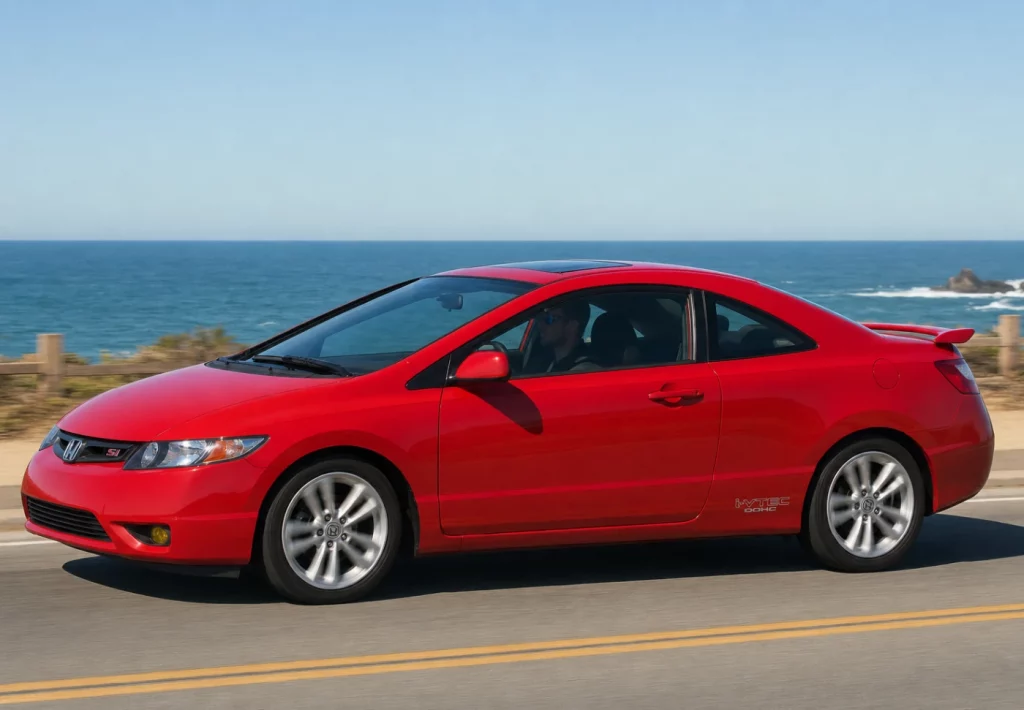
The most important rule of high-mileage Civic buying: 150,000 miles is not a death sentence for a Civic — but it is a test of maintenance. A well-maintained 9th gen R18 with 180,000 miles and records is a better buy than a neglected 10th gen 1.5T with 120,000 miles and no history. Buy the car, not the odometer.
Quick Answer — Which High-Mileage Civic Should You Buy?
| Generation | Years | Estimated Lifespan (Well-Maintained) | Primary Risk at 150K+ | Verdict |
|---|---|---|---|---|
| 8th Gen (R18) | 2006–2009 | 180,000–230,000 | Cracked engine block (casting defect) | Avoid — block issue limits many cars |
| 8th Gen (R18) | 2010–2011 | 220,000–280,000 | AC compressor, rear suspension bushings | Good budget buy with records |
| 8th Gen Si (K20Z3) | 2006–2011 | 200,000–260,000 | Transmission synchros (3rd gear), engine mounts | Inspect carefully — synchro wear is common |
| 9th Gen (R18) | 2013–2015 | 230,000–290,000 | CVT judder (2014+), premature brake wear | Best high-mileage buy — most durable generation |
| 9th Gen Si (K24Z7) | 2013–2015 | 210,000–270,000 | Clutch at 80K–120K, valve adjustment | Great enthusiast buy with clutch records |
| 10th Gen 2.0L (K20C2) | 2017–2021 | 250,000–300,000 | CVT fluid neglect, AC compressor | Best modern high-mileage choice |
| 10th Gen 1.5T (L15B7) | 2019–2021 | 180,000–250,000 | Oil dilution, head gasket, carbon buildup | Buy only with complete service records |
| 10th Gen Si (L15B7) | 2017–2021 | 200,000–250,000 | Clutch, oil dilution, turbo wear | Inspect carefully — high risk of abuse |
Sources: CarLifespanCheck life expectancy by model year (2026); NHTSA complaint data; CivicX and 9thGenCivic owner reports; AmpAuto common problems guide (2025); Au7o analysis of 14,638+ owner reports (2026).
The critical insight: The R18 1.8L engine in the 9th gen (2013–2015) and the K20C2 2.0L engine in the 10th gen (2017–2021) are the safest high-mileage choices. Both are naturally aspirated, have no Turbocharger complexity, and are proven to reach 250,000+ miles with routine maintenance. The 1.5T can reach 200,000+ miles — verified examples exist — but requires stricter maintenance and accepts higher risk of major repairs.
What 150,000-Mile Civics Cost in 2026
The used market in 2026 has cooled from the pandemic highs. A Civic AT 150,000–180,000 miles is priced for cash buyers and budget commuters, not financed purchases. The price range reflects condition and records more than model year.
| Generation | Model Years | 150K–180K Mile Price Range | 180K–220K Mile Price Range | Best Value Pick |
|---|---|---|---|---|
| 8th Gen | 2009–2011 | $3,500–$5,500 | $2,500–$4,000 | 2010–2011 LX with records ($4K–$5K) |
| 8th Gen Si | 2009–2011 | $5,500–$8,000 | $4,000–$6,000 | 2010–2011 Si with clutch done ($6K–$7.5K) |
| 9th Gen (R18) | 2013–2015 | $6,000–$9,000 | $4,500–$6,500 | 2014 EX with CVT fluid records ($7K–$8.5K) |
| 9th Gen Si | 2014–2015 | $8,000–$11,000 | $6,000–$8,500 | 2015 Si with clutch + valve adjustment done ($9K–$11K) |
| 10th Gen 2.0L | 2018–2021 | $9,000–$13,000 | $7,000–$10,000 | 2018–2019 Sport or LX ($9K–$11K) |
| 10th Gen 1.5T | 2019–2021 | $10,000–$14,000 | $8,000–$11,000 | 2019 EX with CVT records ($10K–$12K) |
| 10th Gen Si | 2019–2021 | $14,000–$17,000 | $11,000–$14,000 | 2019 Si with clutch + oil dilution fix ($13K–$15K) |
Source: National listing data from CarGurus, Cars.com, AutoTempest (Q1 2026); pricing adjusted for 150K+ mileage band. Prices assume clean title, reasonable cosmetic condition, and maintenance records. Deduct 10–20% for modified cars, salvage titles, or no service records.
At 150,000 miles, the 10th-gen 2.0L cars represent the strongest value proposition. A 2018–2019 Civic LX or Sport with 150,000 miles at $9,000–$11,000 has a K20C2 engine with 100,000–150,000 miles of remaining life, modern safety equipment (Honda Sensing on 2019+), and reasonable interior quality. The 9th-gen R18 cars at $6,000–$9,000 are the best pure economy choice — the lowest-risk engine and the lowest purchase price.
What Breaks at 150,000 Miles — Generation by Generation
The components that fail at 150,000 miles are not mysterious. They are wear items that every high-mileage Civic eventually needs. The question is whether they have already been replaced.
8th Gen (2006–2011) — The Budget Choice with Major Caveats
The 2006–2008 models carry the highest risk of any Civic in this mileage range. The R18 engine block casting defect affects these years, causing Coolant leaks from microcracks that lead to overheating. Honda issued a warranty extension (Service Bulletin 10-048, covering the engine block to 10 years from original purchase with no mileage limit), but many affected cars are now past that window. A 2006–2008 Civic with 150,000+ miles that has NOT had the block replaced is a ticking time bomb — engine replacement costs $3,500–$7,000.
Even the 2009–2011 models, which largely avoid the block issue, have a dense list of 150K-mile wear items:
- AC compressor clutch failure: The most common complaint on 8th gen Civics. Replacement costs $900–$1,400. The clutch can be replaced separately, but most shops replace the entire compressor.
- Rear suspension camber arms: Service Bulletin 13-047 recommends Upper Control Arm kit to fix uneven tire wear. Cost: $300–$500 installed.
- Timing chain tensioner rattle: VTC actuator noise on cold start is common. Cost: $350–$800.
- Wheel bearings: $250–$450 per corner. Front bearings fail more often than rear.
- Clear coat peeling: Cosmetic, $1,200–$3,000 to repaint. Dark colors are the worst.
- Sunvisor failure: Minor, $29–$39 aftermarket. Class action settlement covered this.
- P0128 thermostat code: Under $100 parts, 1.1–1.5 hours labor.
- P0847 transmission pressure switch: Inexpensive part, DIY-friendly.
The 8th-gen Si (2006–2011, K20Z3) has its own set: 3rd gear synchros wearing out (common on aggressively driven examples), Engine Mount failures, and a clutch that typically needs replacement at 80,000–100,000 miles. A 2006–2011 Si at 150,000 miles that has not had a transmission rebuild or at minimum a synchro inspection is a risky buy.
8th gen buying rule: Only buy a 2009–2011 model. The 2006–2008 cars are not worth the risk. If you buy a 2009–2011, budget $1,000–$1,500 for deferred maintenance in the first year. The AC compressor and rear suspension are the most common failures.
9th Gen (2012–2015) — The Most Durable High-Mileage Generation
The 9th gen is the most durable high-mileage Civic generation overall, particularly the 2013–2015 models that received the mid-cycle refresh. The R18 1.8L engine with port injection has no direct injection carbon buildup, no turbocharger, and no Oil dilution. It is arguably the most reliable engine Honda has put in a Civic in the last 20 years.
Known issues at 150,000+ miles:
- CVT judder on 2014–2015 models: CVT fluid neglect is the primary cause — service every 30,000 miles to prevent. Replacement costs $3,000–$4,000 if neglected.
- AC compressor failure: Same compressor family as 8th gen, $900–$1,400.
- Premature brake wear: Common complaint, not a safety issue but adds cost.
- Paint quality issues: Same clear coat weakness as 8th gen on darker colors.
- Rear shocks softening: Around 80,000 miles, $400–$600 for a pair.
- Door lock actuator failure: $150–$250 per door.
The 9th-gen Si (2012–2015, K24Z7) is one of the best high-mileage performance Civic buys available. The K24Z7 is a naturally aspirated 2.4-liter with VTEC on both intake and exhaust cams. It has no turbo, no direct injection carbon buildup, and a proven track record past 200,000 miles on CivicX and 9thGenCivic forums. The 6-speed manual is robust. Clutch replacement at 80,000–120,000 miles is expected ($1,200–$1,800). Valve adjustment is recommended at 105,000 miles ($300–$500 at independent shop).
9th gen buying rule: The 2013–2015 9th gen R18 is the safest high-mileage Civic you can buy. It is simpler than the 10th gen, more reliable than the 8th gen, and cheap to repair. A 2014 EX with 150,000 miles and CVT fluid records is a $7,000–$8,500 car that will last another 100,000 miles.
10th Gen (2016–2021) — The Split Generation
The 10th gen is split sharply by engine. The 2.0L K20C2 in LX and Sport trims is one of the most reliable high-mileage engines Honda produces. The 1.5T L15B7 in EX, EX-L, Touring, and Sport Touring trims has documented issues that require careful evaluation at 150,000+ miles.
2.0L K20C2 (LX, Sport):
- Known to reach 250,000+ miles with routine maintenance (CivicX owner reports)
- No turbocharger to fail
- Direct injection only — intake valve cleaning needed at 80,000–100,000 miles (walnut blasting, $400–$600)
- CVT is the weak point — fluid changes every 30,000 miles are mandatory for longevity
- AC compressor failure on 2016–2019 models ($1,000–$1,800)
- Rear suspension bushing wear (clunking over bumps, $300–$500)
1.5T L15B7 (EX, EX-L, Touring, Sport Touring):
- Oil dilution was the headline issue on 2016–2018 models — fuel enters Oil Pan during cold short trips. 2019+ models have improved piston rings and software calibration. At 150,000 miles, test: smell dipstick for gasoline — if present, walk away unless the car has documented repair history.
- Head gasket failure on high-mileage 1.5T cars — documented evidence of coolant intrusion into cylinders on some 1.5T engines past 100,000 miles, with repair costs of $1,500–$8,000.
- Carbon buildup on intake valves — walnut blast needed every 60,000–80,000 miles.
- Turbocharger wear — at 150,000 miles, inspect for shaft play, boost leak, or whining noise. Turbo replacement: $1,200–$2,000.
- Fuel injector failure on high-mileage cars — replacement $800–$1,200.
That said, verified 1.5T examples at 256,000+ miles exist (CivicX forum, Type 90’s 2020 Civic Coupe Touring at 256K miles running strong with CVT fluid changes every 50K miles). A 2019–2021 1.5T at 150,000 miles with documented oil change history every 5,000 miles or less, CVT fluid changes every 30,000–50,000 miles, and no check engine light history can be a legitimate buy. But it requires more due diligence than the 2.0L.
10th gen buying rule: If you are buying a 10th gen at 150,000 miles, the 2.0L K20C2 is the safer choice. The 1.5T can be a good buy, but only with complete service records showing frequent oil changes and CVT fluid changes. A 2019 1.5T with records is a better buy than a 2017 1.5T with no records.
Generations to Avoid at 150,000+ Miles
2006–2008 8th gen (any trim). The cracked engine block issue makes every car in this range a gamble. Even if the block has been replaced under warranty, the rest of the car is 18–20 years old with all the associated rubber/plastic degradation. The 1.8L R18 in these years has 3,115 NHTSA complaints — by far the highest of any Civic engine. The block casting defect alone generated 183 documented complaints on CarComplaints.com for the 2006 model year, with an average repair cost of $2,910 and average failure mileage of 98,250. Many cars that failed at or before 100,000 miles were repaired under the 10-year warranty extension — but that extension expired years ago.
2016–2018 1.5T (10th gen). At 150,000 miles, these cars carry elevated risk of oil dilution consequences, Head Gasket Failure, and carbon buildup. A 2016 Civic Touring with 150,000 miles at $9,000 might seem tempting, but the cumulative risk of engine damage from years of fuel-contaminated oil makes this a poor bet. If the oil was changed every 3,000–5,000 miles with full synthetic and the software update was applied, risk is reduced but not eliminated.
2012 9th gen (any trim). The first year of the 9th gen has the weakest build quality of the generation, with more interior noise, premature brake wear, and a less refined CVT calibration. The 2013–2015 models are measurably better in every regard.
Modified cars (any generation). A modified Civic at 150,000 miles has likely been driven harder than a stock example. On the 1.5T, aftermarket tunes increase cylinder pressure and accelerate Head Gasket failure. On the 8th/9th-gen Si, aggressive driving accelerates synchro, clutch, and engine mount wear. A stock Civic with service records is always preferable to a modified one at this mileage.
Salvage or rebuilt title at 150,000 miles. A car that was already in a serious accident AND has 150,000 miles is a car with compromised structural integrity and accumulated mechanical wear. The combination is not worth the discount.
First-Year Maintenance Budget at 150,000 Miles
The rule of thumb for a high-mileage car: budget for one major service event in the first year. The actual cost depends on whether previous owners preemptively addressed the 150K-mile wear items.
| Generation | Immediate Service Needs | Deferred Maintenance Risk | First-Year Budget |
|---|---|---|---|
| 8th Gen (2009–2011) | Oil + filter, spark plugs (100K interval), brake fluid flush, coolant flush, serpentine belt inspection | AC compressor failure ($900–$1,400), wheel bearings ($250–$450 each), rear suspension ($300–$500) | $800–$2,500 |
| 9th Gen (2013–2015) | CVT fluid change ($160–$200), brake fluid flush, cabin + engine air filters | AC compressor ($900–$1,400), rear shocks ($400–$600), CVT failure if fluid neglected ($3K–$4K) | $400–$1,800 |
| 9th Gen Si (2014–2015) | Valve adjustment ($300–$500), transmission fluid change ($100–$150), clutch inspection | Clutch ($1,200–$1,800), engine mounts ($300–$600), LSD check | $500–$2,500 |
| 10th Gen 2.0L (2018–2021) | CVT fluid change, spark plugs (100K interval), brake fluid, walnut blast intake valves ($400–$600) | AC compressor ($1,000–$1,800), rear suspension bushings ($300–$500) | $600–$2,000 |
| 10th Gen 1.5T (2019–2021) | CVT fluid change, spark plugs, walnut blast intake valves ($400–$600), oil change with full synthetic | Turbo inspection ($200 diagnostic), head gasket check (coolant test), AC compressor ($1,000–$1,800), fuel injectors ($800–$1,200) | $800–$2,500 |
| 10th Gen Si (2019–2021) | Clutch inspection ($200), transmission fluid, brake fluid, walnut blast, spark plugs | Clutch ($1,200–$1,800), turbo ($1,200–$2,000), adaptive dampers ($400–$600 each) | $1,000–$3,000 |
Sources: RepairPal labor/cost estimates; RockAuto OEM and aftermarket parts pricing (2026); CivicX owner-reported maintenance threads; AmpAuto maintenance cost guide (2025). Labor assumes $80–$120/hour at independent shop.
The 10th-gen 2.0L and the 9th-gen R18 have the lowest first-year maintenance risk. The 10th-gen 1.5T and Si models have the highest, due to turbo, head Gasket, and clutch concerns.
The High-Mileage Decision Framework
The decision to buy a Civic at 150,000+ miles depends on three factors: maintenance history, engine type, and purchase price.
Buy if:
- The car has complete maintenance records showing oil changes every 5,000 miles or less
- CVT fluid (if equipped) was changed every 30,000 miles
- Major wear items (clutch on Si, AC compressor, shocks, control arm Bushings) have been replaced or are priced into the negotiation
- It is a 2013–2015 9th gen with the R18, or a 2017–2021 10th gen with the 2.0L
- It is a 2014–2015 9th-gen Si with clean records and clutch already replaced
- The price reflects the mileage and deferred maintenance risk
Do not buy if:
- No maintenance records exist — the discount for unknown history is 15–20% off market, and many sellers will not accept that
- It is a 2006–2008 8th gen (any engine)
- It is a 2016–2018 1.5T with no documented oil dilution fix
- It has a salvage or rebuilt title
- It has significant modifications without documentation from a known shop
- The seller cannot explain why they are selling (a well-maintained 150K-mile Civic that runs perfectly is usually kept until 200K+)
Pre-Purchase Inspection Protocol for 150,000+ Mile Civics
A pre-purchase inspection at 150,000 miles is not optional. The following checklist covers what a qualified mechanic should verify before purchase. Estimated costs are for repairs if issues are found, not routine service.
| Category | Inspection Item | What to Check | Cost If Failed |
|---|---|---|---|
| Engine | Compression and leakdown test | All cylinders within 10% of each other; no rapid pressure loss | $3,500–$7,000 (engine replacement) |
| Engine | Oil condition / dipstick smell | No gasoline smell (1.5T), no coolant contamination, proper level | $0 (diagnostic) to $8,000 (head gasket on 1.5T) |
| Engine | Timing chain noise (8th/9th/10th gen) | No rattle on cold start, VTC actuator check | $350–$800 (VTC actuator) |
| Engine | Coolant condition and level | No oil in coolant, no coolant in oil, no external leaks at block (8th gen 2006–2008) | $3,500–$7,000 (block replacement on 2006–2008) |
| Engine | Valve adjustment (9th gen Si, 8th gen) | Last performed at 105K miles? If not, due now | $300–$500 |
| Turbo (1.5T) | Shaft play, boost leak, wastegate | No lateral shaft play, no boost leaks, no whining at spool | $1,200–$2,000 (turbo replacement) |
| Transmission | CVT fluid condition and shift quality | Fluid should be clean, not burnt-smelling. No shudder, no rubber-band effect on acceleration. Service history every 30K miles | $200 (fluid change) to $3,000–$4,000 (CVT replacement) |
| Transmission | Manual trans (Si) | No 3rd gear grind (8th gen), no clutch slippage, smooth engagement | $1,200–$1,800 (clutch), $800–$1,500 (synchro work) |
| Suspension | Shocks and struts | No leaking fluid, no bouncing after compression, no clunking | $400–$800 per axle |
| Suspension | Control arm bushings and ball joints | No cracking, no play, no clunking from front lower control arms | $300–$600 per side |
| Suspension | Rear camber arms (8th gen) | Uneven rear tire wear indicates worn upper control arms | $300–$500 (kit + alignment) |
| Brakes | Rotor thickness, pad depth, caliper slide pins | No pulsation, no seized calipers, pads above 3mm | $300–$600 per axle (rotors + pads) |
| AC System | Full functional test (10+ min runtime) | Must blow ice-cold at idle and highway speed. No compressor clutch noise | $900–$1,800 (compressor replacement on 2012–2019) |
| Electrical | Door lock actuators | All four doors lock/unlock smoothly. No chattering | $150–$250 per door |
| Body | Paint condition | No clear coat peeling on roof, hood, or trunk (2006–2018 models) | $1,200–$3,000 (repaint) |
| Maintenance Records | Full service history | Oil changes every 5K miles or less, CVT fluid every 30K (10th gen), spark plugs at 100K, brake fluid every 3 years | No records = higher risk, negotiate price down 15–20% |
Sources: AmpAuto pre-purchase inspection checklist (2025); JohnOnWheels high-mileage Civic buying guide (2025); VINSCRIBE Civic buying guide (2026); CarGuideZone 200K-mile Civic analysis (2025); Samarins.com 8th-gen Civic review (2023); NHTSA complaint data; CivicX and 9thGenCivic forum owner reports.
150K+ Mile Specific Checks — The Engine Bay Interrogation
At 150,000+ miles, the engine bay reveals the car’s history. Here is what to check beyond the standard PPI.
Timing Chain Stretch & Tensioner: The chains on Honda engines last a long time, but by 150,000 miles they can stretch. On K-series (8th/9th gen Si, 10th gen 2.0L) and L-series (1.5T), listen for a metallic rattle or clatter in the first seconds of a cold start. Check for cam/crank correlation codes (P0011, P0016, P0341). On the R18 and K20C2, the Timing Chain tensioner can be inspected through the inspection hole on the block. If the tensioner is fully extended, the chain needs replacement — $800–$1,200.
Valve Clearance Neglect: On R18 and K24 engines, there are no hydraulic lifters. Valve clearance needs manual adjustment every 40,000–50,000 miles. At 150,000 miles, many owners skip this. The risk is burned exhaust valves from inadequate heat transfer. A rough idle on cold start or a Misfire code is a sign of tight valves. A valve adjustment costs $300–$500 at an independent shop.
Oil Consumption & Piston Rings: Honda engines love to rev, and by 150,000 miles, the oil control rings can stick. The test: have a helper rev the warm engine sharply. Blue smoke from the exhaust on throttle blip indicates worn valve seals or stuck rings. If the car uses more than 1 quart of oil per 1,000 miles, the rings are worn. A compression test will confirm — if one cylinder is low and the oil rings are stuck, the repair is expensive.
150K+ Mile Specific Checks — Transmission
The Traditional Auto (5AT): The 5-speed automatic in 8th and early 9th gen Civics is the most durable automatic transmission Honda made in this era. At 150,000 miles, check the fluid color and smell. It should be pink/red. Brown/black fluid with a burnt smell means the friction plates are worn. Test the 1st-to-2nd and 2nd-to-3rd shifts under load — any flare or delay indicates wear. A transmission rebuild costs $2,000–$3,000.
The CVT (2014–2015 9th gen, 10th gen): The CVT is the weak point on high-mileage 10th gen Civics. If the fluid was changed every 30,000 miles, the CVT can last 200,000+ miles. If it was neglected, the belt and pulleys will wear. At 150,000 miles, the fluid should have been changed at least 4–5 times. On the test drive, accelerate from a stop and feel for any shudder, hesitation, or whining. A CVT replacement costs $3,000–$4,500.
The Manual (6MT): On 8th gen Si models, test 3rd gear specifically. Accelerate to 4,500+ RPM in 2nd, shift to 3rd, and feel for grinding or pop-out. On 10th gen Si models, the clutch is the weak point. Do a 3rd-to-4th gear pull from 2,500 RPM to redline. If the RPMs rise without matching speed, the clutch is slipping. A clutch replacement on a 10th gen Si costs $1,200–$1,800.
150K+ Mile Specific Checks — Suspension and Underbody
Front Compliance Bushings & Ball Joints: The rear Lower Control Arm bushings on 8th, 9th, and 10th gen Civics wear out by 100,000–120,000 miles. At 150,000 miles, they are likely on their second set. Check for cracks, tears, or fluid leaks. A worn bushing causes clunking over bumps and vague steering. Replacement costs $300–$600 per side.
Rear Trailing Arm Bushings (8th/9th Gen): These large bushings wear out and cause the rear of the car to wander on uneven highways. Check for cracks and tears. Replacement is $400–$800 for both sides.
The Steering Rack: The electric power Steering Rack on 8th and 10th gen Civics can develop play or stickiness. At 150,000 miles, check for play in the tie rods and listen for clunks when turning. A steering rack replacement costs $800–$1,500.
Fluid Leaks: Check for oil at the engine-transmission junction (rear main seal), under the distributor/cam plug (R18), and on the steering rack. A rear main seal leak costs $800–$1,200 to fix because the transmission must come out. A cam plug leak is a $50 part and 1 hour of labor.
150K+ Mile Specific Checks — Electrical and Accessories
The Alternator & Starter: By 150,000 miles, the Alternator brushes or diode bridge can fail. Test the charging voltage under load — turn on the headlights, blower motor, and rear defroster. The voltage should stay above 13.5V. The starter can develop a slow crank or intermittent engagement. A long crank time on a cold start is a warning. Alternator replacement costs $400–$700. Starter replacement costs $300–$500.
Wheel Bearings: Drive at 50+ mph on a smooth road. Listen for a hum that changes tone when you gently swerve left and right. A hum that gets louder when turning left indicates the right Wheel Bearing is worn (the weight shifts to that side). A front wheel bearing replacement costs $250–$450 per side.
The Verdict: Which High-Mileage Civic to Buy
Best overall high-mileage buy: 2013–2015 9th-gen Honda Civic LX or EX with the R18 1.8L engine. At 150,000–180,000 miles, these cars cost $6,000–$9,000, have an engine with proven 250,000+ mile durability, no turbo, no direct injection carbon buildup, and a CVT that is reliable if fluid was changed. The interior is dated and safety equipment lacks Honda Sensing, but the mechanical risk is the lowest of any Civic in this mileage range.
Best modern high-mileage buy: 2018–2020 10th-gen Honda Civic LX or Sport with the K20C2 2.0L engine. At 150,000 miles, these cost $9,000–$13,000 and offer Honda Sensing (2019+), Apple CarPlay (7-inch display on Sport or EX), and a naturally aspirated engine with no turbocharger. The CVT is the only significant failure point — verify fluid changes.
Best enthusiast high-mileage buy: 2014–2015 9th-gen Civic Si with the K24Z7. At 150,000 miles with a replaced clutch and valve adjustment done, this car costs $8,000–$11,000 and offers the best naturally aspirated Civic driving experience of the modern era. The K24Z7 is a 7,000-rpm VTEC engine with a mechanical LSD and precise hydraulic steering. It has no turbo, no direct injection problems, and a manual transmission that is robust. The compromise is safety — the 9th gen does not match the 10th gen in crash protection.
Do not buy at 150,000+ miles:
- 2006–2008 8th gen (cracked block risk is too high)
- 2016–2018 1.5T without documented repair history (oil dilution + head gasket risk)
- Any Civic without maintenance records (the unknown history discount is rarely accepted by sellers)
- Modified cars (especially tuned 1.5Ts)
- Salvage/rebuilt title cars at this mileage
- 2012 9th gen (weakest year of the generation)
High-Mileage Civic Buying Checklist
☐ 150,000+ mile Civic buying requires engine-specific evaluation — naturally aspirated (R18, K20C2, K24Z7) is safer than turbo (L15B7)
☐ Pre-purchase inspection must include: compression test, CVT fluid check, AC functional test, suspension bushing inspection, and full maintenance record review
☐ 2006–2008 8th gen (R18) has the highest risk — cracked engine block defect affects these years with 183+ NHTSA complaints and average $2,910 repair
☐ 2016–2018 1.5T at 150K+ miles carries elevated oil dilution and head gasket risk — verify oil change history and software update
☐ 2013–2015 9th gen R18 and 2017–2021 10th gen K20C2 are the safest high-mileage choices — proven 250K+ mile longevity
☐ CVT fluid changes every 30,000 miles are mandatory for 10th-gen CVT longevity — no records means high risk of CVT Failure ($3K–$4K)
☐ First-year maintenance budget: $800–$2,500 for 8th gen, $400–$1,800 for 9th gen, $600–$2,000 for 10th gen 2.0L, $800–$3,000 for 1.5T/Si
☐ Price range at 150K–180K miles: $3.5K–$5.5K (8th gen), $6K–$9K (9th gen), $9K–$14K (10th gen)
☐ Compression test and leakdown test are non-negotiable before purchase at this mileage
☐ Stock car with maintenance records always preferred over modified car with unknown history
Sources: CarLifespanCheck life expectancy by model year (2026); NHTSA complaint data; CarComplaints.com 8th gen engine block analysis; CivicX and 9thGenCivic forum owner reports; AmpAuto common problems guide (2025); Au7o analysis of 14,638+ owner reports (2026); RepairPal labor/cost estimates; RockAuto OEM and aftermarket parts pricing (2026); JohnOnWheels high-mileage Civic buying guide (2025); VINSCRIBE Civic buying guide (2026); CarGuideZone 200K-mile Civic analysis (2025); Samarins.com 8th-gen Civic review (2023). Prices are approximate and may vary by region and market conditions.