

Your 7th gen Civic (EM2 coupe, ES1 sedan, EP3 Si hatchback, EU1 UK hatch) has two fuse boxes: one in the passenger compartment (under the driver’s side dashboard) and one in the engine compartment (on the passenger side, behind the battery). This generation is now in the ultra-budget segment — bought by students, K-swap builders, and people who just need a beater that runs. The wiring harnesses on these cars have seen 20+ years of abuse: cheap sound system installs, rotten grounds, and questionable DIY repairs.
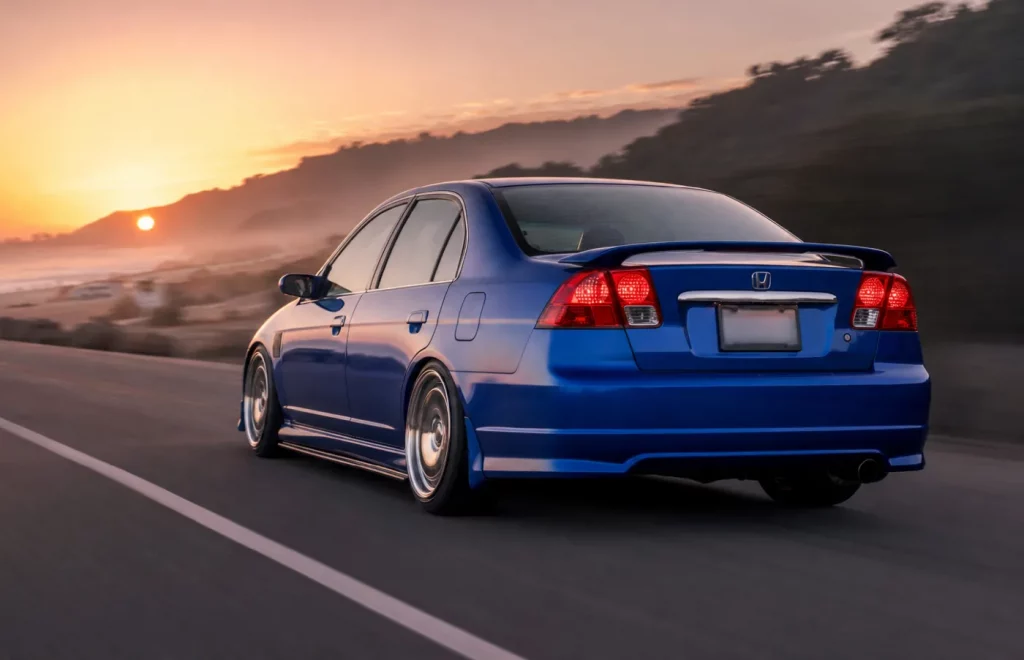
Here’s the raw, garage-tested breakdown of every fuse you need to know — including the 7th gen specific bugs that universal fuse references won’t tell you about.
Quick Reference — Where to Find the Fuse Boxes
| Location | Position | Notes |
|---|---|---|
| Under-Dash (Interior) | Directly under the steering column, above the pedals | Access is tight — you’ll be lying on your back with your neck twisted. To remove the cover, turn the plastic locking knob 90 degrees. Classic EM2/ES1 pain. |
| Engine Bay | Passenger side, behind the battery | Unlike the 8th gen (driver’s side), this one is on the passenger side. The plastic is often brittle from battery acid fumes — it cracks easily in cold weather. Open carefully. |
Passenger Compartment Fuse Box (Under-Dash)
Location: Under the dashboard, driver’s side — above the pedals.
Most commonly blown fuses on the 7th gen:
| № | Amps | Circuit Protected | Common Failure |
|---|---|---|---|
| 18 | 15 A | Cigarette Lighter / Power Socket | 🔌 The #1 blown fuse on this generation. Cheap Bluetooth FM modulators — because the stock 2001 radio has no AUX or Bluetooth — overheat and short out. If your phone won’t charge, this is it. |
| 17 | 15 A | Fuel Pump | ⛽ The legend. If the car cranks but won’t start, check this fuse. Also a known issue: stalls when hot — the pump draws too much current and pops the fuse after heat soak. |
| 4 | 10 A | Alternator | 🔋 Critical. If this fuse blows, the battery stops charging and the dashboard lights up like a Christmas tree. Often pops when someone does DIY alternator work without disconnecting the battery. |
| 8 | 7.5 A | Radio / Accessory (Audio) | 📻 First to die when teenagers twist radio wires together with electrical tape instead of using proper connectors. If the radio is dead, check this first. |
| 1 | 15 A | Power Windows (Main) | If all windows are dead, this is the main power fuse. If only one window doesn’t work — check the individual switches. |
| 12 | 10 A | Turn Signals / Hazard Lights | If your blinkers stopped working, this is the first place to look. Often caused by a trailer wiring short or a bad flasher relay. |
| 5 | 10 A | Brake Lights | 🛑 Brake lights not working? Check this. Also affects the shift interlock on automatics — if the shifter is stuck in Park, this fuse might be blown. |
Engine Compartment Fuse Box
Location: Passenger side, behind the battery.
These are the “heavy” fuses — cooling, ECU, and the main battery fuse.
| № | Amps | Circuit Protected | Common Failure |
|---|---|---|---|
| 19 | 80 A | Main Battery Fuse (bolted) | 🔧 DO NOT yank this with pliers! It’s bolted down — loosen the two screws first. Blows only when someone reverses battery polarity (jump-start with cables swapped). |
| 6 | 15 A | FI ECU — Main Power | 💀 The engine management fuse. If this blows, no spark, no fuel injector pulse, no start. Check this if the fuel pump fuse (#17) is fine but the car still won’t fire. |
| 1 | 20 A | Condenser Fan | 🌡️ D17 engines are notorious for overheating. If this fan doesn’t spin in traffic with A/C on, you’re on borrowed time. D17 overheats = warped aluminum head = blown head gasket. Check this fuse immediately. |
| 4 | 20 A | Radiator Fan | Same as #1 — if the car starts overheating in traffic, both fans should be running. If not, check the fuses and the relays. |
| 2 | 20 A | A/C Compressor Clutch | ❄️ If the A/C clutch won’t engage and the fuse is good, check the A/C relay and the pressure switch. |
| 13 | 10 A | Horn | Horn not working? Could be this, or the clock spring. |
Garage Secrets — 7th Gen Specific Bugs
⚠️ The “Rotten Harness” Under the Fender
This is the most important 7th gen specific issue that fuse-box.info won’t tell you.
The main Wiring Harness runs under the driver’s side front fender. Over time — especially on lowered cars — the tire rubs through the Fender liner and starts grinding against the wiring harness. This causes random short circuits where fuses (especially #15 and #17) blow one after another without any obvious reason.
Diagnosis: If you keep replacing fuses and they keep blowing — check the harness behind the driver’s side fender liner. You’ll find bare copper wires touching the chassis.
Fix: Pull the fender liner, wrap the harness with electrical tape and split loom, and secure it away from the tire.
💡 Rad Fan Relay Dead — But the Fuse is Good
If the cooling fan fuse (#1 or #4) is intact but the fan still doesn’t spin, the radiator fan relay is the problem. These relays are known to die on the 7th gen.
Quick test: Use a paperclip or piece of wire to jump pins 30 and 87 on the relay socket. If the fan spins — the relay is dead. Replace it with a Denso or OEM relay — cheap aftermarket relays fail even faster.
🔧 The Fuel Pump Fuse Trap
On the 7th gen, the Fuel Pump fuse (#17) is undersized for the job. If the fuel pump is old and drawing too much current, the fuse will blow AT the worst possible time — usually when you’re pulling away from a light.
Don’t just replace the fuse. If #17 blows repeatedly, replace the fuel pump. The D17 fuel pump is a known weak point — the motor wears out, increases current draw, and pops the fuse.
Complete Fuse Chart — 7th Gen Civic (2001–2005)
Passenger Compartment Fuse Box (Under-Dash)
| № | Amps | Circuit Protected |
|---|---|---|
| 1 | 15 A | Power Windows (Main) |
| 2 | 10 A | Daytime Running Lights (DRL) — Canada |
| 3 | 10 A | Instrument Cluster / Gauges |
| 4 | 10 A | Alternator |
| 5 | 10 A | Brake Lights / Stop Switch |
| 6 | 10 A | SRS (Airbag) Control |
| 7 | 10 A | Heated Seats (if equipped) |
| 8 | 7.5 A | Radio / Audio System (Memory) |
| 9 | 10 A | Seat Heat (if equipped) |
| 10 | 10 A | Sunroof / Moonroof (if equipped) |
| 11 | 10 A | Power Mirrors |
| 12 | 10 A | Turn Signals / Hazard Lights |
| 13 | 15 A | ECU (Back-up / Memory) |
| 14 | 15 A | Door Lock (Power Locks) |
| 15 | 15 A | Engine Control Unit (ECU) — Main |
| 16 | 15 A | O2 Sensor (Heater) |
| 17 | 15 A | Fuel Pump |
| 18 | 15 A | Cigarette Lighter / 12V Power Outlet |
| 19 | 7.5 A | Interior Lights / Dome Light |
| 20 | 15 A | Tail Lights / Parking Lights |
Engine Compartment Fuse Box (Under-Hood)
| № | Amps | Circuit Protected |
|---|---|---|
| 1 | 20 A | Condenser Fan |
| 2 | 20 A | A/C Compressor Clutch |
| 3 | 15 A | Radiator Fan (Some models) |
| 4 | 20 A | Radiator Fan |
| 5 | 30 A | ABS (Anti-lock Brake System) Pump |
| 6 | 15 A | FI ECU — Main Power (Engine Management) |
| 7 | 15 A | Ignition Coils |
| 8 | 15 A | Windshield Washer Pump |
| 9 | 15 A | Headlight (Left) |
| 10 | 15 A | Headlight (Right) |
| 11 | 15 A | Daytime Running Lights (DRL) Module |
| 12 | 15 A | Horn |
| 13 | 10 A | Backup Lights (Reverse) |
| 14 | 15 A | Starter Motor (Solenoid) |
| 15 | 15 A | Transmission Control Unit (TCU) |
| 16 | 30 A | Electric Power Steering (EPS) |
| 17 | 40 A | Heater / Blower Motor (HVAC) |
| 18 | 60 A | ABS (Anti-lock Brake System) Control |
| 19 | 80 A | Main Battery Fuse (bolted) |
❓ 7th Gen Civic Fuse Box — Frequently Asked Questions
1. Where is the cigarette lighter fuse on a 2002 Honda Civic?
Under the dashboard, driver’s side — fuse #18 (15A). The most common blown fuse on this generation, especially if you’re using cheap Bluetooth FM modulators.
2. Why is my D17 engine overheating but the fuse is good?
The fuse (#1 or #4) protects the circuit. If it’s intact but the fan isn’t spinning: check the radiator fan relay (common failure on 7th gen), the fan switch on the thermostat housing, or — classic D17 — the head gasket is already blown.
3. Can I put a 25A fuse instead of 15A for the fuel pump?
No. Absolutely not. If a 15A fuse keeps blowing, you have a short circuit or a dying fuel pump drawing too much current. Putting in a 25A will melt the harness under the rear seat and you’ll be replacing the whole fuel pump wiring — not just the fuse.
4. Where is the 7th gen Civic interior fuse box located?
Under the dashboard on the driver’s side, above the pedals. You’ll need to lie on your back — turn the plastic locking knob 90 degrees to remove the cover.
5. Where is the 7th gen Civic engine bay fuse box located?
On the passenger side, behind the battery. Unlike the 8th gen (driver’s side), this one is on the right. The plastic cover is brittle from battery acid — open carefully.
6. Which fuse is for the fuel pump on a 7th gen Civic?
Fuse #17 (15A) in the interior fuse box. If the engine cranks but won’t start, check this first.
7. Which fuse is for the radio on a 7th gen Civic?
Fuse #8 (7.5A) in the interior fuse box — audio memory and power. If the radio is dead after a DIY install, this is the first fuse to check.
8. What is the main fuse amperage on a 7th gen Civic?
The main battery fuse is rated at 80 A and is bolted into the engine bay fuse box (#19). Do not pull it without loosening the bolts.
9. Why does my 7th gen Civic keep blowing the fuel pump fuse?
Two reasons: (1) the fuel pump itself is old and drawing too much current — replace it. (2) the wiring harness under the driver’s side fender is rubbed through — a known 7th gen issue. Check the harness before replacing the pump.
10. Does the 7th gen Civic have a fuse for the alternator?
Yes — fuse #4 (10A) in the interior fuse box. If this fuse blows, the battery stops charging and the dashboard lights up like a Christmas tree.
Fuse Box Diagram — Visual Reference
Interior Fuse Box (Under-Dash) — Layout:
The interior fuse box is located under the steering column. The fuse positions are printed on the inside of the cover.
Interior Fuse Box — Label Map (2001-2005)
| Position | Fuse Number | Circuit | Amps |
|---|---|---|---|
| Top Row | 1-7 | Windows, DRL, Cluster, Alternator, Brake, SRS, Seat Heat | 10-15 A |
| Middle Row | 8-14 | Radio, Seat Heat, Sunroof, Mirrors, Turn, ECU, Door Lock | 7.5-15 A |
| Bottom Row | 15-20 | ECU Main, O2 Sensor, Fuel Pump, Cigarette Lighter, Dome Light, Tail | 7.5-15 A |
Engine Bay Fuse Box — Label Map (2001-2005)
| Position | Fuse Number | Circuit | Amps |
|---|---|---|---|
| Row 1 | 1-4 | Condenser Fan, A/C Clutch, Rad Fan, Rad Fan | 15-20 A |
| Row 2 | 5-8 | ABS Pump, FI ECU, Ignition, Washer | 15-30 A |
| Row 3 | 9-14 | Headlight L, Headlight R, DRL, Horn, Backup, Starter | 10-15 A |
| Row 4 | 15-18 | TCU, EPS, HVAC Blower, ABS Control | 15-60 A |
| Main | 19 | Main Battery (bolted) | 80 A |
💡 Pro tip: Take a photo of the fuse box cover before you start pulling fuses. The print on the plastic wears off over time — having a reference photo saves you from guessing which fuse is which.
Sources: Honda factory service manual, owner’s manual, and verified against real-world owner experience from 7th Gen Civic forums. Fuse assignments may vary by trim and market. Always verify with your owner’s manual.