

The 11th generation Civic hatchback arrived for 2022 with cleaner styling, a stiffer chassis, and a significantly nicer interior than its polarizing predecessor. At the top of the non-Type-R hatchback lineup sat the Sport Touring trim, the only way to get the turbocharged 1.5-liter engine with leather, Bose audio, and a 9-inch screen. Between 2022 and 2024, it was also the only Civic hatchback available with both the 1.5T engine and a six-speed manual transmission. For 2025, Honda dropped the 1.5T entirely from the Sport Touring and replaced it with a 200-horsepower hybrid drivetrain — the manual option disappeared with it. This article covers the 1.5T Sport Touring hatchback across its 2022–2025 run and whether the premium over a standard Sport or EX-L hatchback was money well spent.
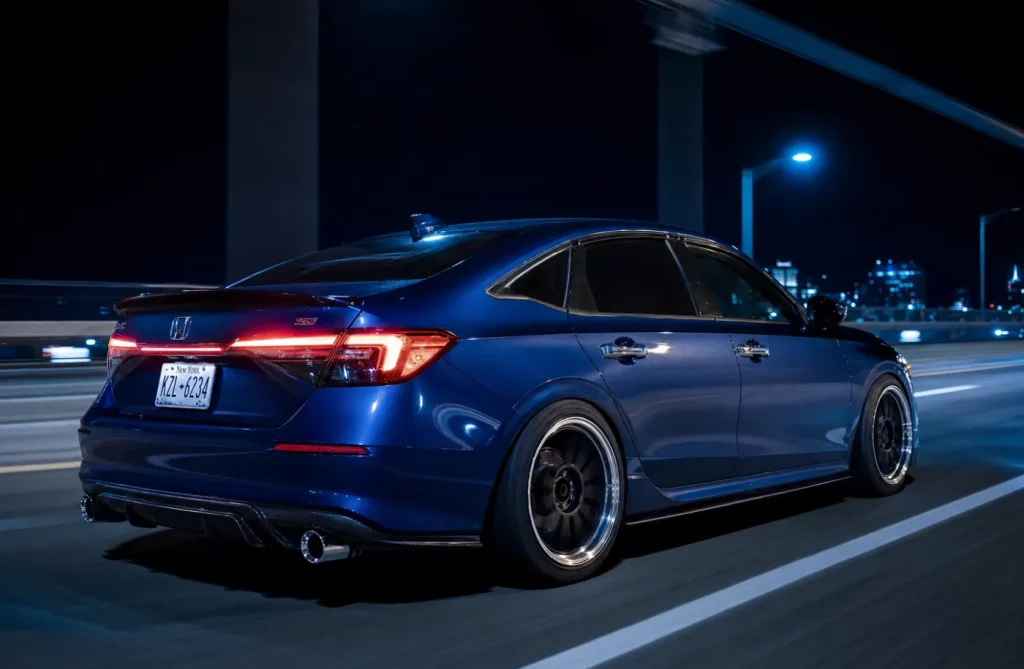
The 11th Generation Platform — What Changed Under the Skin
The 11th gen Civic (FL1/FL2/FL4 chassis codes for the hatchback) moved to Honda’s new Architecture (HA) platform, shared with the Acura Integra and HR-V. The body structure received 8 percent improvement in torsional rigidity and 13 percent improvement in bending rigidity compared to the 10th generation, according to Honda’s 2022 press kit. The Wheelbase grew 1.4 inches (to 107.7 inches), and the rear track widened by 0.5 inches. Honda applied ten times more structural adhesive than on the previous generation, used an aluminum front subframe for the first time on a Civic, and switched to a laser-brazed roof joint.
The chassis changes translated to a fundamentally more refined driving experience. The longer wheelbase improved straight-line stability, the wider rear track reduced yaw delay during corner entry, and new low-friction suspension ball joints improved steering feel. MotorTrend noted that the hatchback “exhibits a new laid-back temperament,” describing the 11th gen as “more mellow and refined” compared to the 10th gen’s sharper-edged character (MotorTrend, November 2021).
Engine — The L15B7 Turbocharged 1.5-Liter
The Sport Touring used the same L15B7 1.5-liter turbocharged four-cylinder carried over from the 10th generation. Output remained 180 horsepower at 6,000 rpm and 177 lb-ft of torque from 1,700 to 4,500 rpm (SAE net, per Honda’s 2023 specification sheet). Compression Ratio was 10.3:1. The engine ran on regular unleaded fuel, unlike the 10th gen Sport Touring’s premium-fuel recommendation (Honda Canada 2021 spec sheet shows premium required for 10th gen; 11th gen switched to regular).
The L15B7 in the 11th gen received revised piston rings and an updated PCV system compared to earlier 10th gen versions, aimed at reducing the Oil dilution issues that affected 2016–2018 models. Direct injection remained, meaning intake valve carbon buildup is still a maintenance consideration at higher mileages. The recommended tune-up interval was 100,000 miles with no scheduled tune-ups before that point (Honda Newsroom, 2025 Civic Hatchback Specifications).
Transmission Options — Manual vs. CVT
The Sport Touring was available with either a six-speed manual transmission or a continuously variable transmission (CVT). The manual was available only on the hatchback body style — the Civic Touring sedan was CVT-only. This made the Sport Touring hatchback the only 11th gen Civic (outside the Si and Type R) where you could pair a turbocharged engine with a manual gearbox.
The six-speed manual shared its gear ratios with the 10th gen Sport Touring: 3.643 first gear, 2.080 second, 1.361 third, 1.024 fourth, 0.830 fifth, 0.686 sixth, with a 4.100 final drive ratio (Honda 2024 Civic Hatchback specifications PDF). The CVT was Honda’s LL-CVT unit with dual-mode paddle shifters, a ratio range of 2.645 to 0.405, and a 4.81 final drive. The CVT gained a three-mode drive system (ECON/Normal/Sport) with Sport mode only on CVT trims; manual cars lacked Sport mode entirely.
| Specification | 6-Speed Manual | CVT |
|---|---|---|
| 0–60 mph (Car and Driver) | 7.3 seconds | 7.5 seconds (sedan) |
| Quarter mile (Car and Driver) | 15.5 sec @ 91 mph | 15.8 sec @ 91 mph |
| 70–0 mph braking (Car and Driver) | 173 feet | 174 feet |
| EPA city/highway/combined (estimated) | 28 / 37 / 31 mpg | 30 / 37 / 33 mpg |
| Curb weight (Honda spec) | 2,976 lbs | 3,018 lbs |
| Drive modes | ECON / Normal | ECON / Normal / Sport |
| Blind spot information system | Not available | Standard |
| Low-speed follow (ACC) | Not available | Standard (CVT only) |
The 6-speed manual removed Honda Sensing driver aids that depended on the CVT: adaptive cruise control with low-speed follow, blind spot information, and the full suite of low-speed collision avoidance functions were CVT-only. Buyers choosing the manual accepted this trade-off.
MotorMatchup recorded a 7.9-second 0–60 time for a 2024 Sport Touring manual, notably slower than Car and Driver’s 7.3-second result, possibly due to test conditions and break-in mileage. Car and Driver noted that their test car had under 400 miles and expected “more separation” between the manual and CVT after break-in (Car and Driver, October 2021).
Year-by-Year Changes — 2022 Through 2025
The 1.5T Sport Touring hatchback saw no major mechanical changes between the 2022 introduction and the 2024 model year. The key change came for 2025, when Honda discontinued the 1.5-liter turbo engine entirely and replaced the Sport Touring with a hybrid variant using a 2.0-liter Atkinson-cycle four-cylinder with two electric motors.
| Model Year | Engine | Horsepower | Transmission | MSRP (inc. dest) | Key Changes |
|---|---|---|---|---|---|
| 2022 | L15B7 1.5T | 180 hp | 6MT / CVT | $31,145 | All-new 11th gen design, HA platform, 9-inch touchscreen, Bose audio standard |
| 2023 | L15B7 1.5T | 180 hp | 6MT / CVT | ~$31,550 | Minor price increase, no content changes |
| 2024 | L15B7 1.5T | 180 hp | 6MT / CVT | ~$32,550 | Price increase; no changes to powertrain or features |
| 2025 | LFC 2.0L hybrid | 200 hp system | eCVT only | ~$32,000–$33,100 | 1.5T discontinued; 2.0L hybrid + eCVT replaces both engine and transmission; no manual option |
Sources: Honda Newsroom 2022 pricing press release, Edmunds 2024 and 2025 model pages, KBB 2025 Civic Hybrid pricing.
The 2025 hybrid Sport Touring produced 200 system horsepower and 232 lb-ft of torque, with an EPA rating of 50 city / 45 highway / 48 combined mpg (Honda Newsroom, 2025 Civic Hatchback Specifications). While quicker off the line due to instant electric torque, it used an eCVT that eliminated the manual entirely. The hybrid was also 313 pounds heavier than the 2024 1.5T manual, AT 3,289 lbs curb weight.
Interior and Technology — Where the Sport Touring Justified Its Price
The interior was the single biggest differentiator between the Sport Touring and lower hatchback trims. Standard equipment included perforated leather-trimmed seats, heated front seats with 8-way power adjustment for the driver and 4-way power for the passenger, a 10.2-inch digital instrument cluster, and a 9-inch color touchscreen with a physical volume knob (Honda Info Center, 2022 Civic Hatchback Features by Trim).
The Bose premium sound system used 12 speakers including a subwoofer and a center-channel speaker. This was a significant step up from the 8-speaker, 180-watt system in the EX-L and Sport trims. The 9-inch screen was the first Civic infotainment system to feel genuinely competitive — crisp graphics, fast response, wireless Apple CarPlay and Android Auto integration, and a built-in navigation system with HD Radio and SiriusXM. Lower trims made do with a 7-inch screen and wired phone connectivity.
Other Sport Touring exclusives included:
- Wireless phone charger
- Rain-sensing windshield wipers
- Front and rear parking sensors
- Auto-dimming rearview mirror with compass and sunglasses holder
- LED fog lights
- Heated gloss-black power side mirrors with integrated LED turn indicators
- Ambient lighting
- Dual-zone automatic climate control
The 2025 hybrid model replaced the Android-based infotainment system with Google built-in, adding voice control, Google Maps navigation, and third-party APP support through the Google Play store (KBB, 2025 Civic Hybrid review).
Performance and Driving Feel
Car and Driver tested a 2022 Sport Touring hatchback with the six-speed manual and recorded 0–60 mph in 7.3 seconds, the quarter mile in 15.5 seconds at 91 mph, and braking from 70 mph in 173 feet. The magazine praised the shift action as “precise and easy to use” but noted the clutch was “effortless” rather than sporty. Observed fuel economy during testing was 32 mpg combined (Car and Driver, October 2021).
MotorTrend tested a CVT-equipped 2022 Sport Touring hatchback and recorded 0–60 in 7.7 seconds and a quarter mile of 15.9 seconds at 89.8 mph. Braking from 60 mph required 117 feet. On the figure-eight course, the hatchback lapped in 26.8 seconds at 0.65 g average. MotorTrend noted the car “feels anxious to get up and go” in Sport mode and praised the “talkativeness” of the steering (MotorTrend, November 2021).
The 11th gen chassis transformation was the real story. The longer wheelbase and wider rear track flattened the car through corners, and the stiffer body reduced the Cowl shake that 10th gen owners sometimes reported over broken pavement. The trade-off was weight: the 11th gen hatchback gained roughly 85–105 pounds over the equivalent 10th gen (10th gen Sport Hatchback 6MT: 2,871 lbs; 11th gen Sport Touring 6MT: 2,976 lbs).
Known Problems and Recalls — 2022–2025 Sport Touring
The most significant issue affecting the 11th gen Civic Sport Touring was a steering gearbox recall. In October 2024, Honda issued Safety Recall 24V-744 covering 2022–2025 Civic and Civic Hatchback models. The steering gearbox worm wheel could swell during use, reducing grease film thickness and increasing friction between the worm wheel and worm gear. The result was increased steering effort and reduced self-centering, which NHTSA classified as a crash risk (NHTSA Recall 24V-744, Service Bulletin 24-119, October 2024). The repair involved replacing the spring seat, spring, and end cap in the EPS gearbox and injecting fresh grease — a 1.7-hour procedure.
A second recall covered 2023–2024 models where the driver’s seat cushion frame may not have been tightened properly during assembly, creating a crash-injury risk if the seat could move in a collision (NHTSA Recall, Consumer Reports 2024).
NHTSA complaint data for the Civic Hatchback (all trims, 2017–2025) shows 35 total complaints through early 2026, with steering defects accounting for 18 of those complaints. The 2023 model year saw a notable spike in steering complaints. The 2024 hatchback had 10 complaints (the highest single-year count), 2022 had 3 complaints, and 2025 had 3 complaints (VinItel, NHTSA ODI data). However, these numbers include all hatchback trims and all engines — there is no evidence the 1.5T had drivetrain-specific issues unique to the 11th gen.
| Model Years | Problem | Severity | NHTSA / Source | Repair Cost Range |
|---|---|---|---|---|
| 2022–2025 | Steering gearbox worm wheel swelling — increased steering effort | High — recall issued, crash risk | NHTSA 24V-744, SB 24-119 | $0 (recall), ~$500–$800 if out of warranty |
| 2023–2024 | Driver seat cushion frame loose from under-torqued fasteners | Moderate — FMVSS noncompliance | NHTSA recall, CR report | $0 (recall) |
| 2022–2024 | L15B7 direct injection carbon buildup on intake valves | Low — gradual power loss at 60K+ miles | Forum-reported, inherent to DI | $400–$600 (walnut blasting) |
| 2022–2025 | Infotainment glitches (wireless CarPlay drops, screen lag) | Low — intermittent, software updates address | Civic11Forum, CR owner reports | $0 (software update) |
The 11th gen L15B7 has not experienced the same frequency of Head Gasket failures or oil dilution complaints seen on 2016–2018 10th gen cars. Honda’s revised piston rings and PCV system appear to have reduced — though not entirely eliminated — fuel dilution in the crankcase. Owners running short trips in cold climates should still check oil levels regularly, consistent with any modern direct-injected turbo engine.
Used Market — 2026 Pricing and What to Look For
The manual-transmission Sport Touring hatchback is the rarest 11th gen Civic short of the Type R. According to forum reports on Civic11Forum, manual Sport Touring hatchbacks were allocation-only — dealers could not order them, and many Honda dealers never received one. Forum users reported that the manual Sport Touring hatchback was “more rare than the Si” (Civic11Forum thread, September 2022). One dealer employee reported selling seven to eight 11th gen Si models before ever seeing a non-Si manual hatchback.
Kelley Blue Book June 2026 data shows:
- 2022 Sport Touring hatchback: approximately $24,500–$27,500 resale, $22,000–$25,000 trade-in (approximately 18% depreciation over 4 years)
- 2023 Sport Touring hatchback: approximately $26,000–$28,500 resale, $24,000–$26,000 trade-in
- 2024 Sport Touring hatchback: approximately $28,000–$30,500 resale, $25,500–$28,000 trade-in
The manual versions carry a modest premium on the used market — typically $1,000–$2,000 over equivalent CVT cars, though finding one listed may require waiting or searching nationally. The 2024 model year is the last year of the 1.5T manual Sport Touring, which may eventually command collector interest similar to the 10th gen Sport Touring 6MT.
Sport Touring vs. Lower Hatchback Trims — Is the Premium Worth It?
The Sport Touring hatchback carried a roughly $3,800–$4,200 premium over the EX-L hatchback and a $5,500–$6,200 premium over the standard Sport hatchback depending on model year. The premium bought leather, Bose audio, the 9-inch screen, digital cluster, navigation, wireless charging, parking sensors, rain-sensing wipers, fog lights, ambient lighting, and power seats.
The EX-L hatchback had heated seats, dual-zone climate, a moonroof, and the 1.5T engine, but lacked the digital cluster, Bose system, 9-inch screen, navigation, and parking sensors. The Sport hatchback (with the 2.0-liter naturally aspirated engine) lacked the turbocharged engine entirely.
Whether the Sport Touring premium was worth it depends on priorities. For someone who values the Bose system, wireless CarPlay, and parking sensors and plans to keep the car for five-plus years, the difference works out to roughly $650–$800 per year for features that are difficult or messy to add after purchase. For someone who does not care about audio quality or leather and would rather save $5,000, the EX-L makes more sense.
Decision Block — Buy the Sport Touring If…
Buy the 1.5T Sport Touring hatchback (2022–2024) if:
- You want a manual transmission with a turbocharged engine and refuse to drive an automatic
- Leather seats, a premium Bose system, and a 9-inch infotainment screen matter to you
- You want parking sensors and rain-sensing wipers from the factory rather than aftermarket
- You plan to keep the car long enough to amortize the $3,800–$4,200 premium over the EX-L
- You are willing to search nationally for a manual example and potentially pay a mark-up
Skip the Sport Touring and buy an EX-L or Sport hatchback if:
- You want blind spot monitoring and the full Honda Sensing suite with low-speed follow (CVT-only features on these trims; the manual Sport Touring does not have them)
- You do not care about Bose audio, power seats, or navigation
- You want the best fuel economy — the hybrid Sport Touring (2025+) beats the 1.5T by 15 mpg combined
- You want the lowest upfront cost and are comfortable adding aftermarket audio
- You prefer a more aggressive exterior look — the 10th gen Sport Touring had a center-outlet exhaust and sharper body lines that the 11th gen does not replicate
The Hybrid Question — Does the 2025+ Sport Touring Change the Equation?
The 2025 hybrid Sport Touring produces 200 system HP and 232 lb-ft of torque, out-torquing the Civic Si (192 lb-ft). The hybrid achieves 50 city / 45 highway / 48 combined EPA mpg (Honda Newsroom, 2025 Civic Hatchback Specifications). It costs approximately $33,100 — roughly $1,000 more than the 2024 1.5T Sport Touring after accounting for inflation adjustments. The trade-off is the complete loss of a manual transmission, a 313-pound weight increase, and an eCVT that eliminates any sense of mechanical connection. The hybrid is faster in a straight line from a stop due to instant electric torque, but heavier through corners and disengaged from the driving experience. For buyers who prioritize efficiency over engagement, the 2025 hybrid Sport Touring is objectively the better car. For drivers who want a stick shift with leather and Bose, the 2022–2024 1.5T Sport Touring is the only answer.
Quick Reference Checklist
☐ 11th gen Sport Touring hatchback (2022–2024) used 1.5L L15B7 turbo with 180 hp and 177 lb-ft — same engine as 10th gen carryover
☐ Available with six-speed manual or CVT; manual deleted blind spot monitoring and low-speed ACC compared to CVT
☐ 0–60 mph in 7.3 seconds (manual, Car and Driver); 7.7 seconds (CVT, MotorTrend)
☐ Key upgrades over EX-L: Bose 12-speaker audio, 9-inch touchscreen, 10.2-inch digital cluster, leather seats, parking sensors, rain-sensing wipers, wireless charging, navigation
☐ Steering gearbox recall (NHTSA 24V-744) affects all 2022–2025 models — verify repair was completed before purchase
☐ Manual Sport Touring was allocation-only and extremely rare; fewer examples exist than the 11th gen Si
☐ 2025 model replaced 1.5T with 2.0L hybrid (200 hp, 48 mpg combined, eCVT only, 3,289 lbs curb weight)
☐ Used pricing June 2026: 2022 ~$24,500–$27,500, 2023 ~$26,000–$28,500, 2024 ~$28,000–$30,500
☐ Manual versions carry $1,000–$2,000 used premium over CVT; expect to search nationally for a 6MT example
☐ Buy for: manual + turbo + leather + Bose combination that no other 11th gen Civic offered
☐ Skip if: you want full Honda Sensing suite, better fuel economy (buy the hybrid), or the lowest entry price