

The EX and Touring share the same 1.5-liter turbocharged engine. That is the most important fact in this comparison. Unlike the LX-to-Sport jump, where the performance is identical and the money goes entirely to cosmetics, the EX-to-Touring gap is about interior quality, audio, and technology. The $3,600–$4,000 difference (MSRP plus destination, depending on model year) buys a comprehensively upgraded cabin experience on an otherwise identical powertrain.
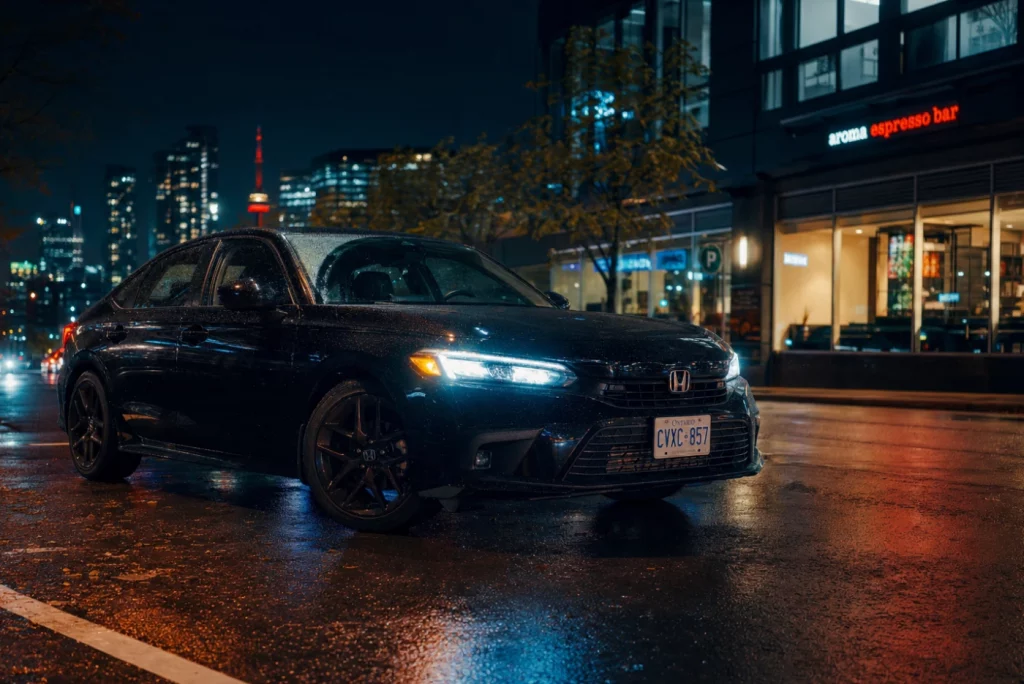
Important caveat: The EX and Touring trims existed only in the 2022–2024 model years for the 11th generation Civic sedan. For 2025, Honda discontinued both the 1.5-liter turbo engine and these trims, replacing them with the Sport Hybrid and Sport Touring Hybrid. This comparison covers the 2022–2024 model years in the US market. The Canadian market is different: there the EX retained the 2.0-liter naturally aspirated engine, making the Touring the only 1.5T sedan trim below the Si.
Quick Verdict — EX vs Touring in 30 Seconds
| Factor | EX | Touring | Winner |
|---|---|---|---|
| Price (new) | $24,700–$26,950 | $28,300–$30,550 | EX |
| Engine | 1.5T (180 hp) | 1.5T (180 hp) | Tie |
| Transmission | CVT | CVT + paddles | Touring |
| Infotainment screen | 7-inch | 9-inch | Touring |
| Driver display | 7-inch TFT | 10.2-inch digital | Touring |
| Audio system | 8-speaker (180W) | Bose 12-speaker | Touring |
| Seat material | Cloth | Leather | Touring |
| Wireless CarPlay | Wired only | Wireless | Touring |
| Parking sensors | No | Front + rear | Touring |
| Rear Cross Traffic | No | Yes | Touring |
| MPG combined | 36 | 34 | EX |
| Tire replacement cost | $600–$800/set | $800–$1,200/set | EX |
| Best value | Yes | — | EX |
| Best fully-loaded | — | Yes | Touring |
The bottom line: The EX is the smarter financial decision for most buyers. The Touring is the better car for buyers who value luxury features and plan to keep the car for 5+ years. Don’t buy the Touring if it forces you into a worse car — a clean EX with lower mileage and better history is always a better buy than a high-mileage Touring.
The Complete Feature Delta
The table below covers every meaningful difference between the 2022–2024 Civic EX and Touring sedans. Items not listed are identical between the two trims.
| Category | EX | Touring |
|---|---|---|
| MSRP (2022 / 2023 / 2024) | $24,700 / $25,650 / $26,950 | $28,300 / $29,450 / $30,550 |
| Engine | 1.5L turbo (180 hp, 177 lb-ft) | 1.5L turbo (180 hp, 177 lb-ft) |
| Transmission | CVT | CVT with paddle shifters |
| Wheels | 17-inch alloy with gloss black inserts | 18-inch alloy with shark gray inserts |
| Tires | P215/55R17 all-season | P235/40R18 all-season |
| Driver display | 7-inch color TFT | 10.2-inch full digital |
| Infotainment screen | 7-inch touchscreen | 9-inch touchscreen |
| Smartphone integration | Wired Apple CarPlay / Android Auto | Wireless Apple CarPlay / Android Auto |
| Audio system | 180-watt, 8 speakers | Bose 12 speakers with subwoofer |
| Seat material | Cloth | Leather-trimmed |
| Driver seat adjustment | 6-way manual | 8-way power |
| Front passenger seat | 4-way manual | 4-way power |
| Climate control | Single-zone automatic | Dual-zone automatic |
| Wireless charging | Not available | Qi charging pad |
| Navigation | Smartphone-based | Honda Satellite-Linked Navigation |
| Moonroof | One-touch power moonroof | One-touch power moonroof |
| LED fog lights | Not available | Standard |
| Blind Spot Information | Standard | Standard with Cross Traffic Monitor |
| Rear Cross Traffic Monitor | Not available | Standard |
| Parking sensors | Not available | Front and rear |
| Auto-dimming mirror | Not available | Standard |
| HomeLink | Not available | Standard |
| Heated front seats | Standard | Standard |
| Heated side mirrors | Standard with turn indicators | Standard with turn indicators |
| Combined MPG | 36 mpg | 34 mpg |
| Curb weight | ~3,004 lb | ~3,077 lb |
Sources: Honda Newsroom (2022 Civic Sedan pricing release, June 2021), Honda Info Center (2022–2024 Civic Sedan Features by Trim), Honda Canada official specifications (2022 Civic Sedan), Cars.com trim data, Civic11 Forum specifications thread.
What EX Already Gives You — Don’t Call It “Base”
The 11th gen EX is not a stripped-down car. It has the 1.5T engine, heated front seats, a moonroof, dual-zone climate control (single-zone on EX, dual-zone on Touring), keyless entry with push-button start, remote start, 17-inch alloy wheels, the full Honda Sensing suite, Blind Spot Information, Apple CarPlay and Android Auto (wired), an 8-speaker audio system, and the honeycomb mesh dashboard that defines the 11th gen interior. The EX is a well-equipped car by any standard. The Touring takes it further.
Key items EX already has: Heated front seats, moonroof, Honda Sensing, Blind Spot Information, 17-inch wheels, 1.5T engine, cloth seats, 8-speaker audio, wired CarPlay, push-button start, remote start, single-zone climate control.
If you are coming from an older car or a lower trim, the EX will feel like a significant upgrade. The Touring is for buyers who want more.
The Interior Is the Real Upgrade
The EX already has a reasonably nice interior for the class — heated cloth seats, a moonroof, and the honeycomb mesh dashboard that defines the 11th Gen cabin. The Touring transforms that into something closer to an entry-level luxury car.
Leather-trimmed seats. This is the single most noticeable upgrade. The EX’s cloth seats are comfortable and durable, but the Touring’s perforated leather seating surfaces elevate the cabin feel significantly. The leather, combined with the heated front seats (standard on both), makes the interior feel closer to an Acura Integra than a base Civic. On the Civic11 Forum, owners who cross-shopped EX and Touring consistently say the leather is what made them choose the Touring (“2022 Civic Touring vs EX — is it worth it?”, 2022).
Power seats. The Touring adds 8-way power adjustment for the driver and 4-way for the front passenger. The EX has manual seats with height adjustment. This matters most in households where multiple drivers share the car — power memory is not offered (the Civic does not have memory seats AT any trim level), but the power adjustment makes dialing in position easier.
Dual-zone automatic climate control. The EX has single-zone automatic climate control — the driver and passenger share the same temperature setting. The Touring allows separate left and right temperature settings. This is a small convenience that becomes meaningful on longer trips with a passenger who prefers a different temperature.
10.2-inch digital driver display versus 7-inch TFT. The EX has a 7-inch color TFT display flanked by analog-style gauges. The Touring gets the full 10.2-inch reconfigurable digital instrument cluster that can display navigation directions, audio information, and a full-screen MAP (dependent on the built-in navigation). This is a visual upgrade that changes how the dashboard looks every time you drive. Forum owners on Civic11 Forum note that the 10.2-inch cluster is one of the Touring’s most appreciated features (“Touring-specific features you actually use,” 2023).
9-inch infotainment versus 7-inch. Both screens run the same Honda interface, but the larger 9-inch screen on the Touring reduces the visual clutter and makes Apple CarPlay and Android Auto easier to use. The Touring also gets wireless Apple CarPlay and Android Auto — the EX requires a USB cable. Wireless charging is Touring-only as well, so Touring owners can leave the phone in the charging tray and never think about cables.
The Bose System — The First in a Civic
The 12-speaker Bose premium audio system was a first for the Civic when it launched with the 11th generation. The Touring’s Bose system uses Bose Centerpoint 2 and SurroundStage digital signal processing with a 12-channel amplifier. The system was co-developed with Honda engineers during the vehicle design phase, with speaker placement optimized for the Civic’s cabin acoustics (Honda Newsroom, 2022 Civic Sedan debut, June 2021).
The EX’s 180-watt, 8-speaker system is adequate — it produces clear mids and acceptable treble, but it lacks bass presence and sounds thin at higher volumes. The Bose system adds a subwoofer and fills the cabin with substantially better low-end response and spatial separation. On the Civic11 Forum, owners describe the difference as “the Bose is the one thing I notice every single day” versus “the 8-speaker system is fine if you’re not an audiophile” (Civic11 Forum, Bose Premium Sound System Details, 2021).
If you care about audio, buy the Touring. Retrofitting a comparable aftermarket system — subwoofer, amplifier, speakers, sound deadening — would cost $1,000–$2,000 and would not integrate as cleanly as the factory Bose system. For the buyer who listens to music during every commute, the Bose system alone offsets a meaningful portion of the price gap.
Safety and Convenience Additions
Both the EX and Touring include the full Honda Sensing suite — Collision Mitigation Braking, Adaptive Cruise Control with Low-Speed Follow, Lane Keeping Assist, Road Departure Mitigation, and Traffic Sign Recognition. These are identical across both trims.
The Touring adds three things the EX does not have:
Blind Spot Information with Rear Cross Traffic Monitor. The EX has standard Blind Spot Information (the light in the side mirror). The Touring adds Rear Cross Traffic Monitor, which alerts you to crossing traffic when reversing out of a parking space. This is the single most useful safety upgrade for urban driving and tight parking lots.
Front and rear parking sensors. The EX has no parking sensors. The Touring has sensors front and rear with visual and audible alerts. Given that the Civic sedan has a moderately high rear deck and the Touring rides on 18-inch wheels more prone to curb damage, parking sensors are genuinely useful.
Auto-dimming rearview mirror and HomeLink. Small convenience items that matter in daily use — the auto-dimming mirror reduces nighttime glare from SUV headlights, and HomeLink integrates garage door and gate openers into the mirror.
What You Give Up by Going Touring
Fuel economy. The EPA rates the EX at 33 city / 42 highway / 36 combined versus 31 city / 38 highway / 34 combined for the Touring. The 2 mpg penalty comes from the heavier 18-inch wheels, wider tires, and 73 additional pounds of curb weight. Over 15,000 miles per year at $3.50 per gallon, the EX saves approximately $100–$125 annually at the pump.
Ride quality. The Touring rides on 18-inch wheels with P235/40R18 tires. The EX uses 17-inch wheels with a taller sidewall tire (P215/55R17). The difference is less dramatic than the LX-to-Sport jump because the 17-inch tire still has reasonable sidewall height, but the Touring transmits more road noise and impact harshness than the EX. If you regularly drive on poorly maintained roads, the EX will be the more comfortable daily driver.
Repair costs. The 18-inch tires cost more per replacement ($800–$1,200 per set vs $600–$800 on the EX), the Bose system is expensive to repair out of warranty, and the leather seats require conditioning and are more prone to wear than cloth. The 10.2-inch digital cluster is also a more expensive repair if it fails.
Wheels, Tires & Ride — The 17 vs 18 Inch Trade-off
The wheel difference between EX and Touring is one of the most under-discussed but impactful differences. The EX’s 17-inch wheels with 55-series tires absorb road imperfections significantly better than the Touring’s 18-inch wheels with 40-series tires.
Cost difference: A set of quality all-season tires for the EX costs $600–$800. The same tires for the Touring cost $800–$1,200. Replacement wheels are also more expensive — OEM 18-inch Touring wheels cost approximately $400–$600 each vs $250–$350 for the EX’s 17-inch wheels.
Winter tire cost: The difference is even larger for winter tires. A set of 17-inch winter tires costs $500–$700. A set of 18-inch winter tires costs $700–$1,000. If you live in a snowy climate, the EX saves you $200–$300 per winter tire set.
Ride quality: The EX’s taller sidewall (55-series vs 40-series) absorbs potholes and road imperfections more effectively. The Touring’s lower-profile tires transmit more impact harshness to the cabin. On poorly maintained roads, the EX is noticeably more comfortable.
The wheel rule: 17-inch wheels are cheaper to live with. The 18-inch wheels on the Touring look better and handle slightly better, but the EX saves you money on every tire replacement and delivers a more comfortable ride on rough roads.
MPG Difference — Small but Real
The EX’s 36 mpg combined vs the Touring’s 34 mpg combined is a 2 mpg difference. Over 15,000 miles per year at $3.50 per gallon, that is approximately $100–$125 per year in additional fuel cost. Over five years, that is $500–$625. The difference is not a dealbreaker, but it is real.
The lower fuel economy comes from:
- Heavier wheels (18-inch vs 17-inch)
- Wider tires (235mm vs 215mm)
- Heavier vehicle weight (approximately 73 lb difference)
- More electrical draw from the larger screen, Bose system, and other electronics
Used-Market Pricing — EX vs Touring in 2026
In the used market, the gap between EX and Touring narrows. A 2022 EX with 30,000–40,000 miles trades for approximately $22,000–$24,000. A 2022 Touring with similar mileage trades for approximately $25,000–$27,000. The gap is typically $2,000–$3,500, depending on condition, location, and the specific car.
The used-market calculation is different from the new-car calculation. A $2,000 gap between EX and Touring is easier to justify than a $4,000 gap. If you can find a Touring for only $1,500 more than an EX, the Touring is the better buy — the leather, Bose system, and larger screens are worth that premium. If the gap is $3,500 or more, the EX is the better financial decision.
Used-market rule: Don’t buy the higher trim if it forces you into the worse car. A clean EX with 35,000 miles and service records is a better buy than a Touring with 80,000 miles and no history — even if the Touring has Bose and leather. Condition and maintenance history matter more than trim level.
The Value Calculation — Is $4,000 Justified?
The Touring’s $3,600–$4,000 premium buys a shorter list of upgrades than the $2,000 LX-to-Sport jump, but the items on that list are higher-value. Here is what the money actually buys:
Factory leather seats. Aftermarket leather upholstery runs $1,200–$2,000 for a Civic and rarely fits as well as factory leather. The Touring’s leather is included in the purchase price and covered under warranty.
Bose 12-speaker system. A comparable aftermarket system costs $1,000–$2,000 installed and requires tearing apart door panels. The Touring’s Bose system is factory-integrated, uses vehicle-specific equalization, and does not void any warranties.
Larger screens. The 10.2-inch cluster and 9-inch touchscreen cannot be retrofit to a lower trim without extensive electrical work. These are Touring-only hardware.
Wireless charging, wireless AA/CP, navigation. Convenience items that are individually modest but add up to a phone-free experience — no cables, no phone mount, no separate GPS device.
Safety extras. Cross Traffic Monitor and parking sensors are genuinely useful but can be partially addressed aftermarket (parking sensors are available as dealer accessories).
The honest answer: the Touring makes financial sense if you plan to keep the car for 5–7 years and would otherwise spend $2,000–$3,000 on aftermarket upgrades. If you would keep the car stock, the EX saves money and gives up very little on the road — the engine, transmission, handling, and safety cage are identical. The difference is entirely in how the cabin feels.
What $4,000 Can Buy You on an EX
One way to evaluate the Touring premium is to ask: “What could I do with the same money on an EX?”
- $300–$600: Aftermarket speaker upgrade (front components, rear coaxials)
- $300–$800: 17- or 18-inch aftermarket wheels
- $200–$600: Quality tires
- $300–$500: Wireless CarPlay adapter (works with the EX’s 7-inch screen)
- $100–$300: Dash cam
- $500–$1,000: Tint, ceramic coating, or other cosmetics
- $200–$400: Leather seat covers (custom-fit, not factory quality but close)
For $2,000–$3,000, you can address many of the Touring’s advantages aftermarket. The exceptions are the 10.2-inch digital cluster, the factory Bose integration, and the power seats. These cannot be retrofit cost-effectively. If those are important to you, the Touring is the only way to get them.
EX vs Touring by Buyer Type
| Buyer Type | Better Choice | Why |
|---|---|---|
| Daily commuter | EX | Saves money, better MPG, more comfortable ride, no need for luxury features |
| Long highway road-tripper | Touring | Bose audio, leather comfort, quieter cabin, navigation, cross-traffic safety |
| Aftermarket enthusiast | EX | You’d replace the audio and wheels anyway — save the $4,000 |
| Factory luxury seeker | Touring | Leather, digital cluster, Bose, wireless CarPlay — the full package |
| Best value used | EX | Lower entry price, less depreciation, cheaper tires and maintenance |
| Fully-loaded daily | Touring | The best Civic you can buy without stepping up to the Si or Type R |
| Long-term owner (5+ years) | Touring | Amortize the premium over many years of daily use |
| Short-term owner (2–3 years) | EX | The Touring’s premium features depreciate faster than the EX’s lower entry price |
Common Used-Car Inspection Points — EX vs Touring
If you are buying used, these are the specific things to check on each trim:
- CVT behavior: Both trims share the same transmission. Test for shudder, hesitation, or whining — these are signs of CVT wear.
- Tires (Touring): Check for uneven wear on the 18-inch tires — the lower-profile tires are more sensitive to alignment issues.
- Wheels (Touring): Inspect the 18-inch wheels for curb rash — repairs are expensive on machine-finished wheels.
- Leather (Touring): Check the driver’s seat bolster for wear — leather can crack or crease with hard use.
- Bose system (Touring): Test all speakers at moderate volume — blown speakers are a common issue on Bose systems in hot climates.
- Infotainment (both): Check the screen for responsiveness and the wireless CarPlay connection (Touring) — early 2022 units had software glitches.
- Parking sensors (Touring): Test all sensors by moving close to obstacles — a failed sensor shows a warning on the dashboard.
- Honda Sensing cameras: Verify the forward camera and radar are calibrated — a recent windshield replacement can affect calibration.
EX vs Touring — Final Scorecard
| Category | EX | Touring |
|---|---|---|
| Value | 10/10 | 7/10 |
| Comfort | 8/10 | 10/10 |
| Technology | 8/10 | 10/10 |
| Audio | 7/10 | 10/10 |
| MPG | 10/10 | 8/10 |
| Tire costs | 10/10 | 7/10 |
| Performance | 9/10 | 9/10 |
| Used-car value | 10/10 | 8/10 |
Quick Decision Block
Buy the EX if: You prefer cloth seats, do not need navigation or wireless charging, are satisfied with the 8-speaker audio, and want the best fuel economy available with the 1.5T engine. The EX is the smarter financial decision for a buyer who keeps cars for 3–5 years and resells — the Touring’s premium items depreciate faster than the EX’s lower entry price.
Buy the Touring if: You want factory leather, the Bose system, the 10.2-inch digital cluster, wireless phone integration, and parking sensors included in your financing. The Touring makes sense for a buyer who plans to keep the car long-term and values the premium cabin experience every day. On the used market, the Touring also holds a modest resale advantage over the EX, though not enough to recover the full $4,000 premium.
The Canadian exception. In Canada, the EX retained the 2.0-liter naturally aspirated engine through the 2024 model year, making the Touring the only non-hybrid Civic sedan with the 1.5T. For Canadian buyers, the Touring’s premium also buys the turbocharged engine, altering the value equation significantly in the Touring’s favor.
Frequently Asked Questions
Is Civic Touring worth it over EX?
Yes, if you want leather, Bose audio, the 10.2-inch digital cluster, wireless CarPlay, and parking sensors. No, if you don’t care about these features and prefer to save $4,000.
Is EX or Touring more reliable?
They share the same powertrain and platform. The Touring has more electronic components (larger screens, Bose system, parking sensors), which means more things that can fail. The powertrain is equally reliable on both trims.
Does Touring have a different engine?
No. Both EX and Touring use the same 1.5L turbo L15B7 engine producing 180 hp and 177 lb-ft of torque. The Canadian market EX is different — it uses the 2.0L naturally aspirated engine, so the Touring is the only 1.5T sedan below the Si in Canada.
Is Touring faster than EX?
No. The Touring is slightly heavier (approximately 73 lb) and has wider tires, so it is marginally slower in 0–60 testing, but the difference is not noticeable in normal driving.
Does EX have heated seats?
Yes. Heated front seats are standard on both EX and Touring. Heated rear seats are not available on any Civic trim.
Does EX have a moonroof?
Yes. Both EX and Touring have a one-touch power moonroof.
Does Touring get worse MPG?
Yes. The Touring is rated at 34 mpg combined vs 36 mpg combined on the EX. The difference is approximately 2 mpg.
Is Bose worth it?
Yes — if you care about audio quality. The Bose system is significantly better than the 8-speaker system in the EX. If you listen to music or podcasts during every commute, the Bose is worth the upgrade.
Can you add wireless CarPlay to EX?
Yes — there are aftermarket wireless CarPlay adapters that plug into the USB port. They cost $50–$150 and work with the EX’s 7-inch screen. The experience is not as seamless as factory wireless CarPlay in the Touring, but it works.
Can EX get leather seats?
Aftermarket leather seat covers are available and cost $300–$1,000 installed. They are not factory quality and do not have the same fit, but they are a reasonable alternative.
Can you add power seats to EX?
Not cost-effectively. Power seat frames from a Touring can be retrofitted, but the wiring and modules are complex. Most owners do not attempt this.
Are Touring tires expensive?
Yes. The Touring’s 235/40R18 tires cost approximately $800–$1,200 per set, compared to $600–$800 for the EX’s 215/55R17 tires. Replacement wheels are also more expensive.
Is a used Touring worth the premium?
It depends on the price gap. If the gap is $2,000 or less, the Touring is worth it. If the gap is $3,500 or more, the EX is the better value. Also consider condition — a clean EX with lower mileage is always better than a high-mileage Touring.
Which 11th-gen Civic trim is the best value?
The EX is the best value in the 11th gen lineup. It has the 1.5T engine, heated seats, a moonroof, and Honda Sensing at a reasonable price. The Sport is the best value for buyers who don’t need the turbo engine. The Touring is the best fully-loaded Civic, but it is not the best value.
Quick Reference Checklist
☐ EX and Touring share the same 1.5L turbo engine — no performance difference (US market, 2022–2024)
☐ Touring adds leather seats, 10.2-inch digital cluster, 9-inch touchscreen, Bose 12-speaker audio
☐ Touring adds wireless Apple CarPlay/Android Auto, wireless charging, navigation
☐ EX has cloth seats, 7-inch displays, 8-speaker audio, wired smartphone integration
☐ Touring adds Cross Traffic Monitor and parking sensors over the EX
☐ EX gets 36 combined mpg vs 34 combined mpg for the Touring
☐ EX and Touring discontinued after 2024 — replaced by Sport Hybrid and Sport Touring Hybrid for 2025
☐ Canadian market EX used the 2.0L engine, making the Touring the only 1.5T sedan below the Si
☐ $3,600–$4,000 gap adds approximately $65–$72/month on a 60-month loan
☐ Used market gap: $2,000–$3,500 — if gap is under $2,000, Touring is worth it
☐ EX is the better financial decision for most buyers; Touring is for buyers who value luxury features
Sources: Honda Newsroom (2022 Civic Sedan pricing release, June 2021), Honda Info Center (2022–2024 Civic Sedan Features by Trim), Honda Canada official specifications (2022 Civic Sedan), Cars.com trim data, Civic11 Forum specifications thread, EPA fuel economy ratings, Kelley Blue Book used pricing data (2026). Prices are approximate and may vary by region and market conditions.