

The 10th-generation Honda Civic (2016–2021) introduced the L15B7 1.5-liter turbocharged four-cylinder across the lineup, replacing the naturally aspirated R18 and K24 engines of prior generations. The engine appeared in two distinct factory calibrations: the standard L15B7 in non-Si models (174–180 hp rated) and the L15B7 in the Civic Si (205 hp rated). Both share the same basic block, direct-injection fuel system, and Mitsubishi Heavy Industries TD03 Turbocharger, but the Si receives a larger intercooler, higher boost pressure, and a manual transmission with a limited-slip differential. The aftermarket response has been extensive, with multiple well-documented stages of modification producing repeatable power gains on 93 octane pump fuel.
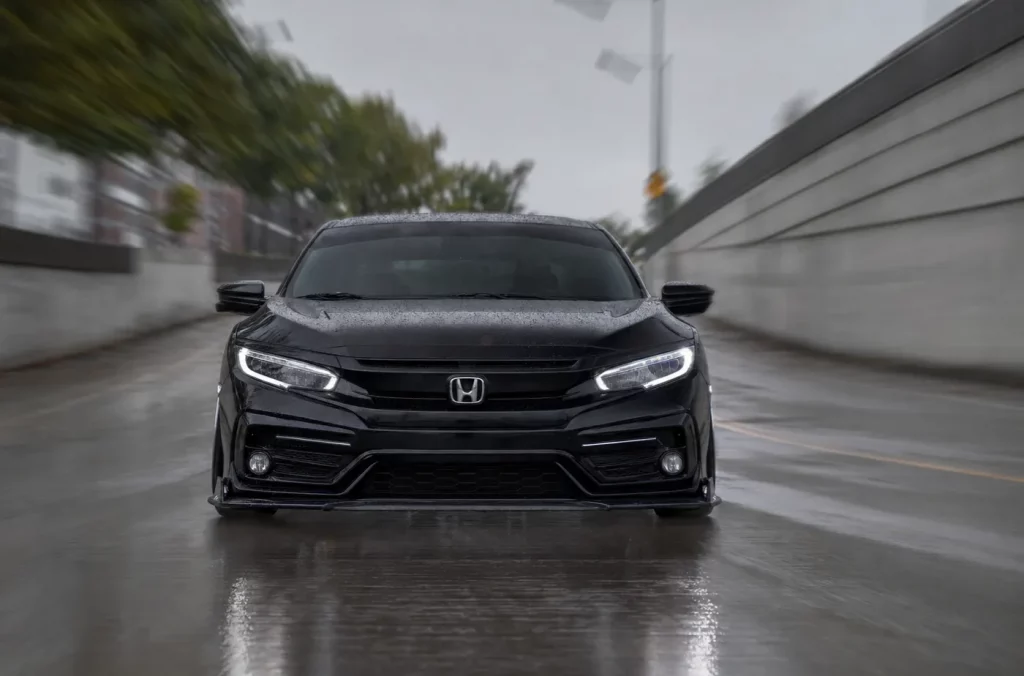
10th Gen Civic 1.5T Dyno Results — Stock vs Stage 1 vs Stage 2 vs Full Bolt-On on 93 Octane
This article documents real WHP and WTQ gains for the 2016–2021 Civic 1.5T — what each tuning stage actually adds on pump gas. The focus is on US-market non-Si 1.5T models (EX-T, Touring, Hatchback Sport) with the 6-speed manual transmission, with a separate section for the Civic Si.
The L15B7 — What Makes This Engine Special
The L15B7 is Honda’s first mainstream turbocharged four-cylinder in the Civic. It replaced the R18 and K24 engines that had powered the previous two generations. The engine uses a direct-injection fuel system, a Mitsubishi Heavy Industries TD03 turbocharger, and a compact 1.5-liter displacement. It produces 174–180 hp at the crank in non-Si form and 205 hp in the Si.
What makes the L15B7 particularly responsive to tuning is the factory calibration. Honda set the engine up conservatively to run on 87 octane fuel across all climates. The turbocharger is not pushed to its limit from the factory, and the fuel system has significant headroom. This means that a simple calibration change can unlock substantial power gains without any hardware modifications.
The L15B7 uses a closed-deck block design, which provides excellent cylinder stability under high boost. The connecting rods are the weak point — they are lightweight powdered-metal units that can bend under excessive low-end torque. This is why tuners typically taper boost targets AT lower RPM to protect the rods.
Not Every 10th Gen 1.5T Starts at the Same Power
One of the most important things to understand before looking at dyno numbers is that different 10th Gen Civic 1.5T models start at different power levels from the factory.
| Model | Factory Crank HP | Transmission | Factory Boost |
|---|---|---|---|
| Civic EX-T / Touring | 174 hp | CVT / 6MT | ~16 psi |
| Civic Hatchback Sport (2017–2018) | 180 hp | CVT / 6MT | ~16.5 psi |
| Civic Hatchback Sport (2019–2021) | 180 hp | CVT / 6MT | ~16.5 psi |
| Civic Si (2017–2020) | 205 hp | 6MT only | ~19 psi |
The Si is a different animal. It runs higher boost from the factory, has a larger intercooler, and uses a more aggressive calibration. The non-Si cars run lower boost and have smaller intercoolers. This means that a Stage 1 tune on an Si starts from a higher baseline than a Stage 1 tune on a non-Si car.
For this article, the primary dataset focuses on the 2016–2021 Civic EX-T, Touring, and Hatchback Sport with the 6-speed manual transmission. The Si is covered in a separate section.
Dyno Baseline: What the L15B7 Makes From the Factory
Factory-rated output is 205 HP at the crank for the Si and 174–180 hp for non-Si models, but chassis dyno testing reveals significant under-rating. The L15B7 consistently reads higher at the wheels than its crank rating would suggest, which has been confirmed by multiple independent tuners.
A stock non-Si 1.5T with the 6-speed manual typically produces 180–190 WHP and 190–205 WTQ on a Dynojet with 93 octane fuel. The Si produces approximately 200–210 WHP and 200–210 WTQ on the same dyno.
The figures below are from TSP (Two Step Performance) and PRL Motorsports Dynojet testing on 93 octane fuel unless otherwise noted. Different dynos read differently — TSP’s dyno produces lower absolute numbers than PRL’s — so the delta over stock within each test is the more meaningful figure.
| Configuration | WHP | WTQ | Boost | Source |
|---|---|---|---|---|
| Si — Stock | 182 whp | 206 wtq | ~19 psi | TSP dyno (93 oct) |
| Si — Stock | 208 whp | 203 wtq | ~19 psi | PRL dyno (93 oct) |
| Si — Stock (91 oct) | ~190 whp | ~190 wtq | ~19 psi | DSPORT (91 oct CA) |
| Non-Si MT — Stock | 187 whp | 200 wtq | ~16 psi | TSP dyno (93 oct) |
| Non-Si MT — Stock | ~184 whp | ~186 wtq | ~16 psi | Vit’s dyno (93 oct) |
The Si pulls roughly 2 psi more boost from the factory than non-Si variants, which accounts for most of its 15–20 whp advantage on the same fuel. The Si also benefits from a better-flowing intake tract and intercooler, though the turbocharger and engine block are identical between the two calibrations. (Sources: Two Step Performance, TSP Stage 1 tune page; PRL Motorsports, 1.5T Drop In Turbo blog, Feb 2026; DSPORT Magazine, Sept 2021; CivicX forum, stock non-Si dyno thread)
Stock 1.5T Dyno Results — Real-World Baseline
One of the most useful published baseline tests is from a 2017 Civic EX-T with the 6-speed manual. On TSP’s Dynojet, the car produced 187 WHP and 200 WTQ on the factory calibration. This is a real-world baseline from an actual car, not a manufacturer claim.
It is important to note that this is not a universal number. A stock baseline is meaningful primarily when compared with later runs on the same car and dyno. Different dynos, weather conditions, and fuel quality all affect the absolute number.
Factory HP is not wheel HP. The factory rating of 174–180 hp is at the crank. On a Dynojet, the drivetrain loss through the 6-speed manual transmission is approximately 10–12%, which puts the stock WHP in the 180–190 range.
Stage 1: Tune Only — The Biggest Gain Per Dollar
A Stage 1 calibration does not replace any hardware. It adjusts boost targets, ignition timing, cam timing, fuel tables, throttle response, and disables rev hang. On the 10th gen L15B7, this is done through either KTuner or Hondata FlashPro. The factory tune leaves significant headroom because it must account for 87 octane fuel, altitude variation, and octane learning. A Stage 1 tune on 93 octane reclaims most of that headroom.
The TSP Stage 1 tune, developed by Derek Robinson of Innovative Motorworks, is the most widely documented off-the-shelf calibration for the Si. On a stock 2017 Civic Si running 93 octane, it produced 237 whp and 281 wtq from a factory baseline of 182 whp and 206 wtq — a gain of 55 whp and 76 wtq. Boost increases from 19 psi to approximately 24.5 psi on Map 3 (Sport mode). The torque curve shifts dramatically: peak torque arrives at roughly the same 3,200–3,400 rpm range but holds higher for longer, and the midrange gain from 2,500 to 5,000 rpm is the most noticeable difference in daily driving.
TSP later released the Stage One+ tune, a more aggressive revision running 26 psi on 93 octane. On a stock 2020 Si, it produced 248 whp and 290 wtq — an additional 11 whp and 9 wtq over the standard Stage 1. The One+ tune requires 93 octane exclusively and an upgraded clutch is recommended, as the stock clutch can slip under the higher torque output, particularly in warmer conditions. (Source: Two Step Performance, TSP Stage 1 and Stage One+ product pages)
The Ktuner starter 23-psi base map sits in between: 208 whp and 258 wtq. It is a conservative baseline included with the KTuner unit, intended as a safe starting point for custom tuning rather than a final calibration.
| Tune Calibration | WHP | WTQ | Peak Boost | Fuel Required |
|---|---|---|---|---|
| Factory calibration | 182 whp | 206 wtq | 19 psi | 87 octane |
| KTuner Starter 23 psi | 208 whp | 258 wtq | 23 psi | 91+ octane |
| TSP Stage 1 | 237 whp | 281 wtq | 24.5 psi | 91+ octane |
| TSP Stage One+ | 248 whp | 290 wtq | 26 psi | 93 octane only |
Important caveat: The stock Si clutch begins to show signs of slip above roughly 260 wtq on a Dynojet. The Stage One+ tune at 290 wtq exceeds that threshold, and owners should budget $1,200–1,800 for a clutch upgrade (ClutchMasters FX250/350, ACT, or South Bend options are common). The Stage 1 tune at 281 wtq is near the limit and may slip on higher-mileage cars or in hot weather.
Why Stage 1 Gives So Much Torque
There are several reasons why a simple software change produces such dramatic results on the L15B7.
First, the factory boost targets are conservative. The non-Si runs approximately 16 psi peak, and the Si runs approximately 19 psi. A Stage 1 tune raises these targets to 21–24 psi, which is a significant increase in airflow. More air means more power.
Second, the torque limits are raised. The factory ECU uses torque-based control, meaning it targets a specific torque output and adjusts boost, throttle, and timing to achieve it. Raising the torque limits allows the engine to produce significantly more torque.
Third, the throttle response is sharpened. The factory calibration uses a delayed throttle response to improve fuel economy and drivability. A Stage 1 tune removes this delay, making the car feel much more responsive.
Fourth, the ignition timing is optimized for higher octane fuel. The factory calibration is designed for 87 octane and is conservative on 93. A Stage 1 tune adds timing advance, which increases power without increasing boost.
Fifth, the cam timing is adjusted. The L15B7 uses variable valve timing on both the intake and exhaust cams. Optimizing cam timing for power improves cylinder filling and exhaust scavenging.
KTuner’s Stage 1 calibration for the 2016–2021 Civic Turbo increases boost targets to approximately 18–21 psi depending on the MAP, along with changes to throttle response and spool behavior. However, the boost number alone does not determine the WHP gain — the calibration strategy matters just as much.
Peak Gains vs Gains Across the Powerband
One of the most common mistakes when evaluating dyno results is focusing only on peak horsepower. A tune that adds 32 WHP at the peak might add 39 WHP at a specific RPM in the midrange. The area under the curve is often more important than the peak number.
On the 2017 Civic EX-T, the TSP Stage 1 tune added 39 WHP at 6,100 RPM and 63 lb-ft of torque at 3,400 RPM. The peak gains were 32 WHP and 58 WTQ, but the gains at specific points in the powerband were even larger.
This is why a Stage 1 tune feels so much faster than the peak numbers suggest. The midrange torque gain transforms the driving experience.
Don’t judge a tune by peak WHP alone. Consider the peak number, the midrange gain, the area under the curve, the torque delivery, and the heat-soak consistency.
Stage 1 Non-Si: 10th Gen Civic EX-T / Touring / Hatchback Sport
The non-Si 1.5T (found in the Civic LX, EX, EX-T, Hatchback Sport, and Sport Touring) shares the same L15B7 block and turbocharger as the Si. The differences are in calibration, intake, and intercooler. The factory tune runs approximately 16 psi of boost versus the Si’s 19 psi, and the intercooler is smaller.
The TSP Stage 1 tune for the non-Si produces 219 whp and 258 wtq from a stock baseline of 187 whp and 200 wtq on 93 octane — a gain of 32 whp and 58 wtq. (Source: Two Step Performance, Non-Si Stage 1 tune page)
The non-Si tune holds torque to approximately 3,400 rpm, somewhat lower than the Si Stage 1 tune, to avoid overstressing the CVT (CVT cars receive a further torque-limited calibration below 3,000 rpm). Non-Si manual cars can run the same bolt-on modifications and drop-in turbo as the Si, but the fuel system is the same, and the stock clutch on the non-Si 6MT is weaker than the Si’s. Most non-Si owners running Stage 2 power levels report clutch slip above 240 wtq.
| Non-Si Configuration | WHP | WTQ | Gain over Stock |
|---|---|---|---|
| Stock | 187 whp | 200 wtq | — |
| KTuner Starter 21 psi | 203 whp | 250 wtq | +16 whp / +50 wtq |
| TSP Stage 1 (93 oct) | 219 whp | 258 wtq | +32 whp / +58 wtq |
Stage 2: Bolt-Ons + Tune (Stock Turbo)
Stage 2 on the 10th gen L15B7 adds hardware to improve airflow into and out of the engine. The standard recipe includes:
Cold air intake (CAI): A quality CAI (PRL Cobra, 27WON, or Mishimoto) adds 5–10 whp by reducing intake air temperatures and improving flow. The key benefit is not peak power but consistency: a CAI pulls air from outside the engine bay rather than from behind the radiator, reducing heat-soak-induced timing retard on consecutive pulls. (Source: 27WON Performance, How to Make 300hp blog, 2021)
Downpipe and front pipe: The factory downpipe is the single most restrictive element in the exhaust system. Replacing it with a 3-inch catted or catless downpipe and matching front pipe adds 15–20 whp. The gains come from increasing the pressure differential across the turbo turbine, allowing exhaust gases to exit faster and reducing backpressure. PRL, 27WON, and RV6 offer the most common downpipe options. (Source: 27WON Performance, 2021; CivicX forum, community dyno thread)
Front-mount intercooler (FMIC): The stock Si intercooler is a bar-and-plate unit that heat-soaks quickly during sustained boost. Aftermarket FMICs (PRL, Mishimoto, 27WON, HKS) are typically 50–70 percent larger in core volume. Mishimoto documented a 20–40-degree Fahrenheit drop in charge air temperatures across their intercooler on a tuned Si, with corresponding power gains of roughly 10 whp on a tuned car. On back-to-back dyno pulls, the factory intercooler loses power rapidly as IATs climb; an aftermarket unit holds power across multiple pulls. (Source: Mishimoto Engineering Blog, 2018; PRL Motorsports, Feb 2026)
Combined, the full bolt-on package (CAI + downpipe/front pipe + FMIC + tune on 93 octane) produces approximately 270–290 whp depending on the dyno. The stock turbocharger is the limiting factor: the MHI TD03 runs out of flow capacity at roughly 280–290 whp on 93 octane with bolt-ons and a tune. Beyond that point, compressor discharge temperatures spike and the turbo becomes a restriction rather than a power adder.
| Upgrade | WHP Gain (Typical) | Notes |
|---|---|---|
| Cold air intake only | +5 to +10 whp | Gains from lower IATs, not airflow |
| Downpipe + front pipe only | +15 to +20 whp | Biggest single hardware gain |
| Front-mount intercooler only | +5 to +15 whp | Sustained power, not peak |
| Turbo inlet pipe | +3 to +5 whp | Minor spool improvement |
| Cat-back exhaust | +3 to +8 whp | Downpipe is the bottleneck, not the cat-back |
| Full bolt-ons + Stage 2 tune (93 oct) | +85 to +100 whp over stock | Turbo-limited; ~270–290 whp typical |
What Does Stage 2 Actually Mean?
One of the problems with the term “Stage 2” is that it is not standardized. For one tuner, Stage 2 means a tune and an intake. For another, it means a tune, intake, downpipe, and intercooler. For a third, it means a tune and ethanol blend.
To avoid confusion, this article uses the following definitions:
Stage 1: Tune only on otherwise stock hardware.
Stage 2: Tune plus supporting hardware modifications (intake, downpipe, intercooler).
Full Bolt-On (FBO): Multiple airflow and cooling upgrades plus a custom or advanced tune.
This provides a consistent framework for comparing results across different builds.
Stage 2 Real-World Dyno Results
A well-documented Stage 2 build on a 2019 Civic Hatchback Sport with the 6-speed manual included a PRL Cobra intake, turbo inlet pipe, Mishimoto intercooler, Borla catback, PRL Street downpipe, flex-fuel hardware, Hondata, and a Stage 2 OTS calibration. The result was 248 WHP and 293 WTQ.
This is a documented example, not a guarantee. The result reflects the complete hardware package and calibration rather than one standardized Stage 2 definition. Different hardware combinations and tuning strategies will produce different results.
Stage 2 is worth it on the stock turbo if you are willing to invest in the supporting hardware. The gains are significant, particularly in the midrange, and the car feels substantially faster than a Stage 1 car. However, the stock turbo remains the limiting factor, and the cost per WHP is higher than Stage 1.
Full Bolt-On (FBO): Stock Turbo, Maximum Effort
With the stock turbo pushed to its flow ceiling, the FBO 10th gen Si running 93 octane typically lands at 275–290 whp and 290–310 wtq on a Dynojet. On 91 octane, 27WON reports most cars land at 280–285 whp; on 93 octane, the same cars hit just above 300 whp. The limiting factor is the stock turbo compressor wheel, which cannot flow enough air above approximately 26 psi to support higher output without generating excessive discharge temperatures that trigger knock retard.
The TSP Stage 2 Flex Fuel tune reaches 270 whp and 327 wtq on an ethanol blend (approximately E30–E40) while using the stock turbo. That torque figure is substantially higher than what the stock clutch can handle — virtually every Stage 2 car requires an upgraded clutch. The stock fuel system can support up to approximately 30 percent ethanol content before injector duty cycle becomes a concern. (Source: TSP, Stage 2 Flex Fuel tune; PRL Motorsports, Feb 2026)
FBO — What Actually Counts?
Typical FBO setup for the 10th Gen 1.5T includes:
- Cold air intake
- Turbo inlet pipe
- Front-mount intercooler
- Charge pipes
- Downpipe
- Front pipe
- Catback exhaust
- Custom calibration
However, FBO is not an official technical standard. Every build has its own combination of parts. This is why it is important to look at specific documented builds rather than assuming there is one FBO power number.
Drop-In Turbo Upgrade: FBO + Bigger Turbo
The single largest power adder for the L15B7 is a drop-in turbocharger that replaces the stock MHI TD03 unit while using the factory mounting points, Coolant lines, and oil lines. PRL Motorsports documented their 1.5T Drop In Turbo on a 10th gen Civic Si equipped with PRL’s full bolt-on catalog (CAI, downpipe, front pipe, intercooler, turbo inlet pipe).
On 93 octane, the car produced 302 whp at 6,000 rpm and 319 wtq at 4,100 rpm. The results represent a 45 percent increase in horsepower and a 57 percent increase in torque over the stock baseline of 208 whp and 203 wtq (on PRL’s dyno). On a 26 percent ethanol blend (E26), output climbed to 324 whp at 6,500 rpm and 333 wtq at 4,300 rpm. The torque curve below 3,500 rpm was transformed: at 3,500 rpm, the car made 256 wtq on 93 octane versus the stock 182 wtq — a 41 percent improvement. (Source: PRL Motorsports, 1.5T Drop In Turbo Dyno Testing, Feb 2026)
The 27WON W1 and W2 drop-in turbos follow a similar formula, with the W1 targeting 300–320 whp on pump fuel and the W2 capable of 330–350 whp on ethanol blends. DSPORT Magazine documented that the MHI sport turbo upgrade (essentially the same concept) delivers 295–300 whp on a stock long-block with supporting bolt-ons and 91 octane fuel. (Source: DSPORT Magazine, Sept 2021; 27WON Performance, How to Make 300hp, 2021)
The Intercooler — Does It Add Peak WHP?
On a single dyno pull, the intercooler may add only a small amount of peak power — typically 3–10 WHP depending on the conditions. Its real benefit is consistency. On back-to-back pulls, the stock intercooler heat-soaks and the ECU pulls timing, reducing power. An aftermarket intercooler holds power across multiple pulls.
Mishimoto conducted controlled testing of the 1.5T with different combinations of intercooler, piping, and tune. The intercooler itself gave a small peak gain — up to 3 WHP and 8 WTQ — while its primary advantage was in reducing charge air temperature and resisting heat soak.
This is a common misconception: a bigger intercooler does not automatically add significant peak horsepower. Its benefit is most apparent on hot days and during sustained boost, where it prevents charge air temperature from rising and triggering knock retard.
The intercooler’s potential becomes much more significant on a tuned setup. Mishimoto’s testing showed that the intercooler’s benefits were amplified when combined with a calibration that could take advantage of the lower intake air temperatures.
The Intake — Real Power or Mostly Sound?
Intakes are often marketed with claims of +15 HP, but real-world results without proper calibration can be significantly more modest. One detailed community test found that installing a CAI and intercooler on the stock tune produced a gain of approximately 5–7 WHP across a wide rev range. Further calibration optimization produced much larger gains.
This is an important lesson: hardware creates potential, but the calibration determines how much of that potential is actually used. An intake alone is not a magic power adder. Combined with a proper tune, it can contribute to the overall package.
The Tune Is Usually the Multiplier
This is one of the most important thesis points of the article: Hardware Creates Potential. The Tune Uses It.
The intercooler alone produces a small peak gain. But after a tune, the intercooler delivers lower IATs, less heat soak, more stable boost, and better power repeatability. Mishimoto’s testing showed that the intercooler’s potential becomes more apparent on a tuned setup.
Similarly, a downpipe without a tune produces almost no gain. The ECU is torque-targeted and will reduce boost to maintain its targets. The downpipe creates potential, but the tune unlocks it.
This is why a Stage 1 tune delivers more power than bolt-ons without a tune. The calibration is the key.
Consolidated Dyno Comparison: Si Edition
| Stage | Hardware | WHP | WTQ | Gain over Stock |
|---|---|---|---|---|
| Stock | Factory | 182 whp | 206 wtq | — |
| Stage 1 | Tune only | 237 whp | 281 wtq | +55 whp / +75 wtq |
| Stage 1+ | Tune only (26 psi) | 248 whp | 290 wtq | +66 whp / +84 wtq |
| Stage 2 | CAI + DP/FP + FMIC + tune | ~275–290 whp | ~295–315 wtq | +93 to +108 whp |
| FBO + Drop-In Turbo | FBO + upgraded turbo (93 oct) | 302 whp | 319 wtq | +120 whp / +116 wtq |
| FBO + Drop-In + E26 | FBO + upgraded turbo + ethanol | 324 whp | 333 wtq | +142 whp / +130 wtq |
TSP baseline figures (182/206) used as stock reference. Stage 2 and drop-in turbo figures from PRL’s dyno (stock 208/203 baseline). The Stage 2 range reflects multiple sources and dyno variation.
Efficiency of Each Dollar: Cost per WHP
The L15B7 responds to modifications with unusual efficiency relative to earlier Honda engines. A K-series or B-Series required $3,000–5,000 in head work, cams, and headers to gain 50 whp; the L15B7 gains 55 whp from a $600–800 tuning device and a $150 off-the-shelf calibration file.
Stage 1 ($750–1,000): KTuner V2 ($449–549) or Hondata FlashPro ($695–795) plus an OTS tune file ($150). Total cost approximately $600–950. Gain: 50–55 whp. Cost per whp: approximately $12–17.
Stage 2/FBO ($2,500–3,500): Tuning device and tune ($600–950), cold air intake ($300–450), downpipe and front pipe ($500–700), front-mount intercooler ($500–800), clutch upgrade ($1,200–1,800). Total cost approximately $3,100–4,700. Gain: 90–110 whp over stock. Cost per whp: approximately $30–45.
Drop-in turbo FBO ($4,500–6,000): Everything in Stage 2 plus drop-in turbocharger ($800–1,200) and flex fuel kit ($250–450). Total cost approximately $4,000–6,000. Gain: 120–140 whp over stock. Cost per whp: approximately $35–45.
The Stage 1 tune remains the highest-efficiency modification in the L15B7 catalog by a wide margin. A 55 whp gain for under $1,000 represents a power-per-dollar ratio that is difficult to match across the broader Honda aftermarket. However, the Stage 1 tune exposes the clutch as a weak point on higher-mileage cars, and owners should budget accordingly.
Torque Curve Comparison: Where the Power Lives
The shape of the torque curve changes substantially between stages. The stock L15B7 in the Si delivers peak torque of 206 wtq at roughly 3,200 rpm, then tapers to approximately 180 wtq by 6,000 rpm. The TSP Stage 1 tune raises peak torque to 281 wtq at roughly the same engine speed and holds approximately 220 wtq to 6,000 rpm.
The PRL drop-in turbo configuration changes the character entirely. On 93 octane, peak torque of 319 wtq arrives at 4,100 rpm (higher than stock), but below 3,000 rpm the curve is nearly identical to stock. From 3,000 rpm upward, the additional airflow from the larger compressor wheel produces a torque curve that climbs steeply to its peak and holds more strongly to redline. At 5,500 rpm, the drop-in turbo car still makes approximately 290 wtq — more than the Stage 1 tune makes at its peak.
Limitations: Clutch, Fuel System, and Turbo
Three components limit how far the L15B7 can go on pump fuel without internal engine modification:
Clutch. The factory clutch in the Si handles approximately 260–270 wtq on a Dynojet before slipping becomes intermittent, and approximately 280 wtq before it becomes consistent. Higher-mileage clutches slip sooner. The non-Si manual clutch slips earlier, around 240 wtq. An upgraded clutch is mandatory for Stage 2 and highly recommended for Stage One+ tune users who drive the car hard.
The stock clutch on the non-Si is even weaker. Most non-Si owners running Stage 2 power levels report clutch slip above 240 wtq. This is a significant limitation for anyone building a non-Si 1.5T.
Fuel system. The L15B7 uses direct injection with a high-pressure Fuel Pump (HPFP) that can support approximately 30 percent ethanol content before injector duty cycle reaches 100 percent. Beyond that point, fuel pressure drops and the engine runs lean. Upgraded HPFPs (Nostrum, XDI) are available but rare on this platform. On 93 octane alone, the stock fuel system is not a limiting factor for any of the configurations described above.
Turbocharger. The stock MHI TD03 compressor wheel runs out of flow at approximately 26–27 psi. Above that boost pressure, discharge temperatures exceed 250 degrees Fahrenheit, triggering knock retard and reducing timing advance. A drop-in turbo solves this by fitting a larger compressor wheel (approximately 48.3 mm inducer / 60 mm exducer versus the stock ~42 mm inducer) within the same housing, allowing the engine to reach 300+ whp without exceeding safe discharge temperatures.
CVT vs Manual — Why Dyno Results Are Harder to Compare
The CVT presents unique challenges for dyno testing. The CVT can use a different RPM profile, load the dyno differently, and is more difficult to compare with the 6-speed manual. Even KTuner warns that their CVT dyno numbers can be skewed due to RPM mismatches during testing.
For this reason, the primary tables in this article are based on 6-speed manual cars. CVT cars should be evaluated separately, and the torque numbers on CVT cars are typically lower than on manual cars due to transmission limitations.
If you have a CVT Civic, forget about the numbers above 220 WTQ. The steel belt in the CVT physically begins to slip at high torque. Tuners artificially smooth the torque curve in the KTuner software to protect the transmission from destruction.
Safety Warning: The L15B7’s Weak Connecting Rods
The stock connecting rods in the L15B7 are thin and do not tolerate high low-end torque. If peak boost is set at 2,500–3,000 rpm, the rods can bend or break. This is why competent custom tuning always shifts the torque peak higher in the rev range — typically closer to 4,000 rpm — to protect the bottom end.
The rods are the primary limitation of the L15B7 platform. They are lightweight powdered-metal units designed for fuel efficiency, not high boost. Once torque exceeds approximately 300 WTQ, the rods are under significant stress. This is why many tuners prefer to limit torque rather than chase peak numbers.
For builds targeting 300+ WHP, a forged rod upgrade is strongly recommended. Aftermarket rods from companies like Saenz, Manley, or Eagle can handle significantly more torque and provide a safety margin for high-boost applications.
Heat Soak — The Stock Intercooler’s Weakness
The factory intercooler on the 10th Gen Civic is small and heat-soaks quickly. After a few dyno runs, intake air temperatures (IATs) climb significantly, and the ECU begins pulling timing, costing 15–20 WHP.
This is why an upgraded intercooler is one of the first purchases for anyone moving beyond Stage 1. An aftermarket intercooler allows the car to hold power across multiple pulls and is essential for track use or repeated hard driving.
PRL Motorsports documented that their aftermarket intercooler reduced charge air temperatures by 20–40 degrees Fahrenheit compared to the stock unit on a tuned 1.5T. On hot days, the difference is even more significant.
Beyond Full Bolt-On: When the Stock Turbo Is No Longer the Limit
In 2026, PRL Motorsports published a test of a 10th Gen Civic Si with their 1.5T Drop-In Turbo and a full set of bolt-ons. The stock baseline of this Si was 208 WHP and 203 WTQ. On 93 octane, the modified setup reached 302 WHP and 319 WTQ.
This is a different category from FBO. It is an upgraded turbo setup that goes beyond the stock turbo’s flow ceiling. For owners who want 300+ WHP, a drop-in turbo upgrade is the next logical step.
This configuration should not be included in the main FBO table for non-Si 1.5T cars. It is a separate upgrade path with different costs and considerations.
| Configuration | Setup | Fuel | WHP | WTQ | Evidence |
|---|---|---|---|---|---|
| 2017 EX-T 6MT | Stock | 93 | 187 | 200 | Same-car baseline |
| 2017 EX-T 6MT | KTuner 21 psi | 93 | 203 | 250 | Same dyno |
| 2017 EX-T 6MT | TSP Stage 1 | 93 | 219 | 258 | Same dyno |
| Hatchback Sport MT | Stage 2-style FBO | Premium | 248 | 293 | Documented build |
| Modified Si | Drop-in turbo + FBO | 93 | 302 | 319 | Different category |
The first three rows show the most useful comparison — a direct stock-to-Stage 1 progression on the same car and dyno. The 248/293 result is from a specific modified Hatchback Sport build. The 302/319 result is from an upgraded-turbo Civic Si, which should be kept separate from the stock-turbo non-Si comparison.
Estimated Stage Progression — Typical Observed Ranges
The table below shows typical observed ranges for each stage, based on published dyno examples. These are not guaranteed results. Individual results vary based on the specific car, dyno, fuel quality, and calibration.
| Stage | Typical WHP | Typical WTQ |
|---|---|---|
| Stock | 180–195 | 180–210 |
| Stage 1 | 200–225 | 230–265 |
| Stage 2 | 215–240 | 245–280 |
| FBO | 230–255 | 260–300 |
Quick Reference Checklist
☐ Stock non-Si 1.5T WHP on Dynojet: 180–190 / Si: 200–210
☐ Stage 1 tune (KTuner/Hondata, non-Si): 219 WHP / 258 WTQ (TSP, 93 oct)
☐ Stage 1 tune (KTuner/Hondata, Si): 237 WHP / 281 WTQ (TSP, 93 oct)
☐ Stage One+ tune (Si, 26 psi): 248 WHP / 290 WTQ — 93 octane only
☐ Stage 2 (CAI + DP/FP + FMIC + tune): ~275–290 WHP / ~295–315 WTQ (Si)
☐ FBO + drop-in turbo (93 oct): 302 WHP / 319 WTQ (PRL, Si)
☐ FBO + drop-in + E26: 324 WHP / 333 WTQ (PRL, Si)
☐ Intercooler alone: small peak gain — consistency benefit is more important
☐ Downpipe + tune: +15–20 WHP — largest single hardware gain
☐ Intake alone: +5–10 WHP — benefits from lower IATs
☐ Catback exhaust: +3–8 WHP — downpipe is the bottleneck
☐ Stage 1 tune is the best power-per-dollar mod — 50+ WHP for under $1,000
☐ Stock clutch limit (Si): ~260–270 WTQ — Stage One+ exceeds this
☐ Stock clutch limit (non-Si): ~240 WTQ — Stage 2 requires clutch upgrade
☐ CVT torque limit: ~220 WTQ — higher torque will damage the transmission
☐ Stock connecting rods are the engine’s weak point — avoid aggressive low-end torque
☐ Stock intercooler heat-soaks quickly — upgrade recommended for Stage 2
☐ Dyno numbers are not directly comparable across different dynos and conditions
☐ CVT dyno results are harder to compare than manual — different RPM profiles
FAQ — 10th Gen Civic 1.5T Dyno Results
How much WHP does a stock 10th Gen Civic 1.5T make?
A stock non-Si 1.5T with the 6-speed manual typically produces 180–190 WHP and 190–205 WTQ on a Dynojet with 93 octane. The Si produces 200–210 WHP and 200–210 WTQ. Different dynos will produce different numbers.
How much WHP does Stage 1 add?
On a non-Si 1.5T, TSP Stage 1 adds 32 WHP and 58 WTQ, going from 187 to 219 WHP. On the Si, TSP Stage 1 adds 55 WHP and 75 WTQ, going from 182 to 237 WHP. The Stage One+ tune adds even more: 248 WHP and 290 WTQ.
Is Stage 2 worth it on the stock turbo?
Yes — Stage 2 adds significant midrange power and transforms the driving experience. However, the stock clutch becomes a limitation, and the cost per WHP is higher than Stage 1. For a budget-conscious owner, Stage 1 is the better value.
How much torque can the stock CVT handle?
The CVT is the limiting factor on automatic cars. Torque above approximately 220 WTQ can cause the steel belt to slip, leading to transmission failure. Tuners typically limit torque on CVT cars to protect the transmission. If you have a CVT, do not expect to reach the numbers listed for manual cars.
Does an intercooler add horsepower?
On a single dyno pull, an intercooler adds a small amount of peak power — typically 3–10 WHP. Its real benefit is consistency: it prevents heat soak and allows the car to hold power across multiple pulls. On a tuned car, the intercooler’s benefits are amplified.
Do I need an intake for Stage 1?
No — Stage 1 is a tune only. The factory intake is sufficient for Stage 1 power levels. An intake is a Stage 2 upgrade that adds power when combined with a tune and other supporting modifications.
Can a stock-turbo Civic 1.5T make 250 WHP?
Yes — with full bolt-ons (CAI, downpipe, intercooler) and a custom tune on 93 octane, a non-Si 1.5T can reach 240–255 WHP. The Si can reach 275–290 WHP with the same modifications. These are observed ranges, not guarantees.
What does Stage 2 actually mean?
Stage 2 typically means a tune plus supporting hardware modifications: intake, downpipe, intercooler, and often a clutch upgrade. However, the definition varies between tuners. This article uses Stage 1 (tune only) and Stage 2 (tune + hardware).
Is 93 octane required for tuning?
Most off-the-shelf tunes are designed for 91 or 93 octane. 93 octane allows more aggressive timing and boost targets, producing more power. Running 87 octane on a 93 octane tune will cause knock and potential engine damage. Always use the fuel specified by the tune.
Why does my dyno number differ from someone else’s?
Dynos vary significantly between shops and even between runs on the same dyno. Weather, altitude, fuel quality, and the specific car’s health all affect the number. The most meaningful comparison is the gain on the same car and dyno, not the absolute number.