

The FK8 Honda Civic Type R (2017–2021) represents Honda’s first factory turbocharged performance Civic sold in global markets. Powered by the K20C1, a 2.0-liter turbocharged four-cylinder rated at 306 hp at 6,500 rpm and 295 lb-ft at 2,500–4,500 rpm at the crank, the FK8 was designed from the outset for both track performance and daily usability. The engine features a closed-deck block, forged steel crankshaft, forged connecting rods, sodium-filled exhaust valves, and a dual-scroll Mitsubishi Heavy Industries TD04 Turbocharger. The factory boost pressure is approximately 23 psi peak, tapering to approximately 18 psi at redline.
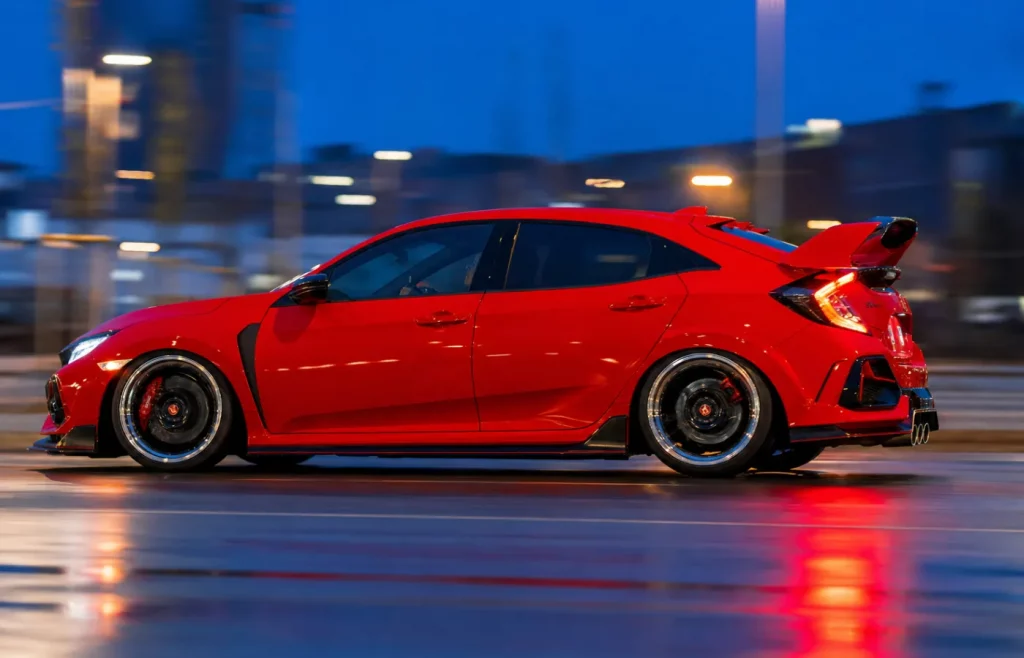
The K20C1 responds to modifications with an enthusiasm that surprised even experienced Honda tuners. The combination of a robust bottom end, direct injection, and a turbocharger that is not pushed to its limit from the factory means that substantial power gains are available through calibration alone, and bolt-on modifications push the platform well past 400 crank horsepower on pump gas. This article documents dyno-verified output at every stage: stock, Stage 1 tune-only, downpipe and tune, and full bolt-on on 93 octane pump fuel.
FK8 Type R Dyno Results at a Glance
There is no single “stock WHP” number for the FK8 Type R. Different dynos, weather, elevation, and correction factors produce different results. The ranges below represent observed results from published dyno tests and community data.
| Setup | Typical WHP Range | Typical WTQ Range | Fuel |
|---|---|---|---|
| Stock | 285–310 | 260–305 | 91–93 |
| Stage 1 tune | 320–345 | 330–360 | 91–93 |
| Custom tune + basic mods | 335–365 | 350–380 | 91–93 |
| Downpipe + tune | 340–370 | 350–390 | 91–93 |
| FBO + custom tune | 370–390 | 370–400 | 93 |
These are observed ranges from published dyno results, not guaranteed results for every car. Community compilations show that a tune alone typically delivers significantly more effect than FBO without ECU calibration.
Stock Output: How Much WHP Does the K20C1 Really Make?
The FK8 Type R is known for producing wheel horsepower figures that closely approach its crank rating, a result of relatively low drivetrain loss through the 6-speed manual transmission and the engine’s efficient power delivery. However, the FK8 is also unusually sensitive to ambient conditions. The factory ECU pulls boost aggressively in hot weather, and dyno results vary significantly based on intake air temperature, barometric pressure, and whether the car was allowed to cool between pulls.
Most healthy stock FK8 Type Rs appear to dyno somewhere around 285–310 WHP on common chassis dynamometers, but direct comparisons between different dynos are unreliable.
| Configuration | WHP | WTQ | Dyno Type | Source |
|---|---|---|---|---|
| Stock (2018) | 293 whp | 283 wtq | Dynojet | DSPORT Magazine |
| Stock (2018) | 287 whp | 260 wtq | JST dyno | JST Performance |
| Stock (Canada) | 280 whp | 285 wtq | Dynapack | CivicX owner |
| Stock (2021, 65°F) | 334 whp | 340 wtq | Dynojet | CivicX owner |
| Stock (typical range) | 290–305 whp | 280–295 wtq | Dynojet | Community consensus |
The torque curve is the defining characteristic of the stock K20C1. Peak torque of approximately 280–295 wtq arrives by 3,000–3,500 rpm and holds flat through approximately 5,000 rpm before tapering. The horsepower curve climbs steadily from 3,000 rpm to its peak AT approximately 6,200–6,500 rpm.
Stage 1: Tune Only — The Best Power-per-Dollar Upgrade
The K20C1’s factory calibration leaves substantial headroom. The ECU targets a peak boost of approximately 23 psi, but the turbocharger and engine are capable of safely running 26–28 psi on pump fuel with proper calibration. A Stage 1 tune through Hondata FlashPro or KTuner adjusts boost targets, ignition timing, cam timing, fuel tables, and throttle response while keeping all factory hardware in place.
The Stage 1 tune is the single highest-efficiency modification in the FK8 catalog. A 50+ whp gain for under $1,000 is exceptional by any standard, and it is achieved without any hardware changes.
Why does the FK8 feel much faster after a tune? Because the tune increases boost, torque, throttle mapping, and torque targets. The car becomes significantly more responsive throughout the rev range.
| Setup | WHP | WTQ | Gain | Source |
|---|---|---|---|---|
| Stock (DSPORT) | 296.7 | 290.6 | — | DSPORT Magazine |
| Hondata OTS tune | 318.9 | 335.0 | +22 WHP / +44 WTQ | DSPORT Magazine |
| Stock (JST) | 287 | 260 | — | JST Performance |
| KTuner Stage 1 OTS | 342 | 352 | +55 WHP / +92 WTQ | JST Performance |
| Stock (Vivid Racing) | 233 | 257 | — | Vivid Racing |
| VR Tuned ECU flash | 290 | 350 | +57 WHP / +93 WTQ | Vivid Racing |
The typical Stage 1 FK8 on 93 octane produces 330–350 whp and 340–360 wtq on a Dynojet, depending on the specific calibration and ambient conditions. Boost targets increase to approximately 26–28 psi peak, tapering to approximately 22–24 psi at redline. The stock clutch handles Stage 1 power levels without issue on most cars.
Stage 1 OTS Tune vs Custom Tune
A custom tune does not automatically mean huge peak horsepower gains over an OTS calibration. The advantage of a custom tune often lies in smoother power delivery, safer fueling, better boost control, improved midrange response, and adaptation to the specific car and fuel quality.
JST Performance documented a custom 93 octane tune on a car with an upgraded intercooler and cat-back exhaust (stock downpipe, stock intake) producing 363 whp and 376 wtq — a gain of 76 whp and 116 wtq over their stock baseline. The custom tune was more aggressive than the Ktuner OTS Stage 1 calibration, with optimized ignition timing and boost targeting for the specific fuel and hardware combination.
Does a Downpipe Add Power Without a Tune?
Many owners assume that adding an intake, exhaust, and downpipe automatically yields huge power gains. On the FK8, this is not always true.
FBO without a tune produces almost no peak WHP gain. The FK8 ECU is oriented toward torque targets. If the engine begins producing more airflow and torque, the ECU can reduce boost, adjust throttle, and modify engine management to maintain its targets. Bolt-ons create potential. The calibration determines how much of that potential is actually used.
Downpipe + Tune Dyno Results
Replacing the factory downpipe with a 3-inch aftermarket unit is the single most effective bolt-on modification for the K20C1. The downpipe reduces exhaust backpressure downstream of the turbocharger turbine, allowing the turbo to spool more quickly and maintain higher boost at high rpm.
A CivicX owner with an HKS intake, HKS intercooler and charge pipes, RV6 downpipe and front pipe, and a custom tune from Kinetic Autoworks produced 383 whp and 398–404 wtq on 93 octane. This car had a full bolt-on setup minus a cat-back exhaust.
The downpipe typically adds 15–25 whp on a tuned FK8 compared to the same tune with the stock downpipe. A catted downpipe adds approximately 15–20 whp; a catless downpipe adds approximately 20–25 whp but requires a defouler or ECU calibration to suppress the check engine light.
Full Bolt-On (FBO): The Ultimate Pump Gas Setup
Full bolt-on for the FK8 Type R includes a cold air intake, downpipe, front pipe, front-mount intercooler, cat-back exhaust, and a custom tune on 93 octane. At this stage, the stock turbocharger is the primary limiting factor, and the engine produces approximately 370–390 whp.
A well-documented FBO build on CivicX used PRL Motorsports components: PRL intercooler, PRL catted downpipe, PRL Stage 1 intake, PRL charge pipes, Remus cat-back exhaust, and a custom tune on 93 octane. The result was 376 whp and 387 wtq. The owner noted that the catted downpipe likely cost 5–10 whp compared to a catless unit.
The highest documented FBO result on 93 octane pump gas comes from a CivicX owner with HKS intercooler, front pipe, and downpipe, PRL charge pipes, Mishimoto intake and radiator, and a Hondata FlashPro custom tune by Derf Tuned. The car produced 390 whp on 93 octane. The tuner noted that most FBO FK8s on his dyno land at 370–380 whp.
The Intercooler Factor: Why It Matters
The FK8’s factory intercooler is adequate for stock power levels but heat-soaks quickly during sustained boost. On a tuned car running higher boost, the stock intercooler allows charge air temperatures to climb rapidly, triggering the ECU to pull timing and reduce boost.
DSPORT Magazine documented that the intercooler alone was worth approximately 8 whp on a tuned car, but the real benefit is consistency: the car holds power across multiple pulls rather than losing power as the intercooler heat-soaks.
PRL Motorsports documented that their aftermarket intercooler reduced charge air temperatures by 20–40 degrees Fahrenheit compared to the stock unit on a tuned FK8. On hot track days, the intercooler upgrade is arguably the most important modification for maintaining consistent performance.
The Stock Turbo Ceiling: Where FBO Ends
The stock MHI TD04 turbocharger on the K20C1 reaches its flow ceiling at approximately 390–400 whp on 93 octane. Beyond this point, compressor discharge temperatures rise above 250 degrees Fahrenheit, and the turbo cannot maintain boost pressure at high rpm. The stock fuel system can support approximately 400–420 whp on pump gas before injector duty cycle becomes a limitation.
To exceed 400 whp on the FK8, the next step is a turbo upgrade. Drop-in turbocharger options (PRL, 27WON, PWR) replace the stock compressor wheel with a larger unit while using the factory housing and mounting points. These typically support 450–500 whp on pump gas with supporting modifications.
Real FBO + Custom Tune Example
An Innovative Motorworks build with PRL intercooler, PRL Stage 1 intake, PRL catted downpipe, Remus front pipe, Remus exhaust, turbo blanket, and custom KTuner calibration produced 376 whp and 387 wtq on 93 octane. The tuner intentionally limited peak torque for engine longevity, demonstrating that maximum torque is not always the goal.
FBO + No Tune vs FBO + Tune
| Configuration | WHP | WTQ |
|---|---|---|
| Stock baseline | 306 | 305 |
| FBO, no tune | 310 | 300 |
| FBO + OTS tune | 344 | 365 |
| FBO + custom tune | 376 | 387 |
This is one of the most useful sequential examples — it shows that bolt-ons without tuning accomplish almost nothing, while the calibration unlocks the potential.
Cost per WHP: The FK8 Advantage
Stage 1 ($700–1,000): Hondata FlashPro ($695–795) or KTuner V2 ($549–649) plus an OTS or custom tune file ($150–300). Total gain of 40–60 whp. Cost per whp: approximately $15–20.
Stage 2 ($2,000–3,000): Tuning device and tune ($700–1,000), downpipe ($400–700), intercooler ($500–800), intake ($300–450). Total gain of 70–90 whp. Cost per whp: approximately $25–35.
FBO ($3,500–5,000): Everything in Stage 2 plus front pipe ($200–350), cat-back exhaust ($600–1,200), and custom dyno tune ($400–600). Total gain of 85–100 whp. Cost per whp: approximately $40–50.
The Stage 1 tune is the single highest-efficiency modification in the FK8 catalog. A 50+ whp gain for under $1,000 is exceptional by any standard.
What Makes the Biggest Difference?
1. Tune: The biggest gain per dollar.
2. Intercooler: More consistency and thermal stability.
3. Downpipe + calibration: Adds substantial potential with the right tune.
4. Intake: Usually does not give a huge peak WHP gain by itself.
5. Catback exhaust: Often affects sound, weight, and flow characteristics more than peak horsepower.
Quick Reference — FK8 Dyno Results
☐ Stock FK8 WHP on Dynojet: 285–310 (varies by dyno, weather, fuel)
☐ Stage 1 tune (Hondata/KTuner): 330–350 WHP / 340–360 WTQ on 93 octane
☐ Stage 1 custom tune + intercooler + exhaust: 342–363 WHP / 352–376 WTQ
☐ Downpipe + tune: 340–370 WHP / 350–390 WTQ
☐ FBO + custom tune (93 octane): 370–390 WHP / 370–400 WTQ
☐ FBO, no tune: almost no gain — the ECU torque targets override bolt-ons
☐ Intercooler is critical for consistency — stock unit heat-soaks rapidly
☐ Stock turbo ceiling: ~390–400 WHP on pump gas
☐ Stock fuel system limit: ~400–420 WHP on pump gas
☐ Stage 1 tune is the best power-per-dollar mod — 50+ WHP for under $1,000
☐ Dyno numbers are not directly comparable across different dynos and conditions
☐ Custom tune advantage: smoother curve, safer fueling, better midrange, not just peak power
☐ The FK8’s K20C1 responds to tuning better than any previous Civic Type R
FAQ — FK8 Type R Dyno Results
How much WHP does a stock FK8 Type R make?
Most healthy stock FK8 Type Rs dyno around 285–310 WHP on a Dynojet. The factory crank rating is 306 HP. Drivetrain loss through the 6-speed manual is relatively low, but dyno results vary significantly with weather and conditions.
How much WHP does a Stage 1 FK8 make?
A Stage 1 tune (Hondata or KTuner, no hardware changes) typically produces 330–350 WHP and 340–360 WTQ on 93 octane. The gain over stock is 40–60 WHP.
Does a downpipe add horsepower without a tune?
No — FBO without a tune produces almost no peak WHP gain. The FK8 ECU targets torque values and will reduce boost or adjust management to maintain them. Bolt-ons create potential, but the calibration unlocks it.
How much WHP can a stock turbo FK8 make on 93 octane?
The stock turbo ceiling on 93 octane is approximately 390–400 WHP. Beyond this point, compressor discharge temperatures rise, and the turbo cannot maintain boost at high rpm. The stock fuel system supports up to approximately 400–420 WHP.
Is 400 WHP safe on a stock FK8 engine?
The K20C1 bottom end is robust and can handle 400 WHP safely with a proper tune and supporting modifications (intercooler, fuel system if approaching the limit). However, the stock clutch may struggle at this power level, and the fuel system is near its limit.
Do bolt-ons add power without tuning?
Almost none. The FK8 ECU is torque-targeted and will compensate for increased airflow by reducing boost. FBO without a tune is essentially a waste of money for power gains — the power only comes when the calibration is adjusted.
Is a custom tune better than an OTS map?
A custom tune is usually better for the specific car, fuel, and conditions. It provides smoother power delivery, safer fueling, better boost control, and improved midrange response. Peak horsepower may be similar, but the overall driveability is superior.
Does an intercooler add horsepower?
An intercooler alone adds little peak horsepower on a single dyno pull. Its real benefit is consistency — it prevents heat soak and allows the car to hold power across multiple pulls. On a tuned car, the intercooler allows the ECU to maintain timing and boost more aggressively.
How much wheel horsepower does the FK8 lose through the drivetrain?
The FK8’s 6-speed manual transmission has relatively low drivetrain loss — approximately 4–8% depending on the dyno. A stock FK8 rated at 306 crank hp typically puts down 285–310 WHP.
Why do different dynos show different WHP?
Dynojet, Mustang, and Dynapack dynos use different measurement methods and calibration. Weather, altitude, correction factors, and the specific dyno unit all affect the number. Direct comparisons between different dynos are not reliable — compare gains on the same dyno instead.