

Four of the most compelling Sport compacts on sale in 2025–2026 land in very different places on the performance spectrum. The Honda Civic Si, Volkswagen GTI, Subaru WRX, and Hyundai Elantra N are frequently cross-shopped, but their instrumented test results tell a story of divergent priorities. Below is a head-to-head comparison of the numbers that matter: 0–60 mph, quarter-mile, skidpad lateral grip, and braking distance, sourced from Car and Driver and MotorTrend instrumented testing.
The Four Contenders: What They Bring
The basis of comparison here is the 2025 model year for all four cars, though each represents slightly different philosophies:
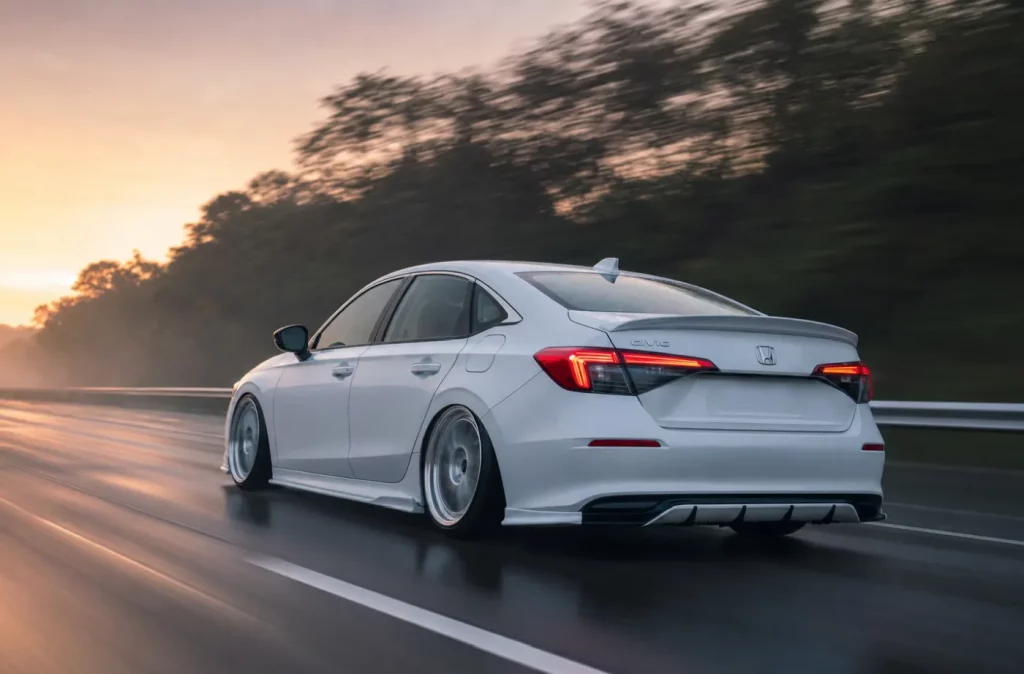
2025 Honda Civic Si — Front-wheel drive, six-speed manual only. A 1.5-liter turbo four making 200 hp and 192 lb-ft of torque. The lightest car in this group AT roughly 2,950 lb. Sticker price around $31,400. Car and Driver rates it 10/10. (Sources: MotorTrend, Dec 2024; Car and Driver, 2022 instrumented test)
2025 Volkswagen Golf GTI Autobahn — Front-wheel drive, now seven-speed DSG only (no more manual). A 2.0-liter EA888 turbo four making 241 HP and 273 lb-ft. Curb weight 3,293 lb. Pricing from $33,670 for the S trim to $42,105 for the Autobahn. (Source: Car and Driver, Aug 2025 instrumented test)
2025 Subaru WRX Limited — All-wheel drive, six-speed manual. A 2.4-liter turbo flat-four making 271 hp and 258 lb-ft. Curb weight approximately 3,350 lb. Pricing starts at roughly $35,000 and rises to around $46,875 for the tS trim. For this comparison, the standard WRX Limited data is used alongside tS figures where relevant. (Sources: Car and Driver, 2022 Limited test; Car and Driver, Jan 2025 tS test)
2025 Hyundai Elantra N DCT — Front-wheel drive, available with either a six-speed manual or eight-speed dual-clutch automatic. A 2.0-liter turbo four making 276 hp (286 with N Grin Shift overboost) and 289 lb-ft. Curb weight 3,334 lb (DCT). MSRP from $35,445. (Source: MotorTrend, Apr 2025 instrumented test)
| Specification | Civic Si | VW GTI | Subaru WRX | Elantra N |
|---|---|---|---|---|
| Engine | 1.5L turbo I-4 | 2.0L turbo I-4 | 2.4L turbo flat-4 | 2.0L turbo I-4 |
| Horsepower | 200 hp | 241 hp | 271 hp | 276 hp (286 NGS) |
| Torque | 192 lb-ft | 273 lb-ft | 258 lb-ft | 289 lb-ft |
| Transmission | 6MT only | 7-speed DSG | 6MT | 8-speed DCT / 6MT |
| Drive | FWD | FWD | AWD | FWD |
| Curb weight | ~2,950 lb | 3,293 lb | ~3,350 lb | 3,334 lb |
| Base MSRP | $31,400 | $33,670 | ~$35,000 | $35,445 |
0–60 mph: The Gap Is Wide
The spread between the slowest and fastest car in this group is 2.3 seconds, which is enormous in this class. The Elantra N DCT runs 0–60 in 4.7 seconds according to MotorTrend’s test, putting it in genuine hot-hatch territory — quicker than a 2023 Civic Type R manual (5.3 seconds, per MotorTrend). Its N Grin Shift overboost bumps output to 286 hp for 20 seconds at a time, and the launch control and eight-speed DCT deliver consistent hard launches with minimal wheelspin despite driving only the front wheels. (Source: MotorTrend, Apr 2025)
The GTI and WRX essentially tie at 5.6 seconds, though through very different powertrains. The GTI’s EA888 2.0T produces strong low-end torque (273 lb-ft at 1,600 rpm) and the DSG shifts without interrupting power. The WRX’s 2.4-liter flat-four makes 258 lb-ft at 2,000 rpm, but its manual transmission and all-wheel-drive traction offset the power delivery gap. The standard WRX Limited actually tested slightly quicker at 5.5 seconds than the heavier tS trim (5.6 seconds). (Sources: Car and Driver, Aug 2025 GTI test; Car and Driver, 2022 WRX Limited test)
The Civic Si is the outlier at 7.0 seconds to 60 mph in MotorTrend’s testing and 6.8 seconds in Car and Driver’s 2022 test. It gives up roughly 40 hp and 80 lb-ft to the GTI, and its sole six-speed manual requires a deliberate launch with no dual-clutch assist. The Si’s 1.5-liter turbo simply runs out of steam against the bigger-displacement competition. (Sources: MotorTrend, Dec 2024; Car and Driver, 2022 Si test)
| Metric | Civic Si | VW GTI | WRX (Limited) | Elantra N DCT |
|---|---|---|---|---|
| 0–60 mph | 7.0 sec (6.8 C&D) | 5.6 sec | 5.5 sec | 4.7 sec |
| Quarter mile | 15.4 sec @ 92.1 mph | 14.2 sec @ 100 mph | 13.9 sec @ 101 mph | 13.3 sec @ 106.7 mph |
| 60–0 braking | 102 ft | 158 ft (70–0) | 153 ft (70–0) | 105 ft |
| Skidpad (300-ft) | 0.94 g (0.95 C&D) | 0.91 g | 0.95 g | 0.97 g |
| Power-to-weight | 14.75 lb/hp | 13.66 lb/hp | ~12.36 lb/hp | 12.08 lb/hp |
Note: Civic Si braking 60–0 from MotorTrend is not directly comparable to 70–0 figures from Car and Driver. Where available, 70–0 figures from the same source are listed. The 60–0 test from MotorTrend used summer tires ($300 option).
Quarter Mile: Trap Speed Tells the Real Story
Quarter-mile time is one thing, but trap speed reveals true power-to-weight capability. The Elantra N crosses the line at 106.7 mph, a speed that would embarrass many cars costing twice as much. The WRX Limited traps 101 mph with AWD traction helping its 1.67-second 60-foot advantage over FWD cars. The GTI hits an identical 100 mph but takes a full 0.3 seconds longer to cover the quarter due to its front-drive traction ceiling and lower peak power. (Sources: Car and Driver; MotorTrend)
The Civic Si’s 92.1 mph trap speed in MotorTrend testing (93 mph in Car and Driver’s 2022 test) confirms what the power deficit suggests: it is a momentum car, not a drag car. It loses 14.6 mph to the Elantra N at the quarter-mile mark. For context, the difference between the Civic Si and Elantra N trap speeds is roughly the same as the difference between a base Toyota Corolla and a Civic Si.
Why the WRX Is Faster but Not Always More Fun
The WRX is significantly quicker than the Civic Si in a straight line — 5.5 seconds to 60 mph versus 7.0 seconds, and 13.9 seconds in the quarter-mile versus 15.4 seconds. But the WRX is also 400 lb heavier, consumes more fuel (19 mpg city versus 27 mpg), and its boxer engine’s low-end torque and AWD traction come with a weight penalty that dulls transient response. The Civic Si’s lighter weight and sharper steering make it feel more agile, even if it loses the drag race.
MotorTrend noted that the WRX’s manual transmission is less precise than the Si’s, and its suspension is tuned for rally-stage compliance rather than sharp turn-in. The Si’s chassis communicates more clearly through the steering wheel, and its helical limited-slip differential lets it put down power earlier in corners than its 200 hp would suggest. In a back-to-back test, the Si is more engaging to drive on a twisty road, even though the WRX is faster on paper.
Skidpad: Grip Versus Power
The skidpad numbers tell a different story than the drag strip. Lateral grip is where chassis engineering, tire selection, and suspension tuning matter more than raw power.
The Hyundai Elantra N leads at 0.97 g on the MotorTrend skidpad, achieved on 245/35R19 Michelin Pilot Sport 4S tires with an e-LSD that lets the driver get on power early. The Subaru WRX Limited is close behind at 0.95 g (0.96 g for the tS trim with its adaptive dampers and Bridgestone Potenza S007 tires). The Civic Si manages 0.94 g on its optional high-performance summer tires, impressive given its 200-hp output and roughly 2,950-lb curb weight — it only gives up 0.03 g to the WRX despite 71 fewer horsepower. (Sources: MotorTrend, Dec 2024; Car and Driver, Jan 2025 tS test; MotorTrend, Apr 2025)
The GTI posts the lowest skidpad figure at 0.91 g on Hankook Ventus S1 Evo3 summer tires. That is still a respectable number, but it trails the group. Part of the gap may be the GTI’s taller, heavier hatchback body versus the sedan footprint of the WRX, Civic, and Elantra N.
Braking: Civic Si Surprises
The Civic Si’s 102-foot stop from 60 mph (MotorTrend) is the best braking number in this group, and by a meaningful margin. The Elantra N stops from 60 mph in 105 feet. When converted to 70–0 mph (Car and Driver methodology), the Si needs 160 feet, the WRX Limited 153 feet, the WRX tS 159 feet, and the GTI 158 feet.
The Si stops short despite having the smallest brakes in the group — its advantage comes from being roughly 350 lb lighter than the GTI and nearly 400 lb lighter than the WRX tS. The Elantra N DCT’s 105-foot stop from 60 is also strong for a 3,334-lb car; MotorTrend noted its brake feel resembled a Porsche GT3 RS in its pressure-based modulation. (Sources: MotorTrend, Dec 2024 Si; MotorTrend, Apr 2025 EN DCT; Car and Driver, Aug 2025 GTI; Car and Driver, Jan 2025 WRX tS)
Figure Eight — The Complete Handling Picture
MotorTrend’s figure-eight test provides the most complete view of handling capability. The Elantra N DCT is the class leader at 24.3 seconds at 0.80 g. The WRX Limited (manual) is close at 25.0 seconds at 0.74 g. The Civic Si runs 26.3 seconds at 0.67 g, and the GTI S manual runs 26.0 seconds at 0.68 g on all-season tires.
But the GTI’s figure-eight time varies dramatically with tires. The GTI on all-season tires posted 26.0 seconds at 0.68 g. With summer tires, the figure-eight improves to approximately 25.5 seconds at 0.72 g — a full half-second improvement from a tire change alone. This is a critical point: the GTI’s chassis is capable of more grip than its all-season tires allow. (Sources: MotorTrend, various GTI tests)
The figure-eight results confirm the Elantra N’s chassis superiority, but they also show that the WRX and Civic Si are not far behind in combined handling. The Civic Si’s 26.3-second time is slowest in the group, but its 0.67 g average is close to the GTI’s all-season figure of 0.68 g. With stickier tires, the Si would likely improve into the 25-second range.
Elantra N DCT vs Manual: How Big Is the Gap?
The Elantra N is one of the few cars left that offers both a manual and a DCT option. The gap between them is enormous in instrumented testing. The DCT car is a full second quicker to 60 mph (4.7 vs 5.7 seconds) and 1.0 second and 6.7 mph faster through the quarter mile (13.3 at 106.7 vs 14.3 at 100.0). The DCT also improves figure-eight performance from 25.2 seconds at 0.73 g to 24.3 seconds at 0.80 g. (Sources: MotorTrend, Apr 2025 DCT test vs 2024 manual test)
That is the largest manual-to-DCT spread in the Sport Compact class and is partly explained by the manual car lacking launch control and the DCT holding boost between shifts. Buyers choosing the manual in an Elantra N pay a 1.0-second penalty in the quarter mile and a 0.7-mpg fuel economy penalty (combined).
| Elantra N Transmission | 0–60 | Quarter Mile | Figure Eight | 60–0 |
|---|---|---|---|---|
| 8-speed DCT | 4.7 sec | 13.3 @ 106.7 mph | 24.3 sec @ 0.80 g | 105 ft |
| 6-speed manual | 5.7 sec | 14.3 @ 100.0 mph | 25.2 sec @ 0.73 g | not tested |
How Much Do Tires Change the Numbers?
This is one of the most important takeaways from the entire comparison. The GTI’s performance swings wildly depending on tire choice. A GTI on all-season tires is a 0.86–0.88 g car on the skidpad and runs 26.0 seconds in the figure-eight. On summer tires, the same car is a 0.92–0.96 g car and runs 25.5 seconds in the figure-eight. The tire compound accounts for up to 0.08 g of grip and 0.5 seconds of figure-eight time — a larger difference than the gap between the Si and the GTI in many metrics.
This is why comparing performance numbers across different test vehicles without noting the tire specification is meaningless. The Civic Si’s 0.94 g on optional summer tires is impressive, but it would likely be 0.89 g on all-season tires. The Elantra N’s 0.97 g on PS4S tires is excellent, but it would be higher on Cup 2s and lower on all-seasons.
For buyers, the lesson is clear: if you care about performance, prioritize the tire option. The difference between all-season and summer tires is larger than the difference between many of these cars.
Civic Si vs GTI: The Real Rivalry
On paper, the Civic Si and GTI are not in the same performance class. The GTI has 41 more horsepower, 81 more lb-ft of torque, and a DSG transmission that shifts faster than any manual. The GTI is 1.4 seconds quicker to 60 mph and 1.2 seconds quicker through the quarter-mile. But the Si is $2,000 cheaper, 300 lb lighter, and has a manual transmission that both MotorTrend and Car and Driver consider the best in the segment.
What the numbers don’t capture is the GTI’s mature ride quality, superior cargo space, and more refined interior. The GTI is the better daily driver for most people. The Si is the better driver’s car for people who prioritize engagement over outright speed. If you value comfort and daily usability, the GTI wins. If you value engagement and a manual transmission, the Si wins.
Civic Si vs WRX: FWD vs AWD
The WRX beats the Si in every acceleration metric: 5.5 seconds to 60 versus 7.0 seconds, 13.9 seconds in the quarter-mile versus 15.4 seconds, 101 mph trap speed versus 92.1 mph. But the WRX is also 400 lb heavier, consumes more fuel, and has a less precise manual transmission.
In dry conditions, the Si’s lighter weight and sharper steering make it more engaging on a twisty road. In wet or snowy conditions, the WRX’s AWD traction is a game-changer. If you live in a climate with inclement weather, the WRX is the safer and more capable choice. If you live in a dry climate and prioritize engagement, the Si is the better choice.
Civic Si vs Elantra N: Value vs Power
The Elantra N is the clear performance winner: 4.7 seconds to 60, 13.3 @ 106.7 mph in the quarter-mile, 0.97 g on the skidpad, 105-foot braking. It is quicker than the Civic Type R in some tests. But it costs $4,000 more than the Si, and its DCT is required to achieve those numbers. The manual Elantra N is 1.0 second slower to 60 and 1.0 second slower in the quarter-mile — still faster than the Si, but the gap narrows to 0.7 seconds to 60 and 0.1 seconds in the quarter-mile.
The Elantra N’s firm suspension, aggressive styling, and track-focused tuning make it less daily-usable than the Si. The Si is the more comfortable daily driver with better fuel economy. If you want the fastest car on a track, buy the Elantra N. If you want the best daily driver that is still fun, buy the Civic Si.
Which Car Wins by Metric
| Category | Winner | Runner-Up |
|---|---|---|
| 0–60 mph | Elantra N DCT — 4.7 sec | WRX Limited — 5.5 sec |
| Quarter mile (time) | Elantra N DCT — 13.3 sec | WRX Limited — 13.9 sec |
| Quarter mile (trap) | Elantra N DCT — 106.7 mph | WRX Limited — 101 mph |
| Skidpad (lateral g) | Elantra N DCT — 0.97 g | WRX tS — 0.96 g |
| Braking 60–0 | Civic Si — 102 ft | Elantra N DCT — 105 ft |
| Power-to-weight | Elantra N DCT — 12.08 lb/hp | WRX Limited — ~12.36 lb/hp |
| Fuel economy (combined) | Civic Si — ~30 mpg est | GTI — 27 mpg |
| Best manual transmission | Civic Si | Elantra N (manual) |
| Best daily driver | GTI | Civic Si |
Power-to-Weight and Real-World Acceleration
Power-to-weight ratio explains the order this group finishes in. The Elantra N DCT delivers 12.08 lb per horsepower (using 276 hp), the best in class. The WRX Limited is close at roughly 12.36 lb/hp. The GTI sits at 13.66 lb/hp, and the Civic Si sits at roughly 14.75 lb/hp — a 22 percent disadvantage to the Elantra N.
But weight distribution and gearing also play a role. The Civic Si’s short gearing makes it feel quicker around town than its 7.0-second 0–60 suggests, while the WRX’s short gearing means frequent shifts on back roads. The GTI’s DSG and wide torque band make it the easiest car to drive quickly without conscious effort: 273 lb-ft on tap from 1,600 rpm means it seldom needs a downshift.
The Full Picture: Performance Is More Than Numbers
Straight-line numbers favor the Elantra N DCT across every metric, and by wide margins in acceleration. But the instrumented tests do not capture the manual transmission experience that comes standard on the Civic Si and WRX, nor the GTI’s more mature ride quality and cargo versatility, nor the Subaru’s all-weather traction in rain and snow.
The Civic Si’s slowest-in-class acceleration numbers are balanced by its lowest weight, shortest braking distance, competitive skidpad grip, and a shift feel that Car and Driver and MotorTrend both consider the best in the segment. It is a momentum car in a group that increasingly values power, but its handling reflexes and the engagement of its six-speed manual remain strong arguments — especially at a starting price roughly $4,000 below the Elantra N and WRX.
The Elantra N DCT is the clear objective winner in straight-line performance and lateral grip, and its 0.97-g skidpad figure and 4.7-second 0–60 time put it in a different performance tier than the other three cars here — closer to the Civic Type R and Golf R than to the Si or standard GTI. But it achieves those numbers through a DCT and firm suspension tuning that not every buyer will want to live with daily.
Quick Reference — Sport Compact Comparison
☐ 0–60 mph fastest: Elantra N DCT 4.7 sec (MT 5.7) — 1.0 sec faster than DCT; WRX 5.5 sec; GTI 5.6 sec; Civic Si 7.0 sec
☐ Quarter mile fastest: Elantra N DCT 13.3 @ 106.7 mph (MT 14.3 @ 100.0) — WRX 13.9 @ 101 mph; GTI 14.2 @ 100 mph; Civic Si 15.4 @ 92.1 mph
☐ Skidpad highest g: Elantra N DCT 0.97 g (MT 0.96) — WRX tS 0.96 g; WRX Limited 0.95 g; Civic Si 0.94 g (C&D 0.95); GTI 0.91 g
☐ Braking 60–0 shortest: Civic Si 102 ft — Elantra N DCT 105 ft; GTI 158 ft (70–0); WRX Limited 153 ft (70–0)
☐ Power-to-weight best: Elantra N DCT 12.08 lb/hp — WRX ~12.36 lb/hp; GTI 13.66 lb/hp; Civic Si 14.75 lb/hp
☐ Best manual transmission: Civic Si — the most precise and engaging shifter in the class
☐ Best daily driver: GTI — most refined ride, best cargo space, quietest cabin
☐ Best value: Civic Si — $31,400 base price, best fuel economy, best resale value
☐ Best all-weather capability: WRX — AWD traction in rain and snow
☐ Best track car: Elantra N — the fastest around a circuit, best brakes, best grip
☐ Tire compound matters more than most owners realize — summer tires vs all-seasons can change skidpad by 0.05–0.08 g and figure-eight by 0.5 sec
☐ Manual vs DCT/DSG: Elantra N manual is 1.0 sec slower to 60 than DCT — the largest gap in the class
☐ The Civic Si is a momentum car — it rewards carrying speed through corners rather than accelerating out of them
☐ The Elantra N is a power car — it rewards getting on the power early and using its torque to pull out of corners
FAQ — Civic Si vs GTI vs WRX vs Elantra N
Which sport compact is the fastest?
The Hyundai Elantra N DCT is the fastest in a straight line: 4.7 seconds to 60 mph and 13.3 seconds at 106.7 mph in the quarter mile. The manual Elantra N is slower at 5.7 seconds to 60 mph and 14.3 seconds at 100.0 mph.
Is the Civic Si faster than the GTI?
No — the GTI is significantly faster in a straight line: 5.6 seconds to 60 mph versus 7.0 seconds for the Si, and 14.2 seconds in the quarter mile versus 15.4 seconds. However, the Si is lighter and has a better manual transmission.
Does the WRX handle better than the Civic Si?
On a skidpad, the WRX is slightly better (0.95 g vs 0.94 g). In the figure-eight, the WRX is significantly better (25.0 sec vs 26.3 sec). But the Si’s lighter weight and sharper steering make it more engaging on a twisty road.
Is the Elantra N worth the extra money over the Civic Si?
If you value performance above all else, yes — the Elantra N is significantly faster and handles better. If you value daily comfort, fuel economy, and a manual transmission, the Civic Si is the better value.
What is the best manual transmission in this class?
The Civic Si has the best manual transmission in this class. Car and Driver and MotorTrend both rate its shift feel as the most precise and engaging in the segment.
Which car has the shortest braking distance?
The Civic Si stops from 60 mph in 102 feet — the shortest in this group. The Elantra N DCT is close at 105 feet. At 70 mph, the WRX stops in 153 feet and the GTI in 158 feet.
How much do tires affect performance?
Tires can change skidpad grip by 0.05–0.08 g and figure-eight times by 0.5 seconds. A GTI on all-season tires is a 0.86 g car; on summer tires, it is a 0.92 g car. The tire compound matters more than the difference between many of these cars.
Which car is best for daily driving?
The GTI is the best daily driver — it has the most refined ride, the quietest cabin, the best cargo space, and the most comfortable seats. The Civic Si is a close second with better fuel economy and a lower price.
Should I buy the Elantra N with the manual or DCT?
The DCT is 1.0 second faster to 60 mph and 1.0 second faster in the quarter mile. If you prioritize performance, buy the DCT. If you prioritize driver engagement, buy the manual — but know you are giving up a full second to 60 mph.
Which car holds its value best?
The Civic Si historically holds its value better than the GTI, WRX, and Elantra N. Honda’s reputation for reliability and the Si’s enthusiast following support strong resale values.