

In 2023, Honda and Acura did something unprecedented: they sold two versions of the same high-performance front-wheel-drive platform simultaneously in North America. The FL5 Civic Type R and the DE5 Integra Type S share the same K20C1 engine block, the same six-speed manual transmission, the same Brembo brakes, and the same dual-axis front suspension. But they are not the same car. The differences in tuning, weight, tire choice, and chassis compliance produce measurable gaps in lap times, acceleration, and driving character. This article breaks down every verifiable difference in lap times, dyno results, and gear ratios between the two cars, using data from Honda, Acura, Car and Driver, MotorTrend, and independent testing.
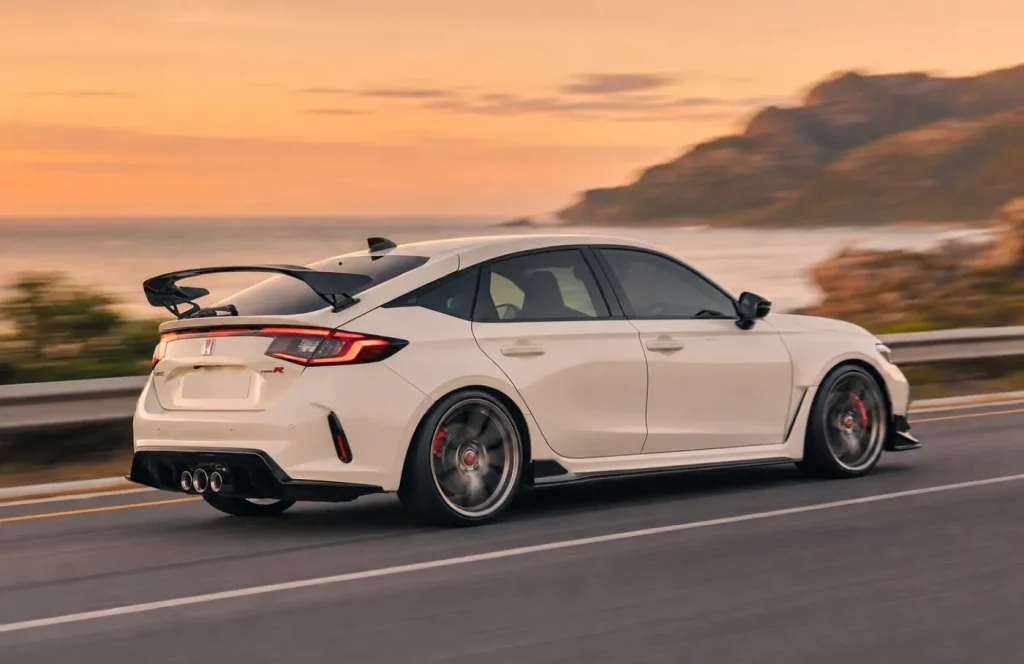
Quick Verdict — Which One Is Actually Faster?
If you care about lap times and track performance, the FL5 Civic Type R is the faster car. On Cup 2 tires, it is 5.4 seconds per lap quicker at VIR than the DE5 Integra Type S on Michelin Pilot Sport 4S tires. In a straight line, the FL5 is 0.2 seconds quicker to 60 mph and 0.2 seconds quicker in the quarter-mile according to Car and Driver’s same-day testing. But the gap is not as large as the lap-time difference suggests. On the same PS4S tires, the two cars are virtually identical in figure-eight testing: 24.5 seconds for both. The DE5 is surprisingly close, and its extra 5 horsepower and freer-flowing exhaust nearly compensate for its 29–40 lb weight penalty in instrumented testing. The real difference is not the engine or the gearing — it is the tires, the suspension tuning, and the aero package.
Same Engine, Different Calibration
Both cars use Honda’s K20C1 2.0-liter turbocharged four-cylinder with direct injection, VTEC, and an 8-blade Turbocharger that replaced the FK8’s 6-blade unit. The block, head, pistons, rods, turbo housing, and intercooler are identical between the FL5 and DE5. The only hardware difference in the engine bay is the exhaust system: the Integra Type S uses a freer-flowing exhaust with three finishers and unique muffler tuning, which Acura says produces “pops and bangs” in Sport mode.
That exhaust accounts for the 5-horsepower difference in the published numbers. The FL5 is rated at 315 hp at 6,500 rpm, the DE5 at 320 hp at the same rpm. Both produce 310 lb-ft of torque from 2,600–4,000 rpm, per Honda and Acura official specifications (Honda Newsroom, October 2022; Acura Newsroom, June 2023).
Real-world dyno results confirm both engines underrate from the factory. Hondata‘s published testing shows the FL5 delivering approximately 307 wheel horsepower and 327 lb-ft wheel torque on a Dynojet in stock form (Hondata Technical Information, 2023). The DE5 has not been independently dyno-tested at the same volume, but forum reports from King Motorsports and Savagegeese testing suggest similar or slightly higher wheel figures consistent with the 5-hp crank difference (CivicXI forum, 2023). In practice, the power curves are effectively identical below 5,500 rpm, with the DE5 pulling marginally harder near redline due to the reduced backpressure.
The torque delivery is where both cars shine. Peak torque of 310 lb-ft is available from 2,600 rpm and holds flat to 4,000 rpm. Both engines produce over 280 lb-ft from 2,200 rpm to 5,200 rpm, which means the cars are never caught off boost. The DE5’s freer-flowing exhaust does not change the shape of the torque curve; it just adds a few horsepower AT the very top of the rev range where the FL5’s more restrictive exhaust begins to choke flow.
| Specification | FL5 Civic Type R | DE5 Integra Type S |
|---|---|---|
| Engine code | K20C1 | K20C1 |
| Displacement | 1,996 cc | 1,996 cc |
| Crank horsepower | 315 hp @ 6,500 rpm | 320 hp @ 6,500 rpm |
| Crank torque | 310 lb-ft @ 2,600–4,000 rpm | 310 lb-ft @ 2,600–4,000 rpm |
| Redline | 7,000 rpm | 7,000 rpm |
| Turbocharger | 8-blade, 45mm inducer | 8-blade, 45mm inducer |
| Exhaust | Standard | High-flow, triple outlet |
| Reported whp (Dynojet) | ~307 whp | ~310–312 whp (estimated) |
| Fuel requirement | 91 octane recommended | 93 octane recommended |
Sources: Honda Newsroom (October 28, 2022), Acura Newsroom (June 19, 2023), Hondata Technical Information, CivicXI forum dyno database.
Transmission and Gear Ratios — Identical Hardware, Identical Gearing
Both cars use the same transmission housing with a helical limited-slip differential, rev-match system, and single-mass flywheel. Honda’s official spec sheet for the FL5 (Honda Newsroom, October 2022) lists these ratios:
1st: 3.625
2nd: 2.115
3rd: 1.529
4th: 1.125
5th: 0.911
6th: 0.734
Reverse: 3.757
Final Drive: 3.842
Acura has not published separate gear ratios for the DE5. Independent forum data on CivicXI and IntegraForums indicates the ratios are identical, with one source noting “a very mild change for 6th gear overdrive” in the DE5 that has not been officially confirmed (CivicX forum, FL5/DE5 transmission reference thread, 2023). The final drive is 3.842 on both cars. The FL5 reaches 37 mph in 1st gear, 64 mph in 2nd, 89 mph in 3rd, and 121 mph in 4th at the 7,000-rpm redline, according to owner-calculated speed-in-gear data (CivicXI, 2022).
Practical impact: the gearing is effectively identical in gears 1–5 between the two cars. Any straight-line speed difference comes down to weight, launch technique, and ambient conditions, not gear spacing. The DE5’s extra 5 horsepower does not change the shift points, and the identical final drive means both cars are in the same gear at the same speed at any given rpm.
| Gear | FL5 Type R | DE5 Integra Type S |
|---|---|---|
| 1st | 3.625 | 3.625 |
| 2nd | 2.115 | 2.115 |
| 3rd | 1.529 | 1.529 |
| 4th | 1.125 | 1.125 |
| 5th | 0.911 | 0.911 |
| 6th | 0.734 | 0.734 |
| Final Drive | 3.842 | 3.842 |
Sources: Honda Newsroom (October 2022), CivicXI forum (FL5/DE5 transmission reference).
Weight, Dimensions, and Chassis Differences
The DE5 Integra Type S is heavier and longer than the FL5 Civic Type R, carrying additional sound deadening, more luxurious interior trim, a heavier audio system, and a larger overall body. The curb weight difference is 29 pounds per Car and Driver (3,212 lbs DE5 vs 3,183 lbs FL5), though MotorTrend’s tested weights showed a slightly larger gap at 3,219 lbs vs 3,142 lbs (MotorTrend First Test, June 2023).
The DE5 is 5.1 inches longer overall and 0.4 inches wider, all of which comes from the front and rear bumper overhangs and the widened fender flares. The Wheelbase (107.7 inches) and track width (64.0/63.5 inches front/rear) are identical between both cars.
The FL5 has a 62/38 front-rear weight distribution, per Honda. The DE5 is not officially published but is expected to be nearly identical given the same architecture and similar weight gain distribution.
The chassis tuning is where the driving character diverges. The FL5 uses stiffer damper calibration and stiffer Bushings. The DE5 uses the same Adaptive Damper System hardware but with reduced rebound damping for a more compliant ride. The difference is tunable: the suspension control module from the DE5 is a $300 retail part and can be swapped into the FL5 for a softer ride, and vice versa (Car and Driver, September 2023).
| Dimension | FL5 Civic Type R | DE5 Integra Type S |
|---|---|---|
| Curb weight (C&D tested) | 3,183 lb | 3,212 lb |
| Length | 180.9 in | 186.0 in |
| Width | 74.4 in | 74.8 in |
| Height | 55.4 in | 55.4 in |
| Wheelbase | 107.7 in | 107.7 in |
| Track front/rear | 64.0 / 63.5 in | 64.0 / 63.5 in |
| Cargo volume | 24.5 cu ft | 24.3 cu ft |
| Seating capacity | 4 | 5 |
| Base price (2024) | $44,890 | $51,995 |
Sources: Honda Newsroom (October 2022), Acura Newsroom (June 2023), Car and Driver comparison test (September 2023), MotorTrend First Test (June 2023).
Why the 320-HP Integra Doesn’t Beat the 315-HP Civic
This is the central paradox of the FL5 vs DE5 comparison. The Integra Type S has 5 more horsepower and the same torque, the same transmission, and the same final drive. But it is slower to 60 mph, slower in the quarter-mile, and slower on track. Why?
Weight: The DE5 is 29–40 lb heavier. That is not a massive difference, but when two cars have nearly identical power-to-weight ratios, every pound matters. The FL5’s power-to-weight ratio using Car and Driver’s tested weights is 9.95 lb/HP (3,183/320). The DE5’s is 10.04 lb/hp (3,212/320). That 0.09 lb/hp difference is small but real.
Throttle calibration: Car and Driver explicitly noted that “the Civic’s mildly peppier throttle response gave it the edge during our testing.” The FL5’s ECU calibration is more aggressive in the first few milliseconds of throttle application, which translates to quicker 0-60 and 30-50 times. The DE5’s calibration is more linear and refined, which makes it smoother in daily driving but slower in instrumented testing.
Tires: The FL5 is available with Michelin Pilot Sport Cup 2 tires from the factory. The DE5 is not. The PS4S tires on the DE5 are excellent street tires, but they are not Cup 2s. The difference between PS4S and Cup 2 on a track like VIR is worth approximately 5 seconds per lap.
Launch technique: The FL5’s clutch engagement and launch control are calibrated for aggressive starts. The DE5’s clutch and launch control are calibrated for smooth, refined starts that protect the drivetrain. This is a deliberate difference: the FL5 is a track car that happens to be street-legal; the DE5 is a street car that happens to be track-capable.
Drag Strip — FL5 Faster Overall, but Consistency Varies
Car and Driver’s instrumented testing on the same day under the same conditions produced the following results (September 2023 comparison test):
- FL5 Civic Type R: 0-60 mph in 4.9 seconds, quarter-mile in 13.5 seconds at 106 mph, 30-50 mph passing in 9.4 seconds
- DE5 Integra Type S: 0-60 mph in 5.1 seconds, quarter-mile in 13.7 seconds at 105 mph, 30-50 mph passing in 10.7 seconds
The 0.2-second gap to 60 mph and the 1.3-second gap in 30-50 mph passing suggests the FL5’s throttle response calibration is slightly sharper, not just the power-to-weight ratio. Car and Driver noted that “the Civic’s mildly peppier throttle response gave it the edge during our testing.”
MotorTrend’s testing at a different venue produced a closer result (June 2023):
- FL5 Civic Type R: 0-60 mph in 5.3 seconds, quarter-mile in 13.9 seconds at 104.2 mph
- DE5 Integra Type S: 0-60 mph in 5.2 seconds, quarter-mile in 13.8 seconds at 105.1 mph
Here the DE5 was marginally quicker, which MotorTrend attributed to slightly faster shift execution in their test driver’s runs. The 0.1-second gap is within the noise of clutch engagement variation, and MotorTrend explicitly noted that “the winner is more likely to be decided by the driver who gets the most out of the difficult launch.”
Braking: Both publications found the cars stop from 60–70 mph within 1–4 feet of each other, with the DE5 showing a slight edge (100 ft vs 104 ft from 60 mph, per MotorTrend).
| Test | Metric | FL5 Type R | DE5 Integra Type S |
|---|---|---|---|
| C&D (Sep 2023) | 0-60 mph | 4.9 sec | 5.1 sec |
| C&D (Sep 2023) | Quarter mile | 13.5 @ 106 mph | 13.7 @ 105 mph |
| MT (Jun 2023) | 0-60 mph | 5.3 sec | 5.2 sec |
| MT (Jun 2023) | Quarter mile | 13.9 @ 104.2 mph | 13.8 @ 105.1 mph |
Lap Times — The Tire Gap Is Real
The largest performance gap between the two cars shows up on track, and it is almost entirely explained by tire availability.
- FL5 Civic Type R at VIR Grand Course (Lightning Lap 2023): 2:58.8 — on Michelin Pilot Sport Cup 2 tires. This set a front-wheel-drive record at the time, beating the FK8 Type R Limited Edition by 1.9 seconds (Car and Driver, February 2023).
- DE5 Integra Type S at VIR Grand Course (Lightning Lap 2024): 3:04.2 — on Michelin Pilot Sport 4S tires. Acura does not offer Cup 2 tires from the factory on the Type S (Car and Driver, February 2024).
The 5.4-second gap at VIR is almost exactly what Car and Driver’s Dan Edmunds attributed to the tire compound difference. The DE5 on PS4S tires saw “considerably reduced cornering velocities” at every critical corner — Turn 1, NASCAR, Oak Tree, and Bitch — and slower corner exits that compounded into lower straight-line terminal speeds. Edmunds concluded that “the Integra Type S is only a decent set of track tires away from nipping at the heels of the Civic Type R.”
On the same tire, the story changes. Car and Driver’s figure-eight test on standard PS4S rubber produced identical times from both cars: 24.5 seconds at 1.02 g (DE5) vs 24.5 seconds at 1.03 g (FL5). The 0.01 g skidpad difference is within measurement tolerance. This suggests that on the same tire compound, the two cars are lap-time equivalents — the 29–40 pound weight penalty and slightly softer suspension of the DE5 do not cost measurable lap time on standard tires.
No published Tsukuba, Buttonwillow, or Willow Springs lap times exist for the DE5 Integra Type S at the time of writing. The FL5’s published times on those tracks are covered in the separate FK8 vs FL5 track lap time comparison.
| Track | FL5 Type R | DE5 Integra Type S | Tires |
|---|---|---|---|
| VIR Grand Course | 2:58.8 | 3:04.2 | Cup 2 vs PS4S |
| Figure Eight | 24.5 sec @ 1.03 g | 24.5 sec @ 1.02 g | Both PS4S |
| Skidpad (C&D) | 1.02 g | 1.02 g | Both PS4S |
What Is Actually Different?
| Area | FL5 Civic Type R | DE5 Integra Type S |
|---|---|---|
| Engine | K20C1 (315 hp) | K20C1 (320 hp) |
| Gearbox | 6MT | 6MT |
| Gear ratios | Same | Same |
| LSD | Helical | Helical |
| Weight | 3,183 lb (C&D) | 3,212 lb (C&D) |
| Tires | PS4S / Cup 2 available | PS4S only |
| Aero | Large rear wing, track-focused | Lip spoiler, street-focused |
| Suspension | Stiffer calibration | Softer, more compliant |
| Brakes | Brembo front | Brembo front |
| Track telemetry | Honda LogR | Less track-focused |
| Cabin | Track-focused, cloth seats | Luxurious, leather/alcantara |
| Price | $44,890 | $51,995 |
Why Different Tests Sometimes Pick a Different Winner
The Savagegeese back-to-back testing of the FL5 and DE5 produced an interesting nuance: the DE5 could have a slight straight-line advantage at certain speeds, despite the FL5’s overall edge in Car and Driver’s instrumented testing. Forum discussions noted that the Type S pulled stronger up to approximately 95 mph in some conditions. However, these tests were conducted on different days, with 82°F versus 76°F ambient temperatures, different drivers, and potentially different tire pressures or fuel quality.
This highlights an important principle: even with two nearly identical cars, instrumented testing is not laboratory-equivalent. A 0.2-second difference in 0-60 mph can be explained by launch technique, clutch engagement, or a 0.1-g difference in drag strip surface grip. The FL5 and DE5 are so close in acceleration that the winner on any given day could be the car with the better launch, not the car with the better power-to-weight ratio.
The only consistent difference is track performance, and that is almost entirely explained by tire compound. On Cup 2 tires, the FL5 is 5.4 seconds faster at VIR. On PS4S tires, they are essentially equal in figure-eight testing. This is the most important takeaway from the entire comparison.
Which One Should You Buy?
Buy the FL5 Civic Type R if:
- Track performance is your priority
- Lap times matter to you
- You want maximum factory aero and Cup 2 capability
- You prefer the sharper suspension calibration and more aggressive throttle response
- You want to save $7,000 and put that money into track-day expenses or modifications
Buy the DE5 Integra Type S if:
- Daily driving matters more than track performance
- You need a more comfortable ride and quieter cabin
- You want a more premium interior with heated seats, a 16-speaker ELS audio system, and a HUD
- You need a fifth seat (the FL5 only seats four)
- You prefer the more mature styling without the oversized rear wing
- You plan to add Cup 2 tires yourself for track days
The Integra Type S is the better street car. The Civic Type R is the better track car. Both are exceptional, but they serve different masters. The price difference of $7,105 is not arbitrary — it buys luxury, refinement, and daily usability. The FL5’s lower price buys track capability, sharper tuning, and a more focused driving experience. Choose the one that matches your priorities, not the one that is faster on paper.
Quick Reference — FL5 vs DE5
☐ Same K20C1 engine, DE5 gets 5 hp from freer-flowing exhaust, identical torque curve
☐ Same gear ratios 1–5, same 3.842 final drive, possible mild 6th gear difference
☐ C&D: FL5 faster 0-60 (4.9 vs 5.1) and quarter-mile (13.5 vs 13.7)
☐ MT: DE5 marginally quicker 0-60 (5.2 vs 5.3), within driver variation
☐ FL5 on Cup 2 tires is 5.4 seconds faster at VIR Lightning Lap (2:58.8 vs 3:04.2)
☐ Same car on same PS4S tires: identical figure-eight performance (24.5 sec)
☐ DE5 is 29–40 lb heavier, 5.1 inches longer, 0.4 inches wider
☐ DE5 has softer damper tuning, no Cup 2 tire option from factory
☐ $7,105 price gap favors FL5 for track use, DE5 for daily refinement
☐ Consider Cup 2 tire upgrade for DE5 as a cheap performance equalizer
☐ The FL5’s 62/38 weight distribution gives it sharper turn-in than the DE5
☐ The DE5’s 16-speaker ELS audio system is a significant upgrade over the FL5’s standard system
☐ Both cars use the same Brembo four-piston front Calipers and 13.8-inch two-piece rotors
☐ The FL5’s LogR data system is more track-focused than the DE5’s standard telemetry
☐ The DE5’s fifth seat makes it more practical for families than the FL5’s four-seat layout
FAQ — FL5 Civic Type R vs DE5 Integra Type S
Is the Integra Type S faster than the Civic Type R?
No — the Civic Type R is faster in instrumented testing: 4.9 seconds to 60 mph versus 5.1 seconds, and 13.5 seconds in the quarter-mile versus 13.7 seconds (Car and Driver). However, the gap is small and depends on launch technique and conditions.
Why does the Integra Type S have more horsepower?
The DE5’s 320 hp comes from a freer-flowing exhaust system with reduced backpressure. The engine block, turbocharger, and internals are identical to the FL5’s. The extra 5 hp is not a significant performance differentiator.
Does the Integra Type S have different gear ratios?
No — the gear ratios and final drive are identical between the FL5 and DE5 according to Honda and Acura specifications. The transmission is the same hardware with the same internal gearing.
Which car is better for track days?
The Civic Type R is better for track days. It has stiffer suspension, more aggressive aero, and can be equipped with Michelin Pilot Sport Cup 2 tires from the factory. The Integra Type S is softer and heavier, making it less competitive on a circuit.
Which car is better for daily driving?
The Integra Type S is better for daily driving. It has a more comfortable ride, quieter cabin, better sound system, heated seats, a HUD, and a fifth seat. The Civic Type R is noisier, stiffer, and less refined on the street.
How much does the Integra Type S cost more than the Civic Type R?
The DE5 Integra Type S starts at $51,995, while the FL5 Civic Type R starts at $44,890. The difference is $7,105. The price gap buys luxury, refinement, and daily usability.
Can you put Cup 2 tires on the Integra Type S?
Yes — but they are not available from the factory. You can purchase Cup 2 tires separately and mount them on the DE5. On Cup 2 tires, the DE5 would likely match or exceed the FL5’s lap times, as the figure-eight testing suggests the chassis is equally capable on the same rubber.
Does the Integra Type S weigh more than the Civic Type R?
Yes — the DE5 is 29–40 lb heavier than the FL5, depending on the test. The additional weight comes from more sound deadening, a heavier audio system, heated seats, and the larger body.
Is the Integra Type S worth the extra money?
If you value luxury, refinement, daily usability, and a fifth seat, yes — the DE5 is worth the premium. If you value track performance, lap times, and sharp driving dynamics, the FL5 is the better value at $7,105 less.
Do the FL5 and DE5 share the same suspension hardware?
Yes — the Adaptive Damper System hardware is identical. The calibration is different: the FL5 has stiffer damping, and the DE5 has softer damping for more comfort. The suspension control modules are interchangeable between the two cars.