

Daily Driving the 2023–2025 Honda Civic Type R — An Honest Assessment
The 2023 Honda Civic Type R (FL5) arrived as the most powerful and refined Civic Type R ever sold in the US. It shares the 11th-generation Civic platform with a 107.7-inch Wheelbase, a fully independent suspension, and a stiffer body structure than the outgoing FK8. The formula is unchanged from the 1997 original: a high-revving turbocharged four-cylinder, a close-ratio 6-speed manual transmission, a front helical limited-slip differential, and a hatchback body. What changed is the execution — the FL5 is quieter inside, less visually aggressive, and more livable at city speeds than the FK8. This assessment covers what it is actually like to daily drive the FL5, with verified data from Car and Driver testing, Honda Newsroom specifications, and EPA ratings.
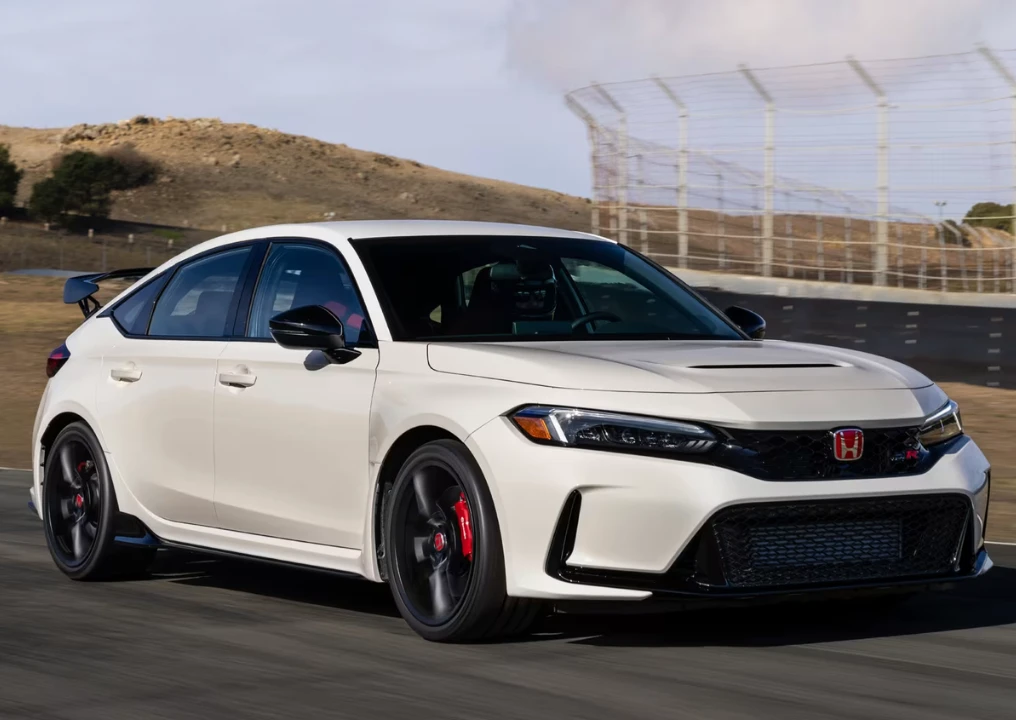
Powertrain — How It Actually Performs
The FL5 Type R uses the K20C1 2.0-liter turbocharged inline-four, producing 315 horsepower at 6,500 rpm and 310 lb-ft of torque from 2,600-4,000 rpm. This is the same engine family as the FK8, but with a revised Turbocharger (larger compressor wheel, optimized turbine), a more efficient intercooler, a new intake duct from the front grille, and a redesigned exhaust manifold. Peak torque arrives 500 rpm later than the FK8’s 2,100 rpm, but the FL5 holds peak torque for a longer, flatter plateau — 310 lb-ft from 2,600 to 4,000 rpm vs the FK8’s 295 lb-ft at 2,100-4,000 rpm.
| Specification | 2023+ Civic Type R (FL5) | 2017-2021 Type R (FK8) |
|---|---|---|
| Engine | K20C1 2.0L turbo | K20C1 2.0L turbo |
| Horsepower | 315 hp @ 6,500 rpm | 306 hp @ 6,500 rpm |
| Torque | 310 lb-ft @ 2,600-4,000 rpm | 295 lb-ft @ 2,100-4,000 rpm |
| 0-60 mph (C&D) | 4.9 sec | 5.1 sec |
| Quarter-Mile (C&D) | 13.5 sec @ 106 mph | 13.7 sec @ 104 mph |
| Braking 70-0 (C&D) | 153 ft | 156 ft |
| Skidpad (C&D) | 1.02 g | 0.99 g |
| EPA Combined MPG | 22/28/24 (city/hwy/comb) | 22/28/25 |
Sources: Car and Driver (December 2022 issue, C/D test results), Motor Trend (December 2022), Honda Newsroom (2023 and 2025 Civic Type R specifications), EPA fueleconomy.gov.
Daily Driving Reality — Comfort and Usability
The FL5 Type R is a genuinely usable daily driver, which the FK8 was not for everyone. The cabin is quieter — Honda added additional sound deadening and a more conventional dashboard layout without the FK8’s layered trim. The front seats (now covered in suede-like material) are heavily bolstered but not as aggressively narrow as the FK8’s buckets, and the driver’s seat offers a power-adjustable cushion angle and lumbar support. The rear seat remains functional for adults on short trips (37.4 inches of rear legroom, matching the standard Civic) and folds flat for 24.5 cubic feet of cargo space with the hatch closed.
The ride quality is the most surprising improvement. Honda equipped the FL5 with adaptive dampers (three modes: Comfort, Sport, +R). In Comfort mode, the Type R rides more smoothly than a Civic Si in Normal mode. The trade-off is that +R mode is stiffer than the FK8’s stiffest setting, making it genuinely harsh on broken pavement — deliberately for track use, not for commuting. Most owners report using Comfort for street driving and +R only for back roads or track days.
Daily practical limitations include the 265/30ZR19 Michelin Pilot Sport 4S tires (expensive to replace, ~$380-420 per tire, and susceptible to pothole damage on the 19-inch wheels), the low front splitter (ground clearance is reduced versus the standard Civic), and the fuel economy — the Type R returned 24 mpg combined in EPA testing and approximately 22-24 mpg in real-world mixed driving. On a 12.4-gallon fuel tank, this yields approximately 270-300 miles of real-world range. Premium fuel (91 octane minimum) is required. Source: Honda Newsroom specifications, Tire Rack pricing (2025).
The Real Competitors — Not Standard Compacts
The Honda Civic Type R competes with the $45,000-plus segment of hot hatches and sport compacts, not with the Toyota Corolla or standard Mazda3. The competitors that actually overlap on price, performance, and ethos are listed below.
| Model (2025) | Engine / Power | 0-60 | Trans | Drive | MSRP + Dest |
|---|---|---|---|---|---|
| Civic Type R | 2.0T / 315 hp | 4.9 sec | 6MT | FWD | $46,690 |
| VW Golf R | 2.0T / 328 hp | 4.5 sec | 7DSG | AWD | $47,265 |
| Toyota GR Corolla | 1.6T / 300 hp | 5.0 sec | 6MT | AWD | $40,000-$46,000 |
| Hyundai Elantra N | 2.0T / 276 hp | 5.0 sec | 6MT/8DCT | FWD | $35,150-$38,150 |
Sources: Car and Driver (Type R, Golf R, GR Corolla, Elantra N tested), Honda Newsroom (Type R pricing), manufacturer press releases.
The Type R is unique in this segment for its front-wheel drive layout and mechanical LSD. The Golf R and GR Corolla use all-wheel drive for better off-the-line traction and corner exit grip. The Elantra N undercuts the Type R by approximately $8,500-11,500 but makes 39 fewer horsepower and lacks the Type R’s track-mode adaptive damper range and Brembo brake system. The Type R holds its value better than any competitor — Hagerty and J.D. Power data show the Type R retaining approximately 70-75% of its value after three years, compared to the Golf R’s 60-65% and the Elantra N’s 55-60%.
Safety and Driver Assistance — What the Type R Actually Has
The Civic Type R does NOT include the full Honda Sensing suite as found on standard Civics. Honda omits adaptive cruise control and lane-keeping assist on the Type R in some model years due to the track-focused chassis setup and the manual transmission’s conflict with low-speed lane-centering systems. The Type R includes a multi-angle rearview camera, front and rear parking sensors, automatic high-beam headlights, and forward collision warning with automatic emergency braking. Blind-spot monitoring with rear cross-traffic alert is standard. The Type R received a Top Safety Pick+ from IIHS for all 2023-2025 model years, matching the standard Civic’s structural performance. Source: Honda Newsroom (2025 Civic Type R specifications and features), IIHS ratings.
Reliability — What Owners Report
The K20C1 engine in the FL5 Type R carries forward the same fundamental architecture used in the FK8 since 2017 and the Acura RDX since 2019. NHTSA complaint data for the 2023-2025 Civic Type R shows zero reported powertrain complaints as of mid-2025, reflecting the low production volume and the maturity of the engine design. The FK8’s known issues — premature clutch wear on tracked cars, transmission gear whine, and front brake pad life of 15,000-20,000 miles on track — carry over to the FL5. The FL5 added a wider radiator, a more efficient oil cooler, and a larger brake Master Cylinder to improve track endurance.
Owners on the CivicX and Type R forums report the following common issues: factory tires wear out at 10,000-15,000 miles with regular track use; the Brembo brake pads produce significant dust; the suede seat covering requires careful cleaning. No systemic mechanical failures have been documented across the FL5 production run. The 12-volt battery is small and can drain if the car sits for extended periods — a known Honda trait across multiple model lines. Source: NHTSA complaints (2023-2025 Civic Type R), CivicX.com owner surveys, Reddit r/Civic_Type_R.
Pricing and Value — What It Costs
| Cost Factor | 2023 Type R (new) | 2025 Type R (new) | 2025 Civic Si (ref) |
|---|---|---|---|
| MSRP (base) | $43,990 | $45,595 | $31,395 |
| Destination | $1,095 | $1,095 | $1,150 |
| Total New | $45,085 | $46,690 | $32,545 |
| Market Adj. (2023) | $5,000-$10,000 over MSRP | $0-$3,000 over MSRP | MSRP or below |
| 3-Year Resale (est.) | ~72% retained | ~70-75% retained (proj.) | ~65% retained |
Sources: Honda Newsroom pricing releases (October 2024 for 2025, November 2022 for 2023), Hagerty valuation data, Bring a Trailer completed sales. Market adjustment estimates based on dealer forum reporting (CivicX.com, Reddit r/Civic_Type_R).
The $46,690 MSRP of the 2025 Type R makes it $14,145 more than a Civic Si. The premium buys 115 more horsepower, 118 more lb-ft of torque, Brembo four-Piston front brakes, adaptive dampers with three distinct modes, 19-inch wheels with wider Michelin Pilot Sport 4S tires, a limited-slip differential tuned for track use, a dedicated oil cooler and wider radiator, and the Type R’s body and chassis reinforcement. Whether that premium is justified depends entirely on whether the buyer uses the track capability: on public roads at legal speeds, the Si delivers most of the engagement for significantly less money. At a track day, the Type R is in a different class.
Quick Reference — 2023-2025 Civic Type R
☐ Engine: K20C1 2.0L turbo, 315 hp @ 6,500 rpm, 310 lb-ft @ 2,600-4,000 rpm
☐ 0-60 mph: 4.9 sec (Car and Driver) — not 5.7 sec
☐ Quarter-mile: 13.5 sec @ 106 mph
☐ Braking 70-0: 153 ft — among the shortest for any FWD production car
☐ Skidpad: 1.02 g on factory Michelin Pilot Sport 4S tires
☐ Transmission: 6-speed manual with auto rev-match (defeatable) and helical LSD
☐ Drivetrain: Front-wheel drive — not AWD, not RWD
☐ Curb weight: 3,183 lb (C&D) / 3,188 lb (Honda spec)
☐ Dimensions: 180.9 in L, 74.4 in W, 55.4 in H, 107.7 in wheelbase
☐ Cargo: 24.5 ft³ hatchback with rear seats folded
☐ Fuel: 22/28/24 mpg EPA — premium 91 octane required — 12.4 gal tank
☐ 2025 MSRP: $45,595 + $1,095 dest = $46,690 total
☐ Key competitors: VW Golf R, Toyota GR Corolla, Hyundai Elantra N — not standard Corolla/Mazda3
☐ Does NOT include full Honda Sensing — no adaptive cruise or lane-keeping on manual Type R
☐ Market adjustments have cooled from $5K-$10K over MSRP (2023) to $0-$3K (2025)
☐ 3-year resale: ~70-75% — best in the segment
☐ Si comparison: $32,545 total, 200 HP, 6.6 sec 0-60, 2,918-2,952 lbs, similar daily usability
☐ Buy Type R for track capability and resale; buy Si for 85% of the engagement AT 70% of the price