

Under the skin of the FL5 Civic Type R and the DE5 Integra Type S lies the same heart. Both use the K20C1 2.0-liter turbocharged four-cylinder, both have a six-speed manual transmission, both have a helical limited-slip differential, and both ride on the same 11th-generation Civic platform with the same Wheelbase, same track width, and the same dual-axis front suspension. On paper, they are siblings. But they are not the same car.
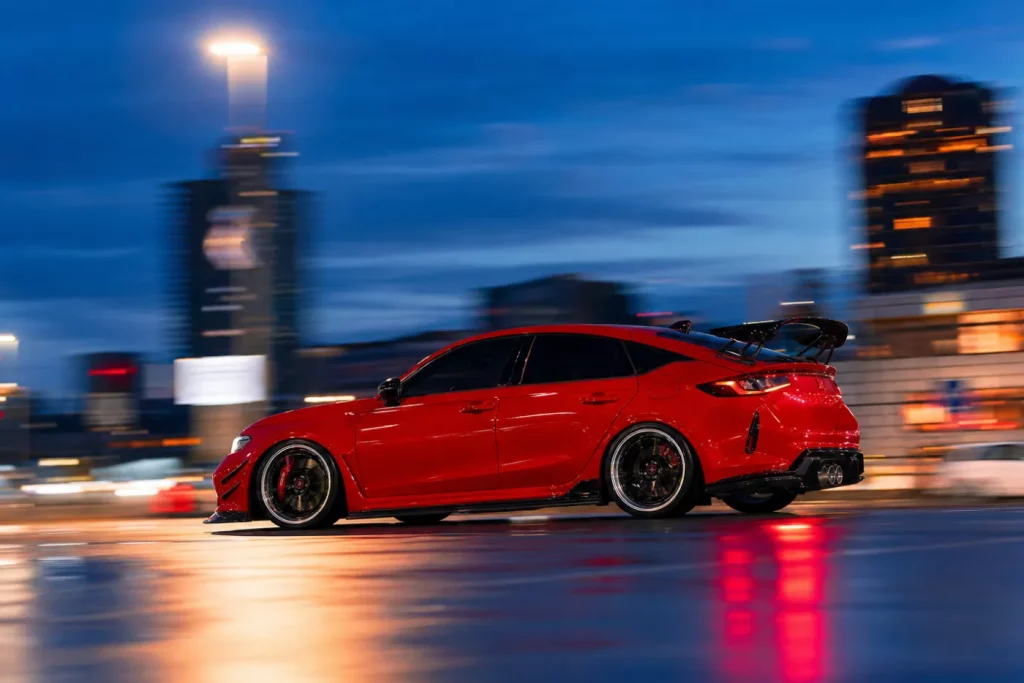
The differences are not in the hardware. They are in the tuning, the personality, the interior, the sound, and the experience of living with a 300+ horsepower manual hatchback every day. The FL5 Civic Type R is a performance-first car that happens to be street-legal. The DE5 Integra Type S is a performance car that happens to be luxurious. This is not a comparison of lap times or dyno numbers. It is a comparison of two very different ways to answer the same enthusiast question: what do you want a high-performance manual hatchback to feel like when you get behind the wheel?
Same Engine. Different Calibration.
Both cars use the K20C1 2.0-liter turbocharged four-cylinder with direct injection, VTEC, and an 8-blade Turbocharger. Both produce 310 lb-ft of torque from 2,600–4,000 rpm. The FL5 is rated at 315 hp at 6,500 rpm. The DE5 is rated at 320 hp at the same rpm. The extra 5 horsepower comes from a freer-flowing exhaust system and a different ECU calibration.
The torque curve is nearly identical. Both engines produce over 280 lb-ft from 2,200 rpm to 5,200 rpm, which means both cars are never caught off boost. The Integra’s extra 5 hp is not a significant difference in performance. It is a difference in character — a slightly sharper top-end delivery, a slightly more urgent sound AT redline.
| Specification | FL5 Civic Type R | DE5 Integra Type S |
|---|---|---|
| Engine | K20C1 2.0T | K20C1 2.0T |
| Horsepower | 315 hp @ 6,500 rpm | 320 hp @ 6,500 rpm |
| Torque | 310 lb-ft @ 2,600–4,000 rpm | 310 lb-ft @ 2,600–4,000 rpm |
| Transmission | 6-speed manual | 6-speed manual |
| LSD | Helical | Helical |
| Adaptive dampers | Yes (Comfort/Sport/Individual/+R) | Yes (Comfort/Sport/Sport+/Individual) |
| Steering ratio | 11.6:1 | 11.62:1 |
| Curb weight | 3,183 lb | 3,212 lb |
| Starting price (2026) | $47,395 | $53,900 |
If the hardware is this closely related, why do these cars feel like such different products? The answer is in the tuning, the interior, the sound, and the visual language.
The Attention Test — Which One Announces Itself First?
The FL5 Civic Type R makes a statement. The large rear wing, the red Honda badges, the aggressive front bumper, the triple exhaust outlets, and the wide stance all communicate one thing: this is a serious performance car. People notice. People take photos. People want to race you at stoplights. It is a car that announces itself.
The DE5 Integra Type S is more understated. It has wider fenders, flared arches, and a more aggressive front bumper than the standard Integra, but it lacks the Type R’s giant rear wing. It looks fast, but it does not look like a race car. It looks expensive. It looks like a car that could be driven to a business meeting without drawing unwanted attention.
The question is not which one looks better. The question is: do you want everyone to know what you drive? Or do you want a car that looks fast to people who know what they are looking at, but understated to everyone else? The FL5 is a car that demands attention. The DE5 is a car that earns respect quietly.
The Sound Test — Two Different Approaches to the Same Engine
The exhaust note is one of the biggest differences between the two cars. Honda and Acura took very different approaches to how the K20C1 should sound.
The FL5 Civic Type R has a center-mounted triple exhaust outlet with an active exhaust valve. The sound changes with drive mode. In Comfort and Sport, it is relatively subdued. In +R mode, the valve opens, and the exhaust note becomes sharper and more aggressive, with a metallic edge at high rpm. The Active Sound Control system also enhances the cabin sound through the speakers, making the engine feel more present than it actually is.
The DE5 Integra Type S has a more traditional dual-exit exhaust with a larger diameter and different muffler tuning. Acura’s tuning produces a deeper, more bass-heavy exhaust note at idle, with pronounced pops and crackles on overrun in Sport and Sport+ modes. The Integra sounds richer, more organic, and more theatrical at low speeds. It is not louder than the FL5 at full throttle, but it has more character in everyday driving.
The FL5 sounds like a track car. The Integra sounds like a sports car. Both are good, but they serve different moods.
The Seat Test — Which One Would You Want for a 300-Mile Weekend?
The FL5’s seats are aggressive. They are designed to hold you in place during hard cornering, with deep bolsters, a high backrest, and firm cushioning. They are excellent on track, but they are not designed for long-distance comfort. The seat position is low and fixed, the bolsters are tight, and there is no lumbar adjustment. After two hours on the highway, you will notice the lack of support.
The DE5’s seats are more accommodating. They are wider, softer, and more adjustable. The Integra Type S has 12-way power driver’s seat with memory and four-way lumbar support. The microsuede upholstery provides grip without the aggressive bolsters. The seat is designed for long drives, not just track sessions. It is comfortable for hours at a time.
Which seat is better? It depends on what you value. If you spend most of your time on twisty roads or at the track, the FL5’s seats are better. If you spend most of your time on highways and back roads, the DE5’s seats are better. The difference is not just about comfort; it is about the intended use of the car.
The Steering Wheel Test — Feedback, Weight, and Confidence
Both cars have electric power steering with variable assist. The FL5 has a steering ratio of 11.6:1. The DE5 has a steering ratio of 11.62:1. On paper, they are nearly identical. In practice, they feel different.
The FL5’s steering is heavier and more direct. There is less assist, more feedback, and more resistance to turning. The front-end response is immediate, and the car changes direction with almost telepathic precision. On a smooth road, it feels alive. On an imperfect road, it can feel busy, with the steering reacting to every bump and crack.
The DE5’s steering is lighter and more refined. It has the same quick ratio but with less weight and more filtering of road imperfections. It is easier to drive in a straight line, less tiring on long trips, and still sharp when you turn the wheel. It does not have the same level of feedback as the FL5, but it is more forgiving on broken pavement.
The FL5’s steering is for drivers who want to feel everything. The DE5’s steering is for drivers who want to feel what matters.
Same Adaptive Dampers — Different Personalities
Both cars have adaptive dampers. The FL5 has Comfort, Sport, Individual, and +R modes. The DE5 has Comfort, Sport, Sport+, and Individual modes. The hardware is similar; the tuning is different.
In Comfort mode, the FL5 is firm but livable. The ride is controlled, with minimal body motion, but you feel every road imperfection. In +R mode, the FL5 is stiff, almost track-ready. The body stays flat, the suspension resists compression, and the car feels like it is on rails.
The DE5 in Comfort mode is significantly softer than the FL5. It absorbs bumps better, with less impact harshness. In Sport+ mode, it firms up but never becomes as stiff as the FL5 in +R. The DE5 is always more compliant, always more forgiving, always more focused on the driver’s comfort.
The difference is not that one is better and the other is worse. The difference is that the FL5 prioritizes performance over comfort, and the DE5 seeks a balance.
The Daily-Driver Test — Monday Morning to Sunday Evening
Monday morning commute: The DE5 wins. The softer ride, quieter cabin, and more comfortable seats make stop-and-go traffic less draining. The FL5’s firm suspension and aggressive seat bolsters are tiring in heavy traffic.
Friday evening highway trip: The DE5 wins again. The extra sound insulation, better audio system, and more supportive seats make highway cruising a pleasure. The FL5 is louder, more active, and less relaxing.
Saturday morning B-road run: The FL5 wins. The sharper steering, stiffer suspension, and more immediate throttle response make it more engaging on a twisty road. The DE5 is still excellent, but it is slightly softer, slightly less urgent.
Sunday afternoon drive home: The DE5 wins. After a weekend of driving, the DE5’s comfort and refinement make the return trip more pleasant. The FL5’s focus is rewarding when you are driving hard, but it can be exhausting on the way home.
The FL5 is a weekend car that you can drive during the week. The DE5 is a daily car that you can drive on the weekend.
The Interior Philosophy — Performance First vs Performance + Premium
The FL5’s interior is designed for driving. The red accents, the aluminum pedals, the high-contrast gauges, and the Type R badging all reinforce the car’s performance-focused identity. The materials are durable but not luxurious. The Bose audio system is good, the 10.2-inch digital cluster is clear, and wireless CarPlay works well. But the interior does not feel premium. It feels functional.
The DE5’s interior is designed for both driving and living. The materials are better, the seats are more comfortable, the ambient lighting creates a more upscale atmosphere, and the ELS Studio 3D audio system is one of the best in any car. The cabin is quieter, the controls are more refined, and the overall experience is more luxurious. The DE5 feels like a car that costs more than the FL5.
The FL5’s interior tells you that you bought a Type R. The DE5’s interior tells you that you bought a premium performance car.
The Cargo and Passenger Test — Can Either One Be Your Only Car?
Both cars are practical enough to be daily drivers. The FL5 has 24.5 cubic feet of cargo space with the rear seats up. The DE5 has 24.3 cubic feet. Both have 37.4 inches of rear legroom. Both can carry four adults and luggage for a weekend trip.
But the FL5’s rear seats are less comfortable for long trips, and the cabin is noisier. The DE5’s rear seats are more supportive, and the quieter ride makes it a better family car. The DE5 can be a performance car that also serves as a comfortable daily driver for a family. The FL5 can be a family car, but it will remind you that it is a performance car every time you drive it.
Which One Feels More Special at 35 MPH?
The FL5 feels special as soon as you sit in it. The low driving position, the aggressive seats, the red accents, the engine note, and the steering weight all communicate that this is a car designed for driving. Even at 35 mph, the FL5 feels like an event.
The DE5 feels special in a different way. It feels refined, premium, and composed. It does not shout about its performance at low speeds. It waits for you to push the throttle before revealing its character. The DE5 is a car that saves its drama for when you want it.
Which one is better? It depends on whether you want your car to feel special all the time, or only when you are driving hard.
Which One Is Better as a Weekend Warrior?
The FL5 is the better weekend warrior. It is sharper, more aggressive, and more focused. The suspension is stiffer, the steering is quicker, and the seats hold you tighter. It is a car that rewards aggressive driving and feels at home on a back road or a track.
The DE5 is the better GT car. It is still fast, still capable, and still engaging, but it is more comfortable, more refined, and more forgiving. It is a car that you can drive fast for hours without feeling exhausted.
The difference is not that one is faster. The difference is in the experience. The FL5 is for drivers who want to feel the road. The DE5 is for drivers who want to feel the road but also want to arrive feeling fresh.
Which One Makes More Sense as a Daily?
The DE5 makes more sense as a daily driver. It is more comfortable, quieter, and more refined. The seats are better for long commutes, the ride is more forgiving, and the cabin is more premium. The FL5 is more tiring to drive every day.
But the FL5 can be a daily driver if you are willing to accept the compromise. It is not a stripped-out race car. It has air conditioning, a good audio system, and a comfortable enough ride for most people. The question is whether you want your daily commute to be an event or a convenience.
The Price Difference Changes the Question
The FL5 starts at $47,395. The DE5 starts at $53,900. The difference is $6,505. That is not insignificant.
The extra money buys a more premium interior, a quieter cabin, more comfortable seats, a better audio system, and a more understated design. It buys a car that feels more expensive than the FL5, even though the performance hardware is nearly identical.
Is the price difference worth it? If you value comfort, refinement, and daily usability, the DE5 is worth the extra money. If you value pure performance, focused driving, and a lower purchase price, the FL5 is the better value.
The Verdict — You’re Buying a Personality
The FL5 Civic Type R and the DE5 Integra Type S are not two versions of the same car. They are two different answers to the same question: what do you want a high-performance manual hatchback to feel like when you get behind the wheel?
Buy the FL5 if you want a car that constantly reminds you that you bought a Type R. Buy it if you want the most focused, aggressive, and track-ready manual hatchback available. Buy it if you do not mind the firmer ride, the louder cabin, and the attention.
Buy the DE5 if you want Type R performance without Type R visual drama. Buy it if you want a car that is fast, capable, and engaging but also comfortable, refined, and understated. Buy it if you want to drive a performance car that does not announce itself to everyone around you.
Neither car is the “civilized” version of the other. They are two different interpretations of the same enthusiast formula. Choose the one that fits your personality, not the one that fits the spec sheet.
Quick Reference — FL5 vs DE5 Type S Character
☐ FL5: 315 hp / 310 lb-ft, 6MT, LSD, adaptive dampers (Comfort/Sport/Individual/+R), 11.6:1 steering, 3,183 lb, $47,395
☐ DE5: 320 HP / 310 lb-ft, 6MT, LSD, adaptive dampers (Comfort/Sport/Sport+/Individual), 11.62:1 steering, 3,212 lb, $53,900
☐ FL5 is more aggressive, more focused, and more track-ready
☐ DE5 is more refined, more comfortable, and more daily-usable
☐ FL5 has a large rear wing, red badges, and aggressive aero — it demands attention
☐ DE5 has wider fenders and a more understated design — it looks fast but not like a race car
☐ FL5 exhaust is sharper and more metallic in +R mode; DE5 is deeper and more theatrical at low speeds
☐ FL5 seats are aggressive and track-focused; DE5 seats are wider, softer, and have lumbar adjustment
☐ FL5 steering is heavier and more direct; DE5 steering is lighter and more refined
☐ FL5 is the better weekend warrior; DE5 is the better daily driver and GT car
☐ Price difference: $6,505 — buys premium interior, better seats, quieter cabin, and more understated design
☐ Both cars are excellent; they are just excellent in different ways
FAQ — FL5 Civic Type R vs DE5 Integra Type S Character
Is the Integra Type S just a more comfortable Civic Type R?
No — the Integra Type S is a different interpretation of the same performance formula. It has the same engine, transmission, and LSD, but it is tuned for a more refined, daily-usable experience. The Civic Type R is more focused on track performance.
Which car is faster?
The Civic Type R is slightly quicker in instrumented testing — 4.9 seconds to 60 mph versus 5.1 seconds, and 13.5 seconds in the quarter-mile versus 13.7 seconds. The difference is small and depends on launch technique and conditions.
Does the Integra Type S have adaptive dampers?
Yes — the DE5 has Adaptive Damper System with Comfort, Sport, Sport+, and Individual modes. The FL5 also has adaptive dampers with Comfort, Sport, Individual, and +R modes.
Which car is better for daily driving?
The Integra Type S is better for daily driving. It has a more comfortable ride, quieter cabin, better seats, more premium interior, and a more refined overall character. The Civic Type R is more focused on performance and is less comfortable for long commutes.
Which car has a better sound system?
The Integra Type S has the ELS Studio 3D audio system with 16 speakers, which is one of the best factory systems available. The Civic Type R has a Bose 12-speaker system that is good but not in the same league.
Is the Integra Type S worth the extra money?
It depends on your priorities. If you value comfort, refinement, and daily usability, the Integra is worth the $6,500 premium. If you value pure performance and focused driving, the Civic Type R is the better value.
Which car has more cargo space?
Both cars have nearly identical cargo space: the FL5 has 24.5 cubic feet, and the DE5 has 24.3 cubic feet. Both are practical enough for daily use and weekend trips.
Is the FL5 too stiff for daily driving?
It depends on your tolerance for a firm ride. The FL5 is stiff in +R mode and firm even in Comfort mode. Some owners find it acceptable for daily use; others find it tiring. The DE5 is significantly more compliant.
Does the Integra Type S have the same engine as the Civic Type R?
Yes — both use the K20C1 2.0-liter turbocharged four-cylinder. The DE5 has 5 more horsepower (320 vs 315) from a freer-flowing exhaust and different ECU tuning.
Which car is more exclusive?
The Integra Type S is produced in lower volume and has a higher price, making it more exclusive. The Civic Type R is more common but still relatively rare compared to standard Civics.