

The Honda Civic Type R has always been about more than lap times. It’s about the way the steering loads up in a corner, the way the chassis communicates through the seat, and the way the engine responds to every millimeter of throttle pedal travel. And few debates in the Honda community are as heated as the clash between the FK8 and FL5 generations of the Type R.
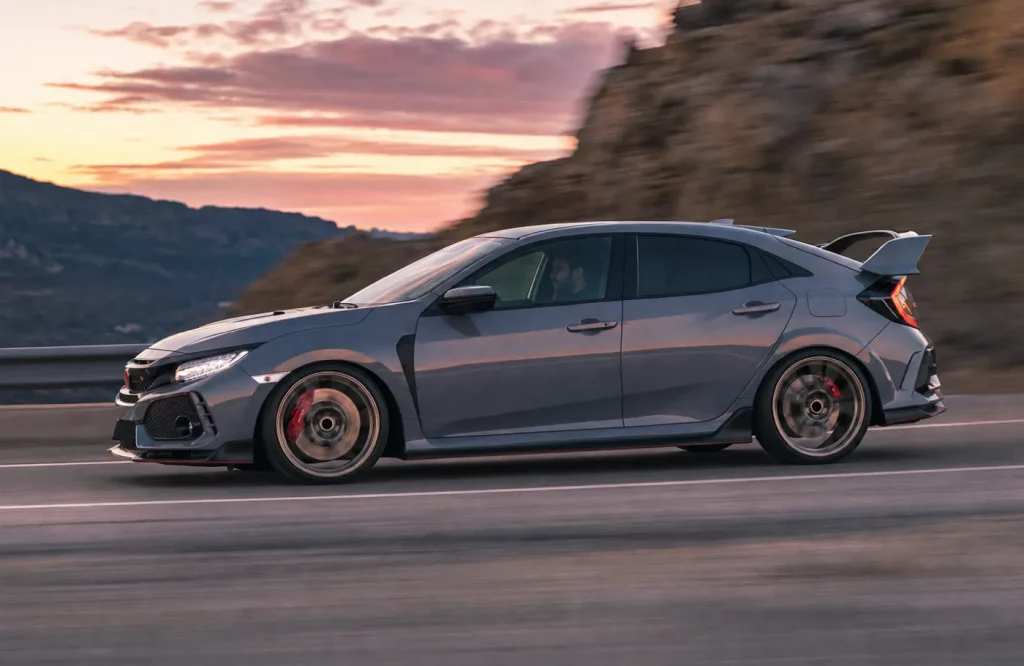
This isn’t just a comparison of spec sheets. It’s a battle between two completely different philosophies of what a front-wheel-drive performance car should be. The FK8 (2017–2021) arrived as a raw, aggressive, anime-inspired missile that rewrote the rules of what was possible with a front-wheel-drive chassis. The FL5 (2023+) is a more mature, more refined, more precise instrument — a scalpel where the FK8 was a broadsword.
The question is not which car is objectively faster. It’s which one actually feels better to drive — on a back road, on a track day, and on the drive home.
The FK8 delivers a rawer, more dramatic driving experience with a wilder personality and surprising daily comfort. The FL5 is more precise, more stable, thermally superior, and easier to drive fast consistently. The FK8 is the more memorable car; the FL5 is the better car in almost every measurable way. Choose based on whether you value character or capability.
The Question Everyone Gets Wrong
Most comparisons start with the spec sheet. The FK8 made 306 horsepower and 295 lb-ft of torque from its K20C1 turbocharged four-cylinder. The FL5 makes 315 horsepower and 310 lb-ft. And then the conclusion is automatic: the FL5 wins.
But those extra 9 horsepower and 15 lb-ft don’t explain the difference in how these cars feel. The engine is fundamentally the same K20C1. The extra power comes from a revised Turbocharger, intake, and exhaust system — not from a completely different powerplant. The real difference is in everything surrounding the engine.
The FL5 isn’t better because it has 315 horsepower. It’s better because Honda spent years refining the chassis, the suspension geometry, the cooling system, and the steering calibration. The question is whether those refinements make the car more enjoyable to drive — or simply more polished.
Did Honda make the Type R better — or simply more polished? That’s the real question this article answers.
| Specification | FK8 Type R (10th Gen) | FL5 Type R (11th Gen) |
|---|---|---|
| Engine | K20C1 | K20C1 |
| Displacement | 2.0L turbo | 2.0L turbo |
| Horsepower | 306 hp @ 6,500 rpm | 315 hp @ 6,500 rpm |
| Torque | 295 lb-ft @ 2,500–4,500 rpm | 310 lb-ft @ 2,600–4,000 rpm |
| Redline | 7,000 rpm | 7,000 rpm |
| Transmission | 6-speed manual | 6-speed manual |
| Wheel size | 20-inch | 19-inch |
| Tire size | 245/30R20 | 265/30R19 |
| Tires | Michelin Pilot Sport Cup 2 | Michelin Pilot Sport 4S |
| Wheelbase | 106.3 inches | 107.7 inches |
| Track width (front/rear) | 62.9 / 63.2 inches | 64.1 / 64.5 inches |
| Curb weight | ~3,117 lb | ~3,183 lb |
| Adaptive dampers | Yes (3-mode) | Yes (4-mode) |
| Grille opening area | Baseline | +48% larger |
First Corner: Which One Feels Smaller?
This is one of the most surprising differences between the two generations. On paper, the FL5 is physically larger — longer, wider, with a longer Wheelbase. But the way they feel from the driver’s seat is completely different.
The FK8, despite its actual dimensions, feels smaller and more eager. The chassis is more nervous, more alive, more willing to change direction. The weight transfer is quicker, the rear end is more active, and the front axle is constantly working. You feel the car rotating underneath you, and that sensation creates an intimacy that’s hard to replicate.
There’s a reason the FK8 became a cult car. It feels like a weapon you point AT a corner and fire. The chassis communicates constantly, the rear end is playful under trail braking, and the whole car feels like it’s operating at a higher energy level than the FL5.
The FL5 feels more planted. More stable. More confident. The longer wheelbase and wider track give it a sense of sitting on a platform rather than pointing a weapon. The chassis is more rigid — Honda increased torsional stiffness by 15 percent — and that rigidity translates into a car that feels more substantial, more expensive, and more composed.
The FK8 feels like a weapon you point. The FL5 feels like a platform you stand on.
10th Gen Chassis Character
- Shorter wheelbase
- Narrower track
- More nervous rear end
- Quicker weight transfer
- Feels smaller than it is
- More alive, more demanding
11th Gen Chassis Character
- Longer wheelbase
- Wider track
- More planted rear end
- More stable weight transfer
- Feels substantial and confident
- More refined, more predictable
Steering Feel: Sharp vs Natural
This is one of the most important differences between the two cars, and it’s not as simple as saying one is better than the other.
The FK8’s steering is sharp, immediate, and slightly artificial. It’s fast-ratio steering that feels like it was calibrated for a video game — incredibly responsive, hyper-accurate, and just a little bit numb. The weight builds nicely, but the feedback is filtered. Car and Driver praised the FK8’s steering for its precision and the way it allowed the driver to easily feel the enormous grip of the front axle, even if the ultimate feedback wasn’t as rich as a hydraulic system.
On the road, the FK8’s steering makes you feel like you’re driving something extremely fast. The response is so immediate that small inputs produce big results. It’s confidence-inspiring in a way that makes you feel like a better driver than you actually are.
The FL5’s steering is more natural. More stable. Less nervous. Honda revised the Steering Rack, the suspension geometry, and the electronic power steering calibration to reduce artificial weight and increase natural feel. The result is a steering system that doesn’t try to impress you with its sharpness — it just works.
On the track, the FL5’s steering gives you the sense that you know exactly what the car will do next. There’s less correction required, less uncertainty at the limit, and more predictability in high-speed corners. The steering doesn’t fight you; it guides you.
The FK8 makes you feel like you’re driving a very fast car. The FL5 makes you feel like you’re driving a very precise car. Both are excellent. They just approach excellence differently.
| Aspect | FK8 | FL5 |
|---|---|---|
| Steering Character | Sharp, immediate — slightly artificial, hyper-responsive | Natural, stable — less nervous, more precise near the limit |
| Steering Feedback | Filtered but precise — feels like a video game | More natural communication — feels like a precision instrument |
The Front End: Where the Real Evolution Happened
Both the FK8 and FL5 use Honda’s sophisticated front suspension design that was specifically developed to combat torque steer. But the FL5 represents a significant evolution of that design.
The FK8’s front end is aggressive, lively, and sometimes requires more trust than the driver is willing to give. The front axle works hard, the tires communicate through the wheel, and the car demands active management of the steering inputs. On the limit, the FK8 can be unpredictable — not in a dangerous way, but in a way that keeps you alert.
The FL5’s front end is calmer, more stable, and easier to read at the limit. Honda revised the suspension geometry, increased the rigidity of the steering column and suspension mounting points, and optimized the camber curve for better front-end grip under load. The result is a car that gives you more confidence to push harder, earlier.
Top Gear noted that the changes in steering column rigidity, suspension arms, and overall chassis stiffness work together in the FL5 rather than simply adding more horsepower. The front end doesn’t feel transformed — it feels perfected.
The FL5’s front end is more forgiving, more communicative, and more consistent. It doesn’t require the same level of constant correction. And that’s a real advantage on track.
Road Test: The Broken Pavement Question
One of the most surprising aspects of the FK8 was how well it handled broken pavement. Despite 20-inch wheels and extremely low-profile tires, Car and Driver noted that the FK8 was surprisingly livable on rough roads. The adaptive dampers in Comfort mode do real work, absorbing impacts and smoothing out imperfections in a way that defies the car’s extreme appearance.
The FK8 communicates road texture through the chassis. You feel more vibrations, more impacts, more noise. But it’s not harsh — it’s informative. You know exactly what the suspension is doing at all times.
The FL5 rides on 19-inch wheels with more sidewall, and the suspension calibration is more refined. The result is a car that’s more composed, more controlled, and more comfortable on broken pavement. But it’s also more isolated. The road doesn’t disappear entirely, but it’s definitely more distant.
Do you actually want the road to disappear? For some drivers, the FK8’s rawness is exactly what makes it special. The FL5’s refinement is welcome on long trips, but it comes at the cost of some of the intimacy that made the FK8 so memorable.
| Aspect | FK8 Type R | FL5 Type R |
|---|---|---|
| Wheel diameter | 20-inch | 19-inch |
| Tire sidewall height | Very low (30-series) | Low (30-series with more sidewall) |
| Ride quality in Comfort mode | Surprisingly compliant | More refined, more isolated |
| Road texture feedback | High — you feel everything | Moderate — more filtered |
| Road noise | High | Lower |
| Tire replacement cost | Very expensive | Expensive but more reasonable |
| Pothole vulnerability | High | Moderate |
The 19-Inch vs 20-Inch Question
This is a practical consideration that has real-world consequences for ownership.
The FK8’s 20-inch wheels look aggressive, fill the wheel arches perfectly, and give the car a stance that matches its performance. But they come with downsides. The tires are expensive — a set of Michelin Pilot Sport 4S in the FK8’s 245/30R20 size costs significantly more than the FL5’s 265/30R19. The low-profile sidewall makes the car more vulnerable to pothole damage. And the tire options are limited.
Car and Driver explicitly noted the high cost and extremely low profile of the FK8’s standard 20-inch tires as a real-world drawback, particularly for owners who daily drive their Type R.
The FL5’s 19-inch wheels offer more sidewall, more tire options, and a more reasonable ownership experience. The 265-width tires provide more grip, and the additional sidewall gives the suspension more room to work. It’s a better track-day base and a more livable daily setup.
The FL5 is easier to live with at the tire shop. And that’s a real advantage, not a marketing point.
The Engine: Faster Isn’t the Interesting Part
The K20C1 is fundamentally the same engine in both cars. It’s a 2.0-liter turbocharged four-cylinder with direct injection, dual variable cam timing, and a sophisticated boost control system. The FL5’s extra horsepower and torque come from a revised turbocharger, a freer-flowing intake and exhaust, and a more aggressive calibration.
But the difference isn’t dramatic. The FK8’s engine feels explosive and aggressive. The power delivery is sharp, the turbo response is immediate, and the engine feels like it’s operating at a higher tension level. The FL5’s engine feels slightly more refined, slightly smoother, and slightly more responsive at low rpm.
You won’t buy the FL5 because of nine horsepower. You’ll buy it because of everything surrounding them — the chassis, the cooling, the steering, the stability.
The engine is the constant. Everything else is the variable.
| Engine Detail | FK8 Type R | FL5 Type R |
|---|---|---|
| Engine code | K20C1 | K20C1 |
| Displacement | 2.0L | 2.0L |
| Horsepower | 306 hp | 315 hp |
| Torque | 295 lb-ft | 310 lb-ft |
| Turbocharger | MHI TD04 | Revised MHI TD04 |
| Intake system | Standard | Revised for better flow |
| Exhaust system | 3-outlet design | Revised 3-outlet design |
| Engine character | Explosive, aggressive | Refined, slightly smoother |
The Gearbox: Does the FL5 Improve Perfection?
The FK8’s six-speed manual transmission was already one of the best in the business. Car and Driver praised the short-throw six-speed for its exceptionally precise action and light, natural clutch feel. The shift gates were perfectly spaced, the engagement was mechanical and satisfying, and the rev-match system was seamless.
Honda didn’t try to reinvent the gearbox for the FL5. They refined it. The shifts are slightly smoother, slightly more precise, and slightly more polished. The clutch feel is slightly lighter, and the overall operation is slightly more refined.
Can you improve something that was already nearly perfect? Yes, but not radically. The FL5’s gearbox is better, but the difference isn’t enough to be a deciding factor. Both cars have exceptional shift quality, and neither generation suffers from a transmission that’s less than excellent.
This isn’t a reason to choose one over the other. Both are benchmark-quality manuals.
The Track: Faster vs Easier to Drive Fast
This is where the lap-time article and this driving-impressions article diverge. We’re not publishing a big table of lap times. We’re talking about the experience of driving these cars on track.
The FK8 on track requires more work. The chassis is more nervous, the front end requires more management, the rear end is more active under braking, and the temperatures rise quickly. You’re constantly managing the car’s behavior, correcting the steering, and monitoring the gauges. It’s exhausting — but it’s also exhilarating.
The FL5 on track gives you more stability, more predictability, and more confidence. The chassis is more composed, the front end is more planted, and the thermal management is dramatically improved. You can string together lap after lap without worrying about heat soak pulling timing and dropping power.
In controlled comparison testing, the FL5 has shown a slight lap-time advantage over the FK8. But the more significant advantage is the FL5’s ability to maintain that pace without the same level of thermal degradation. The FK8 can be fast. The FL5 makes being fast easier.
The Confidence Test
This is one of the most important differences between the two cars. Imagine you arrive at a track you’ve never driven before.
In the FK8, you feel the car’s character immediately. The steering is sharp, the chassis is active, and the car communicates its limits clearly. But you may also encounter those limits earlier than expected, and the car sometimes requires more correction to keep it on line. It’s a car that demands your full attention.
In the FL5, you build confidence more quickly. The car is more forgiving, more stable, and more predictable. You reach the limit later, and the car tells you when you’re getting close. It’s easier to repeat good laps, easier to improve your driving, and easier to trust the car in high-speed corners.
Road-and-track impressions consistently describe the FL5 as more forgiving and more confidence-inspiring at the limit than the FK8. The FL5 doesn’t punish mistakes as harshly, and it rewards smooth inputs with consistent performance.
The Surprise: Some Drivers May Still Be Faster in an FK8
This is an important counterpoint. Not every driver will be faster in the FL5.
The driver is still the biggest modification. A skilled driver who understands the FK8’s character and knows how to extract the most from its chassis may still be faster in the older car — especially on a track that suits the FK8’s playful rear end and more aggressive turn-in.
In one owner comparison, a driver who owned both cars posted a better lap time in his modified FK8, noting differences in configuration, tire choice, temperature conditions, and his own progression as a driver. This is an important example of why individual lap times shouldn’t be treated as pure proof of one platform’s superiority.
The FL5 is easier to drive fast. But that doesn’t mean everyone will be faster in it. The FK8 rewards skill, commitment, and familiarity. And for some drivers, that reward is worth more than the FL5’s inherent stability.
Which One Is More Fun on a B-Road?
This is where the emotional verdict starts to form.
The FK8 is more fun on a twisty back road for many drivers. There’s more visual drama, more raw feel, more sense that you’re controlling something extreme. The 20-inch wheels, the aggressive aero, the constant chassis activity — every drive feels like an event. The FK8 makes you feel like you’re getting away with something.
The FL5 is more satisfying on the same road because it gives you more confidence. The balance is better, the chassis is more mature, and you spend less time managing the car’s behavior and more time enjoying the drive. It’s not less fun — it’s differently fun.
Fun is not always the same thing as capability. The FL5 is more capable, but that doesn’t automatically make it more fun. For many enthusiasts, the FK8’s rawness is exactly what they’re looking for.
Which One Would You Take on a 500-Mile Road Trip?
This is where the FK8 continues to surprise. Despite its extreme appearance and aggressive setup, Car and Driver noted that the FK8 was surprisingly livable on long trips. The adaptive dampers in Comfort mode absorb road imperfections, the seats are supportive without being punishing, and the cargo space is genuinely useful.
The FL5 is more refined, quieter, and more comfortable. The 19-inch wheels reduce tire noise, the interior is more premium, and the overall cabin experience is more mature. But it’s still a Type R — you won’t mistake it for a luxury car. Road noise is still present, the ride is still firm, and the seats are still aggressively bolstered.
The FL5 is the better road-trip car, but the FK8 is surprisingly good. Neither car is a bad choice for daily driving, and both will get you where you’re going with a smile on your face.
The Visibility and Interior Experience
This is a detail that often goes overlooked in comparisons, but it matters for daily enjoyment.
The FK8’s cockpit feels like a gaming setup. The red seats, the bright trim, the buttons everywhere, the digital display — it’s dramatic, immersive, and slightly over-the-top. Many owners love exactly this character. It makes every drive feel like an occasion.
The FL5’s cockpit is cleaner, more mature, and better built. The materials are higher quality, the ergonomics are improved, and the overall design is more cohesive. It feels like a premium car rather than a boy-racer special.
Do you want a cockpit or a cabin? The FK8 is a cockpit. The FL5 is a cabin. Neither is wrong; they just suit different tastes.
The Personality Test
Instead of another dry table, consider this approach.
Choose the FK8 if you want the crazier-looking Type R, if you prefer rawness over refinement, if you want the more dramatic driving experience, if you enjoy modifying cars, and if you want maximum character per dollar.
Choose the FL5 if you want the best factory Type R, if you do regular track days, if you value thermal consistency and confidence at the limit, and if you want a Type R that feels mature without feeling boring.
Verdict: Road vs Track
The conclusion should be nuanced. Here’s how it breaks down.
Best Raw Driving Experience
FK8
More dramatic, more aggressive, more special. The FK8 feels like an event every time you drive it.
Best Road Car
FL5
More refined, more mature, better ergonomics. It’s a Type R that works better as a daily driver.
Best Track-Day Car
FL5
More stable, more thermally consistent, easier to drive fast repeatedly. It doesn’t overheat after three laps.
Best Value for an Enthusiast
FK8
Lower entry price, massive character, huge aftermarket support. Especially if you plan to modify.
Best For Learning to Drive Fast
FL5
More forgiving, more confidence-inspiring, easier to improve your driving skills in.
Best For Driving Excitement
FK8
The chassis is more alive, the steering is sharper, the car is more demanding. It rewards effort.
Final Thought
The FL5 is the better Civic Type R. The FK8 may still be the more memorable one.
The FL5 makes you feel like you’re becoming a better driver. The chassis inspires confidence, the car is forgiving at the limit, and the thermal management lets you focus on driving rather than managing temperatures. It’s a car that teaches you how to be faster.
The FK8 makes you feel like you’re driving something wild. The raw character, the dramatic appearance, the active chassis, the constant communication — it’s a car that demands your full attention and rewards your effort. It’s a car that feels special every time you drive it.
The FK8 is the car that rewrote the rules. The FL5 is the car that perfected them. Which one is better depends entirely on what you value more: character or capability, rawness or refinement, drama or precision.
If you want the best tool for going fast, buy the FL5. If you want the car that makes you feel something every time you drive it, buy the FK8.
Both are extraordinary cars. They just serve different masters and different driving preferences.
FAQ — FK8 vs FL5 Civic Type R
Which Civic Type R is faster, the FK8 or the FL5?
The FL5 is generally faster in instrumented testing, with a slight advantage in 0-60 mph and lap times. However, the difference is not dramatic — both cars are exceptionally fast for front-wheel-drive vehicles. The FL5’s real advantage is its ability to maintain consistent lap times without overheating, rather than just a single fast lap.
Is the FL5 more reliable than the FK8?
The FL5 addresses the FK8’s main reliability weakness — heat management. The larger grille opening (48 percent larger), revised intercooler, and Hood vent improve cooling significantly. The FK8 was known for heat soak on track in hot weather, which the FL5 largely solves. Both cars are generally reliable, but the FL5 is more thermally robust.
Which Type R is better for daily driving?
The FL5 is more refined for daily driving, with 19-inch wheels that reduce tire noise and improve ride quality. The interior is more premium and better insulated. However, both cars are surprisingly livable as daily drivers. The FK8’s 20-inch wheels are more vulnerable to potholes and more expensive to replace tires on.
Does the FL5 have better steering feel than the FK8?
The FL5 has more natural, more predictable steering feel. The FK8’s steering is sharper and more immediate but slightly more artificial. The FL5 inspires more confidence at the limit; the FK8 feels more exciting. Neither generation has bad steering — they just approach feel differently.
Which Type R is more fun to drive?
The FK8 is generally considered more fun for many enthusiasts because it’s rawer, more dramatic, and more demanding. The FL5 is more precise and more capable but less theatrical. Fun is subjective — choose based on whether you prefer character or capability.
Should I buy an FK8 or FL5 Type R?
Buy the FK8 if you want a rawer, more dramatic driving experience with a wilder personality and you’re willing to manage heat issues on track. Buy the FL5 if you want a more refined, more capable, and more thermally consistent Type R that inspires confidence at the limit. The FK8 is the more memorable car; the FL5 is the better car.
Does the FL5 overheat like the FK8?
No — the FL5 was specifically redesigned to address the FK8’s heat management issues. The larger grille, revised intercooler, and hood vent keep intake air temperatures and Coolant temperatures more stable during track use. The FL5 can run multiple hot laps without the power degradation that affected the FK8.
What are the main differences between FK8 and FL5 interiors?
The FL5 has a cleaner, more premium interior with higher-quality materials. The FK8 has a more dramatic, gaming-inspired cockpit with red accents and more buttons. The FL5’s infotainment is more modern, and the overall ergonomics are improved. Both cars have excellent seats, but the FL5’s are slightly more comfortable for long trips.
Which Type R has better resale value?
Both hold their value exceptionally well. The FK8 is becoming increasingly desirable as the last of the wilder Type R designs, and clean examples command premium prices. The FL5 is newer and more refined, which also supports strong resale value. The FK8 may have slightly stronger enthusiast appeal in the long term due to its more dramatic character.
What are the common problems with each generation?
FK8: Heat soak on track (addressed with aftermarket radiators and intercoolers), 20-inch wheel vulnerability, and some owners report brake fade with aggressive track use.
FL5: Higher purchase price, less dramatic styling, and the more refined chassis may feel less exciting to some drivers. Early FL5 examples show excellent reliability.