

The 11th generation Honda Civic (2022-present) entered its fourth model year for 2025 with a significant lineup change: the 1.5-liter turbocharged engine was removed from the EX and Sport Touring trims and replaced with a two-motor hybrid powertrain. The base LX, however, remained unchanged — it keeps the same 2.0-liter naturally aspirated K20C2 engine that entered production in 2022, with a slight detune for 2025. That makes the LX something of a question mark for buyers: is a $24,250 base-model Civic with a low-horsepower naturally aspirated engine a smarter buy than spending thousands more for the hybrid? This article uses Honda Newsroom specifications, Car and Driver instrumented testing, and EPA fuel economy data to answer that question.
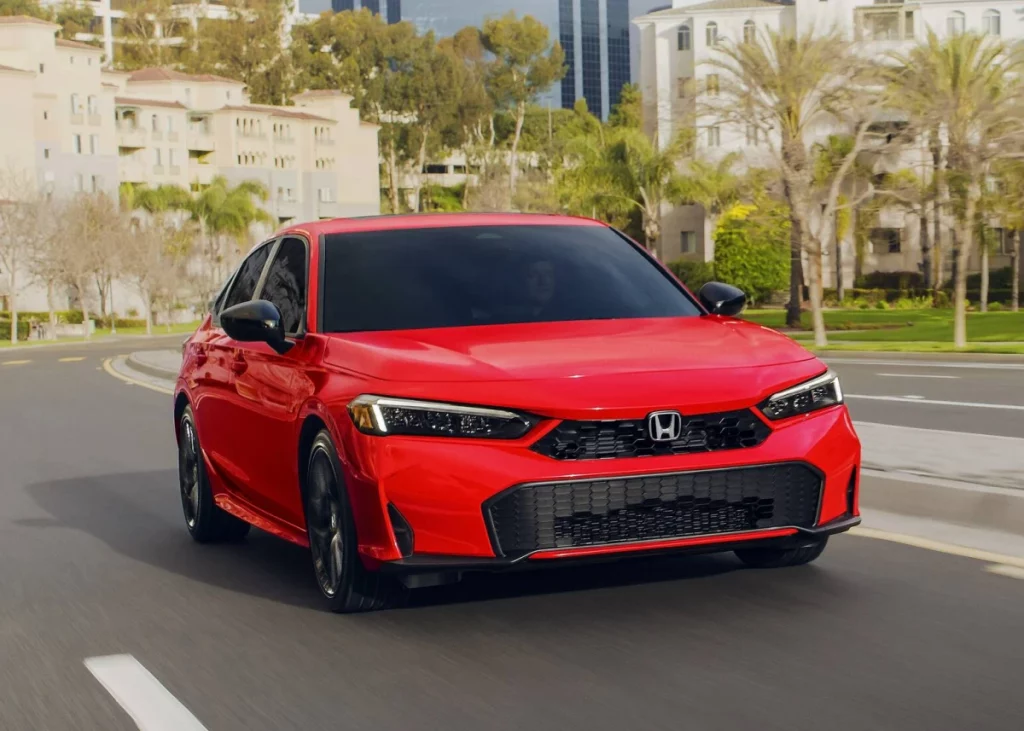
What the LX Actually Is
The 2025 Honda Civic LX is a base-trim sedan with the K20C2 2.0-liter naturally aspirated inline-four engine rated at 150 horsepower at 6,400 rpm and 133 lb-ft of torque at 4,000-5,000 rpm, paired exclusively with a continuously variable transmission (CVT). The LX sits $5,850 below the Sport Hybrid ($30,100) and offers the same standard Honda Sensing safety suite — adaptive cruise control, lane-keeping assist, collision mitigation braking, and road departure mitigation — that every 2025 Civic trim receives. It does not offer any optional powertrain upgrades or a manual transmission. It is the only Civic trim in 2025 without alloy wheels (steel wheels with covers are standard). Source: Honda Newsroom (2025 Civic Sedan features by trim), Honda Canada specifications (2022 Civic Sedan engine specs).
The LX is not and has never been a 1.5-liter turbocharged car. The 1.5T engine in the 11th generation is available only on the 2022-2024 EX and Sport Touring trims (180 hp, 177 lb-ft) before being replaced by the hybrid powertrain for 2025. The LX uses the same 2.0-liter naturally aspirated engine architecture as the 10th generation base model, with slightly revised calibration for the 11th generation chassis. Source: Honda Newsroom (2022 Civic Sedan specifications).
The Acceleration Reality — 8.8 Seconds to 60 MPH
Car and Driver tested a 2022 Honda Civic Sport sedan — which uses the identical 2.0-liter naturally aspirated drivetrain as the LX — and recorded 8.8 seconds to 60 mph, 16.9 seconds in the quarter-mile at 86 mph, and a rolling 5-60 mph time of 9.1 seconds. The 0-60 time drops to approximately 9.2 seconds with the 1-foot rollout subtracted. This is the slowest Civic tested by Car and Driver since the 8th generation base models. The 0-60 time is 1.5 seconds slower than the 1.5T Civic hatchback tested at the same time (7.3 seconds) and 2.6 seconds slower than the 2025 Civic Hybrid (6.2 seconds).
Claims of 7.5 seconds to 60 mph for the LX are not supported by any published instrumented test. The LX’s power-to-weight ratio (approximately 150 HP / 2,875 lbs = 52.2 lb/hp) makes the 8.8-second result physically consistent with the powertrain. Source: Car and Driver (2022 Civic Sport tested, March 2022).
2025 Civic Trim Pricing — How the LX Compares
| Trim | Engine | MSRP | + Destination | Total MSRP |
|---|---|---|---|---|
| LX | 2.0L NA — 150 hp | $24,250 | $1,095 | $25,345 |
| Sport | 2.0L NA — 150 hp | $26,250 | $1,095 | $27,345 |
| Sport Hybrid | 2.0L Hybrid — 200 hp | $30,100 | $1,095 | $31,195 |
| Sport Touring Hybrid | 2.0L Hybrid — 200 hp | $33,100 | $1,095 | $34,195 |
Note: The 2025 Si ($31,395 + $1,150 dest = $32,545) and Type R ($45,595 + $1,150 dest = $46,745) are not listed above because they are separate performance models with unique drivetrains, not trims on the standard Civic sedan option sheet. Source: Honda Newsroom (2025 Civic Sedan pricing, June 2024).
Fuel Economy — Where the LX Excels
The LX returns 32 mpg city, 41 mpg highway, and 36 mpg combined on 87-octane regular fuel. These numbers improved by 1 mpg across the board for 2025 versus the 2022-2024 LX calibration, due to revised ECU tuning and reduced friction in the CVT. The LX achieves these figures without needing premium fuel, a hybrid battery, or a Turbocharger.
The 2025 Civic Hybrid Sport returns 50/47/49 mpg combined, which is 13 mpg better than the LX combined figure. The payback calculation depends on annual mileage: AT 15,000 miles per year and $3.30 per gallon for regular fuel, the LX consumes approximately $1,375 in fuel annually at 36 mpg. The hybrid at 49 mpg consumes approximately $1,010 annually — a difference of $365 per year. The $5,850 price gap between LX and Sport Hybrid would take approximately 16 years of fuel savings to recoup. That calculation assumes stable fuel prices and does not account for the hybrid’s additional $150-200 per year in scheduled maintenance (more complex fluid and cooling system). Source: EPA fueleconomy.gov, Honda Newsroom.
| Metric | LX (2.0L NA) | Sport Hybrid | Si (1.5T) |
|---|---|---|---|
| MSRP (excl. dest) | $24,250 | $30,100 | $31,395 |
| 0-60 (C&D) | 8.8 sec (Sport test) | 6.2 sec | 6.6 sec |
| EPA Combined MPG | 36 mpg | 49 mpg | 30 mpg |
| Annual Fuel Cost* | ~$1,375 | ~$1,010 | ~$1,650 |
* Calculated at 15,000 mi/yr, $3.30/gal regular fuel. Si recommends premium fuel (approximately $3.80/gal), which would raise its annual fuel cost to approximately $1,900. Source: EPA fueleconomy.gov, AAA fuel price averages.
What You Give Up on the LX
The LX is the only 2025 Civic trim with steel wheels (16-inch with plastic covers). It uses manual single-zone air conditioning rather than automatic climate control. The infotainment screen is a 7-inch color LCD with wired Apple CarPlay and Android Auto — the Sport and above get the same size but with wireless connectivity and more features. There is no push-button start (the LX uses a traditional keyed ignition), no blind-spot monitoring with rear cross-traffic alert (that starts on Sport), no rear USB-C ports, no moonroof, and no alloy wheels. The seat fabric is a basic woven cloth without the Sport trim’s sportier pattern. Source: Honda Newsroom (2025 Civic Sedan features by trim).
The LX does share the same 107.7-inch wheelbase, the same Advanced Compatibility Engineering body structure, the same front MacPherson Strut / rear multilink suspension architecture, the same 7-inch driver information display, and the same Honda Sensing suite as every other 2025 Civic Sedan. The chassis and safety structure are identical regardless of trim.
Who Should Buy the LX — and Who Should Not
Buy the LX if: your budget is strictly under $26,000 out the door and you have no interest in performance driving. The LX is an appliance — it gets you from A to B with the best fuel economy in the non-hybrid Civic class (36 mpg combined), proven K20C2 reliability (no turbocharger, no direct-injection carbon buildup, no CVT shudder issues reported on this generation), and the same Honda Sensing safety equipment as the $34,195 Sport Touring Hybrid. The LX is the smartest buy for a college student, a first-time new-car buyer, or anyone whose primary criteria are a low monthly payment and a Honda warranty.
Skip the LX if: you do even occasional highway merges with traffic of moderate density, you drive mountain passes, or you have ever owned a car that accelerates faster than 8 seconds to 60 mph. The LX’s 8.8-second 0-60 time is noticeable in real-world driving. The CVT holds the engine at high RPM during sustained acceleration, producing significant engine noise without corresponding speed. The LX is also not the right choice if you plan to modify the car — the K20C2 in the 11th generation has essentially no aftermarket tuning support because its ECU architecture is different from the 1.5T and Si powertrains.
The smarter buy for most people: the 2025 Civic Hybrid Sport at $30,100. The $5,850 premium over the LX buys 50 more horsepower, 99 more lb-ft of torque, a 2.6-second-faster 0-60 time (6.2 vs 8.8 seconds), 13 more mpg combined (49 vs 36), alloy wheels, push-button start, blind-spot monitoring, wireless Apple CarPlay, automatic climate control, and significantly better resale value. The fuel savings alone will not close the price gap for most ownership periods (approximately 16 years break-even at 15,000 mi/yr), but the driving experience improvement is immediate and substantial. If you can afford the payments, the Hybrid Sport is the better value. If you genuinely cannot stretch the budget past $26,000, the LX is a competent economy car that will run for 200,000 miles without significant repair cost. Source: Car and Driver (2025 Civic Hybrid tested), Edmunds (2025 Civic trims comparison).
Warranty and Reliability
The LX is covered by Honda’s standard 3-year/36,000-mile limited bumper-to-bumper warranty and a 5-year/60,000-mile powertrain limited warranty. Rust perforation coverage extends to 5 years with unlimited miles. The LX is not eligible for the 8-year/100,000-mile hybrid component warranty that covers the hybrid models. Source: Honda Warranty Coverage (owner.honda.com).
The K20C2 engine in the LX shares its basic architecture with the 10th generation K20C2 (2016-2021), which has accumulated approximately 10 years of production history without any systematic engine failures, Oil dilution issues, or premature timing chain wear. The engine uses port injection rather than direct injection, which means there is no carbon buildup on intake valves — a maintenance cost that the 1.5T and Si engines incur at high mileage (approximately $400-600 for walnut blasting at 60,000-80,000 miles). The LX’s CVT is the same P0 series unit used in the 2022-2024 non-hybrid Civic, which has not generated the same frequency of warranty claims as the 10th generation CVT. Source: CivicX.com owner reliability database, NHTSA complaint data (2022-2025 Civic).
Quick Reference — Is the LX the Smartest Buy?
☐ LX uses the 2.0L K20C2 (150 hp, 133 lb-ft) — not a 1.5L turbo. The 1.5T was on 2022-2024 EX/Sport Touring only
☐ 2025 LX MSRP: $24,250 + $1,095 dest = $25,345 total
☐ 0-60 mph: 8.8 seconds (C&D Sport test — identical 2.0L drivetrain). Not 7.5 seconds
☐ 70-0 mph braking: 170 feet (C&D). Claims of 125 feet from 60-0 are incorrect — that would be supercar territory
☐ EPA fuel economy: 32/41/36 mpg on regular fuel. The Hybrid returns 50/47/49 mpg
☐ Fuel payback on LX vs Hybrid: approximately 16 years at 15,000 mi/yr, $3.30/gal
☐ LX has: steel wheels, keyed ignition, manual A/C, wired Apple CarPlay, 7-inch touchscreen
☐ LX lacks: alloy wheels, push-button start, blind-spot monitoring, moonroof, wireless CarPlay
☐ LX has: full Honda Sensing safety suite, same chassis as all other trims, same 107.7-inch Wheelbase
☐ LX engine: port-injected (no carbon buildup). 1.5T and Si engines are direct-injected (walnut blast at ~60-80K)
☐ The LX is the smartest buy only if your hard budget cap is ~$26,000 and you do not care about acceleration
☐ The Sport Hybrid ($30,100) is the smarter buy for most buyers: 200 hp, 49 mpg, 6.2 sec 0-60, more features
☐ The Si ($31,395) is the enthusiast choice: 6-speed manual, 200 hp, Helical LSD, 6.6 sec 0-60, 30 mpg comb
☐ Honda warranty: 3yr/36K bumper-to-bumper, 5yr/60K powertrain. No hybrid component warranty on LX