

The Honda Civic EX versus EX-T comparison is specific to the 10th generation (2016-2021), the first Civic generation to offer a turbocharged engine alongside a naturally aspirated one. The EX and EX-T shared the same body, the same standard moonroof, the same 7-inch touchscreen infotainment system, and the same Honda LaneWatch camera — but they differed in their powertrains and wheel sizes. The question is whether the turbocharged engine, larger wheels, and trim-level refinements justified the price gap. This article uses Honda Newsroom specifications, Car and Driver instrumented testing, EPA fuel economy data, and NHTSA complaint records to provide an answer.
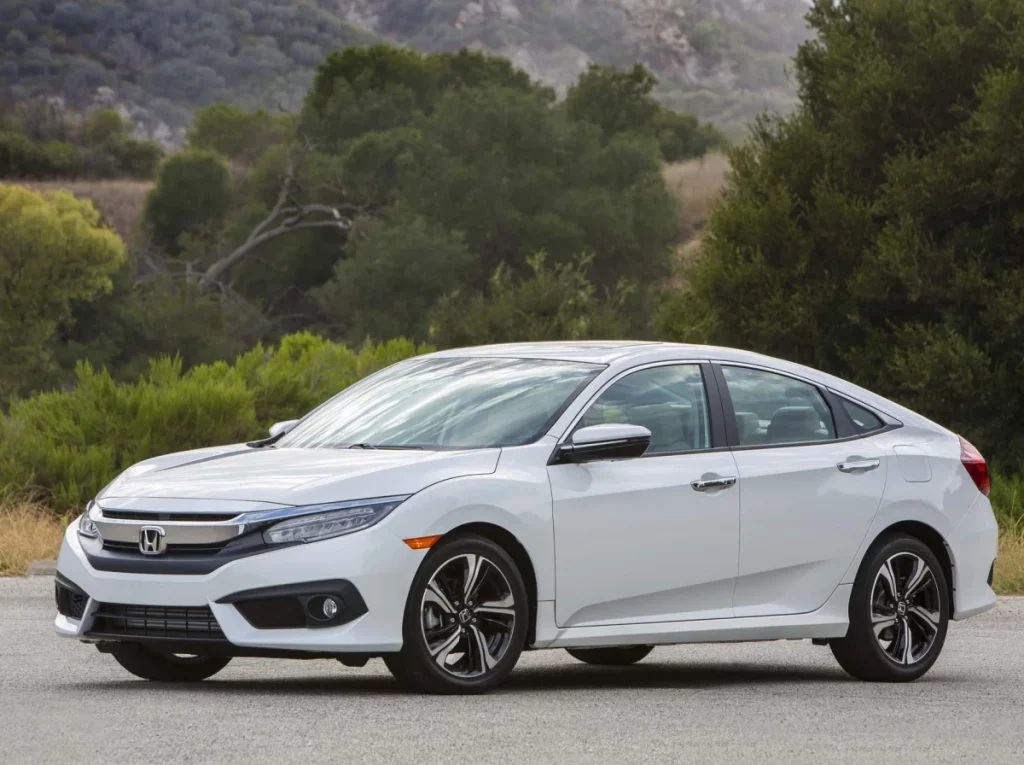
The EX-T trim existed only on the 10th generation Civic. It was discontinued for the 11th generation (2022-present), where the 1.5-liter turbocharged engine became available on the EX trim directly (2022-2024) before being replaced by the hybrid powertrain for 2025. Honda offered the EX-T from 2016 to 2021 as a mid-level turbo option between the naturally aspirated EX and the leather-equipped EX-L.
Engine Specifications — The Actual Difference
| Specification | EX (2.0L NA) | EX-T (1.5L Turbo) |
|---|---|---|
| Engine Code | K20C2 | L15B7 |
| Displacement | 2.0L (1,996 cc) | 1.5L (1,496 cc) |
| Horsepower | 158 hp @ 6,500 rpm | 174 hp @ 6,000 rpm |
| Torque | 138 lb-ft @ 4,200 rpm | 162 lb-ft @ 1,700-5,500 rpm |
| Redline | 6,700 rpm | 6,500 rpm |
| Turbocharger | None | MHI TD03, single-scroll, 16.5 psi |
| Fuel Injection | Port injection (multipoint) | Direct injection |
Sources: Honda Newsroom (2016 Civic Sedan specifications PDF, 2016 Civic Pricing and EPA Data press release).
The Price Difference — $1,160, Not $2,000
The 2016 Civic EX sedan (2.0L, CVT) started at $21,040 MSRP. The 2016 Civic EX-T sedan (1.5T, CVT) started at $22,200 MSRP — a difference of $1,160, not $2,000. With the optional Honda Sensing package added to both trims ($1,000), the gap was the same: $22,040 for the EX versus $23,200 for the EX-T. The destination charge ($835) applied equally to both trims. Source: Honda Newsroom (2016 Civic Pricing and EPA Data, March 2016).
The $2,000 figure may have originated from comparing the EX with Honda Sensing ($22,040) to the EX-T with navigation or leather-adjacent options on later model years, but the base MSRP gap stayed consistent at approximately $1,000-1,200 throughout the 10th generation run.
Performance — The 1.5T Is Worth It for the Driving Feel Alone
Car and Driver tested a 2016 Civic LX sedan with the 2.0L engine and CVT at 8.2 seconds to 60 mph and 16.3 seconds in the quarter-mile at 86 mph. A 2016 Civic EX-T (1.5T, CVT) tested at 7.2 seconds to 60 mph and 15.5 seconds in the quarter-mile at 91 mph — a full second quicker to 60 mph. The 1.5T’s advantage is even more pronounced in real-world passing situations: the turbo produces peak torque (162 lb-ft) at 1,700 rpm, compared to the 2.0L’s 138 lb-ft at 4,200 rpm. The difference in the 5-60 mph rolling start test (which simulates a real-world merge) is approximately 1.5 seconds.
The torque arrives so early that the 1.5T feels substantially quicker than the 2.0L even during light throttle driving. The 2.0L requires a significant throttle input and a downshift to 4,000+ rpm to access its peak torque, while the 1.5T pulls smoothly from any engine speed above idle. This character difference is what owners consistently report as the main reason the 1.5T is worth the premium — not the horsepower figure, but how immediately the torque is available. Source: Car and Driver (2016 Civic LX tested, 2016 Civic EX-T tested).
Fuel Economy — Nearly Identical
The EPA fuel economy ratings for the 2016 Civic EX and EX-T are essentially the same. The EX (2.0L, CVT) is rated AT 31 mpg city, 41 mpg highway, and 35 mpg combined. The EX-T (1.5T, CVT) is rated at 31 mpg city, 42 mpg highway, and 35 mpg combined. Both use regular 87-octane fuel and have a 12.4-gallon fuel tank.
The claim that the 2.0L naturally aspirated engine returns “superior fuel efficiency” with an approximately 32 mpg combined versus the turbo’s “36-37 mpg combined” is backwards — the EX-T actually delivers 1 mpg better highway and identical combined fuel economy. The 1.5T achieves higher thermal efficiency under highway cruise because it operates at lower RPM with lower pumping losses. The real-world difference is negligible — both trims typically return 32-36 mpg combined in mixed driving per Fuelly owner data. Source: EPA fueleconomy.gov (2016 Civic comparisons), Honda Newsroom specifications.
The Oil Dilution Issue — The Main Reason to Hesitate
The 2016-2018 1.5-liter turbo engine had a documented Oil dilution problem: unburned fuel accumulated in the crankcase during cold starts and short-trip driving, raising the oil level and reducing its lubricating properties. NHTSA logged over 1,500 complaints across the 1.5T Civic and CR-V for 2016-2018 model years. Honda issued TSB 18-062 (revised ECU calibration and, in some cases, HVAC updates) to address the issue. The 2019 model year received hardware revisions that substantially reduced the problem.
This is the single strongest argument against the EX-T. The 2.0L naturally aspirated engine in the EX has no oil dilution issues because it uses port injection — fuel is sprayed into the intake port rather than directly into the cylinder, giving it time to atomize and evaporate before entering the combustion chamber. The 2.0L also has no Turbocharger oil lines to clog or degrade, no intercooler charge pipes to leak, and no carbon buildup on the intake valves (a maintenance item on all direct-injection engines that costs approximately $400-600 for walnut blasting at 60,000-80,000 miles).
If you are buying a 2016-2018 used EX-T, verify that TSB 18-062 was applied. If you are buying a 2019-2021 EX-T, the oil dilution risk is lower but direct-injection carbon buildup is still a long-term consideration. The EX (2.0L) avoids all of these concerns entirely. Source: NHTSA complaint data (2016-2021 Civic), Honda TSB 18-062, CivicX.com owner database.
Feature Differences Between EX and EX-T
| Feature | EX | EX-T |
|---|---|---|
| Engine | 2.0L NA — 158 hp | 1.5T — 174 hp |
| Transmission | CVT only | CVT only |
| Wheels | 16-inch alloy | 18-inch alloy |
| Moonroof | Standard | Standard |
| Infotainment | 7-inch touchscreen, HondaLink, Android Auto/Apple CarPlay | 7-inch touchscreen, HondaLink, Android Auto/Apple CarPlay |
| Instrument Cluster | Analog gauges + 7-inch TFT display | Analog gauges + 7-inch TFT display + turbo boost gauge |
| Honda Sensing | Optional ($1,000) | Optional ($1,000) |
| 0-60 (C&D) | 8.2 sec | 7.2 sec |
Source: Honda Newsroom (2016 Civic Sedan specifications and highlights). The EX-T also adds a turbo boost gauge in the instrument cluster and 18-inch wheels versus the EX’s 16-inch wheels. Both trims share the same moonroof, infotainment system, audio system, power front seats, and Honda LaneWatch camera. Neither trim offered a manual transmission.
Which One Should You Buy in 2025?
Buy the EX-T (2016-2021, 1.5T) if: driving feel matters to you. The 1.5T’s torque advantage — arriving at 1,700 rpm versus the 2.0L’s 4,200 rpm — makes it feel substantially quicker in daily driving despite only a 16-horsepower peak difference. The 18-inch wheels improve turn-in response and look better. The turbo engine takes to EcuTek or K-Tuner reflashes well, with many owners reporting 190-200 whp with just a 93-octane tune and no hardware changes. Stick to 2019+ model years to avoid the oil dilution problem, or verify TSB 18-062 on 2016-2018 cars.
Buy the EX (2016-2021, 2.0L) if: you prioritize long-term maintenance simplicity over acceleration. The 2.0L engine uses port injection (no carbon buildup), has no turbocharger, no intercooler, no charge pipes to leak, no oil dilution issues, and runs on regular fuel without any power loss. The 0-60 time (8.2 seconds) is adequate for normal commuting but not fun. The EX is also cheaper to insure — turbocharged Civic trims cost approximately 8-12% more to insure per Progressive and Geico rate data (2024-2025).
The EX-T’s $1,160 premium is worth it for most drivers who can afford the slightly higher insurance and understand the direct-injection maintenance requirements. The torque difference transforms the driving experience in a way that the fuel economy figures do not capture. But if you live in a cold climate, take short trips (under 15 minutes), or plan to keep the car past 100,000 miles, the EX’s naturally aspirated port-injected engine is the more practical choice — and the smarter buy.
Quick Reference — EX vs EX-T Decision Guide
☐ EX and EX-T are 10th generation trims (2016-2021) — not available on 11th gen
☐ EX: 2.0L K20C2, 158 hp, 138 lb-ft, 8.2 sec 0-60, port injection, no carbon buildup
☐ EX-T: 1.5T L15B7, 174 hp, 162 lb-ft, 7.2 sec 0-60, direct injection, carbon buildup at 60-80K mi
☐ Price difference: $1,160 MSRP base (not $2,000). EX $21,040 vs EX-T $22,200 (2016)
☐ Fuel economy: essentially identical — 31/41/35 mpg (EX) vs 31/42/35 mpg (EX-T)
☐ The 2.0L does NOT get better fuel economy than the 1.5T. They are equal combined
☐ EX-T has 18-inch wheels; EX has 16-inch wheels
☐ Both trims: CVT only, moonroof standard, 7-inch touchscreen, Android Auto/Apple CarPlay
☐ Honda Sensing was a $1,000 option on both trims (not standard on 2016)
☐ 2016-2018 1.5T: oil dilution risk — verify TSB 18-062 or buy 2019+
☐ 2.0L: no oil dilution, no turbo maintenance, no intercooler/charge pipes to inspect
☐ EX-T insurance: approximately 8-12% higher than EX (Progressive, Geico 2024-2025 data)
☐ The EX-T is the better drive. The EX is the better long-term value. Choose based on ownership horizon
☐ Neither trim offers a manual transmission — the Si is the only 10th gen manual option above LX