

The FK8 Civic Type R is the most capable front-drive performance car ever offered by Honda. It lapped the Nürburgring in 7:43.8, outran a Porsche 718 Cayman S at VIR Lightning Lap, and Car and Driver named it “one of the purest-driving new cars for sale today at any price.” But the FK8 was also the first Type R sold in the US since 2001, which meant thousands of American buyers suddenly had to live with it as their only car. Two long-term tests covering a combined 60,000 miles — Car and Driver’s 40,000-mile test of a 2019 model and MotorTrend’s 20,100-mile test of a 2018 model — reveal exactly where the FK8 excels and where it frustrates. Sources: Car and Driver (June 2019), MotorTrend (October 2019), MotorTrend FK8 owner feature (June 2020).
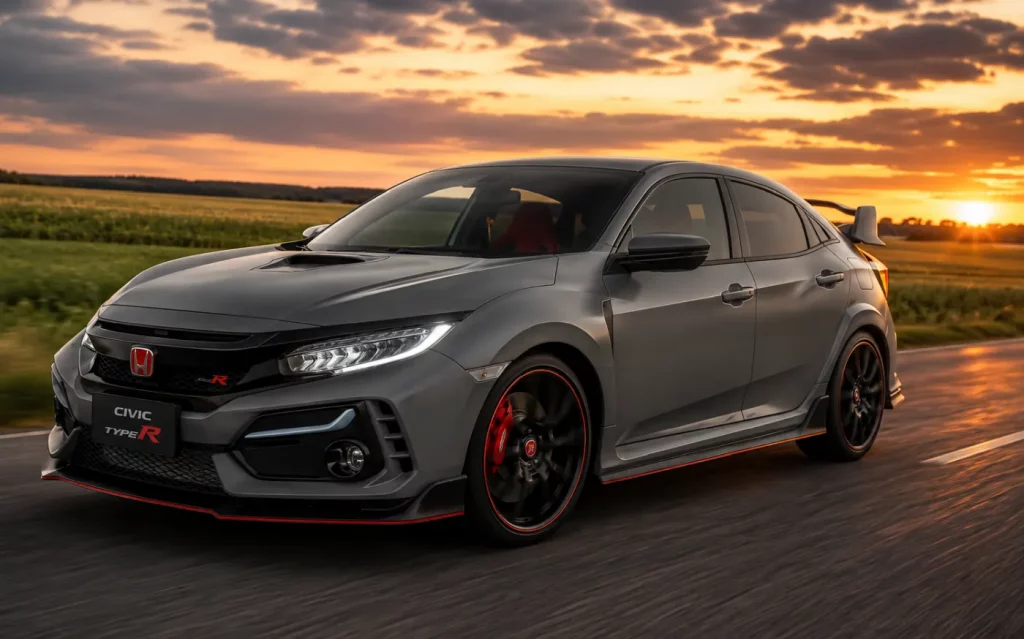
The Track Case — What Makes It a Weapon
The FK8’s powertrain and chassis are the core argument for the car. The K20C1 2.0-liter turbo four produces 306 hp at 6,500 rpm and 295 lb-ft from 2,500 rpm. The six-speed manual has a mechanical limited-slip differential that pulls the car through corners rather than pushing it wide. The adaptive dampers and dual-axis front suspension eliminate torque steer — a problem that plagued previous high-power front-drivers like the Focus RS and Mazdaspeed 3. Source: Honda Newsroom, Car and Driver.
The track numbers speak for themselves. Car and Driver’s 2019 test recorded a 0–60 time of 5.0 seconds and a quarter-mile of 13.5 seconds AT 107 mph. The skidpad grip measured 0.99 g on stock 20-inch Continental SportContact 6 tires. The brakes stopped the car from 70 mph in 147 feet. At 40,000 miles, the same car still ran 0–60 in 5.1 seconds, the quarter-mile in 13.8 seconds at 105 mph, and the skidpad actually improved to 1.01 g. The performance degradation over 40,000 hard miles was negligible.
MotorTrend’s Chris Walton recorded a 1:24.81 lap of Streets of Willow Springs and called the car “the best performing front-drive production car in history.” He held that opinion after 20,100 miles and asked Honda if he could buy the car when the loan ended.
The Track Problem — Overheating
There is one significant caveat to the track weapon narrative: the FK8 overheats on shorter, tighter circuits in warm weather. Car and Driver took their Type R to GingerMan Raceway (1.9-mile course) in mid-80°F temperatures. The car could not complete a single hot lap. The engine temperature gauge spiked into the danger zone, power was pulled, and the car entered limp mode with a P0087 code (low fuel-rail pressure). A VW Golf R and Ford Focus RS at the same track day had no cooling issues. Source: Car and Driver 40,000-mile report.
At VIR, a faster circuit with more high-speed airflow, the FK8 had no cooling problems and set the fastest front-drive lap in Lightning Lap history. The overheating occurs specifically on short, low-speed tracks where radiator airflow is reduced. Honda addressed this on the 2020 model with a 13 percent larger grille opening and a modified lower spoiler, which reduced engine temperatures by 18°F. Owners of pre-2020 cars who track their FK8 frequently report that aftermarket radiators (Koyorad, Mishimoto) solve the issue. Source: MotorTrend FK8 owner feature (June 2020), Honda midcycle refresh data.
The Daily Driver Case — What Works
Reliability. Both long-term tests reported zero mechanical failures. MotorTrend’s car covered 20,100 miles with no problems, no recalls, and no unscheduled downtime. Car and Driver’s car similarly had zero powertrain issues through 40,000 miles. The engine consumed no oil between changes on either test. The maintenance costs were $369 for three oil changes and inspections on the C/D car, and $369 total on the MT car — reasonable for a performance car. Source: Car and Driver, MotorTrend.
Seats. The front buckets are universally praised. Both reviewers described them as supportive and comfortable on long trips. After 20,100 miles of daily contact, the Alcantara and cloth showed no wear. The seats have “incredible bandwidth” — comfortable enough for a 332-mile single-day drive and supportive enough for a track day. Source: MotorTrend one-year review.
Cargo space. The FK8 hatchback has the largest cargo area in the compact hot hatch class. MotorTrend’s reviewer fit a six-foot ladder, an office desk, and large speakers. Car and Driver loaded half a dozen bags of mulch. The 60/40 split rear seats fold flat. For a car that runs the Nürburgring in 7:43, it carries more than most crossover SUVs.
Fuel economy. EPA rating is 22 city / 28 highway / 25 combined. MotorTrend averaged 24 mpg over 20,100 miles and saw 31 mpg on a 332-mile highway day. Car and Driver averaged 25 mpg. Both are within range of a typical compact car — not Prius territory, but not a penalty for daily driving.
Residual value. MotorTrend reported that the FK8 retained 87 percent of its value after three years, compared to 58 percent for a 2015 Subaru WRX STI and 76 percent for a 2017 BMW M2. FK8s still command dealer markups on the used market. Source: MotorTrend, IntelliChoice.
The Daily Driver Case — What Frustrates
Wheel and tire fragility. The 20-inch factory wheels with 245/30R20 tires have approximately 2.9 inches of sidewall. They are the single biggest pain point of FK8 ownership. Car and Driver bent a front wheel on a pothole at 4,522 miles — the replacement wheel cost $1,307, the tire was $296, and the car was stranded overnight because there was no spare tire. Two weeks later, a nail pierced the brand-new replacement tire. The other front tire wore out at 8,873 miles, which Car and Driver called a record for their long-term fleet. The second front wheel was found bent during a tire mount — straightened for $150. Total wheel and tire damage over 40,000 miles: $2,012. MotorTrend similarly bent a wheel on a sewer cover and Honda replaced it as a goodwill gesture (otherwise approximately $500). Source: Car and Driver, MotorTrend.
The fix is well-known: 18-inch aftermarket wheels (BBS, Enkei, Volk Racing) with 245/40R18 or 265/35R18 tires. Many owners immediately sell the factory 20-inch wheels. Car and Driver tested 18-inch BBS RF521 wheels with Michelin Pilot Sport 4S tires and reported improved ride quality, less road noise, similar cornering and braking performance, and an expected tire life of approximately 25,000 miles. The 0–60 time was 0.3 seconds slower due to the taller gearing effect.
Road noise and exhaust drone. Car and Driver reported “a ton of road noise” on the highway. The three-pipe exhaust system drones at cruising speeds — 3,200 rpm at 80 mph in sixth gear. The exhaust also makes an “uninspiring sucking sound” at wide-open throttle. The cabin is not a quiet place for long highway trips.
Second-gear synchro. By 10,838 miles, Car and Driver’s Type R showed resistance to aggressive second-gear shifts. By 40,000 miles, the synchro would “walk out on the job,” leaving a grind instead of engagement. The transmission also occasionally resisted going into first gear. The estimated diagnostic cost was $800. Honda did not cover this under warranty during the test. MotorTrend’s car did not experience this issue, which may indicate variance between individual cars or driving styles. Source: Car and Driver.
Seat frame clunk. The driver’s seat height-adjustment lever developed a clunk at approximately 20,000 miles. The dealer quoted $1,359 for a replacement seat frame and determined it was not covered under warranty. This is a single data point but a notable cost exposure. Source: Car and Driver.
Outdated infotainment. The 7-inch touchscreen is slow, has no volume knob on 2017–2018 models (added for 2019), and has no knob for HVAC temperature adjustment. The cruise control on pre-2020 cars is non-adaptive and requires iterative button presses with no set-speed display. Car and Driver described the cruise control as “about a decade behind.” The 2020 model added Honda Sensing (adaptive cruise, forward collision warning) as standard equipment.
Metal shift knob. The aluminum knob reaches scalding temperatures in summer sun and is painfully cold in winter. Multiple owners report keeping a microfiber cloth in the car as a glove. The 2020 model introduced a heavier egg-shaped knob and Alcantara steering wheel wrap.
No spare tire. The FK8 comes with a tire repair kit only. A flat on the highway means a tow. Car and Driver was stranded overnight after a pothole blowout because no repair was possible. Aftermarket spare tire kits are available (approximately $200–400) and are a common first purchase for FK8 owners who drive in areas with poor roads.
Ownership Cost Summary
| Cost Category | Car and Driver (40K mi) | MotorTrend (20K mi) | Notes |
|---|---|---|---|
| Scheduled maintenance | $369 | $369 | Oil, inspection, rotation at 6K/10K/15K intervals |
| Tires (normal wear) | $304 (one front tire at 8.8K mi) | $1,380 (full set Michelin PS4S at 14K mi) | Rotate every 5K mi to extend life |
| Wheel damage (pothole/impact) | $2,012 | $500 (goodwill covered) | 20″ wheels are fragile. 18″ swap is common fix |
| Rear brake pads | N/A | $222 | Rear pads do most stabilizing work — common early wear |
| Unscheduled repairs (non-warranty) | $1,359 (seat frame estimate) | $0 | Seat frame issue may be isolated |
| Fuel (91-octane premium) | Not itemized (25 mpg avg) | $3,322 (835 gal, $3.97 avg/gal) | ~$8.82/day in fuel |
2020 Midcycle — What Changed
Honda addressed several FK8 criticisms with the 2020 update. The grille opening grew by 13 percent, paired with a modified lower spoiler, to reduce track overheating. Engine temperatures dropped by 18°F. The brakes received two-piece 350mm front rotors and new pads, which reduced pedal stroke by 17 percent and improved fade resistance. The suspension got stiffer Bushings and new low-friction ball joints for quicker steering response. Inside, the steering wheel and shift boot gained Alcantara wrap, the shift knob gained 90 grams of weight, and Honda Sensing (adaptive cruise, forward collision warning) became standard. Active Sound Control was added to enhance the natural engine note through the speakers. A new paint color — Boost Blue — replaced Aegean Blue. The price increased to $37,950 including destination, up $695.
Owners of pre-2020 cars were most envious of the LogR data-logging APP and the oil temperature gauge, which the 2020 model received. One owner — Jeffrey Ting, who ran a heavily modified 2018 car — said he would “strongly consider trading mine in” if Honda had fixed the overheating, but he noted the 2020’s larger grille and radiator might still not be enough for aggressive track use. Source: MotorTrend FK8 owner feature.
The Verdict — Who Should Buy an FK8
The FK8 Type R is the correct car for the buyer who wants one car that does everything well and occasionally runs a track day at a fast circuit with good airflow. It is a legitimate 40,000-mile daily driver with zero powertrain problems, reasonable maintenance costs, and the deepest cargo space in its class. The seats are comfortable, the manual transmission is excellent (if you get a good synchro), and the car has aged into a cult-classic Residual Value hold.
The FK8 is the wrong car for the buyer who lives in a city with potholes, drives mostly highway miles at 75+ mph, or does frequent track sessions at short, low-speed circuits in warm weather. The wheel and tire setup is a recurring expense, the highway noise is fatiguing, and the overheating issue on tight tracks is real even with the 2020 update. Those buyers should budget $2,000–3,000 for 18-inch wheels and an aftermarket radiator, or consider the FL5 (11th gen) Type R, which resolved the cooling problem with a larger standard radiator and 19-inch wheels.
Quick Reference
☐ 306 hp, 295 lb-ft, 6-speed manual, LSD standard. 0–60 in 5.0 seconds (C/D)
☐ FK8 runs 0–60 in 5.1 seconds and 1/4-mile in 13.8 at 105 mph after 40,000 miles — minimal performance loss
☐ Overheating on short tracks in warm weather is a known issue. 2020 models (larger grille) improved but did not fully solve it
☐ 20-inch wheels with 30-series tires are fragile. Budget for 18-inch aftermarket wheels ($1,500–3,000) or expect pothole damage
☐ Front tire wear: 8,000–10,000 miles on stock Contis with factory rotation. Rotate every 5,000 miles for ~15,000-mile life
☐ Second-gear synchro issues reported on some cars. Test before buying a used FK8 — grind on aggressive 1-2 upshift is a red flag
☐ No spare tire. Buy an aftermarket kit (~$200–400) if you drive on poor roads
☐ Road noise is high on the highway. Exhaust drones at 3,200 rpm (80 mph in 6th)
☐ Metal shift knob gets hot in sun, cold in winter — keep a cloth handy
☐ Rear brakes wear faster than fronts (stabilization duty) — budget $200–250 at ~15,000–20,000 miles
☐ Resale value: approximately 87 percent retained at 3 years — exceptional for the segment
☐ 2020+ models add Honda Sensing, LogR app, larger grille, oil temp gauge — worth the premium for track use
☐ 2017–2018 models: no volume knob, no physical HVAC controls. 2019+ added the knob. 2020+ added Honda Sensing
☐ MotorTrend gave the FK8 a fully reliable verdict over 20,100 miles. Car and Driver reported zero powertrain failures in 40,000 miles