

The 8th generation Honda Civic (2006–2011) is widely regarded as one of the best-driving compact cars of its era, but its automatic transmission carries baggage from one of the largest transmission liability episodes in Honda’s North American history. The confusing part is that the Civic’s specific transmission — the Honda SPCA 5-speed automatic paired with the R18A 1.8L engine — was not the primary target of the major class action lawsuits. The massive settlements involved the V6 B7XA/BAXA family of transmissions used in the Odyssey, Pilot, Accord V6, and Acura models. But the Civic’s SPCA unit shares the same era, the same basic 5-speed architecture, and the same tarnished reputation by association. This article sorts out what actually happened to the Civic’s automatic transmission, which lawsuits applied, and what owners should know. Sources: ProblemsByVin Honda 5-speed database (7,166 NHTSA complaints across 23 model-year combinations), CarComplaints 2006–2008 Civic transmission pages, gearboxlist.com SPCA transmission specifications, 8thCivic forum threads, Honda Newsroom 2008 Civic specifications, NHTSA TSB and recall database, Top Class Actions Honda 5-speed settlement report (January 2021).
The Two Different Transmissions — Civic vs. Everything Else
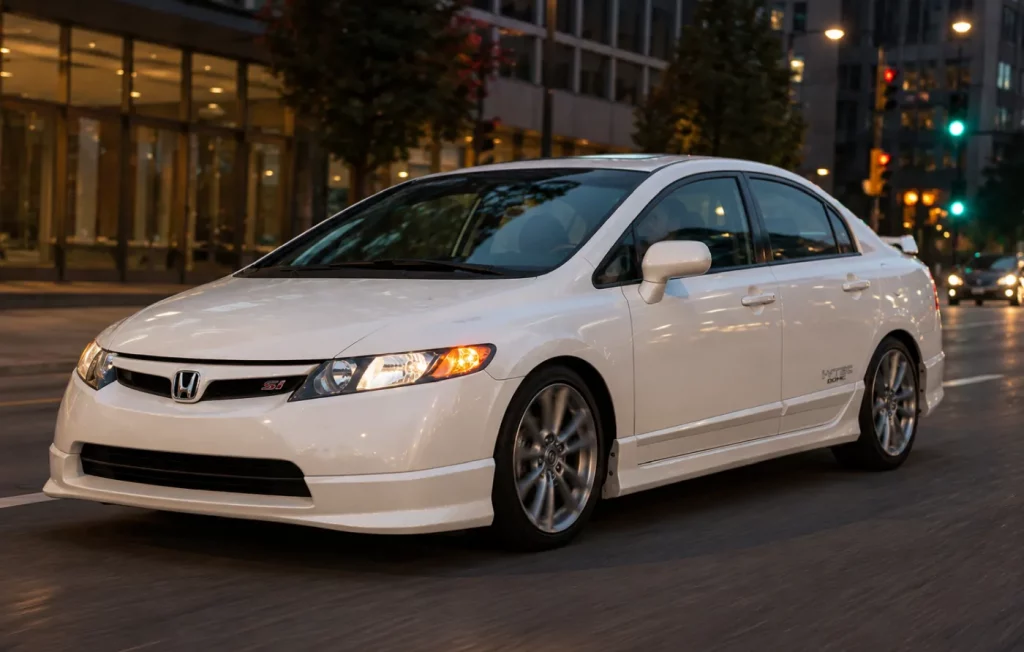
The 8th gen Civic sedan, coupe, and Hybrid used the Honda SPCA 5-speed automatic transmission. This is a compact, transverse-mounted unit designed for the 1.8L R18A engine, producing approximately 140 horsepower. It is a completely different transmission from the B7XA/BAXA family used in Honda’s V6 vehicles. The B7XA/BAXA units handled 240–255 horsepower from the J-Series V6 engines and faced substantially higher torque loads, especially in heavier vehicles like the Odyssey and Pilot. Sources: Honda Newsroom 2008 Civic specifications, gearboxlist.com SPCA specs.
The SPCA transmission was produced from approximately 2005 to 2011. It shares the same basic 5-speed planetary gearset architecture as the larger Hondas, but the internal components — clutch pack design, torque converter, valve body — are scaled for the 1.8L engine’s power output. This distinction matters because the class action lawsuits that created the “Honda 5-speed automatic” reputation were almost entirely about the V6 units overheating, losing 3rd gear, and failing catastrophically under sustained highway loads. Sources: ProblemsByVin B7XA/BAXA database, gearboxlist.com SPCA specifications.
The Big Lawsuit That Did Not Cover the Civic
The most significant class action settlement involving Honda’s 5-speed automatic transmissions was Janet Case, et al. v. American Honda Motor Co. Inc., Case No. BC424169, filed October 19, 2009, in Los Angeles Superior Court. The settlement was preliminarily approved in December 2020 and became final in January 2021. Honda agreed to pay up to $2 million to resolve allegations that it failed to disclose its policy of making warranty adjustments for known transmission defects. Source: Top Class Actions Honda 5-speed settlement report.
The vehicles covered were limited to California-resident original owners of:
- 2003–2004 Honda Accord V6
- 2002–2004 Honda Odyssey
- 2003–2004 Honda Pilot
- 2001–2002 Acura MDX
- 2003 Acura 3.2 TL Type S (specific VIN range)
- 2003 Acura 3.2 CL Type S (specific VIN range)
The Honda Civic was not listed in this settlement. Neither was the CR-V, the Element, or any vehicle with a 4-cylinder engine. The lawsuit targeted the V6 B7XA/BAXA transmission family. Eligible owners who paid out-of-pocket for a genuine Honda transmission replacement before 93 months or 109,000 miles could receive 100% reimbursement. Owners who did not replace their transmission received a $25 credit toward Honda parts. The settlement is now closed — the claim deadline was January 12, 2021. Source: Top Class Actions, settlement website www.Honda5SpeedATClassSettlement.com.
The V6 Transmission Crisis — Why the Reputation Exists
The B7XA/BAXA 5-speed automatic transmission family accumulated 7,166 NHTSA complaints across 23 model-year combinations and 7 vehicle platforms. The most affected vehicles were the 2005 Odyssey (829 complaints), 2007 Odyssey (829 complaints), 2005 Accord (686 complaints), and 2005 Pilot (679 complaints). The failure pattern was well-documented: 3rd gear clutch pack burn-through under sustained highway load, often preceded by a shudder on the 2–3 shift that owners described as “the death wobble.” Some owners went through three replacement transmissions under warranty. Source: ProblemsByVin Honda 5-speed database, NHTSA complaint records.
Honda eventually issued extended warranties covering the transmission to 7 years or 100,000 miles for affected V6 vehicles. The engineering fix — redesigned clutch packs and revised transmission cooling — was phased in around 2008 and largely resolved the issue. Later model years of the same vehicle families (2008–2010) show substantially lower complaint volumes. Source: ProblemsByVin, NHTSA TSB records.
What Actually Went Wrong With the Civic’s SPCA Transmission
The Civic’s SPCA 5-speed automatic is not the V6 transmission, and it did not suffer the same 3rd-gear-clutch-pack failure pattern. But it had its own documented issues, and the NHTSA complaint data shows a modest but real problem pattern.
Shudder on the 2–3 shift. The most commonly reported problem across 8thCivic forum threads and NHTSA complaints is a shudder, shake, or hesitation when the transmission shifts from 2nd to 3rd gear. Owners described it as a “shake at 10–15 mph” or a “jerky shift” in stop-and-go traffic. The cause is typically degraded transmission fluid or a worn shift solenoid. Regular ATF drain-and-fill service using Honda DW-1 fluid often resolves the issue if caught early. Source: 8thCivic forum thread “2008 Honda Civic Jerky Automatic Transmission between 10-15 mph,” 8thCivic repair thread on 2–3 shift shudder.
Pressure control solenoid failure. The clutch pressure control solenoid valve A (PCS A) is a known failure point. The failure code P0776 (A/T Clutch Pressure Control Solenoid Valve A performance / stuck off) appears in 8thCivic forum posts. Symptoms include delayed engagement, harsh shifts, and a transmission that feels like it is slipping. Replacement cost is approximately $150–300 for the solenoid plus fluid. Source: 8thCivic “A/T Clutch Pressure Control Solenoid Valve A” thread, Abdallah96 (2006 Civic R18A).
Shift flare between gears. Some owners reported the transmission flaring (RPMs rising without corresponding acceleration) between 2nd and 3rd or 3rd and 4th gear. This is typically caused by worn shift solenoids or internal clutch pack wear, though it is much less common on the SPCA than on the V6 transmissions. Source: 8thCivic forum transmission discussion threads.
Low-speed hesitation and jerking. A 2008 EX Coupe owner on 8thCivic reported that the transmission jerked between 10–15 mph in stop-and-go traffic. The dealer could not reproduce the issue. Several owners on the same thread reported that Honda issued a software update (PCM reflash) to address shift quality on the R18A automatic, though the TSB number is not widely documented. Source: 8thCivic “Jerky Automatic Transmission between 10-15 mph” thread, Matrix454.
NHTSA Complaint Volume — Civic vs. The V6 Cars
| Vehicle | Transmission | NHTSA Trans Complaints | Pattern |
|---|---|---|---|
| 2005 Honda Odyssey | B7XA 5AT (V6) | 829 | 3rd gear failure, torque converter shudder |
| 2005 Honda Accord V6 | B7XA 5AT (V6) | 686 | Catastrophic 3rd gear failure |
| 2006 Honda Civic | SPCA 5AT (1.8L) | ~10–20 categorized | 2–3 shudder, solenoid issues, shift flare |
| 2007 Honda Civic | SPCA 5AT (1.8L) | ~10–20 categorized | CVT (Hybrid) failure, hard shift, lockout |
The Civic’s complaint volume is approximately 1–2% of the Odyssey’s on a per-model-year basis. The SPCA transmission is not a zero-failure unit, but its failure rate is orders of magnitude lower than the V6 5-speed automatics. CarComplaints.com rates the 2007 Civic automatic transmission problems AT 5.2 out of 10 in severity — “fairly significant” — but notes zero crashes or injuries attributed to transmission failure across the model years. Source: CarComplaints 2006–2008 Civic transmission pages, ProblemsByVin database.
Other Class Actions and Warranty Extensions That Did Affect the Civic
The 8th gen Civic was subject to two other major class action settlements, neither of which involved the transmission.
Rear suspension class action (2006–2007 Civic). A Canadian class action, Kathleen Thorpe v. Honda Canada Inc. (Q.B.G. No. 644 of 2009), alleged that the rear suspension on 2006–2007 Civics caused uneven or rapid rear tire wear. The settlement covered owners in Canada and provided reimbursement for rear Upper Control Arm replacement and tire wear. A parallel US settlement was preliminarily approved in April 2013 and covered 2006–2007 Civics (including Hybrid) and 2006–2008 Civic Hybrids. Honda extended the warranty on the rear upper control arms for vehicles where premature rear tire wear could be established under the settlement terms. Source: NHTSA TSB A-AHP-09092013-9, merchantlaw.com settlement notice.
Engine block warranty extension (2006–2009 Civic). Honda issued a warranty extension covering cracked engine blocks on 2006–2009 Civics (all trims). The defect involved a casting issue during manufacturing that could cause the engine block to crack and leak Coolant, leading to overheating and complete engine failure. Honda extended the warranty to 10 years with unlimited mileage. This was not a class action settlement but a voluntary warranty extension issued in January 2011 and updated multiple times through 2015. The extension covered all 2006–2008 Civics and was later expanded to include 2009 models. Source: NHTSA CSC-10030876-9348, Honda warranty extension letter, oemdtc.com, fixdapp.com.
What Owners Actually Experienced With the SPCA Transmission
The 8thCivic forum threads spanning 2007 to 2020 show a transmission that is generally reliable with regular maintenance but develops solvable problems when neglected. The most common owner-reported issues are:
- 2nd-to-3rd shudder at low speed (10–15 mph) — typically appears between 60,000–100,000 miles. A Honda DW-1 ATF drain-and-fill (not a flush) resolves it in approximately 60–70% of cases. If the shudder persists, the shift solenoid or pressure control solenoid may need replacement.
- Delayed engagement from Park to Drive or Reverse — often caused by low fluid level or a failing pressure control solenoid. Checking the ATF level on a level surface with the engine running at operating temperature is the first diagnostic step.
- Transmission fluid neglect is the primary cause of failure. Multiple forum owners who bought used 8th gen Civics reported that previous owners never changed the ATF. A fluid change at 90,000–120,000 miles on a transmission that was never serviced can sometimes dislodge accumulated debris and cause further issues — some owners recommend leaving neglected fluid alone if the transmission is shifting smoothly.
No 8thCivic forum thread documents a pattern of catastrophic SPCA transmission failure comparable to the V6 B7XA units. No owner reported losing all forward gears at highway speed. No owner reported going through multiple replacement transmissions. The SPCA unit is, by all available evidence, a durable transmission for a 140-horsepower compact car when maintained on schedule. Sources: 8thCivic transmission discussion threads, 8thCivic “ATF fluid” thread (2008 Civic, 95,000 miles), 8thCivic “07 Civic Auto Transmission Problem” thread.
Repair Costs
| Repair | Cost Range | Notes |
|---|---|---|
| ATF drain-and-fill (Honda DW-1) | $80–$150 | Recommended every 30,000–50,000 miles. No flush |
| Pressure control solenoid replacement | $200–$400 | Part ~$100–150, includes fluid change |
| Shift solenoid replacement | $300–$600 | May need valve body removal |
| Valve body replacement | $800–$1,500 | Rarely needed. Rebuild or reman option |
| Full transmission replacement | $2,500–$4,000 | Remanufactured unit + labor. Rare for SPCA |
Why the Reputation Does Not Match the Reality
The 8th gen Civic automatic transmission carries a worse reputation than its actual failure rate deserves. There are two reasons. First, the V6 B7XA/BAXA transmission crisis created a halo of suspicion around every Honda 5-speed automatic from the 2003–2008 era, and the Civic’s SPCA unit was guilty by association. Second, the 8th gen Civic had a genuinely bad reliability reputation overall — the cracked engine block issue, the rear suspension wear problem, and the early CVT failures on the Hybrid model — so buyers and journalists often lumped the automatic transmission into that broader reliability concern.
In reality, the SPCA 5-speed automatic is one of the more reliable components on the 8th gen Civic. It does not share the V6 transmission’s fatal 3rd-gear clutch-pack design flaw. It does not have a documented pattern of catastrophic highway failure. It does not need replacement every 50,000–80,000 miles like the Odyssey and Pilot transmissions did. Its issues are limited to shift quality complaints that are usually solvable with fluid maintenance or a single solenoid replacement. Source: 8thCivic forum transmission threads, CarComplaints data, NHTSA complaint records.
Quick Reference
☐ The 8th gen Civic uses the Honda SPCA 5-speed automatic — a different unit from the V6 B7XA/BAXA transmissions that generated the class action lawsuits
☐ The major 5-speed automatic class action settlement (Janet Case v. American Honda, 2021) covered V6 vehicles only — the Civic was not included
☐ The B7XA/BAXA V6 transmission family accumulated 7,166 NHTSA complaints. The Civic’s SPCA unit accumulated fewer than 100 across all model years
☐ The most common Civic auto transmission problem is a 2nd-to-3rd shudder at 10–15 mph, usually resolved by an ATF drain-and-fill with Honda DW-1 fluid
☐ Pressure control solenoid failure (code P0776) is the most common electrical failure — approximately $200–400 to repair
☐ A separate class action settlement covered the 8th gen Civic’s rear suspension (premature tire wear) for 2006–2007 models
☐ A separate warranty extension covered 2006–2009 Civic engine blocks for casting cracks — 10 years, unlimited mileage
☐ Regular ATF changes every 30,000–50,000 miles are the single most effective preventive measure for the SPCA transmission
☐ Full transmission replacement on the Civic SPCA is rare — most owners never need it
☐ The 8th gen Civic’s automatic transmission is one of the more reliable components on the car, but is often unfairly grouped with the V6 transmission crisis
☐ Honda DW-1 fluid is the only recommended ATF — using generic fluid can cause shift quality issues
☐ If buying a used 8th gen Civic automatic, confirming ATF service history is more important than worrying about the class action lawsuits that never applied to this transmission