

Most Civic owners know that driving style affects fuel economy. What is less understood is how much each habit actually moves the needle and which habits make no real difference AT all. The data from CivicX, 11thGenForum, Fuelly, and fueleconomy.gov owner logs reveals a clear hierarchy: some habits consistently produce 5-10 MPG improvements, while others are placebo-level tweaks that matter only at the margins.
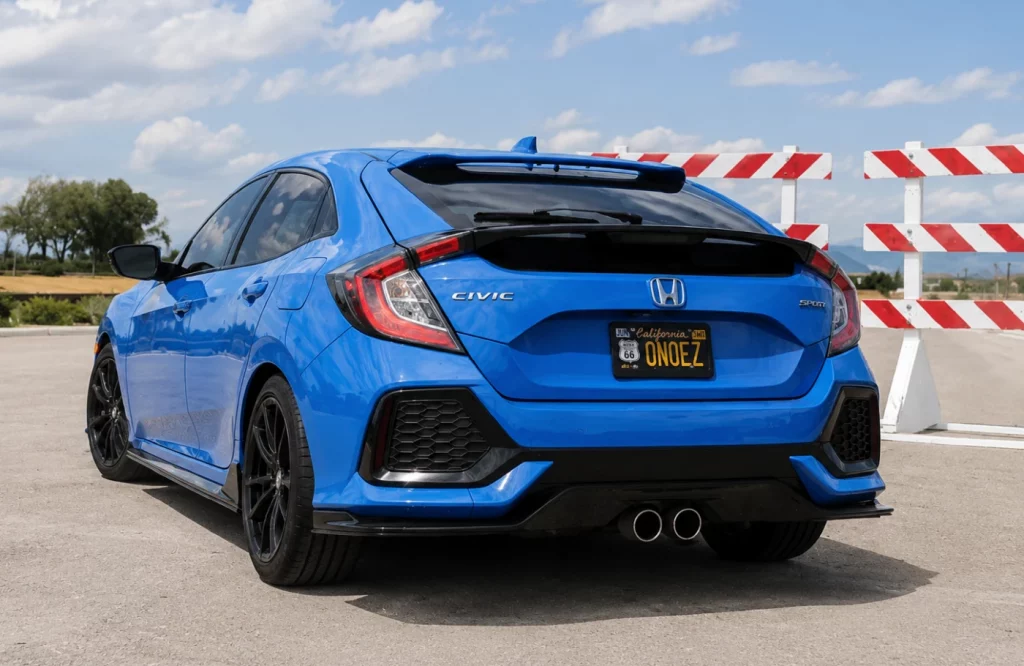
The list below is organized from the highest-impact changes to the smallest. These apply across the 8th through 11th generation Civics, with specific notes where a technique matters more for naturally aspirated engines or turbocharged ones.
1. Drop Highway Speed From 75 to 65 MPH
This is the single highest-impact habit change for any Civic owner with a highway commute. Aerodynamic drag increases with the square of speed, meaning the energy required to push air out of the way rises steeply above 60 MPH. The fueleconomy.gov estimate is that each 5 MPH above 50 MPH is equivalent to paying an additional $0.20 per gallon. For the 1.5T Civic specifically, the effect is measurable tank to tank.
CivicX owner data from a 2016 Touring 1.5T shows that dropping cruise control from 75 MPH to 65 MPH on a 100-mile highway trip raises MPG from approximately 38 to 43 — a 5 MPG improvement. Another 1.5T owner on the same thread running at 60-65 MPH on a 65-mile commute recorded 44.8 MPG on the trip computer and 42.5 MPG calculated at the pump. Source: CivicX.com, “Optimal Cruising Speed for MPG” thread (2017); CivicX.com, “MPG w/ Econ Mode” thread (2016).
The 8th and 9th generation 1.8L Civics are less speed-sensitive than the 1.5T because they do not build boost, but the same aerodynamic principle applies. A 2012 Si owner on CivicX logged a 2,900-mile road trip: at 62 MPH the car averaged 38.75 MPG; at 70 MPH it dropped to 34.6 MPG — a 4.2 MPG difference. Source: CivicX.com, “Optimal Cruising Speed for MPG” thread (2017).
The practical trade-off is time. At 65 MPH versus 75 MPH, a 30-mile highway commute takes 27.7 minutes versus 24 minutes — 3.7 minutes longer each way. Over a year of 240 commuting days, that is about 30 hours of extra drive time. At $3.50 per gallon and 15,000 miles per year, the speed reduction saves approximately $200-$250 annually in fuel for the 1.5T and $150-$200 for the 2.0L naturally aspirated engine.
2. Avoid Short Trips Under 5 Miles
No driving habit change affects fuel economy as much per trip as simply shortening the trip length — but for the trips that cannot be avoided, understanding what happens to the engine in the first few minutes can help.
Every Civic engine runs in open-loop enrichment mode from cold start until the coolant reaches approximately 160-180 degrees Fahrenheit. During this warm-up phase, the air-fuel ratio is richer than stoichiometric (roughly 12:1 instead of 14.7:1) to ensure stable combustion and fast catalyst light-off. Fuel economy during open-loop operation is approximately 30-40 percent worse than normal operating temperature.
An 8th-generation Civic owner on 8thCivic.com logging short commutes under 5 miles in winter reported averaging 22-25 MPG on those trips. The same driver on the same route in summer with a fully warm engine averaged 30-33 MPG — a roughly 30 percent improvement entirely attributable to engine temperature and enrichment mode. Source: 8thCivic.com owner reports; fueleconomy.gov, “Fuel Economy in Cold Weather” (DOE/EPA data).
The practical application: if you have a choice between making two separate 3-mile trips or combining them into one 6-mile trip, the combined trip will use less total fuel because the engine reaches operating temperature once instead of twice. A single cold start and warm-up cycle wastes roughly 0.1–0.15 gallons of fuel compared to a hot restart. Over a week of short trips, that adds up.
For owners of 10th and 11th generation 1.5T Civics, the enrichment period is shorter than on the older naturally aspirated engines because the Turbocharger and closer-coupled catalyst reach operating temperature faster. But the short-trip penalty still exists — the 1.5T’s direct injection system produces elevated particulate emissions and slightly lower efficiency until the catalyst is fully lit.
3. Use Eco Mode Correctly (Not Always, Not Never)
Eco mode on the 10th and 11th generation Civics modifies four systems: throttle response mapping, CVT shift logic, air conditioning compressor engagement, and cruise control behavior. It does not change the engine’s internal efficiency or the CVT’s physical ratio spread. The fuel economy benefit depends entirely on whether the driver compensates for the dulled throttle response.
CivicX owner testing on the 1.5T CVT consistently shows 2-4 MPG improvement with Eco mode enabled in mixed driving. One owner tested two full tanks back-to-back: 34 MPG with Eco on, 32 MPG with Eco off on the same commute. Another owner with a 2016 EX-T reported 42-47 MPG on a 15-mile 20/80 city/highway commute with Eco mode on, and 40-42 MPG on the same route without it. Source: CivicX.com, “Eco Mode” thread (2020); CivicX.com, “MPG w/ Econ Mode” thread (2016).
But the benefit disappears or reverses when the driver presses the accelerator harder to compensate for the dulled response. On the 11thGenForum, one owner tested a hilly residential loop and found Eco mode improved MPG from 19 to 21.1 MPG with the AC running, but hurt MPG from 30.7 to 29.2 with the AC off. The difference was the AC compressor cycling — Eco mode reduces AC engagement, which is where much of the real savings come from. Source: 11thGenForum.com, “Econ mode gas mileage measurements” (2024).
The correct use: enable Eco mode on highways and steady-speed cruising roads where throttle response modulation is not needed. Disable it in stop-and-go city driving where predictable acceleration is needed to merge and navigate traffic efficiently — the penalty of pressing the pedal harder to get the same acceleration negates the benefit. For the 1.5T CVT specifically, Eco mode on the highway at steady cruise produces 2-4 MPG improvement. For the 2.0L naturally aspirated engine, the difference is closer to 0-2 MPG because the engine is already operating in its most efficient range at steady throttle.
Manual transmission owners of the 2.0L naturally aspirated engine report negligible improvement from Eco mode — one 2019 LX 6MT owner logged 37.2 MPG with Eco and 37.0 MPG without, noting that the only noticeable change was the AC running warmer. Source: CivicX.com, “Eco Mode” thread (2020).
4. Use the Idle Stop Feature (11th Gen) or Shut Off the Engine Manually (Older Civics)
The 11th generation Civic (2022-present) comes with an idle stop feature that shuts the engine off when the car is stopped at a traffic light and restarts it when the brake is released. It is enabled by default but many owners disable it because the restart vibration is noticeable. The fuel savings are real but small per stop.
At idle, a warm Civic engine consumes approximately 0.2-0.3 gallons of fuel per hour, depending on accessory load. A typical traffic light stop of 45 seconds burns roughly 0.004-0.006 gallons. Over a commute with 15 traffic lights, that is approximately 0.06-0.09 gallons saved per trip — roughly 1-2 percent of the total fuel consumed on that commute. EPA estimates that idle stop improves combined fuel economy by 3-5 percent in city driving.
The restart consumes the equivalent of roughly 5-7 seconds of idle fuel, so stops shorter than 10 seconds provide no benefit. Stops longer than 20 seconds produce a clear net gain.
For owners of 8th through 10th generation Civics without idle stop, manually shutting off the engine at long stops (train crossings, drive-through lines, long traffic lights) saves the same amount of fuel. The starter motor and battery are designed for many more starts than most owners realize — modern starter motors are rated for 60,000+ cycles, and a start uses less fuel than 10 seconds of idle.
5. Moderate Acceleration — The Turbo Engine’s Sensitivity
The 1.5T engine is more fuel-efficient than the 2.0L naturally aspirated engine at steady cruise but is more sensitive to throttle input during acceleration. The turbocharger builds boost when the engine is under load, and boost increases the amount of fuel injected per cycle to maintain the target air-fuel ratio. Even gentle throttle openings that produce 2-3 PSI of boost reduce fuel economy measurably compared to naturally aspirated operation.
A 10thCivicForum owner with a 1.5T CVT tested this directly: accelerating gradually from a stop to 45 MPH over 12 seconds produced 32 MPG on that segment. Accelerating the same way over 8 seconds — still not aggressive — dropped the segment average to 28 MPG. The difference was boost pressure. Source: 10thCivicForum.com, “Real World MPG” thread (2019).
The technique is to accelerate at a rate that keeps the boost gauge (or the power meter on the digital cluster) in the lower third of its range. On the 11th gen digital gauge cluster, this corresponds to keeping the power indicator in the white or light green zone rather than the darker green or power zones. On the 10th gen without a boost gauge, the audible cue is the engine note staying below the point where the turbo whistle becomes audible.
The 2.0L naturally aspirated engine is less sensitive to acceleration rate because it lacks boost enrichment. Gradual acceleration still helps — the engine reaches optimal BSFC (brake specific fuel consumption) range at moderate throttle openings — but the penalty for slightly harder acceleration is smaller than on the 1.5T.
6. Keep Tires Inflated to Door Placard Pressure (Not Lower, Not Higher)
Under-inflated tires increase rolling resistance, which directly reduces fuel economy. The relationship is roughly linear: a 10 percent drop in tire pressure increases rolling resistance by approximately 10 percent, which reduces fuel economy by approximately 1-2 percent. For a Civic averaging 34 MPG, that is a loss of 0.3-0.7 MPG.
Most Civic owners check tire pressure only at oil changes or when the TPMS light comes on. The TPMS light on the 10th and 11th generation Civics triggers at roughly 25 percent below the placard pressure — by which point the fuel economy penalty has already been in effect for several PSI. The placard pressure for most 10th and 11th generation Civics is 32 PSI front and 33 PSI rear for the sedan, 33 PSI front and 32 PSI rear for the hatchback.
Over-inflating tires above the placard pressure reduces rolling resistance slightly but degrades ride quality and traction, especially in wet conditions. The marginal MPG gain above placard pressure is approximately 0.1 MPG per additional PSI — not worth the trade-off in ride comfort and even tire wear.
7. Coast in Gear — Lift and Coast, Don’t Coast in Neutral
The Civic’s engine management system cuts fuel injection entirely when the car is coasting in gear with the throttle closed and the engine speed above approximately 1,200 RPM. This is called deceleration fuel cut-off (DFCO). When coasting in neutral or with the clutch disengaged, the engine must idle, which consumes fuel.
The difference: coasting down a 1-mile exit ramp in gear with DFCO active consumes approximately zero fuel for that distance. Coasting the same ramp in neutral consumes roughly 0.01 gallons of idle fuel, which is approximately 0.3 MPG of lost efficiency on a 30 MPG tank.
On the 1.5T with CVT, the effect is smaller because the CVT coasts differently from a manual or automatic transmission — the torque converter unlock and CVT ratio change behavior means DFCO activates less predictably. On the 6-speed manual and the 5-speed automatic in the 8th and 9th generations, DFCO activation is consistent and the fuel savings are measurable over repeated trips.
The related technique often called “pulse and glide” — accelerating moderately to 5-10 MPH above the target speed, then lifting off and coasting in gear back down to the target speed — produces the highest efficiency on the Civic 1.5T at speeds between 40 and 55 MPH. The 10thCivicForum owner who averaged 44.2 MPG over 54 fuel-ups described this as his primary technique on flat terrain. He reported that EK Civic hatchback owners on the same forum use the same method to achieve 50+ MPG on non-hybrid engines. Source: CivicX.com, “What is the best real world MPG average you are getting from 2.0l or 1.5l” (2016).
8. Remove Roof Racks, Bike Racks, and Unused Cargo
A roof rack creates aerodynamic drag even when empty. The EPA estimates that a loaded roof box reduces highway fuel economy by 10-25 percent depending on speed and shape. An empty roof rack crossbar reduces highway MPG by approximately 5-8 percent at 65 MPH because it disrupts the laminar airflow over the roof and creates a turbulent wake that increases the car’s effective frontal area.
On a 11th gen Civic Sport Touring Hybrid returning 47 MPG on the highway, an empty roof rack would drop that to approximately 43-44 MPG. Over a 15,000-mile year with 60 percent highway driving, that is roughly $70-90 in unnecessary fuel cost just from leaving the crossbars installed.
Every 100 pounds of additional weight reduces fuel economy by approximately 1-2 percent on the combined cycle, with the penalty concentrated in city driving where stop-and-go acceleration repeatedly moves the extra mass. The effect on highway MPG is smaller — roughly 0.5 percent per 100 pounds — because rolling resistance dominates at steady speed.
9. Combine Trips When Possible
A warm engine restart consumes roughly 7-10 seconds of idle fuel equivalent. A cold start consumes roughly 30-60 seconds of idle fuel equivalent plus the enrichment fuel during the warm-up period. Combining multiple errands into a single loop rather than separate out-and-back trips keeps the engine warm for the entire duration and avoids the cold-start penalty on each intermediate leg.
The effect is significant for short-trip drivers. A driver who makes five separate 4-mile trips per week instead of one 20-mile trip with five stops is adding roughly four cold-start enrichment cycles per week. Over a year, that is approximately 200 extra cold starts, each wasting 0.1-0.15 gallons of enrichment fuel — potentially 20-30 gallons of fuel wasted purely on warm-up cycles that a combined route would avoid.
The practical strategy: plan errands in a loop that starts with the longest highway segment (to warm the engine fastest under light load) and ends with the stop closest to home. This minimizes the amount of cold-engine driving and keeps the engine in closed-loop operation for a higher percentage of the trip distance.
10. Use Summer Blend Fuel When Available (and Avoid Winter Blend Overfill)
Winter blend gasoline contains more butane and other light hydrocarbons than summer blend. Butane has approximately 3-4 percent less energy per gallon than the aromatic hydrocarbons and alkylates used in summer blend. The EPA allows refiners to increase the butane content in winter months (typically November through March) to improve cold-start vaporization.
The practical effect is a 2-4 percent reduction in fuel economy during winter months that has nothing to do with driving style or engine condition. A Civic that averages 36 MPG on summer blend will average 34.5-35 MPG on winter blend under identical driving conditions. This is the reason many owners report a spring “MPG recovery” that they attribute to warmer weather — the fuel itself is more energy-dense.
Refueling strategy matters here. Topping off the tank after the pump clicks off forces excess fuel into the evaporative emissions system, where it can be purged into the engine at a non-optimal air-fuel ratio. The purge cycle briefly enriches the mixture, reducing fuel economy by a negligible amount per event. More importantly, topping off can damage the charcoal canister over time, leading to check-engine lights and service costs that far outweigh any perceived convenience of a full tank.
| Habit | Estimated MPG Improvement | Best For | Effort Level |
|---|---|---|---|
| Drop speed 75→65 MPH | 4-5 MPG | 1.5T highway drivers | Low (set cruise) |
| Avoid short trips under 5 mi | 5-10 MPG per trip | All engines, city drivers | Medium (planning) |
| Use Eco mode (correctly) | 2-4 MPG | 1.5T CVT, highway | Low (press button) |
| Use idle stop | 1-3% city | 11th gen, city traffic | None (auto) |
| Moderate acceleration | 2-4 MPG | 1.5T, city driving | Medium (habit change) |
| Proper tire pressure | 0.3-0.7 MPG | All engines | Low (monthly check) |
| Coast in gear (DFCO) | 0.3-1 MPG | Manual, 5AT | Low (lift foot) |
| Remove roof rack | 2-4 MPG highway | Highway drivers with racks | Low (remove bolts) |
| Combine trips | 5-10% on short trips | All engines, errand drivers | Medium (route planning) |
| Summer fuel / avoid topping off | 2-4% winter vs summer | Cold climate owners | Low (change habit) |
MPG improvements are estimates based on CivicX, 11thGenForum, and 10thCivicForum owner-reported data, combined with DOE/EPA fuel economy technical data. Individual results vary by generation, engine, transmission, driving conditions, and baseline driving style.
What Does Not Matter as Much as Owners Think
Using premium fuel in an engine designed for regular (the 2.0L naturally aspirated and the 1.5T in non-Si trims) does not improve fuel economy. The Civic’s ECU is calibrated for 87 octane. Higher-octane fuel has no additional energy content per gallon — it simply resists knock better. The ECU will not advance timing enough on 93 octane to produce a measurable efficiency gain on the non-Si 1.5T. Some 10thCivicForum owners who tested premium reported a 0.5-1.5 MPG improvement in the Si, but that improvement costs roughly 15-20 percent more per gallon, making the net cost per mile higher rather than lower. Source: 10thCivicForum.com, “Does premium gas give better mpg?” (2017).
Fuel additives marketed as MPG boosters do not work on modern port-injected or direct-injected engines. The Civic ECU continuously adjusts the air-fuel ratio based on the oxygen sensor feedback, and any variation in fuel energy content is compensated for within a few seconds of driving. The only reliable way to improve fuel economy is to reduce the energy required to move the car: slow down, accelerate gently, keep the tires inflated, and remove excess weight.
☐ Reduce highway speed from 75 to 65 MPH — single biggest MPG gain for highway drivers
☐ Combine errands into single loops — avoids cold start enrichment cycles
☐ Use Eco mode on steady-speed roads, disable in stop-and-go traffic
☐ Let idle stop work at traffic lights longer than 20 seconds
☐ Accelerate gently enough to keep the 1.5T out of boost enrichment
☐ Check tire pressure monthly at the door placard PSI
☐ Coast in gear with the throttle closed (DFCO saves fuel on deceleration)
☐ Remove roof racks and crossbars when not in use
☐ Do not top off the fuel tank after the pump clicks off
☐ Do not use premium fuel in a regular-fuel engine