

The question of which Civic trim costs the least at the pump seems straightforward: the most fuel-efficient trim costs the least. In practice, the answer depends on which three variables matter most to an owner: fuel grade requirement (regular versus premium), real-world MPG (which often differs from EPA estimates by trim-specific margins), and driving mix (city versus highway, gentle versus aggressive).
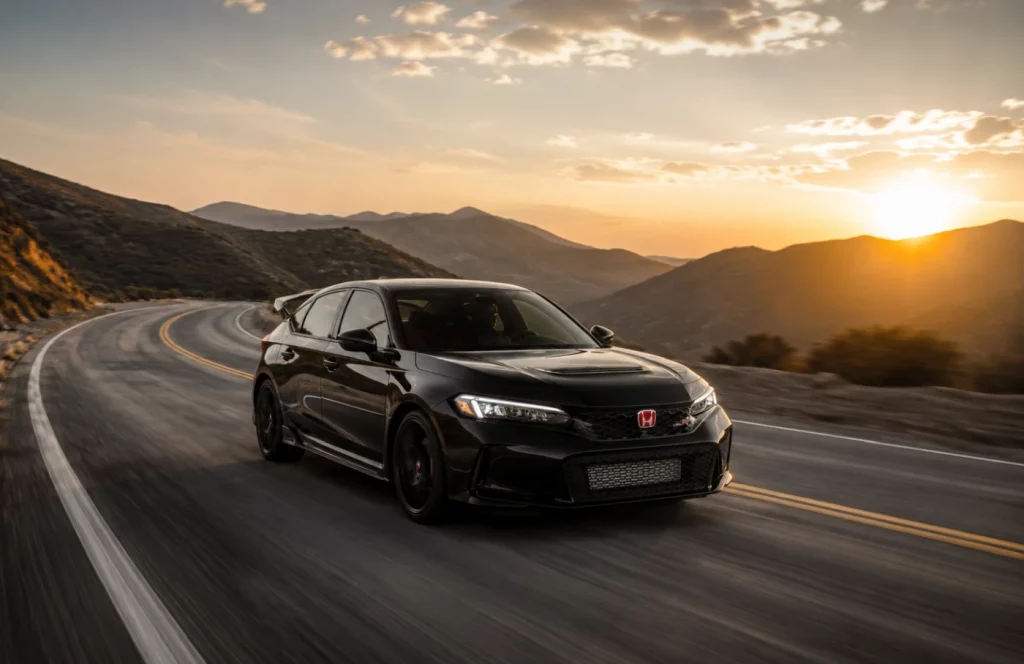
The Si is the most expensive trim to fuel, but not for the reason most buyers assume. The difference between a Sport and an Si at the pump is not primarily the 2-4 MPG rating gap — it is the fuel grade requirement that adds 15-25 percent to the per-gallon cost, shifting the cost-per-mile calculation in a way that the MPG numbers alone do not reveal.
The 11th Generation Trim Lineup (2022-2024)
The 11th generation Civic sedan offered four non-Si trims plus the Si. Each trim level uses a different powertrain combination that affects fuel economy more than the equipment differences between trims.
The LX and Sport use the K20C2 2.0L naturally aspirated engine (158 hp) with a CVT. The difference between the two comes down to wheel and tire sizing: the Sport rides on 18-inch wheels with 235/40R18 tires versus the LX’s 16-inch wheels with 215/55R16 tires. The larger wheels add approximately 4-5 pounds of unsprung mass per corner and increase rolling resistance due to the wider contact patch. The result is a 2 MPG combined penalty on the EPA cycle.
The EX and Touring use the L15B7 1.5L turbocharged engine (180 hp) with a CVT. The EX has the highest EPA combined rating of any non-hybrid 11th gen Civic at 36 MPG combined, driven by the turbo engine’s smaller displacement and the CVT’s ability to hold the engine at low RPM under light throttle. The Touring gets 34 MPG combined, again penalized by larger 18-inch wheels and additional equipment weight (panoramic roof, power seats, premium audio).
The Si uses the L15CA 1.5L turbo engine (200 hp) with a 6-speed manual transmission and a helical limited-slip differential. Its EPA ratings are 27 city / 37 highway / 31 combined, and it requires premium fuel.
Source: Honda Information Center, 2022 and 2023 Civic Sedan EPA Fuel Economy Ratings; fueleconomy.gov, 2022-2023 Honda Civic data.
11th Generation Real-World Fuel Economy by Trim
The EPA ratings provide a standardized comparison, but real-world Fuelly and owner-reported data reveals the actual ownership cost.
For the 2.0L CVT (LX and Sport trims), the combined 33-35 MPG EPA rating translates to real-world averages of 31-37 MPG depending on driving conditions. The lifetime fuel economy thread on 11thGenForum shows a 2022 Sport returning 34.8 MPG over 72,000 miles on regular 87 octane. A 2024 Sport Touring (1.5T CVT, hatchback) reported mid-40s MPG on a 414-mile highway trip. The 2.0L engine is less throttle-sensitive than the 1.5T — owners who drive mostly city miles with moderate traffic average closer to 31-33 MPG, while those with 80 percent highway cruises reach 37-40 MPG. Source: 11thGenForum.com, “Lifetime Gas Mileage” thread (2025); Fuelly.com, 2022-2024 Civic owner databases.
For the 1.5T CVT (EX and Touring), real-world averages cluster around 34-40 MPG combined. The turbo engine’s efficiency advantage is strongest at steady highway speeds between 55-65 MPH, where owners report 38-44 MPG. In city driving with frequent acceleration events, the advantage over the 2.0L narrows to approximately 1-2 MPG because the turbo enters boost enrichment during moderate acceleration, which increases fuel consumption proportionally. The 1.5T’s sensitivity to throttle input means a heavy right foot can erase the efficiency advantage entirely — a Touring driven aggressively in the city will return lower MPG than an LX driven gently, because the turbo engine’s consumption curve rises more steeply with load than the naturally aspirated engine’s.
For the Si, the 31 MPG combined EPA rating is achievable with mixed driving. The 11thGenForum lifetime MPG thread shows a range of results: a 2022 Si reporting 43 MPG on the dashboard display (with a noted 3 MPG overestimation, making it approximately 40 MPG actual) while driving like an “old man”; a 2023 Si averaging 31.7 MPG over 8,500 miles across all fuel grades; a 2025 Si averaging 36.91 MPG actual over 17,000 miles on 89-93 octane, with 80 percent highway driving at or near the speed limit. Car and Driver’s 75-MPH highway fuel economy test of the 2022 Si returned exactly 37 MPG, matching its EPA highway rating. Source: 11thGenForum.com, “Lifetime Gas Mileage” (2025); Car and Driver, 2022 Civic Si road test.
The Fuel Grade Problem: Why the Si Costs More Per Mile
The Si requires premium fuel (91 octane or higher). The LX, Sport, EX, Touring, and all non-Si trims run on regular 87 octane. The price gap between regular and premium varies by region and time of year, but the historical average is approximately $0.50-$0.70 per gallon in the United States, and €0.20-€0.35 per liter in Europe.
The cost-per-mile calculation reveals the actual penalty. AT $3.50 per gallon for regular and $4.10 for premium (a typical $0.60 gap):
– A Civic LX averaging 34 MPG combined on regular costs $0.103 per mile
– A Civic EX averaging 36 MPG combined on regular costs $0.097 per mile
– A Civic Si averaging 32 MPG combined on premium costs $0.128 per mile
The Si costs 24-32 percent more per mile than the EX despite only a 4 MPG EPA combined rating difference. The fuel grade spread accounts for approximately 60 percent of that premium — the remaining 40 percent comes from the Si’s lower MPG.
A 2017 CivicX forum analysis of the 10th generation Si reached similar conclusions. The owner calculated that at $2.00 per gallon for regular and $2.50 for premium, a 2017 EX-T on regular at 35 MPG costs 5.7 cents per mile, while a 2017 Si at 32 MPG on premium costs 7.8 cents per mile — a 37 percent increase per mile. Source: CivicX.com, “2017 Honda Civic Si MPG” thread (2017).
At 12,000 miles per year, the Si adds approximately $300-$400 in annual fuel cost compared to an EX — roughly $25-$33 per month. Over a five-year ownership period, that is $1,500-$2,000 in additional fuel expense attributable entirely to the fuel grade requirement and the small MPG gap.
Can the Si Run on Regular Fuel?
The Si’s ECU is calibrated for premium fuel to take advantage of the higher octane’s knock resistance. The engine uses a higher Compression Ratio and more aggressive ignition timing than the non-Si 1.5T to produce its additional 20 horsepower and 15 lb-ft of torque.
Running regular fuel in the Si triggers the ECU’s knock control system, which retards ignition timing in response to detected knock events. The result is reduced power output — approximately 5-8 horsepower loss at the top end — and potentially lower fuel economy because the engine is not operating at its optimized timing curve. The ECU will not allow the engine to be damaged by knock, but the combination of retarded timing and the driver pressing the accelerator harder to compensate for reduced responsiveness tends to produce combined fuel economy in the 28-31 MPG range on regular, compared to 30-34 MPG on premium.
One 11thGenForum owner tested this directly with a 2023 Si: on 87 octane the car averaged 34.7 MPG; on 89 octane it averaged 36.3 MPG; on 91 octane it dropped to 29.1 MPG (likely a different driving cycle). Source: 11thGenForum.com, “Lifetime Gas Mileage” thread (2025). The data suggests that running 89 octane (mid-grade) may be the economic sweet spot for Si owners who want better cost efficiency than premium but better performance than regular — at the cost of leaving approximately 5-8 horsepower unused.
The net savings of running regular in an Si are small. At 12,000 miles per year with regular at $3.50 and premium at $4.10, and assuming 31 MPG on regular versus 33 MPG on premium, the annual cost is $1,355 on regular versus $1,491 on premium — a $136 annual savings at the cost of noticeably reduced power. Most Si buyers accept the premium fuel cost as part of the performance proposition.
The 10th Generation Comparison (2016-2021): A Wider Spread
The 10th generation Civic lineup had a broader trim and powertrain spread that produces a wider cost-per-mile gap than the 11th generation.
The 2016 Civic base powertrain was the 2.0L K20C2 with CVT (158 hp, regular fuel, 31/41/35 EPA). The mid-range option was the 1.5T L15B7 with CVT (174 hp on regular, 31/42/35 EPA). The Si (1.5T with 6MT, 205 hp, premium fuel, 28/38/32 EPA). The Type R (2.0T K20C1 with 6MT, 306 hp, premium fuel, 22/28/25 EPA). The 2.0L CVT was the efficiency leader in the lineup: real-world Fuelly data from 2016 shows the 2.0L CVT averaging 33-35 MPG combined, while the 1.5T CVT averaged 36-40 MPG depending on driving style. Source: Fuelly.com, 2016 Honda Civic database (812 vehicles, 79,598 fuel-ups).
Fuelly data for the 2017 Si across 82 reporting vehicles shows a combined average of 33.1 MPG, with individual owners ranging from 28.3 to 36.5 MPG. The 2017 Si achieves real-world fuel economy that is competitive with the 2.0L CVT on raw MPG — both average approximately 33 MPG — but the Si’s premium fuel requirement makes it more expensive per mile in every scenario.
At the top of the range, the Type R requires premium fuel and returns 25 MPG combined EPA. Real-world owners on CivicX report 22-26 MPG in mixed driving and 28-30 MPG on highway trips driven gently. At $4.10 per gallon and 24 MPG combined, the Type R costs $0.171 per mile — 76 percent more per mile than the 1.5T CVT and 66 percent more than the 2.0L CVT. Over 12,000 miles, the Type R costs approximately $2,050 in fuel annually, compared to $1,167 for the 1.5T CVT and $1,200 for the 2.0L CVT.
The 9th Generation: When Si Fuel Cost Was Closer to Base Models
The 9th generation Civic Si (2012-2015) used the K24Z7 2.4L naturally aspirated engine (201-205 hp) with a 6-speed manual transmission. Unlike the turbocharged 10th and 11th generation Si, the K24Z7 does not require premium fuel. Honda specified 87 octane regular for the 9th gen Si.
This changes the cost-per-mile calculation significantly. The 2012-2013 Si was EPA-rated at 22 city / 31 highway / 25 combined MPG. The 2014-2015 Si (with a 5 hp bump, reduced friction, and a revised exhaust) was rated at 22/31/25. Fuelly data for the 9th gen Si shows real-world combined averages of 26-29 MPG depending on driving style — approximately 3-4 MPG below the base 1.8L CVT’s real-world average.
On regular fuel at $3.50 per gallon and 27 MPG combined, the 9th gen Si costs approximately $0.130 per mile. The base 2014 Civic CVT averaging 31.5 MPG at the same fuel price costs $0.111 per mile. The gap is approximately 17 percent — significant but much smaller than the 30-35 percent gap between the modern Si and the base trims, because the modern Si pays both a MPG penalty and a fuel grade penalty.
Source: Fuelly.com, 9th gen Civic owner databases; Honda Newsroom, 2014 Civic specifications.
The 8th Generation: The Si’s MPG Was Never the Point
The 8th generation Si (2006-2011) used the K20Z3 2.0L naturally aspirated engine (197 hp) with an 8,000 RPM redline and a 6-speed manual. Premium fuel was recommended but not required. EPA ratings were 21 city / 29 highway / 24 combined MPG — significantly lower than the base 1.8L R18 5AT’s 25/36/30 rating.
Fuelly data for the 2010 Si (the best-represented year) shows a combined average of 26.9 MPG across 7 vehicles and 1,102 fuel-ups. The base 1.8L 5AT for the same year averages 30-31 MPG. The gap is approximately 3-4 MPG, comparable to the modern Si versus base trim gap but without the fuel grade penalty.
The 8th gen Si’s fuel cost is approximately $0.135 per mile when running regular at 27 MPG. The base 1.8L 5AT at 31 MPG costs approximately $0.113 per mile. The Si’s additional cost comes entirely from the MPG gap rather than a fuel grade penalty.
The Sport Trim: Does the Style Premium Cost Fuel?
The Sport trim exists on the 10th and 11th generation Civics as a mid-range appearance package. It is mechanically identical to the LX — same 2.0L engine, same CVT — but adds 18-inch wheels, a sportier front and rear fascia, a center exhaust outlet, and darker interior trim.
The fuel economy difference between the Sport and the LX is entirely attributable to wheel size and tires. On the 11th generation, the LX’s 16-inch wheels with 215/55R16 tires produce EPA ratings of 31/40/35, while the Sport’s 18-inch wheels with 235/40R18 tires produce 30/37/33. That is a 2 MPG combined penalty for the larger wheels.
Real-world owner data confirms the EPA spread. On the 11thGenForum lifetime MPG thread, a 2022 Sport returned 34.8 MPG over 72,000 miles, while LX owners on the same thread reported 34-37 MPG with similar driving conditions. The 2 MPG gap is consistent in real-world driving. Source: 11thGenForum.com, “Lifetime Gas Mileage” (2025).
At $3.50 per gallon and 12,000 miles per year, an LX averaging 35 MPG costs $1,200 annually. A Sport averaging 33 MPG costs $1,273 annually. The difference is approximately $73 per year — about $6 per month. Over five years, that is $365 in additional fuel cost purely for the aesthetic choice of larger wheels.
The 10th generation spread was similar. The 2016 LX/EX with 2.0L CVT and 16-inch wheels was rated at 31/41/35. The 2016 Sport trim (available on the hatchback, which carries the 2.0L with 18-inch wheels) was rated at 30/38/34.
The Hybrid: Highest MPG, Best Cost Per Mile
The 2025 Civic Hybrid resets the fuel economy hierarchy entirely. The Sport Hybrid and Sport Touring Hybrid are EPA-rated at 50 city / 45-47 highway / 48-49 combined MPG on regular fuel. Real-world tests from Cars.com and The Drive show the hybrid averaging 51-52 MPG in mixed driving — exceeding the EPA combined rating by 4-8 percent.
The hybrid’s annual fuel cost at 12,000 miles and $3.50 per gallon is approximately $824 at 51 MPG. That is $376 less than the LX (35 MPG), $449 less than the Sport (33 MPG), and $601 less than the Si (31 MPG on premium). Over five years, the hybrid saves approximately $1,880 in fuel compared to the LX and approximately $3,005 compared to the Si.
The hybrid’s e-CVT drivetrain eliminates the fuel grade cost advantage of the Si question entirely — the hybrid runs on regular fuel, beats every gas trim in MPG by a wide margin, and avoids the $0.60 per gallon premium fuel penalty that drives the Si’s cost per mile upward.
| Trim | Engine / Trans | EPA Comb | Real MPG (Fuelly) | Fuel Grade | Cost/Mile* | Annual Cost (12k mi) |
|---|---|---|---|---|---|---|
| LX (11th gen) | 2.0L CVT | 35 | 34-37 | Regular | $0.100-0.103 | $1,200 |
| Sport (11th gen) | 2.0L CVT | 33 | 31-35 | Regular | $0.100-0.113 | $1,273 |
| EX (11th gen) | 1.5T CVT | 36 | 34-40 | Regular | $0.088-0.103 | $1,167 |
| Touring (11th gen) | 1.5T CVT | 34 | 33-38 | Regular | $0.092-0.106 | $1,235 |
| Si (11th gen) | 1.5T 6MT | 31 | 29-37 | Premium | $0.111-0.141 | $1,491 |
| Hybrid (2025+) | 2.0L e-CVT | 48-49 | 47-52 | Regular | $0.067-0.074 | $824 |
*Cost per mile calculated at $3.50/gal regular, $4.10/gal premium (typical $0.60 gap). Si cost per mile uses premium pricing; the range reflects Si real-world MPG from 29 (aggressive/ city) to 37 (highway cruise). Real-world MPG ranges from Fuelly, 11thGenForum, and CivicX owner databases. EPA ratings from fueleconomy.gov and Honda official data.
The Type R: How Far the Top End Goes
The Civic Type R (10th generation, 2017-2021, and 11th generation, 2023-present) sits at the top of the trim hierarchy and the bottom of fuel economy. Both generations use a K20C1 2.0L turbocharged engine producing 306-315 hp, paired exclusively with a 6-speed manual. Premium fuel is required.
EPA ratings are 22 city / 28 highway / 25 combined for the 10th generation and 22/28/24 for the 11th generation (slightly lower due to increased power and weight). Real-world Fuelly data from 285 reporting Type R owners shows combined averages of 22-26 MPG, consistent with the EPA estimates.
At $4.10 per gallon and 24 MPG, the Type R costs $0.171 per mile. Over 10,000 miles per year (Type R owners tend to drive fewer miles annually than base Civic owners), the annual fuel cost is approximately $1,710. That is 115 percent more than the EX’s fuel cost and 208 percent more than the hybrid’s fuel cost.
The Type R is not purchased for fuel economy, and the premium fuel requirement combined with the 24 MPG real-world average makes it the most expensive Civic to fuel by a wide margin. But the comparison serves as the upper boundary for understanding the trim spread: from the hybrid at $0.067 per mile to the Type R at $0.171 per mile, the fuel cost per mile varies by a factor of 2.6 across the Civic lineup.
Which Trim Actually Costs More at the Pump?
The answer depends on which two trims are being compared, but the hierarchy is clear when annual fuel cost is calculated at real-world MPG rather than EPA numbers.
At 12,000 miles per year with real-world economy:
– The hybrid costs approximately $824 per year — the clear winner
– The EX (1.5T CVT) costs approximately $1,167 per year — the fuel economy leader among gas-only trims
– The LX costs approximately $1,200 per year — efficient on the highway, penalized in city traffic by the 2.0L’s lower urban MPG
– The Touring costs approximately $1,235 per year — penalized by larger wheels and higher equipment weight
– The Sport costs approximately $1,273 per year — the 18-inch wheel penalty costs about $73 per year versus the LX
– The Si costs approximately $1,491 per year — the premium fuel requirement raises the cost by $0.60 per gallon, adding approximately $300 per year versus an equivalent 1.5T on regular
– The Type R costs approximately $1,710 per year at 10,000 miles — the most expensive by a wide margin
The $667 annual gap between the Si and the hybrid at 12,000 miles per year is the largest within the Civic lineup. The hybrid saves $667 per year in fuel costs compared to the Si, and $449 per year compared to the Sport.
The Sport trim is the least fuel-efficient of the gas-only non-performance trims, but the dollar impact is small — $73 more per year than the LX. The Si is the most expensive gas-only Civic to fuel, and the premium fuel requirement is the primary driver — the Si’s raw MPG (31 combined) is comparable to the LX (35 combined) when driven gently, but the fuel grade adds $0.60 per gallon that the LX does not pay.
Generation-by-Generation: Did the Trim Spread Change?
The 8th generation had the smallest cost spread between trims because the Si ran on regular fuel. The base 1.8L 5AT cost approximately $0.113 per mile, while the Si cost approximately $0.135 per mile — a 19 percent gap driven entirely by the MPG difference.
The 9th generation was similar. The base 1.8L CVT at 31.5 MPG on regular cost $0.111 per mile. The Si at 27 MPG on regular cost $0.130 per mile — a 17 percent gap.
The 10th generation widened the gap significantly because the Si switched to premium fuel while the 1.5T CVT and 2.0L CVT remained on regular. The 1.5T CVT at 36 MPG on regular cost $0.097 per mile. The Si at 32 MPG on premium cost $0.128 per mile — a 32 percent gap. The non-Si turbo trims actually improved fuel economy over the base engine, while the Si’s premium fuel requirement pushed its cost per mile in the opposite direction.
The 11th generation maintains the same pattern. The 1.5T CVT EX at 36 MPG combined on regular costs $0.097 per mile. The Si at 31 MPG on premium costs $0.132 per mile — a 36 percent gap. The spread has widened slightly because the Si’s EPA combined rating dropped by 1 MPG (from 32 to 31) between generations while the EX stayed at 36.
☐ The Si costs 24-36 percent more per mile than an equivalent 1.5T CVT — the premium fuel requirement drives approximately 60 percent of that gap
☐ At 12,000 miles per year, the Si adds $300-$400 in fuel cost versus the EX/Touring
☐ The Sport trim costs approximately $73 per year more than the LX — a small penalty for 18-inch wheels
☐ The 1.5T CVT EX is the most fuel-efficient non-hybrid Civic trim at 36 MPG combined EPA
☐ The 2025 hybrid saves $376 per year versus the LX and $667 per year versus the Si
☐ The 9th generation Si ran on regular fuel — its cost gap versus base trims was half that of the modern Si
☐ Running mid-grade (89 octane) in the Si may be the economic sweet spot — similar MPG to premium at lower per-gallon cost
☐ The Type R is the most expensive Civic to fuel at $0.171 per mile — 2.6x the hybrid’s cost per mile
☐ The trim with the lowest EPA rating does not always cost the most at the pump — the Si costs more than the Type R on a per-gallon-adjusted basis because the Type R owner pays per-mile for a different driving experience