

The Honda Civic has used four distinct rear suspension architectures across its generations: double wishbone (6th–7th gen), multi-link (8th–9th gen), a new multi-link design (10th–11th gen), and a dual-axis strut front with multi-link rear for the Type R. The front suspension has remained MacPherson Strut throughout, but the details — spring rates, damper technology, stabilizer bar diameters, and bushing materials — changed significantly with each generation.
Suspension specifications in this article come from Honda Newsroom press releases and official specification sheets per model year (2001, 2006, 2008, 2012, 2015, 2016, 2017, 2022, 2023, 2025, 2026), Honda Canada PDF spec sheets, the Honda Workshop Manual (6th gen), aftermarket spring manufacturer catalog data (TEIN, Eibach, Swift, Whiteline), forum-sourced factory service manual references (Honda-Tech, 8thcivic, 9thgencivic, CivicX), and published technical analysis (27WON, Motor1, Wunderladen Racing).
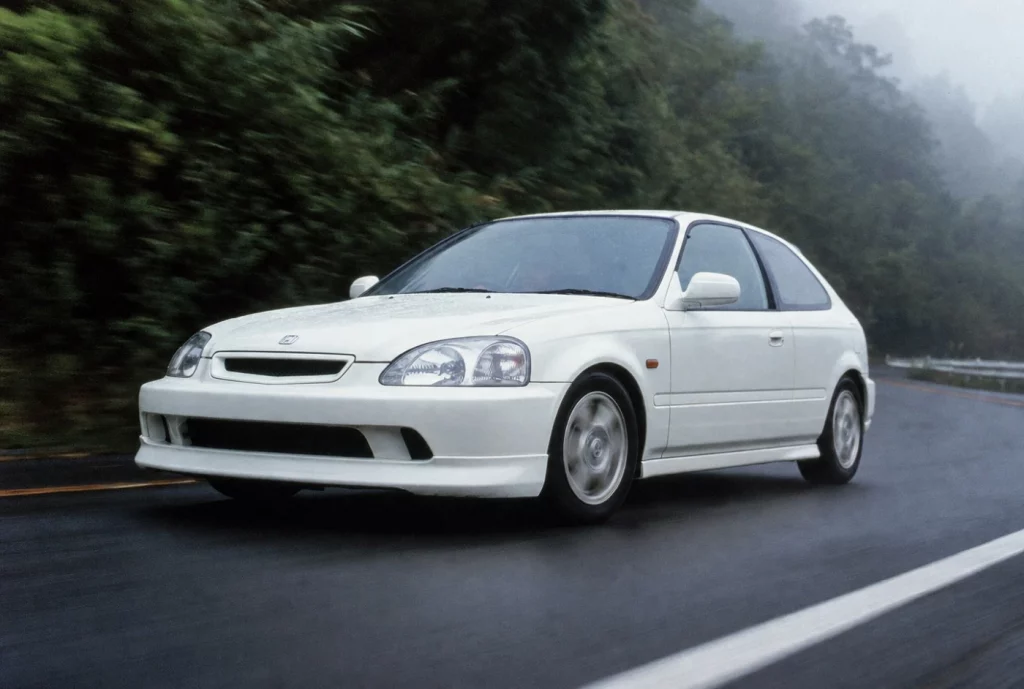
6th Generation (1996-2000): Double Wishbone Rear — A Compact Car Unusual
The 6th generation Civic used a front MacPherson strut and rear double wishbone suspension layout. The double wishbone rear was a Honda hallmark that provided superior camber control through the suspension travel, giving the Civic handling characteristics that most competitors with torsion beam rear axles could not match.
The front struts were single-tube hydraulic dampers filled with nitrogen gas, with a 46 mm piston diameter on non-Si models and a slightly larger damper on the Si. The front coils were linear-rate springs with a factory spring rate of approximately 4.2 kgf/mm (230 lb/in) for the EX and Si (TEIN catalog data, OEM spring cross-reference; Honda-Tech forum citing factory spring measurements). The CX and DX used slightly softer front springs, though Honda did not publish separate rates for the base trims.
The rear double wishbone suspension used separate coil-over-damper units. The rear spring rate was approximately 2.5 kgf/mm (140 lb/in) for the EX and Si (TEIN catalog). The rear dampers were also gas-filled twin-tube units. The Si’s rear springs were firmer than the EX by roughly 10-15 percent, but Honda did not publish precise figures.
Stabilizer bar availability varied significantly by trim:
– CX, DX: No front or rear stabilizer bar
– HX, EX: 22 mm solid front stabilizer bar, no rear bar
– Si (1999-2000): 26 mm solid front stabilizer bar, 13 mm solid rear stabilizer bar
– JDM Type R (EK9): 26 mm front, 22 mm rear
The Si’s 26 mm front bar was substantially larger than the 22 mm bar on the EX. The Si bar required reinforced end links that were unique to the Si — the EX and HX used vertical bolt-type end links through the Lower Control Arm, while the Si used a different end link design that also carried over to the 1994-2001 Integra (D-Series.org, comprehensive sway bar reference guide, verified against factory part numbers).
The rear suspension lower control arms were common across all 6th gen Civics, meaning any 6th gen car could accept a rear sway bar retrofit using Si end links. The Si’s 13 mm rear bar was small, but it was present. Owners adding larger than Si-spec rear bars (such as a 22 mm Integra Type R bar) needed subframe reinforcement to prevent the sway bar mounts from tearing out of the rear subframe (D-Series.org, sway bar reference).
7th Generation (2001-2005): Double Wishbone Retained, Damper Diameter Changed Mid-Cycle
The 7th generation retained the same basic architecture — MacPherson strut front with double wishbone rear — but made two important changes. First, electric power steering replaced hydraulic power steering as standard equipment, adding weight and changing steering feel. Second, the front strut and rear damper diameters changed mid-generation.
The 2001-2002 models used a 50 mm front strut body diameter. The 2003-2005 models used a 55 mm front strut diameter. The 2004-2005 models also changed the front strut-to-knuckle mounting bolts from 14 mm to 16 mm (Honda-Tech, 7th gen suspension FAQ, citing factory parts catalog cross-reference). These changes meant that 2001-2002 coilover kits would not fit 2004-2005 cars without modification or a sleeve kit, though the spring perches were the same diameter across years.
The front spring rates were approximately 3.8 kgf/mm (210 lb/in) for non-Si trims (TEIN catalog). The Si (EP3 chassis) used firmer front springs, though the factory rate was not published in Honda spec sheets. The rear double wishbone retained coil-over-damper units with approximately 2.5 kgf/mm (140 lb/in) spring rate on non-Si cars.
Stabilizer bars were now standard on the front of all trims, but the rear bar remained Si-only:
– DX, LX, EX: Front stabilizer bar only, rear none
– Si hatchback (EP3): Front stabilizer bar with rear stabilizer bar
The Si received four-wheel disc brakes and a firmer rear suspension tune that included the rear stabilizer bar, stiffer rear springs, and revised damper valving.
The sedan and coupe models used a Trailing Arm rear suspension layout with a compact double wishbone geometry. The hatchback (EP3) used a slightly different subframe and rear suspension mounting due to its different floorpan, but the architecture remained double wishbone.
8th Generation (2006-2011): Multi-Link Replaces Double Wishbone
The 8th generation Civic introduced a multi-link independent rear suspension for the first time on Civic, replacing the double wishbone design that had been used since the 4th generation. The multi-link design used stamped steel lower control arms, stamped steel upper control arms, a separate toe control link, and a coil-over-damper unit mounted between the lower control arm and the body. The front remained MacPherson Strut with a lower L-arm and a stabilizer bar.
The Si received significantly stiffer spring rates than the base cars. Factory measurements published on 8thcivic.com place the Si front spring rate at approximately 200 lb/in (3.6 kgf/mm) and the rear at approximately 230 lb/in (4.1 kgf/mm). The base coupe (DX, LX, EX) rates were approximately 170-175 lb/in front and 200-205 lb/in rear — the Si was roughly 17-18 percent stiffer in front and 14-15 percent stiffer in the rear (8thcivic.com, factory spring rate thread, citing Honda-supplied part number comparisons).
The stabilizer bar differences were substantial:
Sedan (FA chassis):
– DX, LX, EX: 24.2 mm front (solid), 10.0 mm rear (solid)
– Hybrid: 24.2 mm front, 12.0 mm rear (larger rear bar for battery weight)
– Si (FA5): 27.0 mm front (solid), 17.0 mm rear (solid)
Coupe (FG chassis):
– DX: No front bar, no rear bar
– LX: 25.4 mm front, 11.0 mm rear
– EX: 25.4 mm front, 11.0 mm rear
– Si (FG2): 28.0 mm front, 17.0 mm rear
All trims: The base cars without rear stabilizer bars could retrofit the Si rear bar (17 mm) or the Progress aftermarket bar, with dramatic improvement in cornering feel noted by owners (8thcivic.com, Sway Bar thread).
The Si’s spring and damper tuning gave it a 0.91 g skidpad result (Car and Driver, 2006 Civic Si test on summer tires) and driven 179-foot 70-0 braking. The base cars with the R18 engine and standard tires managed approximately 0.80 g.
9th Generation (2012-2015): Softer Sways, Stiffer Dampers After Refresh
The 9th generation Civic kept the same MacPherson strut front and multi-link rear architecture as the 8th gen, but the stabilizer bars were dramatically downsized. Honda’s goal was a quieter, more compliant ride — the Si‘s front bar dropped from 27 mm to 18 mm, a 33 percent reduction in diameter.
2012 base trims (DX, LX, EX):
– Front stabilizer bar: 17.0 mm (solid)
– Rear stabilizer bar: 11.0 mm (solid)
– Shock absorber diameter: 18.0 mm front, 15.0 mm rear (The Car Connection, 2012 Civic specifications)
2012 Si:
– Front stabilizer bar: 18.0 mm (solid)
– Rear stabilizer bar: 15.0 mm (solid)
– Steering ratio: 16.08:1 with 3.11 turns lock-to-lock
– Si spring rates: 29 N/mm (165 lb/in) front, 44 N/mm (251 lb/in) rear per Eibach catalog measurements (9thgencivic.com, OE spring rate thread)
The 2014-2015 refresh brought firmer damper valving and revised struts that were physically different from the 2012-2013 dampers. The 12-13 struts would not fit a 14-15 car. The spring rates may have remained the same (Eibach measured the same 29/44 N/mm rates for both generations), but the damper valving was noticeably firmer — owners reported the 2014-2015 cars felt substantially stiffer than the 2012-2013 cars (9thgencivic.com owner reports).
The 2014 Si also received reduced electric power steering boost, adding steering weight that further improved the driver feel. The chassis rigidity improved slightly, with Honda using additional bracing in the front Subframe and rear shock towers.
10th Generation (2016-2021): Multi-Link Redesigned, Huge Sway Bar Range
The 10th generation Civic introduced an all-new Multi-link Rear Suspension design. Honda described it as the most sophisticated chassis in Civic history. The new rear suspension used a compact multi-link layout with a rigidly mounted subframe, separate trailing arm, and a coil-over-damper mounted to the lower control arm rather than to the knuckle.
Key innovations for the 10th gen chassis:
– Dual-pinion electric power steering with variable gear ratio — 2.2 turns lock-to-lock versus 3.1 on the 9th gen
– Hydraulic compliance bushings in the front lower control arms and rear trailing arms — a Civic first that improved ride isolation
– Bonded stabilizer bar bushings for smoother anti-roll response (replacing clamped-on bushings)
– Agile Handling Assist — brake-based torque vectoring for cornering precision
– Aluminum rear damper brackets
The stabilizer bar range across trims was the widest in Civic history:
Front stabilizer bar (tubular):
– LX: 25.0 mm x 4.0 mm wall
– EX (2016-2018), Hatchback non-Type R: 25.5 mm x 4.0 mm wall
– EX (2019-2021), Touring: 26.5 mm x 4.5 mm wall
– Si: 27.0 mm x 4.5 mm wall
– Type R: 29.0 mm x 5.0 mm wall
Rear stabilizer bar (solid):
– LX, EX, Sport: 16.5 mm
– Touring: 17.0 mm
– Si: 18.0 mm
– Type R: 20.5 mm
(Honda Newsroom, 2016 Civic Sedan Specifications; Wunderladen Racing, 10th gen sway bar guide, verified against OEM part numbers and Honda press kit data)
Spring rates varied by body style and trim. The sedan and coupe used different rates than the hatchback:
LX sedan (2016): Front approximately 126.83 lb/in (2.3 kgf/mm), Rear approximately 158.53 lb/in (2.8 kgf/mm) (CivicX.com, suspension general knowledge thread, citing factory measurements)
Si sedan (2017-2021): Front 144.186 lb/in (2.6 kgf/mm) — 7 percent stiffer than the LX — Rear 208.776 lb/in (3.7 kgf/mm) — 32 percent stiffer than the LX (CivicX.com, Si spring rate comparison thread, verified against Honda part number data)
Sport Hatchback (1.5T): Front same as LX at 126.83 lb/in, Rear 158.53 lb/in
The Eibach catalog confirmed the OE front rate for non-Si models at 141-157 lb/in depending on measurement method and trim. The rear springs were progressive-rate on some trims, with Eibach measuring 21-32 N/mm (120-183 lb/in) depending on load (CivicX.com suspension knowledge thread).
The Si’s suspension had different damper part numbers that were stiffer than the standard car. The Si also used different front lower control arms with hydraulic compliance bushings specific to the Si tune.
The 10th gen chassis earned a 0.90 g skidpad result for the Sport Touring hatchback on the 1.5T with all-season tires (Car and Driver, 2017 Civic Hatchback test), matching the 8th gen Si’s performance but with significantly better ride comfort.
FK8 Civic Type R (2017-2021): Dual-Axis Strut Front
The FK8 Civic Type R introduced a dual-axis MacPherson strut front suspension — a fundamentally different design from the standard Civic. The dual-axis strut used a separate hub carrier with the strut attaching to the lower control arm rather than the Knuckle, creating a virtual kingpin axis that reduced torque steer by 0.75 inches of steering axis offset reduction.
The FK8 front suspension used:
– Aluminum knuckles, strut forks, and lower control arms
– 29.0 mm tubular front stabilizer bar with 5.0 mm wall thickness — 1.7 times stiffer than the Hatchback LX
– Front spring rates twice as stiff as the Hatchback LX
– Whiteline catalog measurements place the OE front spring rate at approximately 4.5 kgf/mm (253 lb/in) and rear at 5.1 kgf/mm (286 lb/in) (Whiteline, FK8 specifications; Real Street Performance catalog)
The rear suspension remained multi-link with stamped steel control arms and aluminum hub carriers. The rear stabilizer bar was 20.5 mm solid. The rear spring rate was 1.6 times higher than the Hatchback LX, and the rear stabilizer bar rate was 2.4 times higher (Honda Newsroom, 2017 Civic Type R Press Kit).
The Adaptive Damper System was the first electronically controlled damper system on a Honda Civic. It used stroke sensors and accelerometers to adjust damping in real time across three modes: Comfort, Sport, and +R. The damping force differences between Comfort and +R were extreme — Motor1 described the +R mode as aggressively firm at the end of compression travel (Motor1, 2024 Type R engineering deep dive).
11th Generation (2022-2026): Si and Base Diverge Further
The 11th generation Civic sedan returned with MacPherson strut front and multi-link rear independent suspension for all trims. The standard suspension stabilizer bars were standardized more than the 10th gen across non-Si trims:
2022-2026 non-Si sedan (LX, Sport, EX, Touring):
– Front stabilizer bar: 26.5 mm x 4.5 mm tubular (all trims)
– Rear stabilizer bar: 17.0 mm solid (LX, Sport, EX); 17.5 mm solid (Touring, Sport Touring Hybrid)
– All trims used the same front and rear spring rates, with only damper calibration differences between trims (Honda Newsroom, 2022 Civic Sedan Specifications; 2025 Civic Sedan Specifications)
2022-2026 Civic Si:
– Front stabilizer bar: 27.0 mm x 4.5 mm tubular
– Rear stabilizer bar: 18.0 mm solid
– Steering ratio: 11.46:1 with 2.17 turns lock-to-lock
– Helical limited-slip differential
– Variable-ratio EPS (Honda Newsroom, 2026 Civic Si Specifications; Honda Canada, 2026 Civic Si specifications PDF)
The 11th gen Si’s stabilizer bar specifications were identical to the 10th gen Si, but the chassis was 15 percent more rigid, and the body used three times the amount of structural adhesive. The Si maintained its 110-foot 60-0 braking distance and 0.90+ g skidpad capability.
The 11th gen standard Civic was the first Civic since the 7th generation to use a single front stabilizer bar diameter across all non-Si trims. The previous generation’s trim-specific front bars (25.0 mm LX vs. 26.5 mm Touring) were replaced by a single 26.5 mm bar for all models, with only the rear bar differentiating Touring from lower trims.
FL5 Civic Type R (2023-2024): Same Hardware, Smarter Software
The FL5 Civic Type R used the same suspension hardware as the FK8 — dual-axis MacPherson strut front with 29.0 mm x 5.0 mm tubular front stabilizer bar, multi-link rear with 20.5 mm solid rear stabilizer bar, the same spring rates, and the same Adaptive Damper System hardware (Honda Newsroom, 2023 Civic Type R Press Kit; Motor1 engineering analysis).
What changed was the calibration. The FL5’s Adaptive Damper System was retuned to use ride height sensors at all four corners, sending data to the damper controller 600 times per second. The system adjusted damping based on steering angle, yaw rate, suspension position, and G forces, effectively creating a custom damping curve for every driving situation (Motor1, 2024 Type R deep dive).
The FL5 also gained:
– 1.0-inch wider front track and 0.75-inch wider rear track compared to the FK8
– More rigid front uprights with revised geometry
– A partially aluminum front subframe
– Revised rear suspension Bushings that increased toe-in under compression for better corner exit stability
– A fully revised dual-pinion steering system with 11.6:1 ratio and 2.10 turns lock-to-lock
The FL5’s ride quality was noticeably improved over the FK8. The FL5 Comfort mode was genuinely comfortable on the street, while the FK8’s Comfort mode was still harsh. The +R mode remained extremely firm, but the FL5’s damping curves were more progressive and less jarring at the bump stop (Motor1, 2024 Type R deep dive).
Suspension Specifications Comparison
| Generation | Front Suspension | Rear Suspension | Front Bar | Rear Bar | Total Turns (Steering) |
|---|---|---|---|---|---|
| 6th (1996-2000) | MacPherson strut | Double wishbone | 22-26 mm | 13 mm (Si only) | 3.6 (p/S) |
| 7th (2001-2005) | MacPherson strut | Double wishbone | ~22-24 mm | Si only | 3.6 (p/S) |
| 8th Si (2006-2011) | MacPherson strut | Multi-link | 27-28 mm | 17 mm | 3.1 (EPS) |
| 9th Si (2012-2015) | MacPherson strut | Multi-link | 18 mm | 15 mm | 3.11 (EPS) |
| 10th Si (2017-2021) | MacPherson strut | Multi-link (new) | 27 mm tubular | 18 mm | 2.22 (EPS) |
| 10th FK8 Type R | Dual-axis strut | Multi-link (new) | 29 mm tubular | 20.5 mm | 2.22 (EPS) |
| 11th Si (2022-2026) | MacPherson strut | Multi-link | 27 mm tubular | 18 mm | 2.17 (EPS) |
| 11th FL5 Type R | Dual-axis strut | Multi-link | 29 mm tubular | 20.5 mm | 2.10 (EPS) |
Sources: Honda Newsroom official specifications per model year, Honda Canada and Honda USA spec sheets, Honda Workshop Manual (6th gen), 8thcivic.com / 9thgencivic.com / CivicX.com / Honda-Tech forum factory data compilations, Wunderladen Racing sway bar guide, Whiteline and TEIN catalog measurements. Si front bar sizes for 8th gen vary by body style (27 mm sedan, 28 mm coupe).
Spring Rate Comparison by Generation
| Generation | Trim | Front (lb/in) | Rear (lb/in) | Notes |
|---|---|---|---|---|
| 6th (1996-2000) | EX, Si | ~230 (4.2 kgf/mm) | ~140 (2.5 kgf/mm) | TEIN catalog, base trims softer |
| 7th (2001-2005) | Non-Si | ~210 (3.8 kgf/mm) | ~140 (2.5 kgf/mm) | TEIN catalog |
| 8th (2006-2011) | Base coupe | ~170-175 | ~200-205 | 8thcivic.com factory data |
| 8th (2006-2011) | Si | ~200 | ~230 | 17-18% stiffer front, 14-15% rear |
| 9th (2012-2015) | Si | ~165 (29 N/mm) | ~251 (44 N/mm) | Eibach catalog measurement |
| 10th (2016-2021) | LX sedan | ~127 (2.3 kgf/mm) | ~159 (2.8 kgf/mm) | CivicX factory measurement |
| 10th (2016-2021) | Si | ~144 (2.6 kgf/mm) | ~209 (3.7 kgf/mm) | 7% stiffer front, 32% stiffer rear |
| 10th FK8 Type R | Type R | ~253 (4.5 kgf/mm) | ~286 (5.1 kgf/mm) | Whiteline; 2x front/1.6x rear vs hatch |
| 11th FL5 Type R | Type R | ~253 (4.5 kgf/mm) | ~286 (5.1 kgf/mm) | Same hardware as FK8 |
Sources: TEIN catalog (6th-7th gen), 8thcivic.com forum thread (8th gen), Eibach catalog (9th gen Si), CivicX.com suspension knowledge thread (10th gen), Whiteline catalog (Type R). OEM rates are approximations based on aftermarket cross-reference and factory part number analysis — Honda does not publish spring rates in consumer-facing specifications.
☐ 6th gen: rear double wishbone — a sophisticated setup for a compact car, shared with the Integra and Prelude
☐ 6th gen CX/DX: no stabilizer bars AT either end — roll control came entirely from spring and damper rates
☐ 6th gen Si: 26 mm front bar was the thickest non-Type R Civic front bar from any generation up to that point
☐ 7th gen: strut diameter changed from 50 mm to 55 mm mid-generation (2003) — 2001-2002 and 2004-2005 coilovers are not interchangeable
☐ 7th gen: electric power steering replaced hydraulic for the first time — added steering weight and reduced feedback
☐ 8th gen: multi-link rear replaced double wishbone — the first rear suspension change on Civic since the 1988 4th generation
☐ 8th gen Si front bar (27-28 mm) was nearly three times the diameter of the base sedan’s 10 mm rear bar
☐ 9th gen Si stabilizer bars were dramatically downsized: 27 mm to 18 mm front, 17 mm to 15 mm rear — a 33% front reduction
☐ 9th gen: 2014-2015 dampers and struts are physically different from 2012-2013 — not interchangeable
☐ 10th gen: dual-pinion EPS with 2.22 turns lock-to-lock — the quickest steering ratio on any non-Type R Civic
☐ 10th gen: hydraulic compliance bushings in front LCA and rear trailing arm — a Civic first
☐ Type R: dual-axis MacPherson strut front uses a separate Hub carrier to eliminate torque steer — unique to Type R
☐ FL5 Type R uses the same springs, dampers, and sway bars as FK8 — the difference is entirely in Adaptive Damper calibration
☐ 11th gen non-Si: single front bar size (26.5 mm) across all trims — first time since the 7th generation
☐ 11th gen Si rear bar (18 mm) is larger than the 10th gen Touring front bar (17.5 mm effective) — the Si is not an appearance package