

The Honda Civic’s chassis and suspension development is a story of trade-offs. From the double-wishbone era of the 1990s to the rigid Subframe architecture of the 11th generation, Honda has repeatedly prioritized packaging efficiency and crash safety over pure cornering feel — and then tried to recover the lost feel with body rigidity improvements and steering system refinements.
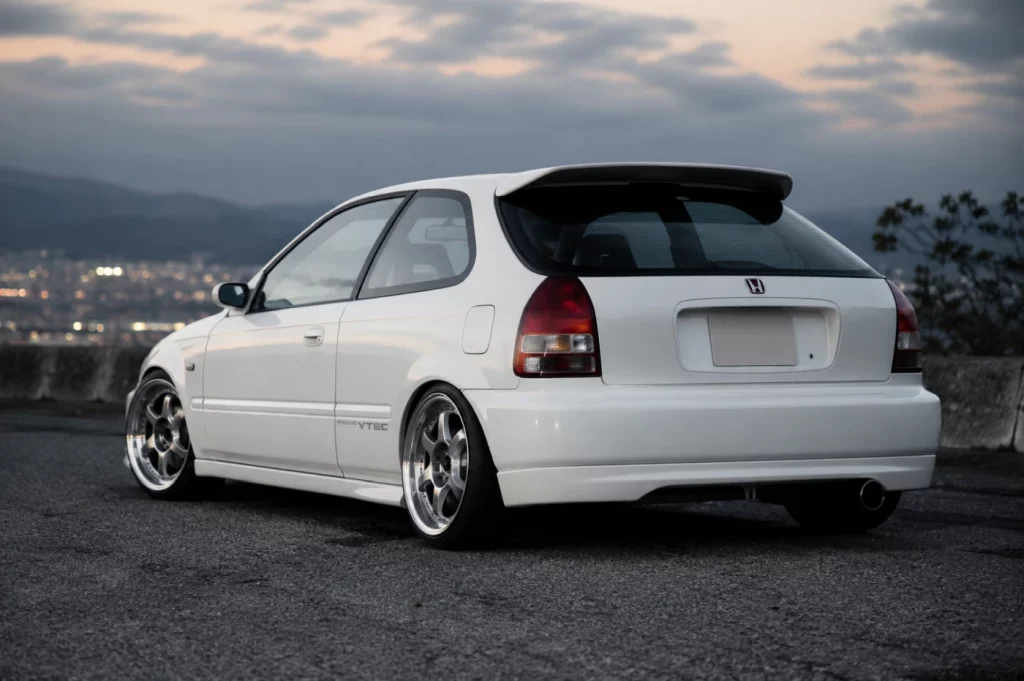
The 2001 model year was the inflection point. That was the year Honda abandoned the double-wishbone front suspension that had been a Civic hallmark since 1987. The switch to MacPherson struts produced an immediate and measurable loss in handling performance, and the enthusiast community has never fully forgiven the decision. But the same packaging change allowed the Civic to grow interior space, achieve five-star crash ratings, and eventually deliver platform rigidity numbers that the double-wishbone cars could not have reached.
This article traces how each generation of the Civic evolved its chassis, suspension geometry, body stiffness, and steering feel — and what those changes mean for the driving experience.
The Double-Wishbone Era — 4th to 6th Generation (1987–2000)
From the 4th generation through the 6th, the Civic used double-wishbone front suspension with a trailing-arm multilink rear. This architecture gave Honda a genuine handling advantage in the compact segment. The double-wishbone design allowed the engineer to control camber gain independently of bump travel, which meant the front tire maintained a larger contact patch during cornering than a strut-based design could deliver. The result was a car that turned in sharply, resisted understeer, and gave the driver real feedback through a hydraulic power Steering Rack.
The 5th-generation (1992–1995) Civic, particularly the EG hatchback and del Sol, became the benchmark for affordable front-wheel-drive handling. The car weighed approximately 2,200 pounds in base form and had a suspension geometry that encouraged rotation at the limit. The 6th-generation EM1 Civic Si (1999–2000) carried the same architecture forward at 2,401 pounds with a slightly stiffer body shell. Car and Driver tested the 1999 Si through a 490-foot slalom at approximately 43.6 mph — a competitive figure for its class. Source: Car and Driver Archival Tests (1999); Grassroots Motorsports “1999-2000 Civic Si Buyer’s Guide” (June 2019).
The limitation of these cars was body rigidity. Honda built the double-wishbone Civics with conventional steel stamping techniques and minimal structural adhesives. The 5th-generation Civic had a torsional rigidity of approximately 8,000 Nm/deg (estimated from period SAE papers), which was adequate for the era but produced noticeable cowl shake when the car was driven hard over uneven surfaces. The body flexed enough that suspension tuning had to account for chassis deflection, limiting how aggressively the dampers could be calibrated.
The Architecture Change — 7th Generation (2001–2005) and the MacPherson Strut Trade
8th Generation (2006–2011) — Refined Struts, Hydraulic Steering, and the K20 Magic
The 8th-generation Civic used a redesigned MacPherson Strut front suspension with a split spring-and-shock arrangement — the spring seated lower on the strut tube, separate from the damper, which reduced the overall height of the suspension assembly. This design allowed a lower hood line while maintaining suspension travel. The rear continued with a trailing-arm multilink, now with the spring and shock separated.
The 8th generation was the last Civic to use hydraulic power steering. The system provided genuine road feel — heavy on-center effort, accurate weighting through corners, and enough feedback to sense tire slip angle through the wheel. Enthusiasts who have driven both 8th and 9th generation Civics consistently report that the 8th generation steering is “much tighter,” “requires significantly more muscle,” and provides feedback that the later EPS systems cannot match, based on forum discussions on 8thCivic.com and 9thCivic.com.
The FA5 Civic Si (2006–2011) became the benchmark for the strut-front Civic as a driver’s car. The combination of the K20Z3 engine (197 horsepower, 8,000 rpm redline), the hydraulic steering rack, the limited-slip differential, and the 11.8-inch front brakes produced a car that Car and Driver called “the best front-driver this side of a MINI Cooper S.” The car weighed 2,877 pounds and pulled 0.91 g on the skidpad. The steering rack ratio was 16.1:1 with 3.1 turns lock-to-lock — relatively slow by modern standards but with enough feedback weight to make the driver feel connected. Source: Car and Driver, “2006 Honda Civic Si vs. Volkswagen GTI Comparison Test” (March 2006).
The body structure was stiffer than the 7th generation, though Honda did not publish specific torsional rigidity figures for the 8th generation independently. The 8th gen used high-strength steel in 55 percent of the body structure, up from approximately 50 percent in the 7th generation. The overall structure was approximately 10–15 percent stiffer in torsion than the 7th generation, based on SAE technical paper estimates from the period.
9th Generation (2012–2015) — The EPS Transition and the Numb Years
The 9th-generation Civic introduced electric power steering to the main Civic line, replacing the hydraulic system that had been used through the 8th generation. The system used an electric motor mounted concentrically around the steering rack, with a power control module that calculated assist level based on vehicle speed and steering input torque. The steering ratio remained 16.1:1 with 3.1 turns lock-to-lock.
The EPS calibration on launch was widely criticized. Owners on 9thCivic.com and 9thGenCivic.com described the steering as “too light,” “artificial,” and lacking “almost no vibration from the road.” One owner wrote: “You hit a bump, the steering wheel has almost no vibration, forget about any normal driving vibrations from the road.” The system provided precise response but filtered out the texture information that hydraulic steering transmitted naturally.
Honda addressed the criticism. For the 2013 model year, the Civic received a reworked EPS calibration, suspension spring changes, and thicker stabilizer bars with new Teflon-lined mounting Bushings. For 2014, Honda made further EPS revisions to “enhance steering response and roll feel” specifically on the LX Coupe and Si models. The 2014 Si also received upgraded damper tuning. These revisions improved the steering feel incrementally, but the fundamental feedback deficit remained compared to the 8th generation. Source: Honda Official Press Release (October 2013, September 2014); 9thCivic.com owner reports.
The body structure of the 9th generation was largely carryover from the 8th generation. Honda focused on NVH improvements rather than rigidity increases. The suspension hardware — MacPherson strut front, multilink rear — was similar to the 8th gen, with slightly revised geometry for the K24 engine’s additional weight.
10th Generation (2016–2021) — The Platform Reset
The 10th-generation Civic was an engineering reset. Honda developed an entirely new global platform — the first truly common architecture across all Civic markets — with a completely redesigned body structure, suspension geometry, and steering system.
The body shell used 58 percent high-strength steel grades, up from 55 percent in the previous generation. Hot-stamped (ultra-high-strength) steel increased from 1 percent to 14 percent of the body. The torsional rigidity increased by 25 percent compared to the 9th generation, with some SAE papers citing 52–65 percent improvement depending on the measurement method and body style. Global bending rigidity increased 19 percent. Despite being larger in every dimension, the body-in-white weighed 68 pounds less than the 9th generation. The center of gravity dropped by 0.6 inches through a lower floor, lower engine mounting position, and a lower H-point for the driver (20 millimeters lower, matching the Audi TT). Source: Honda Official “2016 Civic Body Specs and Data” (October 2015); SAE International, “Honda’s All-New Global 2016 Civic” (November 2015).
The front suspension remained MacPherson strut, but the geometry was revised with a shorter kingpin offset for improved steering response. The rear suspension was a new multi-link design mounted on an ultra-rigid subframe with hydraulic compliance bushings — a significant upgrade from the previous generation’s simpler trailing-arm system. The hydraulic bushings absorbed high-frequency road noise while maintaining precise wheel control during cornering. The stabilizer bars were larger, and the rear stabilizer was mounted directly to the subframe.
The steering system was redesigned. Honda introduced a dual-pinion variable-ratio electric power steering system — the first on any Civic. One pinion connected the steering column to the rack for steering input; a second pinion connected the electric motor to the rack for assist. This separated the driver’s steering effort from the assist motor, reducing friction and allowing a much quicker ratio. The steering ratio dropped from 16.1:1 to 10.93:1, and lock-to-lock turns went from 3.1 to 2.2. The steering column was increased to 1.2 inches in diameter for improved rigidity. The result was a steering system that was faster, more direct, and more precise than any previous Civic — if still lacking some of the natural texture of the 8th generation’s hydraulic system. Source: HandWiki, “Engineering: Honda Civic (Tenth Generation)”; Honda News, “2016 Honda Civic Official Body Specs” (2015).
The Civic Si (FC1, 2017–2021) received significant suspension upgrades beyond the base car: 32 percent stiffer spring rates, 26 percent stiffer stabilizer bars, solid compliance bushings front and rear, high-stiffness upper control arms shared with the Type R, and the first-ever Adaptive Damper System on a Civic Si. The ADS allowed Normal and Sport damper modes. Car and Driver tested the 2017 Si coupe at 0.97 g on the skidpad — the highest lateral acceleration of any Si to that point. Source: Honda News, “Honda Civic Si — Chassis” (May 2017); Car and Driver, “Tested: 2017 Honda Civic Si Coupe” (August 2017).
The FK8 Civic Type R (2017–2021) added continuously variable adaptive dampers (not just two-mode), dual-axis strut front suspension to reduce torque steer, and a full complement of chassis braces including a strut tower bar. The dual-axis strut design moved the steering axis closer to the tire contact patch centerline, reducing the leverage that the front wheels could exert on the steering rack under power — Honda’s solution to torque steer on a car producing 306 horsepower through the front wheels. The FK8 pulled 1.02 g on the skidpad and completed VIR’s Grand Course in 2:54.8 at Car and Driver’s Lightning Lap.
11th Generation (2022–Present) — Refinement and Rigidity
The 11th-generation Civic built on the 10th generation’s platform with targeted improvements in body rigidity, suspension friction reduction, and steering calibration. Honda did not redesign the architecture — the MacPherson strut front and multi-link rear carried over — but applied significant detail changes.
The body shell received 19 percent higher torsional rigidity and 13 percent higher bending rigidity than the 10th generation. Rear suspension mounting point stiffness increased by 17 percent. The key enabler was structural adhesive: the 11th-generation Civic used ten times as much adhesive as the 10th generation, applied in continuous bead and stitch patterns in the underbody. Total high-strength steel content increased from 58 percent to 59 percent, with 29 percent being ultra-high-strength grades. The front side frames were reinforced with a “lattice frame” structure, and the dashboard cross member was redesigned to reduce foot-area deformation during collisions. A laser-brazed roof joint replaced the conventional roof molding, eliminating a potential NVH path while adding structural stiffness. Source: Honda Official Press Release, “2022 Honda Civic Body Structure” (2021); SAE International, “2022 Honda Civic Hatchback Enjoys Premium Assembly, Weight-Cutting Measures” (August 2022); Design News, “Honda Deploys Advanced Manufacturing for the Civic Family” (November 2022).
The Wheelbase increased by 1.4 inches (to 107.7 inches), and the rear track widened by 0.5 inches. Honda engineers reduced suspension friction at the strut top mounts and control arm bushings to achieve a claimed 20 percent smoother ride — a significant improvement that allowed a compliant daily driving character without sacrificing cornering composure. The 10th generation’s hydraulic compliance bushings were retained but re-tuned for the lower friction targets.
The dual-pinion EPS was recalibrated with revised damping and return-to-center programming. The Drive publication described the 11th generation’s steering as “sensitive and direct enough for a fast curve without being twitchy around town.” The base Sport and Touring trims gained a genuine Sport mode that adjusted throttle and transmission mapping, a first for non-Si Civics. Source: The Drive, “2022 Honda Civic Review: The King of Compacts Reaffirms Its Reign” (June 2021).
The 11th-generation Si (FE1, 2022–present) lost the adaptive dampers that the 10th-generation Si had. The decision was cost-driven; Honda opted for conventional fixed-rate dampers with firmer tuning. The Si retained the 12.3-inch front brakes, limited-slip differential, and stiffer springs and stabilizer bars from the 10th-gen formula, but the loss of ADS was noted by reviewers. Car and Driver recorded 0.94 g on the skidpad — 0.03 g lower than the 10th-gen Si — and noted that the ride quality on the non-adaptive dampers was harsher than the previous car’s Sport mode. The revised EPS was described as having “good on-center feel and weighting” but still lacking the texture of a hydraulic system. Source: Car and Driver, “Tested: 2022 Honda Civic Si” (November 2021); The Car Connection, “2023 Honda Civic Review” (2022).
The FL5 Civic Type R (2023–present) retained continuously variable adaptive dampers and the dual-axis strut front suspension. The FL5 added a 48 percent larger grille opening for improved cooling, a wider front track, and stiffer rear subframe bushings. The steering rack was reinforced, and the EPS received Type R-specific calibration. Car and Driver recorded 1.02 g on the skidpad and a 153-foot 70–0 stopping distance, with the handling described as “neutral, predictable, and playful at the limit.”
| Generation | Front Suspension | Rear Suspension | Steering | Torsional Rigidity vs Prior Gen | Skidpad (Si) |
|---|---|---|---|---|---|
| 5th (EG) | Double wishbone | Trailing arm multilink | Hydraulic | Baseline (~8k Nm/deg) | n/a |
| 6th (EM1) | Double wishbone | Trailing arm multilink | Hydraulic | ~5% | ~0.86 g |
| 7th (EP3) | MacPherson strut | Trailing arm multilink | EPS | +95% | ~0.85 g |
| 8th (FA5) | MacPherson strut | Trailing arm multilink (split spring/shock) | Hydraulic | ~+10–15% | 0.91 g |
| 9th (FB6) | MacPherson strut | Trailing arm multilink (refined) | EPS (2012), revised 2013–14 | Minimal change | ~0.90 g |
| 10th (FC1 Si) | MacPherson strut (short kingpin offset) | Multi-link on rigid subframe, hydraulic bushings | Dual-pinion variable EPS (10.93:1) | +25% (vs 9th) | 0.97 g |
| 10th (FK8 Type R) | Dual-axis strut (torque steer reduction) | Multi-link + adaptive dampers | Dual-pinion EPS + Type R calibration | Shared platform | 1.02 g |
| 11th (FE1 Si) | MacPherson strut (low-friction) | Multi-link, 17% stiffer mounts | Dual-pinion EPS (recalibrated) | +19% (vs 10th) | 0.94 g |
Skidpad values from Car and Driver testing. Rigidity figures from Honda official R&D papers, SAE International, and Honda press releases. Sources: Car and Driver, Honda R&D Technical Review Vol. 13 No. 1, SAE International, HandWiki, Honda Official Newsroom.
Body Rigidity: The Numbers That Changed the Driving Experience
Steering Feel: What Was Lost and What Was Recovered
The progression of Civic steering feel is a three-act story. Act one: the double-wishbone cars with hydraulic power steering, where the wheel communicated road texture directly and the driver could feel the front tires’ slip angle through the rim. Act two: the transition to EPS in the 7th generation (EP3) and 9th generation (FB6), where feedback was heavily filtered and the steering was described as numb. Act three: the dual-pinion system introduced in the 10th generation, which recovered precision and speed but never fully restored natural texture.
The 8th generation (FA5 Si) represents the peak of Civic steering feel among modern cars. The hydraulic system provided tangible road texture and progressive on-center weight that made the car feel connected even at low speeds. Enthusiasts on 8thCivic.com consistently report that the difference between an 8th-generation Civic and a 9th-generation Civic is immediately apparent in steering weight and feedback.
The 10th generation’s dual-pinion EPS was a clear improvement over the 9th generation. The faster ratio (10.93:1 vs 16.1:1) and the separated assist motor reduced the artificial lightness that characterized the earlier EPS systems. The steering response was immediate — the 2.2 turns lock-to-lock meant the car changed direction with minimal hand movement. But the system still filtered out the micro-texture information that the hydraulic system transmitted. The wheel communicated position and load but not surface grain.
The 11th generation refined the dual-pinion EPS further with revised damping calibration. The Drive described it as “sensitive and direct enough for a fast curve without being twitchy around town.” The Car Connection praised the “excellent steering heft” and noted that “the Civic is a delight to muscle around in any configuration.” The feel is good for an EPS system — competitive with the Mazda3’s setup, which is the segment benchmark — but it is not hydraulic. The 11th generation’s steering is precise and well-weighted but does not deliver the unfiltered road texture of the FA5 Si.
Suspension Upgrades: What Each Generation Needs Most
The upgrade priority differs by generation because the limiting factor changes.
The 6th generation (EM1) and earlier double-wishbone cars benefit most from rigidity – a strut tower bar, lower chassis brace, and reinforced rear trailing arm bushings. The suspension geometry is fundamentally good, but the chassis flexes under cornering loads. A set of coilovers and a rear sway bar transforms the handling without changing the suspension design. Budget: $600–$1,200.
The 7th generation (EP3) needs rear sway bar and compliance bushing upgrades. The MacPherson strut front reduces available camber; camber plates are a worthwhile addition. The EP3 also benefits from replacing the rubber compliance bushings in the front lower control arms with polyurethane units, which restore steering precision lost to bushing deflection. Budget: $400–$800.
The 8th and 9th generations (FA5, FB6) are the most common track-day Civics. The hydraulic steering on the 8th generation is already good. The limiting factor is the rear suspension’s compliance bushings. Replacing the front Lower Control Arm compliance bushings with a “traction ball” or spherical bearing dramatically improves steering response. A rear sway bar upgrade (22-millimeter from the Si or aftermarket 24-millimeter) reduces understeer and improves rotation. The 9th generation additionally benefits from a steering rack bushing insert to reduce EPS play. Budget: $300–$900.
The 10th generation (FC1) already has solid compliance bushings from the factory, hydraulic rear subframe bushings, and a well-sorted multi-link rear. The most impactful upgrade is a set of performance tires — the base Sport and EX trims leave significant chassis capability on the table with all-season rubber. The Si’s ADS and LSD mean that spring rate upgrades and camber adjustments provide diminishing returns on street tires. Budget: $600–$1,200 for coilovers; $600–$900 for a set of 200TW tires.
The 11th generation (FE1) responds to the same tire-first upgrade strategy. The Si’s loss of adaptive dampers means that aftermarket coilovers with adjustable damping provide more benefit than they did on the 10th-gen Si. A rear sway bar upgrade reduces understeer at the limit. Budget: $1,000–$1,800 for coilovers; $600–$900 for tires.
☐ The double-wishbone era (4th–6th gen) produced the most naturally communicative handling but the least rigid body structure.
☐ The 7th gen’s switch to MacPherson struts was driven by packaging efficiency and crash safety, not handling improvement — and the measurable slalom speed loss confirms it.
☐ The 8th gen FA5 Si is the last Civic with hydraulic power steering and remains the benchmark for steering feel among all modern Civics.
☐ The 9th gen introduced EPS and suffered the worst steering feel of any Civic generation, though 2013–2014 revisions improved it.
☐ The 10th gen’s dual-pinion EPS with 10.93:1 ratio and 2.2 turns lock-to-lock is the best electric steering system Honda has put in a Civic — fast, precise, and well-weighted — but still filters out road texture that hydraulic systems transmit naturally.
☐ The 10th gen Si (FC1) with adaptive dampers is the best-handling non-Type-R Civic ever produced, with 0.97 g skidpad grip and solid compliance bushings throughout.
☐ The 11th gen Si lost adaptive dampers but gained a 19 percent stiffer body shell — the trade-off produces a car that rides more harshly AT low speeds but corners with excellent composure.
☐ The 11th gen base models drive better than any previous non-Si Civic, limited primarily by their all-season tires rather than the chassis.
☐ The fastest handling improvement for any modern Civic (10th or 11th gen) is a set of 200TW summer tires — the chassis can out-drive the stock rubber on every trim except the Type R.
☐ The FK8 and FL5 Type R with dual-axis Strut front suspension, continuously variable adaptive dampers, and 1.02 g skidpad grip represent the peak of Civic chassis engineering, with torque steer effectively eliminated through steering geometry alone.