

Every Civic owner reaches the same point eventually. You’ve got the wheels, you’ve dialed in the fitment, and now the car sits too high. The wheel gap is killing the look, and the factory ride height makes the car look like it’s ready for off-roading. The solution seems simple: lower it. But then comes the question that splits the community: coilovers or lowering springs?
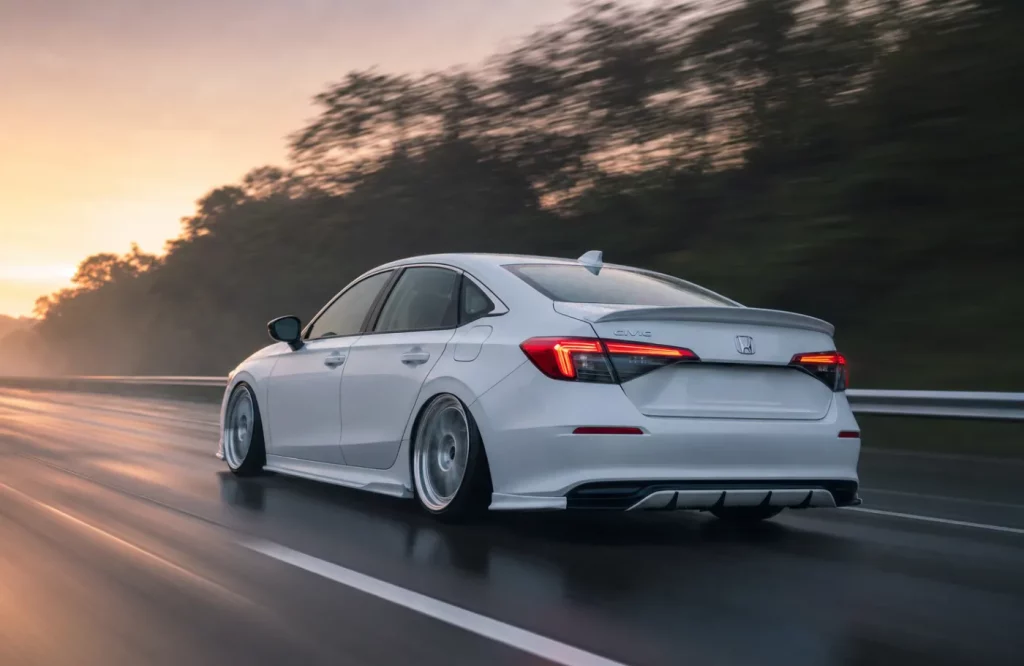
The internet is full of passionate opinions. Some say coilovers are the only way to go. Others insist that quality lowering springs deliver 90% of the performance for a fraction of the cost. The truth is more nuanced. Both options have their place, and the right choice depends entirely on your goals, your budget, and how you plan to use your Civic.
This isn’t a comparison about which option is “better.” It’s a comparison about which option makes sense for the way you actually drive your car. And for most Civic owners, the answer is simpler than they expect.
Lowering springs are the budget-friendly choice for drivers who want a mild drop and improved stance without sacrificing daily comfort — typically $200-400 for springs plus $150-300 for installation. Coilovers are the performance choice for drivers who want full adjustability, better handling, and the ability to fine-tune ride height and damping — typically $800-1,500+ for quality coilovers plus installation. Most Civic owners do not need coilovers. But serious suspension tuning requires more than just lowering springs.
The Three Ways to Lower Your Civic
Before comparing springs and coilovers, it’s worth understanding that you actually have three options for lowering your Civic, not just two.
Lowering Springs: Replacement coil springs that sit lower than stock. You keep the factory shocks and struts. This is the most cost-effective way to lower the car. A good set typically provides a 0.6-1.2 inch drop with a 5-25% increase in spring rate. The springs are designed to work within the limitations of the OEM dampers.
Coil Sleeve Kits: A hybrid system that combines lowering springs with adjustable spring seats and camber plates. You keep the OEM shocks and struts but gain adjustable ride height and camber. This is a middle ground option that offers more adjustability than springs without the full cost of coilovers. The downside: no damper adjustment since you’re still on the factory shocks.
Full Coilovers: Complete replacement units that include springs, shocks/struts, and top hats. Everything is replaced with a performance-oriented system designed to work as a complete unit. You get height adjustment, damping adjustment, and often camber adjustment. These offer the most flexibility for fine-tuning your suspension.
| Option | Cost Range | Adjustability | Best For |
|---|---|---|---|
| Lowering Springs | $200–$400 | Fixed height | Budget builds, mild drops |
| Coil Sleeve Kits | $400–$800 | Height adjustable | OEM+ builds, adaptive damper cars |
| Full Coilovers | $800–$1,500+ | Height, damping, camber | Performance builds, track use |
What Actually Changes When You Lower a Civic?
Understanding what happens when you lower your car is essential to making the right choice. Lowering isn’t just about looks — it fundamentally changes how the suspension works.
Center of Gravity: Lowering the car reduces the center of gravity, which reduces body roll and improves handling response. This is the primary performance benefit of lowering.
Suspension Travel: When you lower the car, you reduce available suspension travel. This means the suspension has less distance to absorb bumps before hitting the bump stops. Too much lowering without appropriate bump stop changes can result in a harsh ride and bottoming out.
Spring Rate: Lowering springs are typically stiffer than factory springs to prevent bottoming out with reduced travel. The increased spring rate reduces body roll but can also make the ride firmer.
Damper Control: The factory dampers are valved for the factory spring rates. When you increase spring rates without changing dampers, the dampers may not adequately control the springs, leading to a bouncy or underdamped feel.
Camber and Toe: Lowering changes the suspension geometry. The rear wheels gain negative camber, and toe settings change. Without proper correction, this can cause uneven tire wear.
Lower does not automatically mean better handling. You can make the car lower and better looking while actually making the handling worse if you don’t address the geometry changes properly.
Best Drop Height for a Daily Civic
For a daily-driven Civic, the best drop is usually smaller than Instagram suggests. Here’s a practical guide to drop heights.
0.5–0.8 Inch Drop: Best for daily drivers, bad roads, and minimizing rubbing risk. You get a subtle improvement in stance without significant compromises. This is the “OEM+” look.
0.8–1.2 Inch Drop: The sweet spot for most Civic owners. You get noticeably less wheel gap, improved appearance, and moderate handling improvements with fewer compromises than more aggressive drops. This is where most quality lowering springs land.
1.5+ Inch Drop: Aggressive fitment territory. You’ll get rubbing risk, alignment concerns, reduced suspension travel, and potentially compromised ride quality. This is where coilovers become more necessary because you need the ability to fine-tune height and damping to manage the compromises.
If your Civic is a daily driver, the best drop is usually smaller than Instagram suggests. A 0.8-1.2 inch drop delivers most of the visual benefit with significantly fewer compromises.
Lowering Springs — Who Should Buy Them?
Lowering springs are the most common first suspension modification for Civic owners. They’re affordable, relatively easy to install, and deliver a noticeable improvement in appearance and handling.
Ideal Buyer:
- Daily driver with occasional spirited driving
- Wants to remove wheel gap without breaking the bank
- Doesn’t need constant height adjustment
- Limited budget
- Wants to keep factory adaptive dampers working
What They Are: Lowering springs are replacement coil springs that sit lower than the factory springs. They’re made from wound steel, coated for durability, and designed to provide a moderate drop while increasing spring rates. A good set is engineered to work within the limitations of the OEM shocks, offering improved handling and grip without being too stiff.
Pros:
- Affordable: Typically $200-400 for a set of four springs
- Simple installation: Direct replacement of factory springs
- Decent ride quality: Better than cheap coilovers on the street
- No complicated adjustments: Install and forget
- Works with OEM dampers: No need to replace shocks
- Preserves adaptive damping: On Si and Type R, springs work with the factory Adaptive Damper System without error codes
Cons:
- Fixed height: Can’t adjust after installation
- Compromised damping: Stock shocks aren’t designed for lowered springs
- Limited drop: Usually 0.6-1.2 inches maximum
- Shorter lifespan: OEM shocks wear faster with stiffer springs
- No damping adjustment: Can’t fine-tune the ride
The Strut Killer Reality: Factory dampers are designed for a specific spring rate and ride height. When you install lowering springs, the damper is forced to work in a compressed state outside its optimal operating range. On small bumps, the suspension can feel nervous, and by 20,000–30,000 miles, factory struts may start to leak. A full replacement will cost more than the initial “savings” from choosing springs.
Popular Brands for CivicX and Civic 11:
- Eibach Pro-Kit: The most popular choice for daily drivers. Provides a moderate drop (typically 0.8-1.0 inches) with excellent ride quality. Owners consistently report the car “still rides comfortably, just a tad bit stiffer than OEM.”
- Eibach Sportline: A more aggressive drop (1.2-1.5 inches) with a firmer ride. Good for owners who want a sportier look but are willing to accept more ride compromise.
- H&R Sport Springs: A slightly more aggressive drop with a firmer ride. Good for owners who want a sportier feel without going to coilovers.
- Swift Springs: Popular among owners doing OEM+ builds. Provides a gradual drop with quality materials.
- $200–400 initial cost
- 0.6-1.2 inch drop
- No height adjustment
- Works with OEM dampers
- 2-4 hour installation
- Preserves factory ADS
- $800–1,500+ initial cost
- Adjustable height
- Damping adjustment available
- Camber adjustment on many kits
- 4-8 hour installation
- May require ADS bypass
Coilovers — When Are They Actually Worth It?
Coilovers are the choice for drivers who want full control over their suspension. They replace everything — springs, shocks/struts, and top hats — with a performance-oriented system designed to work as a complete unit.
When Coilovers Make Sense:
- You need adjustable ride height for wheel fitment
- You’re building an aggressive wheel setup
- You want adjustable damping for different conditions
- You track or autocross your Civic
- You want corner balancing capability
- You want precise control over handling characteristics
What They Are: Coilovers are complete suspension units that include springs, dampers, and mounting hardware. Quality coilovers use a mono-tube shock design with a linear Piston and damping curve, keeping damping predictable through the entire stroke. Height adjustment works independently of spring compression — you lower the car by moving the lower mount, not by crushing the spring. This means you keep suspension travel and the damper continues to work properly, which is why a properly set up coilover car can sit low and still ride well.
Pros:
- Adjustable height: Dial in the perfect drop
- Better damping: Designed to work with the springs
- Performance handling: Significant improvement over stock
- Upgradeable: Can adjust as needs change
- Rebuildable: Quality coilovers can be refreshed instead of replaced
- Corner balancing: Ability to fine-tune weight distribution
Cons:
- Expensive: Quality sets start around $800
- Complex install: More involved than springs
- Maintenance: Need periodic inspection
- Potential harshness: Budget coilovers, especially, can be punishing
- ADS complexity: May require bypass modules on equipped cars
Popular Brands for CivicX and Civic 11:
- BC Racing BR Series: One of the most popular entry-level coilovers. Offers height adjustment, 30 clicks of damping adjustment, and front pillowball camber plates. Spring rates are balanced for comfort and performance.
- Fortune Auto 500: Premium option with digressive damping and Swift springs. Known for excellent ride quality and track capability.
- Tein Flex Z: A popular mid-range option that offers good value for performance.
- Silvers Neomax: Good adjustability and reasonable price point.
The Biggest Myth: Coilovers Are Always Stiffer
This is one of the most common misconceptions about coilovers. Many people assume coilovers automatically ruin ride quality. The reality is more nuanced.
Poor coilovers = harsh. Cheap coilovers with aggressive spring rates and poor valving can absolutely destroy ride quality. They feel crashy, bouncy, and harsh over every imperfection.
Good coilovers = can be comfortable. Quality coilovers with appropriate spring rates and proper valving can ride surprisingly well. Adjustable damping allows you to soften the car for daily driving and firm it up for track use.
Lowering springs can also be harsh. A cheap set of lowering springs on worn factory dampers can ride worse than a quality set of coilovers. The combination of old dampers and stiffer springs often results in a bouncy, uncontrolled ride.
The key factors for ride quality, regardless of which option you choose, are spring rate, damper valving, suspension travel, quality of components, and proper setup. A well-designed, properly installed system — whether springs or coilovers — will ride better than a poorly designed or installed system.
The Adaptive Damper Problem — Important for CivicX Si and Type R
If your Civic has the Adaptive Damper System (ADS), this is a critical consideration. On 10th Gen Civic Si and Type R, the factory electronically controlled dampers are integral to the car’s performance.
The Problem: Removing the factory electronically controlled dampers can trigger dashboard warning lights. The car’s computer expects to communicate with the adaptive dampers, and when they’re removed, it throws codes and may put the car into a limp mode or disable stability control.
Solutions:
- Lowering springs: Keep your factory ADS dampers. No warning lights. The springs work perfectly with the adaptive system, and you can still use Sport and Comfort modes from the cabin. This is the primary reason many Si and Type R owners choose springs.
- Coil sleeve kits: Also keep factory dampers. No warning lights. This was why 27WON initially chose this route for their Si build.
- Coilovers: You’ll need ADS cancel plugs or modules to prevent dashboard codes. Some coilover manufacturers offer these, or you can buy them separately (typically $350–$450 for a set of four).
Exception: The 11th Gen Civic Si does not have adaptive dampers from the factory. This makes the choice simpler — you can install conventional coilovers without worrying about ADS compatibility.
The Camber Tax — What You Need to Know
When you lower a Civic, the suspension geometry changes. The rear wheels gain negative camber (they tilt inward AT the top), and the toe settings change. Without proper correction, you’ll experience uneven tire wear.
What Happens: As the car lowers, the rear suspension’s multi-link geometry causes the wheels to gain negative camber naturally. This isn’t a design flaw — it’s how the suspension works. But beyond a certain point, the camber becomes excessive and causes uneven tire wear.
The Solution: If you want to maintain decent tire life, you need adjustable rear camber arms. Brands like SPC, Skunk2, and Eibach offer them for $200-300. Professional installation and alignment are also required.
When Do You Need Them?
- Drops under 0.8 inches: Factory camber adjustment may be sufficient
- Drops 0.8-1.2 inches: Adjustable camber arms are recommended
- Drops over 1.2 inches: Adjustable camber arms are required
Without proper camber correction, you’ll wear through a set of tires in one season. This is the “camber tax” that many new owners forget to budget for when lowering their Civic.
10th Gen Civic (CivicX) — Springs vs Coilovers
The 10th Gen Civic has the most choices and the most community experience. Here’s how the decision breaks down for each body style.
CivicX Sedan and Coupe: Both share similar suspension geometry. Springs are the most common choice for daily drivers. The 0.8-1.0 inch drop from Eibach Pro-Kit or H&R provides excellent stance without excessive compromise. For owners who want aggressive fitment or track capability, coilovers are the better choice.
CivicX Hatchback (FK7): The hatchback has slightly different rear suspension tuning. Springs work well, but many owners opt for coilovers to achieve the lower stance that looks best on the hatchback body.
CivicX Si: The ADS system is the wild card. Springs work perfectly with the factory dampers, preserving the Sport and Comfort modes. Many Si owners choose springs specifically to keep the adaptive system working. Coilovers require ADS bypass modules, adding $350-450 to the cost.
CivicX Type R (FK8): Same ADS consideration as the Si. The factory dampers are tuned for track use, and springs are a popular way to improve stance while keeping the adaptive system. Type R owners often choose springs to maintain the factory suspension character while lowering the car.
11th Gen Civic — Springs vs Coilovers
The 11th Gen Civic (FE1/FL1) has a simpler suspension setup than the 10th Gen Si and Type R. The standard Civic uses conventional dampers, and the Si no longer has adaptive suspension.
11th Gen Standard Civic: Springs are the most popular choice for daily drivers. The 0.8-1.0 inch drop from quality springs provides excellent stance and improved handling without breaking the bank.
11th Gen Si: The Si no longer has adaptive dampers, making coilovers a simpler choice than on the 10th Gen Si. Owners can install conventional coilovers without worrying about ADS bypass modules. Both springs and coilovers are viable options, depending on the owner’s goals.
Cost Comparison — The Real Budget
The price difference between springs and coilovers is significant, but the total cost includes installation and any additional parts needed.
| Cost Component | Lowering Springs | Coil Sleeve Kit | Full Coilovers |
|---|---|---|---|
| Parts cost | $200–$400 | $400–$800 | $800–$1,500+ |
| Installation (shop) | $150–$300 | $300–$500 | $300–$600 |
| Alignment | $100–$150 | $100–$150 | $100–$150 |
| Camber kit (if needed) | $200–$300 | Often included | Often included |
| ADS bypass (if needed) | Not needed | Not needed | $350–$450 |
| Total Approximate Cost | $650–$1,150 | $800–$1,450 | $1,550–$2,700+ |
Which Option Is Right for Your Civic?
Here’s how to decide based on your goals and budget.
Choose Lowering Springs If:
- You’re on a budget (under $800 total)
- You want a mild drop (0.8-1.0 inches)
- You prioritize daily comfort
- You don’t need height adjustability
- You have adaptive dampers and want to keep them
- You want a simple, set-it-and-forget-it solution
- You drive 80%+ on the street
Choose Coil Sleeve Kits If:
- You want height adjustability without replacing your factory dampers
- You need camber adjustment but want to keep ADS
- You’re willing to deal with potential fitment challenges
Choose Full Coilovers If:
- You want maximum performance and adjustability
- You plan to track or autocross your Civic
- You want adjustable damping and height
- You’re willing to spend $1,500+ on the complete package
- You don’t mind the added complexity
- You’re okay with ADS cancel plugs (if equipped)
- You want aggressive fitment that requires precise height adjustment
Final Thought
The choice between coilovers and lowering springs comes down to one question: what do you actually need from your suspension?
Most Civic owners do not need coilovers. A quality set of lowering springs delivers excellent results for daily driving at a fraction of the cost. But if you’re building a serious performance car or need precise control over ride height and damping, coilovers are the right choice.
As one experienced owner put it: “You want full adjustability go with coilovers. You don’t need adjustability, but you want to lower your car a little bit to improve the stance and ride, lowering springs are just fine.”
FAQ — Coilovers vs Lowering Springs
Which is better, coilovers or lowering springs?
It depends on your goals. Lowering springs are better for budget-conscious daily drivers who want a mild drop and improved handling. Coilovers are better for enthusiasts who want full adjustability, serious performance, and are willing to spend more. Springs cost $200-400; quality coilovers cost $800-1,500+.
Do lowering springs ruin the ride quality?
Quality progressive springs like Eibach Pro-Kit provide a ride that’s “just a tad bit stiffer than OEM” while maintaining daily comfort. Cheap springs or aggressive drops can make the ride harsh. The key is choosing quality springs with an appropriate drop for your car.
How much does it cost to install lowering springs?
Lowering springs cost $200-400 for a set of four. Installation costs $150-300 at a shop if you don’t DIY. An alignment after installation costs $100-150. Additional camber arms may be needed for drops over 0.8 inches, adding $200-300.
How much does it cost to install coilovers?
Quality coilovers cost $800-1,500+. Installation costs $300-600 at a shop. An alignment after installation costs $100-150. Budget an additional $350-450 for ADS cancel plugs if your Civic has adaptive dampers. Adjustable camber arms may be needed for aggressive drops.
Do I need an alignment after lowering?
Yes — an alignment is mandatory after any suspension modification. Lowering changes the suspension geometry, and without a proper alignment, you’ll experience uneven tire wear. A professional alignment should be done immediately after installation.
Do lowering springs wear out factory shocks faster?
Yes — stiffer springs can accelerate wear on factory shocks, especially with aggressive drops. By 20,000-30,000 miles, factory struts may start to leak. However, quality progressive springs designed to work with OEM dampers minimize this effect. Many owners run springs for years without issues.
What are the best lowering springs for CivicX and Civic 11?
Popular choices include Eibach Pro-Kit for a moderate drop with excellent ride quality, H&R Sport Springs for a more aggressive drop, and Swift Springs for OEM+ builds. Eibach Pro-Kit is the most common recommendation for daily drivers.
What are the best coilovers for CivicX and Civic 11?
Popular choices include BC Racing BR Series for the best value-to-performance ratio with 30-way adjustable damping and front camber plates, Fortune Auto 500 for premium digressive damping, Tein Flex Z for a good mid-range option, and Silvers Neomax for adjustability.
What is a coil sleeve kit?
A coil sleeve kit is a hybrid system that combines lowering springs with adjustable spring seats and camber plates. You keep your factory shocks but gain adjustable ride height and camber. It’s a middle-ground option between springs and full coilovers, particularly useful for CivicX Si and Type R owners who want to keep ADS.
Will lowering my Civic trigger a warning light with adaptive dampers?
Lowering springs and coil sleeve kits keep your factory dampers, so no warning light. Full coilovers require ADS cancel plugs or modules (typically $350-450) to prevent dashboard codes on Civics equipped with adaptive dampers. The 11th Gen Si does not have adaptive dampers, so this is less of a concern on newer models.