

The 10th-generation Honda Civic (2016–2021) came with two engine options in most markets: the L15B7 1.5-liter turbocharged four-cylinder and the K20C2 2.0-liter naturally aspirated four-cylinder. The turbo engine gets most of the tuning attention — for good reason. The K20C2, found in LX, Sport, and some EX trims (primarily the sedan and coupe LX/Sport trims), is a very different proposition. It shares the “K20C” naming with the Civic Type R’s K20C1, but the architecture is fundamentally different: naturally aspirated, port-injected, high-compression, and designed for efficiency rather than performance. This guide covers exactly what a tune does on the K20C2, what power gains are realistic, what the tuning options are, and whether it is worth the cost. Sources: KTuner manufacturer dyno data, Phearable.net product documentation, CivicX owner dyno reports, TireMeetsRoad dyno coverage, Wikipedia K-Series engine specifications, 8020 Automotive K20/K24 comparison guide, K20A.org technical discussion, CivicX tuning reliability project data.
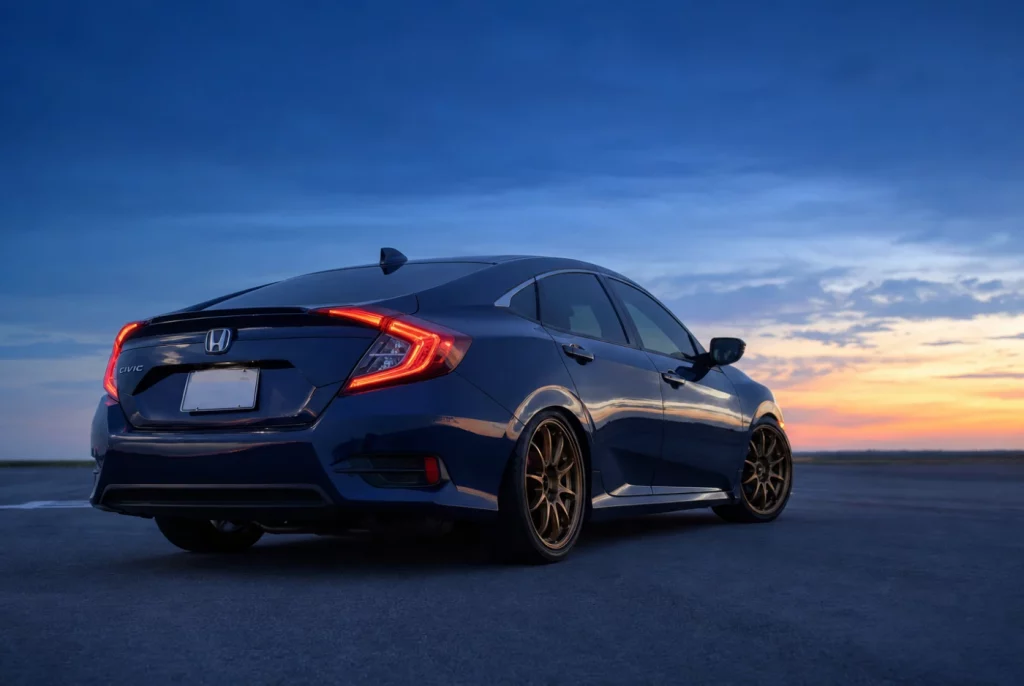
The K20C2 Engine — A Unique and Often Misunderstood Platform
The K20C2 is an unusual engine in Honda’s modern lineup. It is the only EarthDreams-era engine that uses port injection rather than direct injection. The block shares a casting family with the K20C1 (Civic Type R) and K20C4 (Accord 2.0T), but the similarities end there. The K20C2 has a high 10.8:1 Compression Ratio, an integrated exhaust manifold, intake-only VTEC (i-VTEC on the intake cam with VTC) — no exhaust VTEC — and a redline of 6,700 RPM with a 7,000 RPM fuel cut. The bore and stroke are 86.0 mm by 85.9 mm, making it slightly undersquare, favoring midrange torque over top-end horsepower. Source: Wikipedia K-series engine specifications, K20A.org K20C2 technical thread, 8020 Automotive K-series guide.
The engine produces 158 hp at 6,500 RPM and 138 lb-ft at 4,200 RPM at the crank. On a DynoJet, a stock K20C2 typically measures approximately 127 wheel horsepower and 105 wheel torque. The factory calibration is conservative — Honda tuned for 87 octane fuel, emissions compliance, and smooth daily driving. The VTEC engagement is set at approximately 6,100 RPM for the manual transmission and 6,500 RPM for the CVT. On the CVT, VTEC almost never engages — it activates at 6,500 RPM with a 6,700 RPM redline, giving a usable VTEC window of roughly 200 RPM. On the manual, the 600 RPM window between VTEC engagement and redline is barely more useful. Source: Ktuner K20C2 dyno results page, Wikipedia K20C2 specifications, TireMeetsRoad/KTuner dyno coverage, CivicX stock dyno discussion.
The K20C2 is an aluminum-block engine with cast iron cylinder liners — consistent with the broader K-series architecture. It uses dual VTC (variable timing control) phasers on both intake and exhaust cams, which allows the ECU to vary overlap and internal EGR for efficiency. The engine is fundamentally designed for fuel economy and low operating costs, not maximum power output. Source: K20A.org technical analysis, Wikipedia K-series design notes.
Tuning Options — Only One Real Choice
Unlike the 1.5T, which has both KTuner and Hondata FlashPro support, the K20C2 has exactly one tuning platform: KTuner. Hondata does not support the K20C2 ECU. This is not a minor limitation — it means there is no alternative tuning ecosystem and no competition on features or pricing.
KTuner V1.2 ($449 new) is the entry-level device. It connects to the OBD-II port, reads the stock calibration, and flashes the new tune. It requires a laptop for flashing and an Android device running the TunerView app for real-time data monitoring. It supports on-the-fly map switching via cruise control buttons. The KTuner V1.2 does not have a built-in display, but the tuning capability is identical to the more expensive V2. Source: KTuner manufacturer website and product documentation.
KTuner V2 ($649 new) adds a 5-inch color touchscreen that serves as a real-time gauge display and allows map switching and datalogging without a laptop. The V2 is more convenient for owners who want to monitor engine parameters (knock control, Coolant temperature, intake air temperature, AFR) without a smartphone app. The tuning capability is identical to the V1.2. Source: KTuner manufacturer website, CivicX KTuner comparison threads.
Used market. KTuner devices retain approximately 70–80% of their value and can be unlocked and resold. Used V1.2 units are commonly available in the $300–$400 range on CivicX classifieds and Facebook marketplace groups. The device can be unlocked from the original vehicle and locked to a new one, so buying used is a practical option. Source: CivicX classifieds, CivicX tuning reliability project used device discussion.
What a Tune Actually Changes on the K20C2
On a naturally aspirated engine, the tuning strategy is fundamentally different from a turbo engine. There are no boost targets to raise, no wastegate duty cycles to adjust, and no intercooler efficiency to account for. The K20C2 tune works entirely through changes to naturally aspirated engine calibration parameters.
VTEC crossover point. This is the single most impactful change. The factory VTEC engagement at 6,100 RPM (manual) or 6,500 RPM (CVT) makes VTEC nearly unusable on the street. A KTuner tune lowers VTEC engagement to approximately 5,200–5,600 RPM. The KTuner basemap sets it at approximately 5,600 RPM. Some owners further lower it to 4,000–5,300 RPM, though the KTuner calibration is considered the optimal balance based on their dyno testing. The lower crossover means VTEC is active during normal acceleration through the midrange rather than only at full throttle near redline. The change is immediately audible — the characteristic VTEC intake note becomes noticeable at moderate throttle. Source: KTuner K20C2 calibration documentation, TireMeetsRoad KTuner dyno article, CivicX VTEC adjustment thread, CivicX K20C2 VTEC lowering reports.
Ignition timing. The factory timing MAP is set for 87 octane fuel and minimal knock risk across all operating conditions. A tuned calibration advances ignition timing through the midrange and top end, particularly when running 91 or 93 octane fuel. The Phearable Stage 2 tune specifically targets 93 octane and adds significant timing advance across the powerband. The KTuner basemap adds moderate timing advance suitable for 91+ octane. The result is improved power from approximately 3,500 RPM to redline, with the most noticeable gains above 5,000 RPM. Source: Phearable.net K20C2 Stage 2 product page, CivicX Phearable K20C2 tune review, KTuner software calibration notes.
VTC (Variable Timing Control) optimization. The factory VTC calibration is conservative, with cam phaser positions optimized for emissions and fuel economy. Tuned calibrations adjust intake and exhaust cam phaser positioning to improve volumetric efficiency through the midrange. This contributes to the broader torque curve that owners report after tuning — the engine pulls harder from 3,000–4,000 RPM even though peak torque only increases by approximately 15–18 lb-ft. Source: KTuner software features documentation, CivicX K20C2 tuned owner reports.
Throttle response. The factory throttle mapping has a delayed response — particularly noticeable from a stop and during part-throttle driving. The KTuner basemap offers adjustable throttle sensitivity with three levels. Level 2 is the most commonly recommended setting for daily driving, offering noticeably sharper response without being twitchy. The Phearable Stage 2 tune also remaps the throttle curve for more linear response. Source: CivicX K20C2 tuned owner reports, KTuner throttle adjustment documentation.
Speed limiter removal. The 10th-gen Civic is electronically limited to approximately 110–115 mph depending on trim. Tuning removes this limiter. Source: KTuner feature list, CivicX owner reports.
Rev hang reduction (manual transmission). The factory calibration includes significant rev hang — the RPM drops slowly between shifts to reduce emissions. Tuning reduces or eliminates rev hang, allowing faster, cleaner shifts. This is one of the most frequently cited improvements among manual transmission K20C2 owners. Source: CivicX manual transmission owner reports, KTuner calibration features.
Launch control (manual transmission only). The KTuner calibration adds a launch control feature that holds the engine AT a set RPM (typically 3,200 RPM) when the clutch is depressed and the throttle is wide open. This is a secondary benefit — useful for drag strip use but not a reason to buy a tuner on its own. Source: KTuner K20C2 calibration features, Phearable Stage 2 product documentation.
Power Gains — Dyno Data
The power gain on the K20C2 is modest compared to the 1.5T, but the percentage improvement is significant for a naturally aspirated engine. Here is what the actual dyno data shows:
| Calibration | Wheel HP (DynoJet) | Wheel Torque | Est. Crank HP | Gain vs Stock (whp) |
|---|---|---|---|---|
| Factory calibration (87 octane) | ~127 whp | ~105 lb-ft | 158 hp | — |
| KTuner Stage 1 basemap (91+ octane) | ~149–150 whp | ~123 lb-ft | ~172–175 hp | +22–23 whp |
| Phearable Stage 2 (93 octane, stock hardware) | ~155–160 whp | ~125–128 lb-ft | ~178–182 hp | +28–33 whp |
| Phearable custom eTune + full bolt-ons | ~167 whp | ~130 lb-ft | ~185 hp | +40 whp |
KTuner basemap data. KTuner’s own dyno testing, published on their website and validated by the TireMeetsRoad article, showed a stock K20C2 making 127 whp and 105 lb-ft on a DynoJet. After flashing the KTuner basemap (91+ octane calibration with lowered VTEC and revised timing), the same car made approximately 149–150 whp and 123 lb-ft — a gain of +22–23 whp and +18 lb-ft. The VTEC crossover was lowered to approximately 5,600 RPM. Source: KTuner K20C2 dyno results page, TireMeetsRoad November 2017 dyno coverage.
Phearable Stage 2 data. Phearable.net released a Stage 2 tune for the K20C2 in April 2024. Their DynoJet testing showed 166 whp on a CVT car — though the “gain over 45+ HP over stock” claim appears to be calculated against a lower baseline than the standard 127 whp. The documented 166 whp figure is consistent with multiple owner reports. Owners with the manual transmission report similar or slightly higher numbers. The Phearable Stage 2 tune requires 93 octane fuel or 91 octane with 2 gallons of E85 blended in. On 91 octane alone, the gains are smaller — approximately 4–8 hp over the KTuner basemap. Source: Phearable.net product page for K20C2 Stage 2, CivicX Phearable Stage 2 review thread, CivicX K20C2 custom eTune dyno #706.
Full bolt-on maximum. The highest naturally aspirated output documented from a K20C2 is approximately 167 whp (approximately 185 crank hp at a 10% drivetrain loss factor) on a car with full bolt-ons — PRL high-volume intake, RV6 catted downpipe, FunctionWerks front pipe, Mugen FK8 titanium exhaust, and a Phearable custom eTune on 93 octane. The owner who achieved this result noted that the ignition upgrades (spark plugs and coils) made no meaningful difference, and the stock Phearable OTS tune would likely have produced very similar results to the custom eTune. Source: CivicX K20C2 Bolted and Tuned dyno thread, owner dyno #706 (DynoJet).
Nitrous is a separate discussion. Some owners have experimented with nitrous oxide on the K20C2. This is outside the scope of this Stage 1/Stage 2 guide and carries significantly higher risk. The stock K20C2 bottom end is not designed for forced induction or significant additional cylinder pressure.
Bolt-On Modifications — Diminishing Returns
The K20C2 has limited bolt-on potential because the factory intake and exhaust systems are already reasonably well-sized for a 158 HP naturally aspirated engine. Each bolt-on modification produces small gains, and the cost-per-horsepower is poor compared to the tune alone.
Cold air intake. A cold air intake (PRL, AEM, or Takeda) adds approximately 1–3 whp on a tuned K20C2. The AEM CAI is generally well-regarded in the community. Some owners report that short-ram intakes can actually lose midrange torque due to higher intake air temperatures. The PRL high-volume intake is the most common choice and is part of the maximum bolt-on setup that achieved 167 whp. Cost: approximately $250–$400. Gain: approximately 1–3 whp. Source: CivicX K20C2 bolt-on thread, CivicX owner dyno comparison reports.
Downpipe (RV6 catted or catless). The RV6 downpipe is the most effective single bolt-on for the K20C2, primarily because it replaces the restrictive factory downpipe with the integrated Catalytic Converter. The catless version produces the largest gain but is not street-legal in most states. The catted version produces slightly less gain but avoids emissions inspection issues. Owners report that the downpipe adds approximately 3–5 whp on a tuned car. The catless downpipe makes the exhaust noticeably louder, especially combined with an aftermarket exhaust. Cost: approximately $350–$500. Gain: approximately 3–5 whp. Source: CivicX K20C2 downpipe discussion, owner dyno comparison, CivicX K20C2 retuned thread.
Front pipe and exhaust. A larger-diameter front pipe and cat-back exhaust add small gains — approximately 1–3 whp combined. The factory exhaust is not a significant restriction at the K20C2’s power level. Aftermarket exhaust primarily changes the sound. Some owners have removed aftermarket exhausts because they were too loud in combination with a catless downpipe. Cost: $400–$1,200 depending on brand. Gain: approximately 1–3 whp. Source: CivicX K20C2 bolt-on discussion, owner reports, CivicX K20C2 modding thread.
Ignition upgrades (spark plugs and coils). NGK Ruthenium spark plugs and aftermarket ignition coils are frequently mentioned but produce no measurable power gain on a stock or tuned K20C2. Owners who have dyno-tested these upgrades confirm no benefit. The factory ignition system is adequate for the power levels the K20C2 produces. Source: CivicX K20C2 full bolt-on dyno report #706.
| Modification | Typical Cost | Expected WHP Gain | Cost per WHP | Worth It? |
|---|---|---|---|---|
| KTuner V1.2 + basemap | $449 | +22–23 whp | ~$20/whp | Yes — best value by far |
| Phearable Stage 2 tune | $250–$300 | +6–10 whp over basemap | ~$30–50/whp | Marginal — only if committed |
| Cold air intake | $250–$400 | +1–3 whp | ~$130–$250/whp | No — sound only |
| RV6 downpipe (catless) | $350–$500 | +3–5 whp | ~$100–$150/whp | If chasing max NA power |
| Cat-back exhaust | $400–$1,200 | +1–2 whp | ~$400–$1,200/whp | No — sound only |
| Full bolt-on set + eTune | ~$1,800–$2,500 | +40 whp max | ~$50–$60/whp | Only for enthusiast owners |
The data is clear: the KTuner basemap at $449 is the most cost-effective modification for the K20C2 by a wide margin. Bolt-ons produce small gains at significantly higher cost per horsepower. The owner who built the highest-documented K20C2 (167 whp) noted that the stock Phearable OTS tune “would probably get you pretty much the same results, vs full eTune, for less money and effort” — suggesting the tuning software change is responsible for the vast majority of the gain, not the hardware. Source: CivicX K20C2 full bolt-on owner reports, CivicX mod cost-benefit analysis.
Real-World Driving Experience — What the Tune Actually Feels Like
The power gain from a K20C2 tune is modest — approximately 22 whp from the KTuner basemap, representing a 17% increase. The character of the car changes more than the peak number suggests.
VTEC becomes usable. The single most transformative change. With VTEC lowered to 5,200–5,600 RPM, the engine pulls audibly and noticeably harder from the midrange to redline. On the factory calibration, above 5,500 RPM the engine feels flat — the power falls off before VTEC can do anything useful. With the tune, the engine builds steam through the midrange and pulls to redline with increasing urgency. Multiple owners describe this as “the way the car should have come from the factory.” Source: CivicX K20C2 tuned owner reports, KTuner dyno data.
Throttle response sharpens. The factory drive-by-wire calibration has noticeable delay. With Level 2 throttle sensitivity on the KTuner basemap, tip-in response is immediate without being jerky. This makes the car feel noticeably quicker in daily driving, even at part throttle, because the engine responds immediately to pedal input rather than lagging behind. Source: CivicX K20C2 tuned owner feedback, KTuner throttle settings discussion.
Midrange torque improvement. The torque gain of +18 lb-ft is concentrated between 3,000 and 5,000 RPM. This translates to noticeably stronger highway merging and passing acceleration without needing to downshift. Owners describe the tuned car as feeling “more alive” at normal driving speeds. Source: CivicX tuned K20C2 owner reports, TireMeetsRoad KTuner dyno coverage.
Fuel economy. Owner reports are mixed. Some owners report improved highway fuel economy — up to 42 mpg on long highway cruises according to one CivicX owner — because the tune allows the engine to operate more efficiently at part throttle. Other owners report slight decreases (33–35 mpg highway combined) because the improved throttle response encourages more aggressive driving. The tune itself does not add fuel at steady-state cruising; the difference is primarily from driver behavior. Source: CivicX Phearable Stage 2 owner mileage reports, CivicX K20C2 tuned fuel economy discussion.
Not a fast car. The K20C2 with a tune is still not a fast car by modern standards. The 0-60 time improves from approximately 8.0–8.5 seconds stock to approximately 7.2–7.8 seconds with a tune, depending on transmission and conditions. This is comparable to a 2011–2014 Civic Si, which ran approximately 7.0–7.2 seconds 0-60. The tuned K20C2 is quicker than a stock 1.8L 9th-gen Civic, similar to a mid-2010s Mazda3 2.0, and still slower than a stock 1.5T Civic by a meaningful margin. It is not a car that will win stoplight races. Source: CivicX tuned K20C2 acceleration estimates (limited datalogging data), stock Civic 0-60 databases.
Reliability Considerations
The K20C2 is fundamentally a robust engine. The CivicX Tuning Reliability Project lists K20C2 tuned cars in a separate category from 1.5T, Si, and Type R models. The failure rate for tuned K20C2 engines is notably low — the engine is not producing enough additional power to stress the bottom end, and the port injection system avoids the Oil dilution issues that affect the direct-injected L15B7. Source: CivicX Tuning Reliability Project (gtman, as of June 2026).
No head gasket issues. Unlike the L15B7, the K20C2 does not have a pattern of Head Gasket failures associated with tuning. The naturally aspirated engine operates at much lower cylinder pressures than a turbo engine, even with advanced timing. The head studs and head gasket are adequate at the power levels produced by a Stage 1 or Stage 2 tune. Source: CivicX tuning reliability project K20C2 data, CivicX K20C2 failure discussion.
No rod issues. The K20C2 connecting rods are not under the same stress as the L15B7‘s rods in the 1.5T hatchback. The naturally aspirated engine does not produce the torque spike at low RPM that bends rods on turbo engines. High-mileage tuned K20C2 examples are common without engine bottom-end failures. Source: CivicX tuning reliability project, CivicX K20C2 owner discussion.
No CVT failures attributable to tuning. The CVT in the K20C2 is the same CVT used in the 1.5T, but the 2.0 NA produces significantly less torque — approximately 138 lb-ft stock and 123–128 lb-ft at the wheels tuned. This is well within the CVT’s design margins. The CivicX reliability project shows no pattern of CVT failures on tuned K20C2 cars. Source: CivicX tuning reliability project CVT Failure data.
Oil change interval. Standard interval (every 5,000–7,500 miles with full synthetic) is adequate for tuned K20C2 engines. The engine does not experience the fuel dilution or high cylinder pressures that necessitate shorter intervals on the 1.5T. Source: CivicX K20C2 maintenance discussion.
What You Cannot Do — Forced Induction
A common question from K20C2 owners is whether a Turbocharger or supercharger can be added. The practical answer is no. The K20C2 has a high 10.8:1 compression ratio — typical turbo engines run 9.0–10.0:1 at most. The ECU does not support boost control without extensive custom tuning. The stock bottom end is not designed for forced induction cylinder pressures. And perhaps most importantly, no bolt-on turbo kit has been commercially developed for the K20C2. The technical barriers make a reliable forced-induction setup cost-prohibitive and impractical compared to simply selling the car and buying a 1.5T or Si. Source: CivicX K20C2 forced induction discussion, K20A.org technical analysis.
Should You Tune the K20C2?
The answer depends on expectations and what the owner values.
Tune the K20C2 if: You want the car to drive better — sharper throttle response, usable VTEC, removed rev hang, and a more linear power delivery to redline. These changes transform the daily driving experience more than the peak horsepower number suggests. The $449 cost of a KTuner V1.2 is the best-value modification available for the 2.0 NA Civic, and the reliability risk is minimal. This is the right choice for owners who plan to keep the car long-term and want it to feel more responsive.
Do not tune the K20C2 if: You expect the car to become fast, keep up with 1.5T Civics, or produce dyno numbers worth bragging about. A tuned K20C2 makes approximately 150 whp. A stock 1.5T makes 187 whp. A tuned 1.5T makes 219 whp. The gap is fundamental and cannot be closed with bolt-ons or tuning. The K20C2 is an economy engine — port injection, high compression, naturally aspirated, designed for 87 octane fuel. No amount of calibration work changes that hardware reality. An owner who wants more power should sell the 2.0 and buy a 1.5T or Si, which will cost less than a full bolt-on and turbo conversion on the K20C2 and produce better results.
Summary
The K20C2 is the oddball of the 10th-gen lineup — a port-injected, naturally aspirated K-series in a car where most buyers chose the turbo. Tuning it produces a moderate power gain of +22–23 whp from a KTuner basemap, with the maximum bolt-on and custom-tune combination reaching approximately +40 whp (167 whp on a DynoJet). The real value of the tune is not the peak number — it is the drivability improvement. Usable VTEC, sharper throttle response, removed rev hang, and a broader torque curve make the car significantly more engaging to drive. The cost is $449 for the KTuner V1.2, making it the single best-value modification for the K20C2. The reliability impact is minimal because the engine is not stressed beyond its design margins at these power levels. The K20C2 will never be fast. But a tuned K20C2 is measurably more enjoyable to drive than a stock one — and that is a realistic and achievable goal.
K20C2 Tuning — Quick Reference:
☐ KTuner is the only tuning platform for the K20C2 — Hondata FlashPro does not support this engine. The KTuner V1.2 ($449) is the minimum entry.
☐ Stock K20C2 makes approximately 127 whp / 105 lb-ft on a DynoJet (158 hp / 138 lb-ft crank). A KTuner basemap adds +22–23 whp / +18 lb-ft for approximately 150 whp total.
☐ The KTuner tune lowers VTEC engagement from 6,100 RPM to approximately 5,200–5,600 RPM, making VTEC actually usable during normal driving. This is the single most impactful change.
☐ Phearable Stage 2 tune (additional $250–300, requires KTuner hardware) adds approximately 6–10 whp over the KTuner basemap on 93 octane. Requires 93 octane or 91 + E85 blend for full effect.
☐ Bolt-on modifications (intake, downpipe, exhaust) produce small gains — 1–5 whp each — with poor cost-per-horsepower. The maximum bolt-on + custom tune car documented on CivicX reached 167 whp (approximately 185 crank hp).
☐ The tuned K20C2 acceleration improves from approximately 8.0–8.5 sec 0-60 stock to approximately 7.2–7.8 sec — comparable to a 9th-gen Civic Si but still slower than any stock 1.5T Civic.
☐ Forced induction (turbo or supercharger) is not practical on the K20C2 — high compression, no ECU boost support, and no commercial kit availability.
☐ The K20C2 is inherently more reliable-than-average tuned engine — no head Gasket pattern, no rod failures, no CVT failures from tuning at these power levels. Port injection avoids the oil dilution issues of the L15B7.
☐ For owners who want more power: sell the 2.0 and buy a 1.5T or Si. A turbo car will produce more power with just a tune than a fully built K20C2 with every available bolt-on.
☐ For owners who want a better daily driver: the $449 KTuner V1.2 is the best money you can spend on a 2.0 NA Civic. The drivability improvement — throttle response, VTEC, rev hang removal — transforms the experience more than the horsepower number suggests.