

Walk into any used car lot in America and you’ll see them parked within a few spaces of each other. The 10th-generation Civic Si and the FK7 Sport Hatchback. Same 1.5-liter turbocharged engine family. Same basic platform. Same aftermarket potential — or so the internet would have you believe. But anyone who has actually built one of these cars knows the truth: these are two completely different starting points disguised by similar badging.
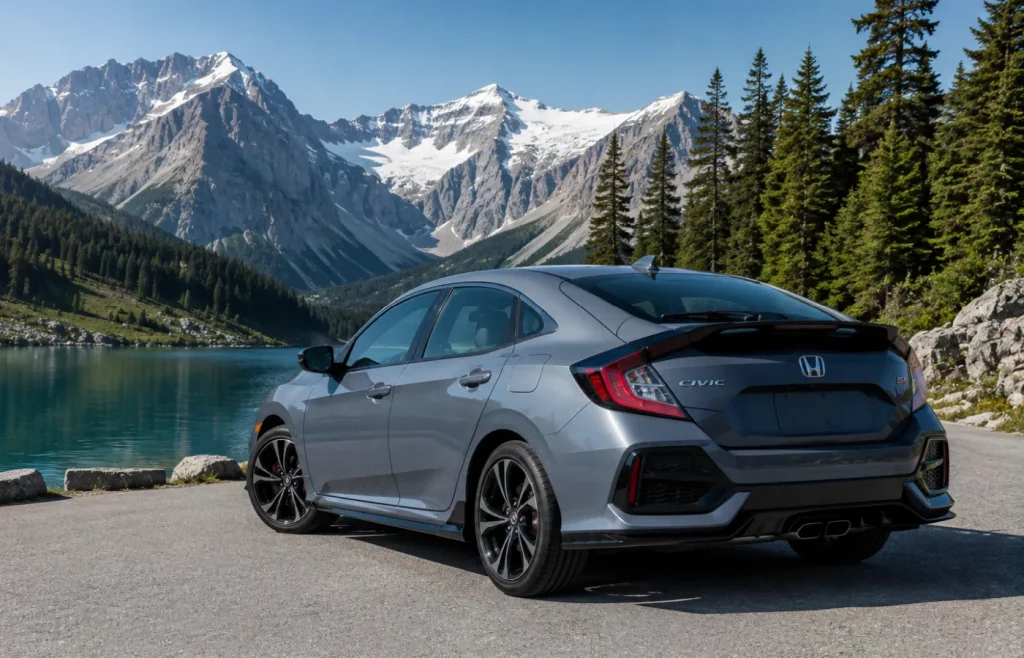
The Si comes from the factory with 205 horsepower, a limited-slip differential, and a chassis that was designed to handle more. The FK7 Hatchback Sport comes with 180 horsepower, an open differential, and a more practical body that just happens to share an engine with the Si. The price gap between them on the used market can be significant. And that gap is exactly what makes this comparison interesting.
This isn’t a debate about which car is better. It’s a debate about which car gives you more performance per dollar after you start modifying it — and whether the FK7’s lower entry price actually makes it the smarter tuner platform.
The Civic Si is the better performance platform out of the box — factory LSD, stronger rods, VTEC on the exhaust cam, and adaptive suspension. The FK7 Hatchback Sport is the better project car if you specifically want the hatchback body and are willing to invest in an LSD, clutch, and careful tuning to match the Si’s foundation. The Si is faster from the start; the FK7 may be cheaper to buy but more expensive to build.
The Real Question: Better Car or Better Starting Point?
This is the central question of the article. The Si is already a performance car from the factory. The FK7 is a practical hatchback that happens to share a turbocharged engine with a performance car. They are not the same thing, and they were not designed for the same purpose.
But the FK7 is cheaper. Sometimes significantly cheaper. And that price difference can buy a lot of modifications. The question is whether those modifications can turn the FK7 into something that matches or exceeds the Si’s performance — and AT what cost.
This is not a comparison of which car is better. It’s a comparison of what gives you more performance per dollar after modifications.
| Specification | Civic Si (FC1/FC3) | FK7 Sport Hatch |
|---|---|---|
| Engine | L15B7 (Si calibration) | L15B7 (standard calibration) |
| Factory horsepower | 205 hp | 180 hp |
| Factory torque | 192 lb-ft | 177 lb-ft |
| VTEC | Yes (exhaust cam) | No (VTC only) |
| Compression ratio | 10.3:1 | 10.6:1 |
| Transmission | 6-speed manual | 6-speed manual / CVT |
| LSD | Helical limited-slip | Open differential |
| Adaptive dampers | Yes (ADS) | No |
| Body style | Sedan / Coupe | Hatchback |
Starting Hardware: What Do You Get Before the First Mod?
The Si starts with better hardware. Honda gave the Si a specific calibration that includes 205 horsepower, 192 lb-ft of torque, and a helical limited-slip differential — features the FK7 does not get. The Si also receives adaptive dampers, a sport-tuned suspension, and a more aggressive final drive ratio.
The FK7 starts with a more pedestrian setup. The engine is tuned for efficiency rather than performance. The open differential is designed for daily driving, not corner exit traction. The suspension is standard Civic hardware, not the sport-tuned package from the Si.
The Si starts with the better hardware. The FK7 starts with the better body shape for hauling track wheels and tools.
Engine: Same 1.5T Doesn’t Mean Same Tuning Starting Point
This is where many people get confused. Both cars use the L15B7 engine family. But they use different versions of it.
The Si gets a specific calibration with 205 horsepower and 192 lb-ft of torque. The FK7 gets the standard 1.5T calibration with 180 horsepower and up to 177 lb-ft depending on the model year. The difference is not just in the tune — it’s in the hardware.
The Si has VTEC on the exhaust cam. The standard L15B7 in the FK7 does not. That means the Si can breathe better at high RPMs, which translates into more top-end power. The FK7 runs out of breath above 5,500 RPM, while the Si continues pulling to redline.
The Si also has a lower Compression Ratio (10.3:1 versus 10.6:1 in the FK7). Lower compression is generally more forgiving of increased boost pressure, making the Si a safer platform for aggressive tuning.
And then there’s the rod issue. Early FK7s (2016-2018) had thinner connecting rods than the Si. In tuning circles, these are sometimes referred to as the “soft rods” — they bend under high low-end torque. The Si’s rods are thicker from the factory and can handle more power before becoming a concern.
- VTEC on exhaust cam
- Lower compression ratio (10.3:1)
- Thicker connecting rods
- Higher factory boost target
- Better high-RPM breathing
- No exhaust VTEC
- Higher compression (10.6:1)
- Thinner rods (early models)
- Drops off after 5,500 RPM
- Lower factory boost
Stage 1: The First $600-$800
This is where the conversation usually starts. You buy a KTuner or Hondata, flash a base map, and see what happens. The results are different between the two cars.
The Si starts at 205 horsepower. After a conservative tune, you’re looking at roughly 220-230 wheel horsepower with minimal hardware changes. The car already has a good foundation, and the tune unlocks what Honda left on the table.
The FK7 starts at 180 horsepower. After a similar tune, you’re looking at roughly 200-210 wheel horsepower. The percentage gain is larger, but the absolute output is still below a tuned Si. The FK7 can catch up, but it needs to start from further behind.
The gap doesn’t disappear with a tune. It just shrinks.
The LSD Problem: Where the FK7 Build Gets Expensive
This is arguably the most important difference between the two cars. The Si comes with a helical limited-slip differential from the factory. The FK7 has an open differential.
What does that mean in practice? When you accelerate out of a corner, the open differential sends power to the wheel with less resistance. That means the inside wheel can spin freely while the outside wheel does the work. The result is wheelspin, understeer, and wasted power.
The LSD in the Si distributes torque between the front wheels to maximize grip. You can get on the power earlier in corners, and the car will pull itself through the apex. It’s one of the single most important performance features on the Si, and it’s not available on the FK7 from the factory.
You can add an aftermarket LSD to the FK7. Brands like MFactory, Quaife, and Wavetrac all make differentials that fit. But it’s not cheap. The LSD itself is around $1,200. Installation requires removing the transmission, which is another $800-1,000 in labor. If you’re doing a clutch at the same time, you can save on labor, but it’s still a significant expense.
By the time you’ve added an LSD to the FK7, you’ve spent roughly $2,000 that the Si buyer didn’t need to spend. That money could have gone toward more power, better tires, or track time.
Transmission: The Si Advantage Isn’t Just the LSD
The Si’s manual transmission is a different unit than the one in the FK7. It has shorter throws, more aggressive gearing, and a more performance-oriented feel. The clutch is also tuned for sportier engagement, though it has a reputation for slipping once you add significant power.
The FK7 manual transmission is the same unit found in other Civic 1.5T models. It’s a good transmission, but it’s not tuned for performance the way the Si’s is. The gearing is taller, the throws are longer, and the overall feel is more focused on daily driving than spirited back-road work.
The FK7 CVT is a different story entirely. If you’re considering a CVT FK7 for tuning, you need to understand the limitations. The CVT belt starts to slip at around 220 wheel torque. That’s a hard ceiling that you will hit quickly with even a conservative tune. The CVT is not designed for power — it’s designed for fuel economy and smoothness.
If you want to build a fast FK7, buy the manual. The CVT is a dead end for performance tuning.
| Aspect | Si (FC1/FC3) | FK7 Manual | FK7 CVT |
|---|---|---|---|
| Transmission type | 6-speed manual | 6-speed manual | CVT |
| LSD | Helical factory | Open | Open |
| Gearing | Performance-oriented | Standard | Standard |
| Shift throw | Short | Longer | N/A |
| Torque limit | ~250 wtq (stock clutch) | ~220 wtq | ~220 wtq (belt limit) |
The Hatchback Advantage Nobody Can Add Later
This is where the FK7 fights back. You can add a tune, an LSD, new suspension, and more power to the FK7. But you cannot turn a Civic Si sedan into a hatchback.
The FK7 body shape is one of its biggest selling points. The five-door hatchback design provides significantly more cargo space than the Si sedan or coupe. With the rear seats folded, you can fit track wheels, tires, tools, and everything else you need for a weekend at the track. The wide rear opening makes loading and unloading easy.
The Si’s trunk is fine for daily use, but it’s limited compared to the hatchback. You’re not fitting a set of track wheels and tires in the trunk of an Si sedan. You might not even fit a set of four tires in the coupe’s trunk. The FK7 swallows them without complaint.
For someone building a track car, this practicality matters. You can take the FK7 to the track with all your gear, drive it home, and do it all again the next weekend. The Si makes that same task significantly more difficult.
The $X Budget Build Battle
This is where the comparison gets interesting. Let’s look at two scenarios and see where the money goes.
Scenario A: $3,000 Modification Budget
Civic Si:
- Ktuner V2: $650
- Phearable Stage 1.5 tune: included
- PRL Cobra CAI: $400
- Intercooler: $500-700
- Better tires: $800
- Total: ~$2,600
FK7:
- KTuner V2: $650
- Phearable tune: included
- PRL Cobra CAI: $400
- Intercooler: $500-700
- Better tires: $800
- Total: ~$2,600
At $3,000, both cars are fairly evenly matched. The Si still has the LSD advantage. The FK7 is making similar power but struggling to put it down on corner exit.
Scenario B: $6,000 Modification Budget
Civic Si:
- KTuner V2: $650
- Phearable tune: included
- PRL Cobra CAI: $400
- Intercooler: $600
- Downpipe: $500
- Clutch upgrade: $1,200
- Better tires: $800
- Suspension: $1,000
- Total: ~$5,150
FK7:
- KTuner V2: $650
- Phearable tune: included
- PRL Cobra CAI: $400
- Intercooler: $600
- Downpipe: $500
- Clutch upgrade: $1,200
- LSD + install: $2,000
- Better tires: $800
- Total: ~$6,150
At $6,000, the FK7 has spent more money and still hasn’t matched the Si’s chassis and suspension advantages. The Si is now making more power and still has the LSD advantage — plus a better chassis and suspension setup from the factory.
The FK7 stops being the cheaper platform somewhere around the $4,000-$5,000 mark. Below that, it can compete. Above that, the Si pulls ahead.
Power Isn’t the Whole Build
Different builds have different priorities. Here’s how the two cars compare across different goals.
Street Pull Build
For highway pulls and straight-line performance, the FK7 can be a compelling choice. The hatchback body doesn’t hurt aerodynamics at speed, and the lower entry price means more money for power mods. Once you add an LSD and tune, the FK7 can keep up with or exceed a similarly modified Si on the highway.
Canyon Car
The Si wins here, and it’s not close. The LSD, adaptive suspension, and sport-tuned chassis make the Si feel alive on twisty roads. The FK7 can be improved with suspension and an LSD, but it takes more money and work to get there.
Autocross
The Si starts with a better chassis and drivetrain. The LSD alone is worth seconds on an autocross course. The FK7 can be competitive, but it needs more work to reach the same level.
Daily + Project
The FK7 wins on practicality. You can daily drive the hatchback, haul track wheels, and still work on it in your garage. The Si is more focused but less flexible.
Which Car Is More Forgiving of a Bad Build?
This is a question that doesn’t get asked enough. If you make mistakes with your build, which car is more likely to survive?
The Si is more forgiving. The stronger rods, lower compression, and better factory calibration give you more headroom. The LSD helps manage traction. The chassis is designed to handle more power.
The FK7 is less forgiving. The thinner rods (on early cars), higher compression, and open differential mean you have less margin for error. A bad tune on an FK7 is more likely to result in a bent rod than a bad tune on an Si.
A bad tune is more dangerous than choosing the “wrong” chassis. But the Si gives you more room to work with.
The Used Market Equation
This is where the FK7 can make its case. On the used market, FK7s are often cheaper than Si models, sometimes by several thousand dollars. That price difference can make the FK7 more appealing to buyers with a limited budget.
But you need to look at the total cost, not just the purchase price. A cheaper FK7 that needs an LSD, clutch, and tune may end up costing more than an Si that already has those features from the factory.
Formula:
FK7 Total Cost = Purchase price + tune + supporting mods + LSD + install
Si Total Cost = Purchase price + tune + supporting mods
If the purchase-price gap is large enough, the FK7 can still be the better value. But that gap needs to be at least $2,000-$3,000 to account for the LSD and other upgrades.
Best Mods for Each Platform
The best modifications for each car are different because their starting points are different.
Best First Mods for Si:
- ECU tune (KTuner or Hondata)
- Intercooler upgrade (heat soak is real)
- Tires (the stock all-seasons are mediocre)
- Clutch planning (the stock clutch will slip with more power)
- Intake/exhaust based on power goals
Best First Mods for FK7 Manual:
- ECU tune (KTuner or Hondata)
- Tires (traction helps with the open diff)
- Intercooler upgrade
- Traction solution (LSD planning or rear Sway Bar)
- Clutch planning
The FK7 needs to address the LSD gap earlier in its build. The Si can focus on power and tires first.
Three Buyers, Two Winners
Buyer #1: The Cheapest Path to a Fast Civic
Winner: Depends on purchase price. If the FK7 is $3,000+ cheaper, it can be the better value. If the gap is smaller, the Si is the smarter buy.
Buyer #2: The Best Factory Foundation
Winner: Civic Si. The factory LSD, stronger rods, VTEC, and adaptive suspension make it the better starting point for almost any build.
Buyer #3: The One-Car Garage
Winner: FK7 Hatchback. The practical body, performance potential, and ability to serve as both a daily and a project make it the more versatile choice.
Verdict: Which Platform Wins?
The conclusion should be nuanced. Here’s how it breaks down.
| Category | Winner |
|---|---|
| Factory performance | Si |
| Engine foundation | Si |
| Transmission | Si |
| LSD | Si |
| Chassis hardware | Si |
| Practicality | FK7 |
| Cargo space | FK7 |
| Entry price | FK7 |
| Modification headroom | Si |
| Project versatility | FK7 |
Final Thought
The Si is the better performance platform. The FK7 may be the better project.
Buy the Civic Si if you want to spend money making the car faster — not fixing the parts Honda didn’t give you. Buy the FK7 if you specifically want the hatchback body and are willing to build the drivetrain around your power goal.
The Si is faster from the start. The FK7 can be built to match it. But the cost to close that gap is real, and it’s not trivial. If you start with an FK7, you’re starting further behind — but you’re also starting with a more practical car and potentially a lower entry price.
There is no universally correct answer. The right choice depends on your budget, your goals, and whether you value the Si’s factory performance advantages or the FK7’s practical hatchback body.
FAQ — Civic Si vs FK7 Hatchback Sport
Is the FK7 engine the same as the Si engine?
No. The Si has VTEC on the exhaust cam, lower compression (10.3:1 vs 10.6:1), thicker connecting rods, and a different factory calibration. The FK7 has the standard 1.5T calibration without exhaust VTEC and with thinner rods in early models (2016-2018).
Does the FK7 have a limited-slip differential?
No. The FK7 Sport Hatch has an open differential from the factory. The Si is the only non-Type R 10th-gen Civic with a factory helical limited-slip differential. You can add an aftermarket LSD to the FK7, but it costs roughly $2,000 with installation.
Which car is better for tuning?
The Si is better for tuning. It has stronger internals, a factory LSD, and VTEC on the exhaust cam. The FK7 can be tuned to similar levels, but it requires more upgrades (LSD, clutch, careful tuning) to reach the same performance.
Does the FK7 have adaptive suspension?
No. The FK7 has standard passive suspension. The Si has Adaptive Damper System (ADS) that adjusts stiffness based on drive mode. The FK7’s simpler suspension is easier to modify with aftermarket coilovers.
Can you tune a CVT FK7?
Yes, but with limitations. The CVT belt starts to slip at around 220 wheel torque, which you will hit quickly with a tune. The CVT is not designed for performance builds — it’s designed for fuel economy. If you want to build a fast FK7, buy the manual.
Is the FK7 cheaper than the Si?
Typically, yes. The FK7 Sport Hatch is often several thousand dollars cheaper on the used market than an Si of the same year and condition. That price difference can be used for modifications, but the FK7 needs more upgrades to match the Si’s factory performance.
Which car has more cargo space?
The FK7 hatchback has significantly more cargo space than the Si sedan or coupe. The wide rear opening and folding rear seats make it much more practical for hauling track wheels, tools, and gear. The Si’s trunk is limited by comparison.
Is the FK7 a good track car?
Yes, but it needs work. The open differential is a major limitation on corner exit. Adding an LSD transforms the car on track. With the LSD and appropriate suspension modifications, the FK7 can be a capable track car — but it will never match the Si’s factory chassis tuning without significant investment.
Which car should I buy for a street build?
If you want straight-line performance and don’t care about cornering, the FK7 can be a good value. If you want a balanced performance car that handles well in corners, the Si is the better choice. The LSD alone is worth the premium for anyone who drives on twisty roads.
Should I buy an FK7 instead of an Si?
Buy the Si if you want the best performance platform out of the box. Buy the FK7 if you specifically want the hatchback body, are willing to invest in an LSD and other upgrades, and understand that the total cost to match the Si’s performance will be higher than the purchase-price difference.