

Walk into any Honda dealership or scroll through the used listings, and you’ll find yourself staring at a dilemma that has split the Civic community in half. On one side sits the Civic Si — a sedan-only Sport Compact with 200 horsepower, a limited-slip differential, and a six-speed manual transmission that enthusiasts swear by. On the other sits the Civic Sport Hatchback with the same six-speed manual — a more practical body, a naturally aspirated 2.0-liter engine, and a price tag that can be thousands of dollars lower.
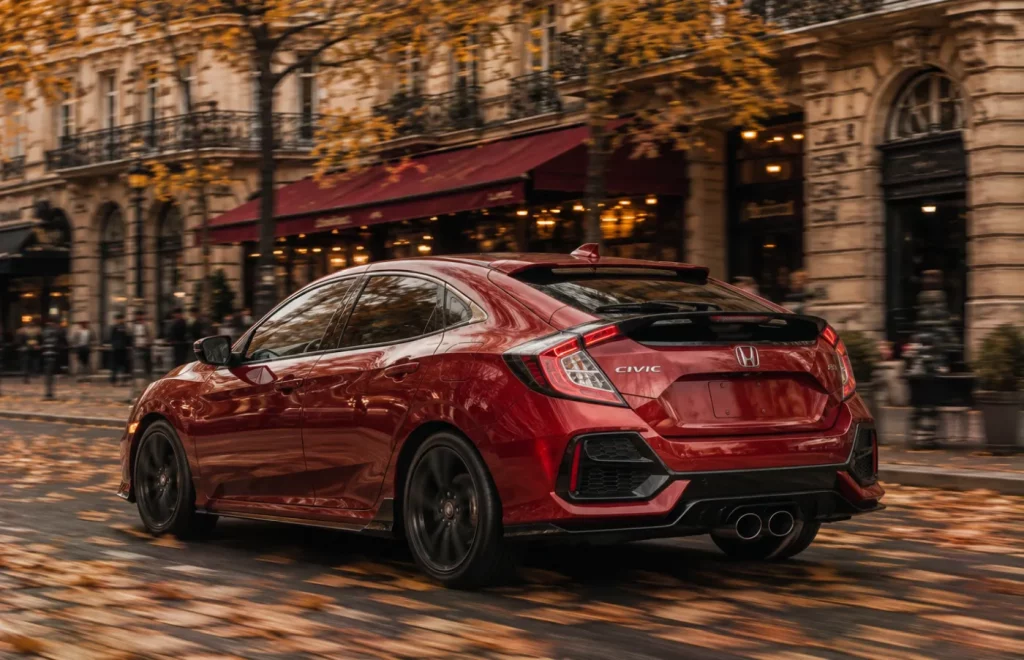
Both cars give you three pedals. Both cars give you Honda’s legendary manual transmission feel. Both cars are 11th-generation Civics. But the difference between them is much larger than the spec sheet suggests — and much smaller than the price gap might imply.
This isn’t a comparison about which car is objectively better. It’s a comparison about what you actually get for the extra money — and whether the Si‘s performance hardware is worth the premium for the way you actually drive.
The Civic Si delivers significantly more power (200 hp vs 158 hp), a limited-slip differential, Sport-tuned suspension, larger brakes, a 9-inch touchscreen, and a 12-speaker Bose audio system. The Sport Hatchback 6MT offers a more practical hatchback body, a simpler naturally aspirated engine, and a lower price. The Si is the better performance car; the Sport Hatchback is the better everyday car. Choose based on whether you value driving engagement or practicality.
The Dilemma: Two Manuals, Two Very Different Cars
When the 11th-generation Civic launched, Honda did something that pleased purists and confused buyers in equal measure. They offered the Civic Si as a sedan-only model with a six-speed manual transmission and a 200-horsepower turbocharged engine. AT the same time, they offered the Civic Sport Hatchback with a six-speed manual transmission — but with a 158-horsepower naturally aspirated 2.0-liter engine.
The result is a lineup where you can get a manual transmission in two very different cars, with a price gap of roughly $2,500–$3,500 between them. But the price gap doesn’t tell the whole story. The Si’s premium buys you more than just extra horsepower — it buys you a completely different driving experience.
As one owner on the Civic11Forum put it: “Every time I get in the Si, I will be having that little bit of extra fun. Even if I’m just commuting to work or driving to the grocery store, every turn, every acceleration, will just be that much more interesting”.
| Specification | Civic Sport Hatchback 6MT | Civic Si (FE1) |
|---|---|---|
| Engine | 2.0L naturally aspirated I4 | 1.5L turbocharged I4 |
| Horsepower | 158 hp | 200 hp |
| Torque | 138 lb-ft | 192 lb-ft |
| Transmission | 6-speed manual | 6-speed manual w/ rev-match |
| LSD | Open differential | Helical limited-slip |
| Suspension | Standard | Sport-tuned, stiffer |
| Brakes | Standard | Larger front and rear rotors |
| Touchscreen | 7-inch | 9-inch |
| Audio | 8-speaker standard | 12-speaker Bose premium |
| Body style | Hatchback | Sedan only |
| Starting MSRP (2022) | ~$25,565 | ~$28,315 |
Where the Money Actually Goes — Under the Hood
The most obvious difference between these two cars is what’s under the Hood. But it’s not just about horsepower numbers.
Si: The 1.5L Turbocharged L15CA
The Civic Si uses a 1.5-liter turbocharged four-cylinder producing 200 horsepower and 192 lb-ft of torque. The engine features VTEC on the exhaust cam, which allows it to breathe better at high RPMs. It also gets a lightweight single-mass flywheel from the Type R, which makes the engine rev more quickly and respond more aggressively to throttle inputs.
Sport Hatchback: The 2.0L Naturally Aspirated K20C2
The Sport Hatchback 6MT uses a 2.0-liter naturally aspirated four-cylinder producing 158 horsepower and 138 lb-ft of torque. It’s a port-injected engine with no Turbocharger, no direct-injection carbon buildup issues, and a reputation for bulletproof reliability. But it’s also significantly less powerful than the Si’s engine.
The key difference isn’t just the 42 horsepower and 54 lb-ft of torque. It’s the character of the power delivery. The Si’s turbo engine delivers its torque low in the rev range — peak torque arrives at just 1,800 rpm and holds through 5,000 rpm. The Sport Hatchback’s naturally aspirated engine builds power more linearly and needs to be revved to access its modest output.
The Transmission: Same Pedal Count, Different Experience
Both cars have a six-speed manual transmission. But they’re not the same transmission.
The Si’s manual comes with rev-match control — a feature that automatically blips the throttle on downshifts, making the car smoother and more satisfying to drive. The Sport Hatchback’s manual lacks this feature. The Si also gets a shorter final drive ratio (4.35:1 versus 4.10:1 in the Sport Hatchback), which gives it more aggressive acceleration.
Owners who have driven both cars report that the shifters feel very similar. As one forum member noted: “I can’t tell any major differences between the two shifters. Both feel great, very smooth most of the time, and they slide right into gear almost every shift”.
However, the Si’s shifter is often described as more notchy and precise. The Si also benefits from a shorter throw and a more substantial shift knob.
The LSD: The Feature You Don’t Notice Until You Push
This is arguably the most important difference between the two cars — and the one that’s hardest to appreciate on a test drive.
The Civic Si comes with a helical limited-slip differential from the factory. The Sport Hatchback has an open differential.
What does that mean in practice? When you accelerate out of a corner, the open differential in the Sport Hatchback sends power to the wheel with less resistance — which means the inside wheel can spin while the outside wheel does the work. The result is wheelspin, understeer, and wasted power.
The LSD in the Si distributes torque between the front wheels to maximize grip. You can get on the power earlier in corners, and the car will pull itself through the apex. As one owner put it: “The limited-slip differential in the Si is the biggest reason for me to pick the Si over the Sport Touring Hatch. It really does make that much of a difference in the curves”.
The LSD is a feature you don’t notice until you push the car hard. But once you do, you’ll never want to go back. It’s the single most important performance feature that separates the Si from the Sport Hatchback, and you cannot add it to the Sport cheaply.
Chassis and Suspension: The Si Is Tighter, the Sport Is More Comfortable
The Si’s suspension is significantly sportier than the Sport Hatchback’s. The springs are 8% stiffer, the anti-roll bars are thicker, and the overall chassis tuning is more aggressive. The brakes are larger on both the front and rear, and the steering is quicker.
The Sport Hatchback’s suspension is tuned for comfort. It’s softer, more forgiving, and better suited to daily driving on rough roads. The car rolls more in corners, but it also absorbs bumps more effectively.
Which one is better? That depends on what you value. The Si is the better canyon carver. The Sport Hatchback is the better commuter.
- Softer suspension
- More forgiving ride
- Better for daily commuting
- No rev-match
- Open differential
- Stiffer sport suspension
- 8% stiffer springs
- Rev-match downshifts
- Helical LSD
- Larger brakes
Interior and Technology: The Si Is More Premium
This is where the Si’s price premium becomes visible. The Si comes with a 9-inch touchscreen, wireless Apple CarPlay and Android Auto, a 12-speaker Bose premium audio system, sport seats with aggressive bolsters, and a more driver-focused cockpit.
The Sport Hatchback has a 7-inch touchscreen, wired Apple CarPlay, an 8-speaker audio system, and standard cloth seats. The interior is functional and pleasant, but it lacks the Si’s premium feel.
The Si’s Bose system alone is a significant upgrade. The Sport’s audio is fine, but the Si’s system transforms the cabin experience. The sport seats hold you in place during cornering, and the larger screen makes the infotainment system more usable.
You’re paying for the interior, not just the engine.
What the Sport Hatchback Does Better
The Sport Hatchback has one massive advantage over the Si: the hatchback body.
The hatchback provides significantly more cargo space than the Si’s sedan trunk. The wide rear opening makes loading and unloading easy. With the rear seats folded, you can fit bikes, furniture, track wheels, or whatever else you need to carry.
Road & Track called the Civic Sport Hatchback with the manual transmission “the best darn thing since honey roasted peanuts” — praising its wholesome goodness and practical nature.
The Sport Hatchback is also the more affordable car. The price gap between the Sport Hatchback 6MT and the Si is approximately $2,500–$3,500, depending on the market and availability.
If you need to carry cargo regularly, the Sport Hatchback is the obvious choice. The Si’s sedan trunk is adequate for daily use, but it’s significantly less practical than the hatchback.
Fuel Economy: The Sport Hatchback Isn’t the Loser
One common assumption is that the turbocharged Si is less efficient than the naturally aspirated Sport Hatchback. The reality is more nuanced.
The Si gets 27 mpg city and 37 mpg highway. The Sport Hatchback 6MT gets approximately 30 mpg city and 37 mpg highway. The difference in highway fuel economy is negligible.
In mixed driving, the Si’s turbo engine is surprisingly efficient, and the Sport Hatchback’s 2.0-liter naturally aspirated engine — while reliable — doesn’t offer a massive fuel economy advantage.
You don’t necessarily buy the Si for better efficiency. You buy it for the performance envelope.
The Used Market Question: How the Price Gap Changes
This is where the comparison gets interesting for buyers who aren’t looking at new cars. On the used market, the price gap between the Si and the Sport Hatchback 6MT can vary significantly based on mileage, condition, and location.
If the gap is small — say, less than $2,000 — the Si is a no-brainer. You’re getting significantly more performance and equipment for a modest premium.
If the gap is $4,000 or more, the Sport Hatchback becomes compelling. You’re saving real money, and you’re getting a more practical car with a manual transmission and Honda’s legendary reliability.
Who Should Buy the Sport Hatchback 6MT?
Buy the Sport Hatchback 6MT if:
- You need the practicality of a hatchback
- You value cargo space and versatility
- You prefer the simplicity of a naturally aspirated engine
- You don’t need the Si’s performance hardware
- You want the cheapest possible entry into an 11th-gen manual Civic
- You’re planning a lightweight OEM+ build
Who Should Buy the Civic Si?
Buy the Civic Si if:
- Acceleration matters to you
- You want the limited-slip differential
- You drive aggressively on twisty roads
- You want a factory performance package
- You don’t want to build your own suspension, brake, and chassis package
- The price gap is small
The Final Question: Is the Si Worth the Extra Money?
If you’re buying with your head, choose the Sport Hatchback 6MT. If you’re buying with your right foot, choose the Si. If you want both, the Si is the better performance bargain — but the Sport Hatchback is the better all-round package.
The Sport Hatchback 6MT gives you the manual transmission experience, the practical hatchback body, and Honda’s bulletproof naturally aspirated engine. The Si gives you the performance experience — the turbo torque, the LSD, the sport suspension, the rev-match, the premium audio, and the satisfaction of owning a genuine Si.
As Road & Track concluded: “The Sport Touring can be amusing at hero velocities, but it’s not the funky monkey the Si is”.
Is the Si worth the extra money? If you want the best possible driving experience, yes. If you want the most practical car for your money, the Sport Hatchback 6MT is the smarter choice.
FAQ — 11th Gen Civic Si vs Sport Hatchback 6MT
Does the Civic Sport Hatchback have a manual transmission?
Yes — the 11th-gen Civic Sport Hatchback was available with a six-speed manual transmission from 2022 through 2024. For the 2025 model year, Honda discontinued the manual transmission in the standard Civic Hatchback, leaving the Si as the only manual option in the 11th-gen Civic lineup.
How much more power does the Si have than the Sport Hatchback?
The Si has 200 horsepower and 192 lb-ft of torque, compared to 158 horsepower and 138 lb-ft in the Sport Hatchback. The difference is 42 horsepower and 54 lb-ft of torque — a significant gap that is noticeable in everyday driving.
Does the Sport Hatchback have a limited-slip differential?
No — the Sport Hatchback has an open differential. The limited-slip differential is exclusive to the Si and Type R models. This is one of the most significant performance differences between the two cars.
Is the Si available as a hatchback?
No — the 11th-gen Civic Si is sedan-only. Honda did not offer the Si as a hatchback in this generation. If you want a hatchback and a manual transmission, the Sport Hatchback 6MT is your only option.
Which Civic is better for daily driving?
The Sport Hatchback is better for daily driving. It has a softer suspension, more cargo space, and a more forgiving character. The Si is more engaging but firmer and less practical.
Does the Sport Hatchback have rev-match?
No — the rev-match system is exclusive to the Si. The Sport Hatchback’s manual transmission lacks this feature, though it still offers a smooth and satisfying shifting experience.
Is the Si worth the extra money?
For enthusiasts who value performance, yes. The Si offers significantly more power, better handling, a limited-slip differential, and a more premium interior. For buyers who prioritize practicality and value, the Sport Hatchback 6MT is the smarter choice.
Which Civic holds its value better?
The Civic Si typically holds its value better than the Sport Hatchback. The Si badge, manual transmission, and enthusiast demand all contribute to stronger resale value.
Can you tune the Sport Hatchback 6MT?
Yes — but the naturally aspirated 2.0-liter engine has limited tuning potential. The Si’s turbocharged engine responds much better to modifications. The Sport Hatchback’s open differential is also a limitation for performance builds.
Which Civic should I buy?
Buy the Si if you want the best performance, handling, and interior. Buy the Sport Hatchback 6MT if you need the practicality of a hatchback and want a manual transmission at a lower price. Both are excellent cars — they just serve different needs.