

My 2009 Civic EX has an R18A1 under the hood, and for most of its life it did exactly what an R18 is supposed to do: start every morning, sip fuel, and ask for nothing but oil changes. Then, somewhere past the 130,000-mile mark, the dipstick stopped lying. The oil level was dropping between changes, and it kept dropping. This is what I found, what I checked, what I actually did, and what I would do differently next time.
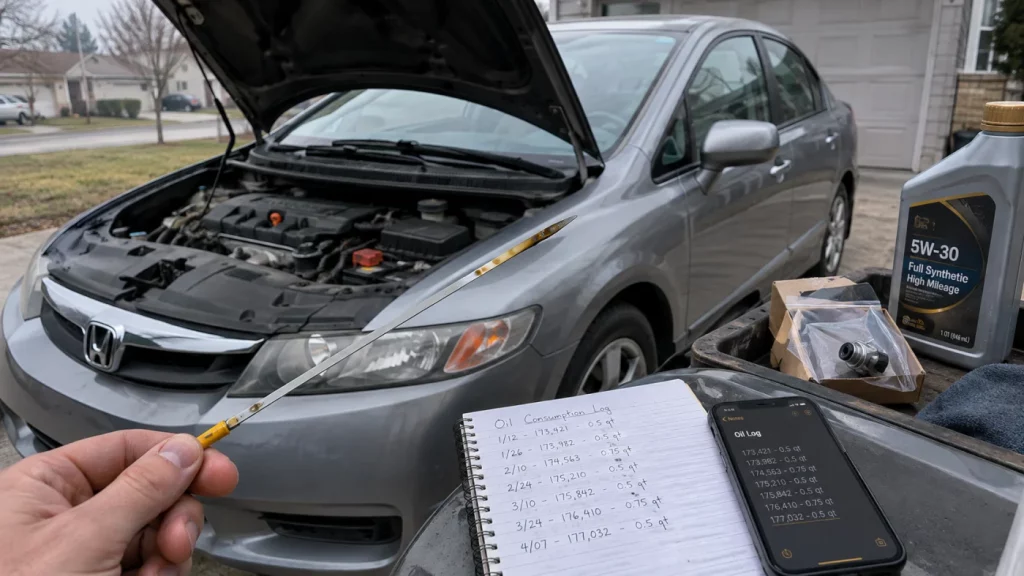
This is not a general article about R18 oil consumption. It is one car, one engine, one owner, and a real diagnostic trail. If you are chasing the same problem, the value here is not the conclusion — it is the process.
Oil consumption on a high-mileage R18A1 is usually caused by one of three things: a clogged PCV valve, sticking oil control rings, or worn valve stem seals. The cheapest and most overlooked fix is the PCV valve. The most effective short-term mitigation is stepping up from 0W-20 to a 5W-30 high-mileage oil. The permanent fix is pulling the engine and replacing the rings — which is often not worth it on a car of this age. On my own 2009 Civic EX, the PCV valve was clogged and the rings were clearly tired, but a new PCV and a switch to 5W-30 cut consumption from 1 quart every 1,200 miles to roughly 1 quart every 2,500 miles. I never rebuilt the engine. I monitored it, topped it off, and kept driving.
1. The Dipstick Doesn’t Lie
My car is a 2009 Civic EX with the R18A1. I bought it in 2014 with 62,000 miles on the odometer. For the first several years of my ownership, I ran 0W-20 synthetic and changed it every 5,000 miles. The car was driven mostly mixed city and highway, with a commute of roughly 35 miles a day.
The first sign was not smoke. It was not a leak on the driveway. It was the dipstick, checked AT 1,000-mile intervals on a flat surface, engine off, after waiting a few minutes for the oil to drain back into the pan.
At first the level was fine. Then it started reading slightly below the top mark at the end of a change interval. Then it started reading at the low mark. Then I had to add oil between changes, which I had never done before.
The first hard number I wrote down was:
1 quart per 1,200 miles
That number is the entire story. It is the difference between “my car uses a little oil” and “my car has a problem I need to understand.” If you only take one thing from this article, take that: measure it, write it down, and calculate the rate.
| Interval | Mileage at Check | Oil Added | Rate |
|---|---|---|---|
| 1 | 131,400 | 0.5 qt | ~1 qt / 1,300 mi |
| 2 | 132,600 | 1.0 qt | ~1 qt / 1,200 mi |
| 3 | 133,800 | 1.0 qt | ~1 qt / 1,200 mi |
| 4 | 135,000 | 1.0 qt | ~1 qt / 1,200 mi |
Pro tip: Check the oil the same way every time. Same surface, same engine temperature, same wait time after shutdown. If you change the method, you change the reading, and the log becomes useless. I wrote date, mileage, and amount added in a notes APP on my phone. A photo of the dipstick at each check is even better evidence.
2. Ruling Out the Obvious First
Before I touched anything, I did the basic external checks. This is where most people skip ahead and start replacing parts. Do not do that.
External leaks. I checked under the car after it sat overnight. I looked at the Valve Cover gasket, the oil pan gasket, the VTEC solenoid gasket, the oil filter, and the drain plug. The underside was dry. No fresh drips, no old stains, no smell of hot oil on the exhaust. The leak was not external.
Exhaust smoke. I had someone rev the engine while I stood behind the car. There was a short puff of blue smoke on cold start, then nothing once warm. Blue smoke on cold start points to valve stem seals. Blue smoke under load points to rings. Mine was the cold-start kind — but it was faint, and it did not explain the full consumption rate.
Spark plugs. I pulled all four plugs and read them. They were uniformly light tan with dark, oily deposits around the threads on cylinders 1 and 4. Not fouled, but not clean either. That pointed to oil getting into the combustion chamber without a single dead cylinder.
Oil condition. I looked at the oil on the dipstick for Coolant contamination, fuel dilution, or sludge. It was dark but not milky, not thin, and not gritty. No coolant smell. The oil itself was not the problem.
This stage does not give you a diagnosis. It tells you where to look next. That is the whole point.
3. The Diagnostics: Compression, Leakdown, and PCV
This is the part that separates a real diagnosis from a guess. I ran three tests, in this order.
PCV Valve Check
The PCV valve on the R18A1 sits at the left rear of the valve cover, behind the oil fill cap, connected to a thin rubber hose. I pulled it, shook it, and listened. A healthy PCV valve rattles with a distinct click. Mine made no sound at all — it was gummed up and stuck.
A clogged PCV valve raises crankcase pressure. That pressure pushes oil vapor into the intake, through the seals, and past the rings. It is the cheapest possible cause of oil consumption, and it is the first thing to rule out.
Compression Test
I pulled all four plugs, disabled fuel and ignition, and cranked the engine with a compression gauge threaded into each cylinder. I recorded the numbers cylinder by cylinder.
Dry compression, all four cylinders: 178, 180, 176, 179 psi. The factory spec for the R18A1 is around 178 psi with a minimum of about 135 psi, and the maximum allowable difference between cylinders is roughly 28 psi. My spread was 4 psi. That is excellent — the valves and Head Gasket were sealing properly.
Leakdown Test
Compression tells you there is a sealing problem. Leakdown tells you where it is. I brought each cylinder to top dead center on the compression stroke, applied compressed air through the spark plug hole, and listened.
Results: 12% on cylinder 1, 10% on cylinder 2, 16% on cylinder 3, 14% on cylinder 4. On a fresh engine you would expect under 5%. Anything over 10% on a high-mileage engine is worth noting, and anything over 20% is a real problem. Mine were all in the 10–16% range — worn, but not catastrophic.
More importantly, the air escaping was audible from the oil fill cap on every cylinder. Not from the intake, not from the exhaust, not from the radiator. That meant the leakage was past the rings, not past the valves or the head Gasket.
| Check | Result | What It Confirms or Rules Out |
|---|---|---|
| External leaks | None found | Rules out gaskets, seals, drain plug, filter |
| Exhaust smoke | Faint blue puff on cold start only | Suggests mild valve stem seal wear, not the main cause |
| Spark plugs | Light tan with oily deposits on cyl. 1 and 4 | Confirms oil entering combustion chamber |
| PCV valve | No rattle — stuck | Confirms crankcase pressure problem |
| Compression test | 178 / 180 / 176 / 179 psi | Rules out valve and head gasket failure |
| Leakdown test | 12% / 10% / 16% / 14%, air from oil fill cap | Confirms ring leakage, not valve leakage |
Pro tip: Normal compression and leakdown numbers do not prove your oil control rings are fine. A cylinder can seal well enough for compression and still have lazy oil rings that fail to scrape oil off the cylinder walls. This is the most common trap on the R18. If your numbers are good but the oil is still disappearing, the rings are still a suspect.
4. What I Actually Found
Here is where I separate what I observed from what I concluded. This distinction matters. Do not let anyone, including me, tell you that compression numbers alone prove a diagnosis.
What I observed:
- The PCV valve did not rattle when shaken. It was stuck.
- Compression was 178 / 180 / 176 / 179 psi — all within spec, spread of only 4 psi.
- Leakdown was 12% / 10% / 16% / 14%, with air escaping from the oil fill cap on every cylinder.
- The intake tube had a light film of oil inside it, consistent with PCV blow-by.
- There was a faint blue puff on cold start, which suggested mild Valve Stem Seal wear.
What I concluded:
- The PCV valve was a major contributor. A stuck PCV raises crankcase pressure and pushes oil vapor where it should not go.
- The most likely remaining cause was sticking or worn oil control rings. This is a known trait of the R18 as it ages. The low-tension rings that help fuel economy are also the rings that gum up first.
- The valve stem seals were probably mildly worn, but they were not the main cause. The blue puff was brief and did not account for a quart every 1,200 miles.
What I could not prove without pulling the engine: whether the rings were stuck, worn, or both. That distinction requires disassembly. Everything else is inference.
5. What I Did, Step by Step
I did not rebuild the engine. I worked through the cheap fixes first and measured the result of each one. Here is the sequence.
Step 1 — PCV Valve Replacement
I replaced the PCV valve with an OEM part. Cost: $28. Time: about 15 minutes. Reason: it is the cheapest possible cause and it is easy to rule out.
Result: consumption dropped from roughly 1 quart per 1,200 miles to roughly 1 quart per 1,800 miles. It helped, but it did not solve the problem. That told me the PCV was part of the story, not the whole story.
Step 2 — Oil Change and Viscosity Change
I was running 0W-20, the factory recommendation for the 2009 Civic. I switched to a 5W-30 high-mileage full synthetic.
Why: a thicker oil at operating temperature is less likely to slip past worn or lazy rings, and it burns off more slowly. This is a personal decision, not a manufacturer recommendation. Honda specifies 0W-20 for this engine. If you make this change, do it knowingly, and monitor the result.
Result: consumption dropped again, from roughly 1 quart per 1,800 miles to roughly 1 quart per 2,500 miles. That was the biggest single improvement.
Step 3 — Monitoring, Not Fixing
After the PCV and the oil change, I went back to checking the level every 1,000 miles and logging it. I did not add any engine flush, any seal conditioner, or any rebuild-in-a-bottle product. I wanted to know what the two simple changes actually did, without noise from other variables.
Result after 10,000 miles: consumption held steady at roughly 1 quart per 2,500 miles. It did not get worse. It did not get better. It stabilized.
Step 4 — What I Decided Not to Do
I did not pull the head. I did not replace the rings. I did not swap in a short block. The math did not work: at 145,000 miles, a ring job quoted at $3,800 was more than the car was worth to me, and the consumption was stable enough to live with.
If consumption had been worse — say, 1 quart per 500 miles — I would have gone the other way. That is the honest version of this story.
6. What Actually Helped, Honestly
This is the part most articles skip. Here is the unvarnished result.
- PCV valve: Helped. Consumption went from 1 qt / 1,200 mi to 1 qt / 1,800 mi. Cost $28 and 15 minutes.
- 5W-30 high-mileage oil: Helped more. Consumption went from 1 qt / 1,800 mi to 1 qt / 2,500 mi. Cost the same as a normal oil change.
- Combined: Consumption dropped from 1 qt / 1,200 mi to 1 qt / 2,500 mi — roughly a 50% reduction.
- What did not help: Nothing wasted money in my case, because I only did the two cheap things. I did not try a flush or an additive, so I cannot speak to those.
- What I did not try: Ring job at $3,800, short block at $2,400 plus labor, or a used engine at $1,200 plus install. None of them made financial sense on a 145,000-mile car worth about $4,000.
The honest answer is: it is still burning oil, and I just top it off. That is more useful to a reader than a fake happy ending.
Important: Do not run a thicker oil, an engine flush, or any additive and then assume the problem is solved. Measure the consumption rate before and after, over at least 3,000 miles, with the same driving conditions. Anything else is guessing.
7. What It Cost Me
Year one of dealing with this, in real numbers:
| Item | Cost |
|---|---|
| PCV valve (OEM) | $28 |
| Oil changes and top-offs over 12 months (about 4 extra quarts) | $45 |
| Compression gauge and leakdown tester (DIY tools, kept) | $70 |
| Anything else (flush, additives, etc.) | $0 |
| Total | $143 |
Compare that to a ring job at $3,800 or a short block at $2,400 plus labor. For me, the math favored monitoring. For you, it might not.
8. What I Would Do Differently
- I would have started the consumption log earlier, before the level got low enough to notice by accident.
- I would have checked the PCV valve at the first sign of consumption, not after a second oil change.
- I would have done the leakdown test sooner. Compression alone gave me a false sense of “the engine is fine.”
- I would not have waited to switch to a 5W-30 high-mileage oil, once I understood the consumption rate.
- I would not have assumed the problem was terminal. A burning R18 is not a dead R18.
9. Buyer’s Checklist: 8th-Gen Civic with the R18
If you are looking at a used 8th-gen Civic and you want to know whether it burns oil, here is what to check before you hand over money.
Ask for the oil log
If the seller has kept track of how much oil the car uses between changes, that is gold. If they have not, assume the worst and check it yourself.
Check the dipstick cold
Look at the level and the color. Low, dark, or gritty oil tells you the car has not been maintained well.
Look at the exhaust on cold start
A blue puff on startup suggests valve stem seals. Blue smoke under load suggests rings. Either one means oil is getting into the combustion chamber.
Pull a spark plug
Oily deposits on the plugs mean oil is entering the cylinder. Uniform light tan is what you want to see.
Shake the PCV valve
It should rattle. If it does not, it is clogged, and it is a cheap fix — but it also tells you the car has not been maintained.
Ask about the porous block recall
Some 2006–2009 R18 engines had porous block issues covered by an extended warranty. Check the VIN with a dealer before you buy.
FAQ — 2009 Civic EX and R18 Oil Consumption
Does the 2009 Honda Civic burn oil?
Some do, especially past 120,000 miles. The R18A1 is not known for catastrophic oil consumption like some engines, but it is common for higher-mileage examples to use oil between changes. A rate of 1 quart per 1,000–1,500 miles is on the high side but not unusual for a car at that age.
How much oil consumption is normal for an R18?
Honda’s own guidance considers up to 1 quart per 1,000 miles within acceptable limits for many engines, but that is a generous threshold. In practice, most healthy R18s use very little oil. If you are adding a quart every 1,200 miles, something is wearing — usually the PCV valve, the rings, or the valve stem seals.
Is PCV valve replacement worth it?
Yes. It is one of the cheapest parts on the engine, it takes about 15 minutes to replace, and a stuck PCV valve can contribute to oil consumption by raising crankcase pressure. On my car, a new PCV valve cut consumption by about 30% on its own.
Can I run 5W-30 in an R18?
Honda specifies 0W-20 for the 2009 Civic. Switching to 5W-30 is a personal decision, not a manufacturer recommendation. Many high-mileage owners do it to reduce consumption and noise. If you make the change, monitor the result over at least 3,000 miles and make sure the oil meets the appropriate API specification.
Will a ring job fix R18 oil consumption?
Yes, if the rings are the cause. A proper ring job involves pulling the head and Oil Pan, removing the pistons, replacing the rings, and honing the cylinders. On a 2009 Civic, that typically costs $3,000–$4,500 at a shop — often more than the car is worth. A used engine or short block is sometimes a cheaper path.
Can I just keep topping off the oil?
Yes, as long as the consumption rate is stable and you check the level regularly. Many high-mileage R18 owners do exactly this. The risk is letting the level get too low, which can cause oil starvation and engine damage. Check every 1,000 miles and keep a quart in the trunk.
What causes oil consumption on the R18?
The three most common causes are a clogged PCV valve, sticking or worn oil control rings, and worn valve stem seals. Less common causes include a failed head gasket or a cracked block, but those usually come with other symptoms like coolant loss or overheating.
Does the 2009 Civic have a porous block issue?
Some 2006–2009 R18 engines had porous block issues that caused coolant leaks, not oil consumption. Honda extended the warranty on affected vehicles. Check your VIN with a dealer to see if your car is covered. This is a separate issue from oil burning.
How do I measure oil consumption accurately?
Check the oil the same way every time: same surface, same engine temperature, same wait time after shutdown. Record the mileage and the amount you add. Do this for at least 3,000 miles to get a reliable rate. Do not rely on the dipstick alone for a single reading.
Should I use a high-mileage oil in my R18?
A high-mileage 5W-30 full synthetic is a reasonable choice for an R18 past 120,000 miles. High-mileage oils contain seal conditioners and a slightly different additive package that can reduce consumption and slow leaks. It is not a cure, but it can help.