

The Honda Civic Si has always been about more than just numbers. It’s about character, engagement, and the way the car makes you feel behind the wheel. And few debates in the Honda community are as heated as the clash between the 9th Gen and 10th Gen Civic Si. This isn’t just a comparison of spec sheets — it’s a battle between two completely different philosophies of what a Sport Compact should be.
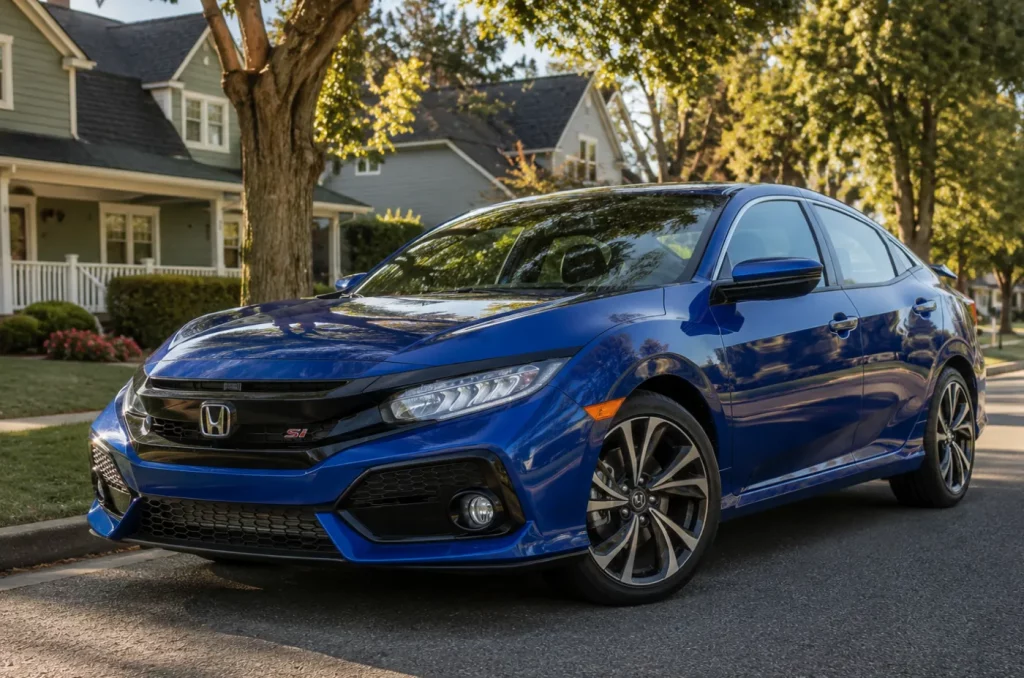
The 9th Gen Civic Si (2012–2015) represents the end of an era. It was the last naturally aspirated Civic Si ever produced, powered by the K24Z7 — a 2.4-liter four-cylinder that delivers linear, predictable power with a character that feels honest and mechanical. The 10th Gen Civic Si (2017–2020) represents the beginning of a new chapter. It was the first turbocharged Civic Si, powered by the L15B7 — a 1.5-liter turbocharged four-cylinder that completely redefined what the Si badge means.
This is not a debate about which car is objectively better. It’s a debate about which driving experience matters more to you. Do you want to work for your speed — or do you want speed to come easily?
The 9th Gen Si offers a naturally aspirated, linear power delivery with a more mechanical feel and old-school Honda character. The 10th Gen Si delivers significantly more mid-range torque, a sharper chassis, adaptive dampers, and vastly greater tuning potential. The 9th Gen is the better emotional choice; the 10th Gen is the better performance choice for most drivers.
The End of One Si Era and the Start of Another
There is a clear fault line in the world of the Honda Civic Si that divides enthusiasts into those who remember what it’s like to rev an engine to redline in search of power, and those who are accustomed to torque being available almost from idle. This line runs precisely between the 9th and 10th generations of the Si.
9th Gen Civic Si (2012–2015): The last naturally aspirated Civic Si in history. Under the Hood sits the K24Z7: 2.4 liters of displacement, 201 horsepower at 7,000 rpm, and 170 lb-ft of torque at 4,400 rpm. Later models (2014–2015) received a minor bump to 205 hp and 174 lb-ft, but the essence remained the same — this is an honest, linear, naturally aspirated engine that demands revs and rewards those who know how to keep the tachometer needle in the powerband.
10th Gen Civic Si (2017–2020): The first turbocharged Civic Si. Under the hood sits the L15B7: 1.5 liters, 205 horsepower at 5,700 rpm, and 192 lb-ft of torque available from 2,100 to 5,000 rpm. Honda effectively preserved the peak horsepower figure but completely changed the way it’s delivered. Instead of revving the engine to redline, now you simply press the gas pedal.
| Specification | 9th Gen Si (FB6/FG4) | 10th Gen Si (FC1/FC3) |
|---|---|---|
| Engine | K24Z7 | L15B7 |
| Displacement | 2.4L | 1.5L |
| Aspiration | Naturally Aspirated | Turbocharged |
| Horsepower | 201–205 hp @ 7,000 rpm | 205 hp @ 5,700 rpm |
| Torque | 170–174 lb-ft @ 4,400 rpm | 192 lb-ft @ 2,100–5,000 rpm |
| Redline | ~7,000 rpm | ~6,500 rpm |
| Transmission | 6-speed manual | 6-speed manual |
| LSD | Helical | Helical |
| Curb weight | ~2,896–2,996 lb | ~2,897–2,950 lb |
| Fuel Economy | 22 city / 31 highway mpg | 28 city / 38 highway mpg |
| Power delivery character | Linear, high-RPM | Strong midrange turbo |
K24 vs Turbo L15: Same Power, Completely Different Engine
This is the central comparison section. Honda maintained nearly identical peak horsepower — 205 HP for both cars in later specifications. But the way that power is achieved is radically different.
The main question is whether you would rather chase the powerband or have the powerband come to you. The K24Z7 demands revs but delivers torque linearly. The turbo L15 delivers significantly more torque much earlier. Honda effectively moved the Si’s character from the world of revving it out to the world of riding the torque.
The torque difference — 22 lb-ft in favor of the 10th Gen — is not just a number on paper. It’s a feeling that changes the entire driving character. In the 9th Gen, you’re constantly searching for the right gear to keep the engine in its powerband. In the 10th Gen, you just press the gas and the car goes.
| Specification | 9th Gen Si | 10th Gen Si |
|---|---|---|
| Peak Horsepower | 205 hp @ 7,000 rpm | 205 hp @ 5,700 rpm |
| Peak Torque | 174 lb-ft @ 4,400 rpm | 192 lb-ft @ 2,100–5,000 rpm |
| Redline | 7,000 rpm | 6,500 rpm |
| VTEC System | Intake only | Exhaust cam (L15CA) |
| Fuel Economy | 22/31 mpg | 28/38 mpg |
The K24Z7 Experience: The Last Naturally Aspirated Si
The K24Z7 is an engine that doesn’t try to be the K20Z3 from the 8th generation. It’s more mature, more restrained, but it still preserves that naturally aspirated honesty that Honda fans love about the old school.
The naturally aspirated K24 offers several advantages over the turbo L15. Throttle response is instant — press the pedal and the car responds immediately with no lag or delay, which makes it perfect for canyon roads and mountain passes. Power delivery is linear and predictable, with the car accelerating smoothly without surprises. There is no boost threshold to wait for, so power is available at all times regardless of rpm. And the engine becomes more exciting as the revs climb, revealing more of its character rather than losing it.
But it’s important to be honest: the K24 is not as much of a screaming engine as the K20Z3 from the 8th generation. After the 8th Gen, some owners consider the K24 more powerful but less dramatic. However, compared to the turbo L15, it remains a representative of the old Honda philosophy. The K24 doesn’t hit you with torque. It builds speed honestly.
The Turbo L15 Experience: The Si Grew Up
It would be too simplistic — and emotional — to say that turbocharging killed the Si. The L15B7 gave the Si what it had been missing all these years: usable power for everyday driving.
The L15B7 delivers 18 to 22 lb-ft more torque depending on the K24 model year — a significant difference felt from the first press of the pedal. Torque is available much earlier, with peak from 2,100 rpm versus 4,400 for the K24, making it perfect for highway merging and passing. The car accelerates more easily without constant downshifts, and on the highway you don’t need to shift down for overtaking. Daily drivability is better, with the car feeling more confident in city traffic. And fuel economy is superior AT 28 city and 38 highway mpg compared to 22/31 for the 9th Gen.
The 10th Gen Si’s peak torque is available from about 2,100 rpm and holds until 5,000 rpm, while the K24 develops its maximum torque significantly higher in the rev range. The turbo Si is faster without asking the driver to work as hard.
Real-World Acceleration: Where the Turbo Wins
Rather than starting with 0–60 times, it’s better to look at real-world scenarios that every driver encounters daily.
On the highway, overtaking from 60 to 80 mph in the 10th Gen doesn’t require a downshift. Just press the pedal, the turbo spools, and the car accelerates. In the 9th Gen, you need to shift down and raise the revs above 5,000. In a fourth-gear pull, the 10th Gen doesn’t need to be revved to redline to feel quick. The turbo torque covers the mid-range, making the car responsive in everyday driving. The 9th Gen requires more deliberate gear selection. At stoplights, the L15B7 creates usable thrust more quickly. You don’t need to launch at high rpm to get a good start — just release the clutch and go. The K24 requires a more aggressive launch technique.
Independent testing results tell a consistent story. Car and Driver recorded 6.3 seconds to 60 mph for the 2017 Si Coupe. MotorTrend recorded approximately 6.1 seconds for a later-model 9th Gen Si. The difference between specific tests varies based on conditions and body style, but the key takeaway is clear: the 10th Gen doesn’t necessarily destroy the 9th Gen in straight-line numbers — but the turbo makes ordinary acceleration feel much easier.
The 9th Gen’s Advantage: Predictability
This is a crucial section that makes the article less formulaic. Turbo torque is great, but a naturally aspirated engine has its own advantages.
The K24 delivers exactly what you ask for — there is no boost transition, no heat-related power variation, and no complex dependency on boost pressure. Throttle response is more predictable, especially on canyon roads, autocross events, wet roads, and long corners. Predictable isn’t the same as slow.
In canyon driving, predictability translates into confidence. You know exactly what the engine will do when you open the throttle, and there’s no lag waiting for boost to build. The K24’s linear response allows you to place the car precisely where you want it, without second-guessing the power delivery.
Chassis Revolution: This Is Bigger Than the Engine
Here’s where the real 10th Gen advantage begins. The 10th Gen Si rides on an entirely new global platform that represents a massive leap forward in chassis engineering. MotorTrend noted a significant improvement in the 10th Gen Si’s dynamic performance compared to previous generations, thanks to a stiffer platform, adaptive dampers, and wider 18-inch tires. In their testing, the 2017 Si achieved approximately 0.97 g on the skidpad, while tested 8th and 9th Gen cars were roughly in the 0.85–0.90 g range.
9th Gen Chassis
- Older architecture
- 17-inch wheels
- Traditional suspension tuning
- Narrower tires
- No adaptive dampers
10th Gen Chassis
- Stiffer body structure
- 18-inch wheels
- Adaptive dampers (ADS)
- Wider track
- Sport mode button
The 10th Gen isn’t just a 9th Gen with a turbo. It’s a fundamentally different car underneath.
Which One Feels More Like a Traditional Honda Si?
Here’s where the real debate lives. The 9th Gen offers naturally aspirated character — the last of its kind — with linear power response that enthusiasts remember from the 90s and 2000s. High-RPM driving engagement rewards those who love to shift, and the old-school Honda feel is increasingly rare in the modern market.
The 10th Gen offers a sharper chassis that’s better for autocross and track days, better grip as the 0.97 g on the skidpad speaks for itself, a stronger midrange that’s perfect for highway driving, and a more capable suspension with adaptive dampers that change the game.
This is a question of engine character versus overall capability. And there is no automatic winner. The 9th Gen offers a traditional Honda experience that’s increasingly rare. The 10th Gen offers objectively better performance in most measurable ways. Your choice depends on what you value more: character or capability.
The Manual Transmission Battle
Both cars come with a manual transmission only — no automatic option was ever offered for either generation. Both have a 6-speed gearbox and a helical limited-slip differential that’s standard on all Si models. But the feel of the car is different.
In the 9th Gen, you shift to keep the K24 in its powerband, maintain revs, and extract the maximum from the engine. The transmission feels mechanical and rewarding, with a positive engagement that rewards deliberate shifts. The shift throw is longer but more satisfying.
In the 10th Gen, shifts become somewhat less mandatory because the turbo torque covers the mid-range, giving you more flexibility in gear selection. You can be in a higher gear and still have adequate power for most driving situations. The gearbox is shorter and more precise, but the clutch is lighter.
The K24 rewards the right gear. The L15 forgives the wrong one.
The Tuning Fight: Here the 10th Gen Changes Everything
This is a substantial section, but it won’t be turned into a full dyno guide — there are separate articles on that topic already.
For the 10th Gen L15, the situation is completely different. The L15B7 responds dramatically to simple modifications like KTuner V2 or Hondata FlashPro tuning, an intercooler upgrade from PRL, Mishimoto, or 27WON, a cold air intake from PRL, 27WON, or AEM, a 3-inch downpipe replacement, and ethanol blends for E30 or E85 tuning.
The turbo L15 has significantly more potential for power gains through tuning. MotorTrend documented examples of 10th Gen Si cars where ECU tuning and bolt-ons radically increased output — gains of 40-50 whp are common with a simple tune and bolt-ons, transforming the car into something that rivals the Civic Type R in straight-line performance.
The K24 is a better engine to preserve. The L15 is a better engine to modify. The K24 rewards careful, thoughtful modifications. The L15 rewards aggressive tuning with dramatic power increases.
The Sound and Emotional Factor
This section is essential because numbers don’t explain why someone would buy an older Si over a newer one.
The K24 delivers the sound of old-school Honda: a naturally aspirated induction sound with that characteristic Honda intake roar, a rising exhaust note with rpm that feels mechanical and honest, intake noise that builds as the revs climb, and a more mechanical feel overall that connects you to the engine.
The L15 delivers the sound of modern turbo Honda: turbo spool and blow-off character with that whoosh and whistle of boost, a lower-pitched exhaust note that’s more subdued but still satisfying, less drama at high rpm because the rev limiter comes quickly at 6,500 rpm, and more opportunities to change the sound via intake and exhaust modifications.
The question is whether you want to hear the engine or the turbo.
Daily Driving: Which One Would You Actually Want on Monday Morning?
Imagine a typical weekday: traffic, A/C running in the summer, a highway commute, and a stop for groceries on the way home.
The 9th Gen offers a simpler powertrain, linear delivery, honest NA character, fewer complex systems to worry about, cheaper insurance premiums, and easier DIY maintenance. But it’s older, has less refinement, fewer modern technologies like Apple CarPlay and backup camera on early models, requires more shifting, and has worse fuel economy at 22/31 mpg.
The 10th Gen offers a modern interior with Apple CarPlay and Android Auto, a better chassis, more torque, easier highway driving, less shifting required, and superior fuel economy at 28/38 mpg. But it has turbo complexity, more systems to consider for long-term ownership, heat management issues in hot climates, and potential Oil dilution on early models that was addressed with ECU updates.
Used Buyer Reality Check
This is a very important section. Today, it’s no longer about which generation was better when new — it’s about which used example is worth buying today.
When buying a 9th Gen, check for maintenance records with documented oil changes every 5,000-7,500 miles, transmission condition with grinding in 2nd and 3rd gear, clutch wear with slipping or hard engagement, oil level and history because K24s can consume oil, suspension condition with clunks especially in the rear, rust in the rear wheel wells and undercarriage, and the VTC actuator for cold-start rattle.
When buying a 10th Gen, check for tuning history to see if it was previously flashed with KTuner or Hondata, evidence of aggressive boost tuning with aftermarket parts, clutch condition because stock clutches are weak, turbo health for unusual whine or play, cooling system maintenance for coolant leaks and radiator condition, oil dilution history with service records for ECU updates, and AC Condenser for proper cooling.
A clean stock car beats a cheaper modified car more often than buyers want to admit. At this age, condition matters more than generation. A well-maintained 9th Gen is a better car than a neglected 10th Gen. When choosing between the two, inspect the transmission, the clutch, the turbo if applicable, and the engine condition thoroughly.
The Generational Personality Test
Instead of another dry table, consider this approach.
Choose the 9th Gen Si if you want the last naturally aspirated Si, if you care more about engine response than peak torque, if you want an old-school Honda experience that reminds you of the 90s, if you plan to keep the engine close to stock, if you want something you can work on in your garage with basic tools, and if you prefer the simpler, more analog driving experience.
Choose the 10th Gen Si if you want more torque everywhere especially for highway driving, if you want the better chassis with adaptive dampers, if you plan to tune the car and modify it, if you want a more modern daily driver with CarPlay and modern tech, if you want better fuel economy for your commute, and if you want a car that feels more modern and refined.
Verdict: Which Generation Wins?
There is no single winner. Here’s how it breaks down.
Best Engine Character
9th Gen Si
The K24Z7 is the last naturally aspirated Si engine. Linear, honest, and increasingly rare — a true enthusiast engine.
Best Chassis
10th Gen Si
Significantly more modern platform with adaptive dampers and higher grip levels at 0.97 g on the skidpad.
Best Midrange Acceleration
10th Gen Si
192 lb-ft of turbo torque from 2,100 rpm changes the driving experience completely.
Best NA Experience
9th Gen Si
No competition here — it’s the last of its kind. The sound, the response, the character are all irreplaceable.
Best Tuning Platform
10th Gen Si
ECU tuning and bolt-ons deliver dramatic power gains at a fraction of the cost of NA tuning.
Best Fuel Economy
10th Gen Si
28 city and 38 highway mpg versus 22/31 for the 9th Gen.
Best Stock Enthusiast Experience
9th Gen Si
For pure driving engagement, the 9th Gen is the more memorable car. It rewards effort and skill in a way the 10th Gen doesn’t.
Final Thought
The 9th Gen Civic Si is the last chapter of Honda’s naturally aspirated performance philosophy. The 10th Gen Si is the beginning of a faster, more tunable, more capable future.
The 9th Gen makes you work for speed. The 10th Gen makes speed easier to access. Which one is better depends on whether you want to drive the engine or use its potential.
The answer depends on what you value. The 10th Gen Si is probably the better car for most people. It’s faster in a straight line, more comfortable on long trips, more refined for daily commutes, and easier to drive in heavy traffic. The L15B7’s torque makes it a better daily driver, and the car is more modern in every way.
The 9th Gen Si may still be the more memorable one. The linear K24Z7, the mechanical feel, the predictable power delivery, and the old-school Honda character are qualities that cannot be replicated by a more comfortable, more refined car. The 9th Gen is a car for drivers who want to feel something.
The 10th Gen is the better car. The 9th Gen is the more interesting one.
FAQ — 9th Gen vs 10th Gen Civic Si
Which Civic Si is faster, the 9th Gen or the 10th Gen?
The 10th Gen Si is generally quicker in instrumented testing, with a slight advantage in 0-60 mph and quarter-mile times. Car and Driver recorded 6.3 seconds to 60 mph for the 2017 Si Coupe. The 10th Gen’s torque advantage gives it better mid-range acceleration and easier daily drivability. However, the difference is not overwhelming — both cars are closely matched in straight-line performance.
Which engine is better, K24Z7 or L15B7?
The K24Z7 is better for linear power delivery, throttle response, and old-school Honda character. The L15B7 is better for torque, tuning potential, daily drivability, and fuel economy. Neither is objectively superior; the choice depends on your priorities and how you use the car.
Does the 9th Gen Si have transmission problems?
The 9th Gen Si has a generally reliable transmission. Honda revised the synchros compared to the 8th Gen, making it smoother and more durable. The 3rd gear synchro issue that plagued the 8th Gen was largely resolved. The 9th Gen’s gearbox is one of its strengths — mechanical, precise, and rewarding to use.
Which Si has better steering feel?
The 9th Gen Si has electric power steering that was heavily criticized for being too light and lacking feedback. The 10th Gen Si has a revised electric steering system that offers better weight and feel, though it still doesn’t match the hydraulic steering of the 8th Gen. Neither generation is particularly praised for steering feel, but the 10th Gen is an improvement over the 9th Gen.
Is the 10th Gen Si a better daily driver?
Yes — the 10th Gen Si is more comfortable, more refined, and easier to drive in traffic. The L15B7’s torque makes it more responsive without needing to rev the engine. The adaptive dampers provide a better ride quality, and the interior is more modern with Apple CarPlay and Android Auto. The 9th Gen Si is more engaging but less comfortable for daily commuting.
Which Si has more tuning potential?
The 10th Gen Si has significantly more tuning potential. The L15B7 responds dramatically to ECU tuning, intake, downpipe, and intercooler upgrades. A simple tune can add 20-30 whp, and bolt-ons can push the car well beyond 240 whp. The 9th Gen Si’s K24Z7 is more expensive to modify for serious gains due to the integrated exhaust manifold restriction.
Should I buy a 9th Gen or 10th Gen Civic Si?
Buy the 9th Gen if you want a naturally aspirated, engaging, old-school Honda experience with linear power delivery and mechanical character — and you’re willing to sacrifice modern tech and fuel economy. Buy the 10th Gen if you want a more comfortable, refined, and daily-usable Si with stronger mid-range torque, a better chassis, superior fuel economy, and vastly greater tuning potential. The 9th Gen is more exciting; the 10th Gen is more practical for most drivers.
Does the 10th Gen Si have VTEC?
Yes — the 10th Gen Si’s L15B7 features VTEC on the exhaust cam. The 9th Gen Si has VTEC on the intake cam only. The 10th Gen’s VTEC is less aggressive and less noticeable than the 8th Gen’s dual VTEC, but it’s still present in the tuning strategy and contributes to the engine’s character.
Which generation has better resale value?
Both generations hold their value well, but the 9th Gen is becoming increasingly desirable as the last naturally aspirated Si. Clean, unmodified examples command premium prices. The 10th Gen is more common and more readily available, but well-maintained stock examples also retain strong value.
What are the common problems with each generation?
9th Gen: Oil consumption on early 2012 models, clutch wear with aggressive driving, suspension aging, VTC actuator rattle on cold starts, and normal wear on interior materials.
10th Gen: Oil dilution on early 2017-2018 models (addressed by ECU updates), clutch weakness when tuned aggressively, heat soak in hot climates (addressed with intercooler upgrades), AC condenser issues, and potential turbo wear with heavily modified cars.