

For over a decade, the 8th Gen and 9th Gen Honda Civic Si have been locked in a debate that shows no signs of cooling. The argument is not about which car is objectively better—it is about which philosophy of driving matters more to you. The 8th Gen Si (FA5 sedan, FG2 coupe) delivers the K20Z3, a 2.0-liter naturally aspirated four-cylinder that lives for high rpm and rewards drivers who chase the redline. The 9th Gen Si (FB6 sedan, FG4 coupe) counters with the K24Z7, a 2.4-liter engine that trades peaky power for mid-range torque and everyday usability. This is not a comparison of spec sheets. It is a comparison of two very different ways to build a Sport Compact.
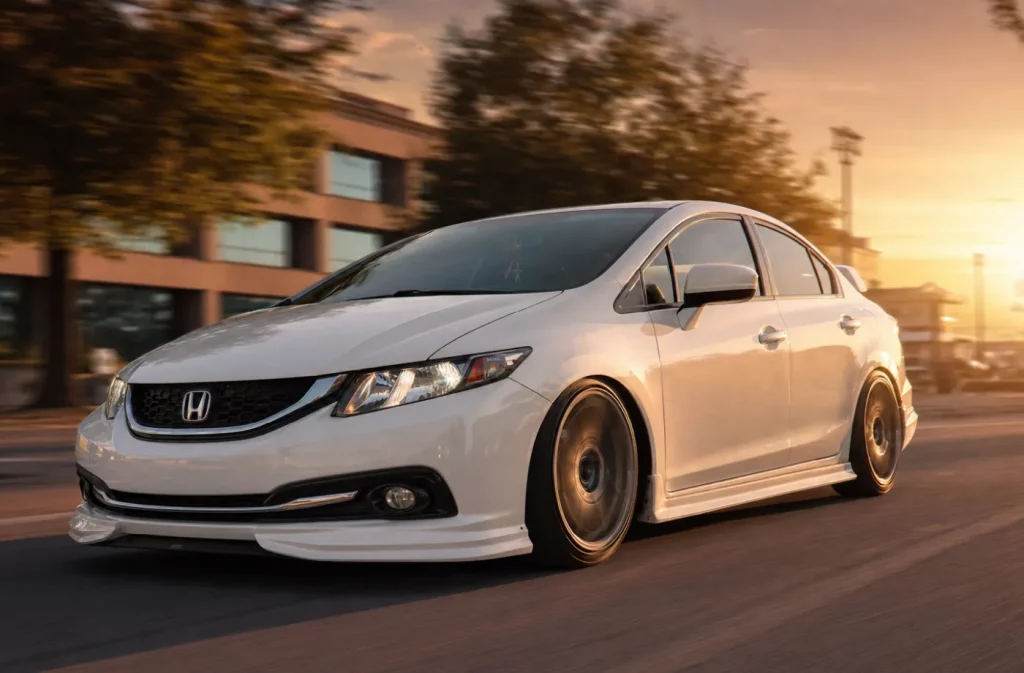
Two Generations, One Big Argument
The 8th Gen Civic Si is the car that defined the Si badge for a generation of enthusiasts. Its K20Z3 engine revs to 8,000 rpm, produces 197 hp at 7,800 rpm, and features true VTEC on both intake and exhaust cams. Below 5,800 rpm, it is a willing but unremarkable four-cylinder. Above that threshold, the cam profiles switch, the intake note hardens, and the engine pulls with a building surge that rewards aggressive driving. The 8th Gen Si is a car that demands to be driven hard.
The 9th Gen Civic Si is a different car entirely. Its K24Z7 engine displaces 2.4 liters, produces 201 hp at 7,000 rpm, and delivers 170 lb-ft of torque at 4,400 rpm—31 lb-ft more than the K20Z3. The extra displacement and torque make the 9th Gen Si easier to drive quickly in daily traffic. It does not need to be revved to 8,000 rpm to feel fast. It is more usable, more forgiving, and more practical. But it lacks the high-rpm character that made the 8th Gen a legend.
Drivers who have owned both generations often describe the 9th Gen as the better daily driver and the 8th Gen as the more memorable weekend car. The difference is not about speed—it is about the experience of driving.
| Specification | 8th Gen Si (FA5/FG2) | 9th Gen Si (FB6/FG4) |
|---|---|---|
| Engine | K20Z3 | K24Z7 |
| Displacement | 2.0L | 2.4L |
| Horsepower | 197 hp @ 7,800 rpm | 201 hp @ 7,000 rpm |
| Torque | 139 lb-ft @ 6,100 rpm | 170 lb-ft @ 4,400 rpm |
| VTEC | Dual (intake and exhaust) | Intake only |
| Exhaust manifold | Traditional bolt-on header | Integrated into cylinder head |
| Redline | ~8,000 rpm | ~7,000 rpm |
| Transmission | 6-speed manual | 6-speed manual |
| LSD | Helical | Helical |
| Curb weight | ~2,877–2,945 lb | ~2,896–2,996 lb |
| Power delivery character | High-rpm focused | Mid-range torque |
K20Z3 vs K24Z7: The Numbers Don’t Tell the Whole Story
The K20Z3 is a high-revving, peaky engine that requires the driver to actively manage the gearbox. It makes peak power near redline, so to access the engine’s potential, the driver must keep the engine above 6,000 rpm. This rewards aggressive driving and punishes laziness. The K20Z3 is a motor that demands attention.
The K24Z7 is a more traditional torque engine. It makes significantly more torque AT lower rpm, so the car feels quicker in normal driving without needing to rev it out. The power delivery is smoother and more linear, which makes the 9th Gen Si easier to drive in traffic and on the highway. The K24Z7 does not have the same top-end rush as the K20Z3, but it does not need it. It is a more mature engine for a more mature car.
The K20Z3 forces the driver to work. The K24Z7 works for the driver.
The K20 Experience: Why the 8th Gen Became a Cult Car
The 8th Gen Si is not a car that impresses with its power numbers. It impresses with its character. The K20Z3 is a motor that becomes more exciting as the rpm climbs. Below 5,800 rpm, it is a pleasant but ordinary four-cylinder. Above 5,800 rpm, the VTEC crossover changes the intake and exhaust cam profiles, and the engine transforms. The intake note deepens, the power delivery surges, and the car pulls hard to the 8,000-rpm redline. The K20Z3 rewards drivers who are willing to chase the redline.
The VTEC crossover is not a sudden burst of power. It is a change in the engine’s breathing that makes the power delivery more aggressive and the engine feel more alive. The K20Z3 is not a motor that makes massive torque, but it is a motor that makes driving feel like an event.
Owners still love the 8th Gen because it forces the driver to do something. You have to choose the right gear, hold the revs, plan your overtakes, and work the gearbox. The car demands engagement, and that engagement is what makes it memorable.
The K24 Experience: Why the 9th Gen Is Faster in Real Life
The 9th Gen Si is not trying to be a high-revving screamer. It is trying to be a faster, more usable car for everyday driving. The K24Z7’s extra displacement and torque make it significantly quicker in the mid-range. Overtaking on the highway does not require a downshift. Pulling away from a stop does not require a high-rpm launch. The 9th Gen Si is easier to drive quickly without trying.
The K24Z7’s power band is centered around the 3,000–6,000 rpm range, which is exactly where most daily driving happens. The extra 31 lb-ft of torque is noticeable from the moment you press the throttle. The 9th Gen Si is not a better track car than the 8th Gen, but it is a better street car.
The 3,000–6,000 rpm advantage is what makes the 9th Gen feel faster in real-world conditions. The car does not need to be revved to 8,000 rpm to feel quick. It is responsive, torquey, and forgiving. The K24Z7 is a motor that makes speed easy.
The Transmission Battle: Which One Feels Better?
Both cars have a 6-speed manual transmission and a helical limited-slip differential. The difference is in the execution.
The 8th Gen Si has a well-known weak point: the 3rd gear synchro. The 3rd gear pop-out issue is widely documented, and many owners have had to replace the synchro or rebuild the transmission. The 2nd gear synchro can also wear over time. The 8th Gen’s transmission is mechanical and rewarding when it is working properly, but it is more fragile than the 9th Gen’s unit.
The 9th Gen Si has a more refined transmission. Honda revised the synchros and improved the shift feel. The gearbox is smoother, more precise, and less prone to wear. The 9th Gen’s transmission does not have the same reputation for failure as the 8th Gen’s unit. It is a better daily-driver transmission.
Do you want to shift because you have to—or because you want to? The 8th Gen forces you to work the gearbox to keep the engine in its power band. The 9th Gen allows you to shift when you want to, not when you have to.
Straight-Line Performance: Which One Is Actually Faster?
The 9th Gen Si is quicker to 60 mph than the 8th Gen Si in most instrumented tests. Car and Driver recorded 6.1 seconds for the 2012 Si sedan and 6.7 seconds for the 2006 Si coupe. The 9th Gen’s torque advantage gives it a better launch and stronger mid-range acceleration. The 8th Gen Si is slower to 60 mph because it needs to be launched at high rpm and shifted aggressively to stay in its power band.
The quarter-mile times tell a similar story. The 2012 Si sedan runs 14.7 seconds at 97 mph, while the 2006 Si coupe runs 15.1 seconds at 95 mph. The 9th Gen is quicker and traps higher. The 8th Gen is slower in a straight line.
But the 9th Gen’s advantage is not overwhelming. The 8th Gen’s high-rpm power delivery makes it feel faster than it is, and on a road course, the 8th Gen’s chassis and power band can compensate for its straight-line deficit.
The Real Driver’s Shootout: Canyon Road
On a canyon road, the 8th Gen and 9th Gen Si reveal their true characters.
Tight hairpins: The 9th Gen Si is easier to drive quickly. The extra torque allows the car to pull out of corners without needing to downshift. The 8th Gen Si requires more work—you need to keep the revs up and be in the right gear. The 9th Gen is more forgiving; the 8th Gen is more rewarding.
Fast sweepers: The 8th Gen Si’s chassis is sharper and more communicative. The steering is heavier, the turn-in is quicker, and the car feels more planted. The 9th Gen Si is softer and more compliant, which makes it more comfortable but less precise. The 8th Gen is the better driver’s car on a fast, flowing road.
Highway pulls: The 9th Gen Si is the better highway car. The extra torque means you do not need to downshift to pass. The 8th Gen Si requires a downshift and a climb to the redline. The 9th Gen is more relaxed; the 8th Gen is more dramatic.
The 8th Gen Si rewards effort. The 9th Gen Si rewards the desire to drive faster with less work.
Steering and Chassis: The Part Nobody Agrees On
The 8th Gen Si has hydraulic power steering. The 9th Gen Si has electric power steering. This is one of the most debated differences between the two generations.
Hydraulic steering provides more feedback and a heavier, more natural feel. The 8th Gen’s steering is communicative and direct. Drivers who value steering feel prefer the 8th Gen.
Electric steering is lighter and more refined. The 9th Gen’s steering is precise but less communicative. It is easier to drive in traffic and less tiring on long trips. Drivers who value comfort and everyday usability prefer the 9th Gen.
There is no agreement on which is better. The 8th Gen is more engaging; the 9th Gen is more refined. Your preference depends on whether you value feedback or comfort.
The Daily Driver Test
Imagine a typical weekday: traffic, AC running, a commute on the highway, and a stop for groceries on the way home. Which Si is better for this routine?
The 9th Gen Si wins the daily-driver test. It has a more comfortable ride, a quieter cabin, better seats, and a more modern interior. The K24Z7’s torque makes it effortless to drive in traffic, and the car does not need to be revved to feel quick.
The 8th Gen Si is less comfortable and more tiring to drive in traffic. The engine’s lack of low-end torque requires frequent downshifts, and the suspension is stiffer. The 8th Gen is a car that is best enjoyed on a back road, not on a commute.
Owners who have owned both generations often describe the 9th Gen as the better daily and the 8th Gen as the more memorable weekend car.
Reliability: Don’t Choose Based on the Engine Alone
Both engines are reliable, but both have weak points.
The 8th Gen Si’s K20Z3 is a proven motor with a strong track record. The engine itself is durable, but the transmission has known issues. The 3rd gear synchro is the most common problem, and repairing it requires a transmission rebuild. The engine’s VTC actuator can also fail, causing a cold-start rattle.
The 9th Gen Si’s K24Z7 is also reliable, but it has its own issues. The integrated exhaust manifold is a weak point for tuning, and the oil consumption on early 2012 models is a known concern. The clutch on the 9th Gen can wear faster than expected with aggressive driving.
At this age, condition matters more than generation. A well-maintained 8th Gen is a better car than a neglected 9th Gen. When choosing between the two, inspect the transmission, the clutch, and the engine condition.
Modification Potential: K20 vs K24
The K20Z3 is a natural tuner. With a cold air intake, a race header, a cat-back exhaust, and a Hondata FlashPro tune, the 8th Gen Si can gain 20–30 whp. The engine responds well to bolt-ons and retains its high-rpm character.
The K24Z7 is more difficult to modify. The integrated exhaust manifold is a restriction, and to make significant power, the cylinder head must be replaced or modified. The popular K20/K24 Frankenstein build combines a K24 bottom end with a K20 head, but this is an advanced project. The 9th Gen Si has less bolt-on potential than the 8th Gen.
The Budget Question: Which One Gives You More Car for the Money?
Used 8th Gen Si prices vary widely depending on condition and mileage. A well-maintained 8th Gen with a clean history and no transmission issues can be a good value. A neglected 8th Gen with a grinding transmission is a project.
The 9th Gen Si is newer, more comfortable, and more refined. It is a better daily driver and a more practical car for most buyers. But it is also more expensive and less exciting to drive.
A $12,000 clean Si can be a better investment than a $9,000 Si that needs a clutch, suspension, tires, and A/C work. Always budget for deferred maintenance.
Who Should Buy the 8th Gen?
Buy the 8th Gen Si if you want the K20Z3 specifically. If the high-revving character, the VTEC crossover, and the 8,000-rpm redline matter more to you than torque or comfort, the 8th Gen is the right choice. It is a car for drivers who want to be engaged and rewarded for effort.
Buy the 8th Gen if you do not mind working the gearbox. Buy it if you want a more mechanical, rawer driving experience. Buy it if you are willing to accept the transmission issues and the aging interior. The 8th Gen rewards effort.
Who Should Buy the 9th Gen?
Buy the 9th Gen Si if you want stronger mid-range torque and a more comfortable daily driver. The extra 31 lb-ft of torque makes the car easier to drive in traffic and more responsive on the highway. The 9th Gen is the better daily driver.
Buy the 9th Gen if you want a more modern interior, a more refined suspension, and a quieter cabin. Buy it if you want speed without effort. The 9th Gen makes speed easier.
Final Verdict: Which One Actually Drives Better?
The answer depends on what you value. The 9th Gen Si is probably the better car for most people. It is faster in a straight line, more comfortable, more refined, and easier to drive. The K24Z7’s torque makes it a better daily driver, and the car is more modern in every way.
The 8th Gen Si may still be the more memorable one. The high-revving K20Z3, the hydraulic steering, the raw character, and the VTEC crossover are qualities that cannot be replicated by a more comfortable, more refined car. The 8th Gen is a car for drivers who want to feel something.
The 9th Gen is the better car. The 8th Gen is the more interesting one.
☐ 8th Gen Si: K20Z3, 197 HP, 139 lb-ft, 8,000 rpm redline, dual VTEC, hydraulic steering, known 3rd gear synchro issues
☐ 9th Gen Si: K24Z7, 201 hp, 170 lb-ft, 7,000 rpm redline, intake VTEC only, electric steering, integrated exhaust manifold
☐ 9th Gen is quicker to 60 mph and in the quarter mile (Car and Driver)
☐ 8th Gen has more character, more high-rpm excitement, and better steering feel
☐ 9th Gen is more comfortable, more refined, and easier to drive daily
☐ 8th Gen is a better weekend car; 9th Gen is a better daily driver
☐ Transmission reliability favors the 9th Gen
☐ Tuning potential favors the 8th Gen
☐ The 9th Gen is the better car. The 8th Gen is the more memorable one
FAQ — 8th Gen vs 9th Gen Civic Si
Which Civic Si is faster, the 8th Gen or the 9th Gen?
The 9th Gen Si is quicker in instrumented testing. Car and Driver recorded 6.1 seconds to 60 mph for the 2012 Si sedan versus 6.7 seconds for the 2006 Si coupe. The 9th Gen’s torque advantage gives it a better launch and stronger mid-range acceleration.
Which engine is better, K20Z3 or K24Z7?
The K20Z3 is better for high-rpm excitement and driver engagement. The K24Z7 is better for torque, daily driving, and ease of use. Neither is objectively superior; the choice depends on your priorities.
Does the 8th Gen Si have transmission problems?
Yes — the 8th Gen Si is known for 3rd gear synchro wear and pop-out. This is a common issue that requires a transmission rebuild. The 9th Gen Si has a more reliable transmission.
Which Si has better steering feel?
The 8th Gen Si has hydraulic steering, which provides more feedback and a heavier feel. The 9th Gen Si has electric steering, which is lighter and more refined but less communicative. Enthusiasts generally prefer the 8th Gen’s steering.
Is the 9th Gen Si a better daily driver?
Yes — the 9th Gen Si is more comfortable, more refined, and easier to drive in traffic. The K24Z7’s torque makes it more responsive without needing to rev the engine. The 8th Gen Si is more engaging but less comfortable.
Which Si has more tuning potential?
The 8th Gen Si has more tuning potential. The K20Z3 responds well to bolt-ons, and the engine’s high-rpm character is enhanced by modifications. The 9th Gen Si’s integrated exhaust manifold is a restriction, and the K24Z7 is more difficult to modify for high-rpm power.
Should I buy an 8th Gen or 9th Gen Civic Si?
Buy the 8th Gen if you want a high-revving, engaging, raw driver’s car with a cult following. Buy the 9th Gen if you want a more comfortable, refined, and daily-usable Si with stronger mid-range torque. The 8th Gen is more exciting; the 9th Gen is more practical.
Does the 9th Gen Si have VTEC?
Yes — but only on the intake cam. The 8th Gen Si has VTEC on both intake and exhaust cams. The 9th Gen’s VTEC is less aggressive and less noticeable than the 8th Gen’s.