

If you’re planning your first track day in a Honda Civic, here’s what nobody tells you before you get there: the car can do it, but not without preparation. The Civic — Si or not — was engineered for public roads, not 20-minute sessions at 9/10ths. The cooling system, brakes, and tires will hit their limits faster than your confidence will.
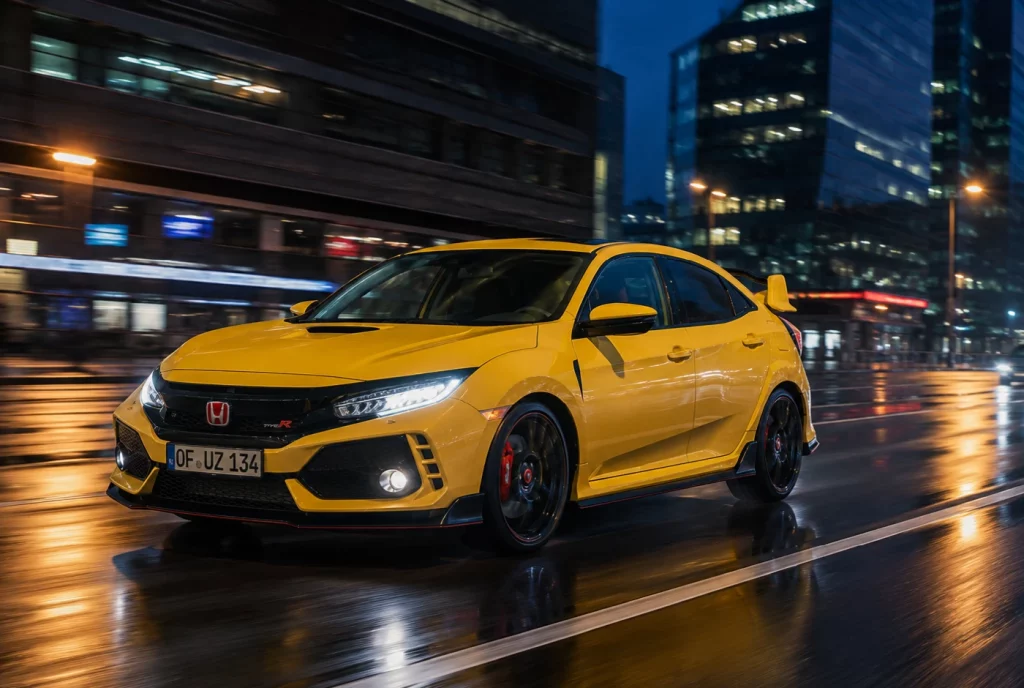
This guide covers what actually fails on track, what temperatures matter, what parts to buy before you go, and what you can safely ignore. It covers both the 10th and 11th generation Si (200 hp, 1.5T, manual) and the FK8 and FL5 Type R (306–315 hp, 2.0T, manual), with notes on the base 2.0L and 1.5T non-Si cars where relevant.
The First Thing That Fails: Brakes
The Honda Civic’s brakes are adequate for street driving and inadequate for sustained track use on every trim below the Type R. The factory pads fade within three to five hot laps on a typical road course. The pedal goes soft, the stopping distance increases, and the fronts start smoking. This is not a defect — it is a design tradeoff. Factory pads prioritize cold bite, low dust, and quiet operation, not thermal capacity.
The Si uses single-piston sliding calipers with 12.3-inch front rotors (10th gen) or 12.0-inch (11th gen). The pads are small relative to the car’s weight (2,952 lbs), and the rotor mass is insufficient to absorb repeated high-speed braking from 100+ mph. CivicX.com owners who track their Si consistently report that stock pads are destroyed in a single event — glazed, cracked, or worn to the backing plate. One owner on CivicX described a 2019 Si coupe that went through a set of OEM front pads in three 20-minute sessions at Road Atlanta. Source: CivicX.com, “Best track rotor/pad/fluid setup with stock calipers? 2020 Civic Si Sedan” (2021).
The Type R has a fundamentally different brake system. The FK8 and FL5 use four-piston Brembo fixed calipers up front with two-piece floating rotors (13.8-inch on FK8, 14.0-inch on FL5). The pad volume is larger, the rotor mass is higher, and the thermal capacity is significantly better. Owners who track Type Rs report that the factory pads are usable for two to three events before replacement, with the main limitation being fluid boiling rather than pad fade.
The first modification for either car is Brake Fluid. This is non-negotiable. Factory Honda DOT 3 fluid has a dry boiling point around 230°C (446°F) and a wet boiling point around 160°C (320°F). Under track use, caliper temperatures routinely reach 150–180°C at the piston, which boils marginal fluid and introduces air into the system. The pedal goes to the floor.
The standard upgrade is Motul RBF600 (dry boiling point 312°C / 594°F) or Motul RBF660 (325°C / 617°F). Castrol SRF (dry boiling point 310°C / 590°F, wet 270°C / 518°F) is the gold standard for wet-condition resistance but costs approximately $70 per liter. A full flush uses roughly one liter. Budget $30–$70 for fluid and $80–$150 for a professional flush. Source: CivicX.com, “Best Brake Fluid for Si” (September 2020). Owner consensus on the same thread recommends Castrol SRF for dedicated track cars and RBF600 for mixed use.
Pads and Rotors: What the Forum Data Says Works
Si owners on CivicX and 8thCivic who track regularly recommend upgrading to a dedicated track pad before the first event. The most common recommendations sorted by aggression:
- Carbotech XP8 or XP10 — The XP8 is the most popular daily/track hybrid on the Si. Good cold bite for street driving and high thermal capacity on track. The XP10 is more aggressive and dusty but stops better. Many owners run XP8 fronts and stock rears.
- G-Loc R8 or R10 — G-Loc was founded by a former Carbotech engineer, and the compounds are similar. R8 roughly matches XP8, R10 matches XP10.
- Hawk DTC-60 — Higher initial bite and higher heat range than the HP Plus. These are dedicated track pads and are unpleasant on the street. Loud, dusty, and require warm-up. Best for cars that are trailered to events.
- Ferodo DS2500 — Good dual-use pad with strong cold bite and reasonable track performance. Not as resistant to heavy fade as the Carbotech compounds but easier to live with daily.
Brake pads for the Si cost approximately $200–$350 for a full set of front track pads. Street pads for daily use cost $80–$150. Owners who track regularly typically swap pads before and after events, which takes approximately 30 minutes per axle once the technique is learned.
Rotors are a secondary concern. Stock Si rotors are sufficient for intermediate-level track driving if paired with the correct pads. The rotors will develop heat checking (surface cracks) over time, which is normal and not a safety issue as long as the cracks do not propagate to the edge of the rotor face. Replace rotors when they reach minimum thickness (stamped on the rotor bell) or when cracks reach the outer edge. A set of Centric blank rotors costs approximately $100 for the front pair and is a popular replacement. Slotted or drilled rotors are not necessary on the Si. They add cost and, in the case of drilled rotors, introduce stress-riser cracking under track heat.
The Type R at OEM power level needs only fluid and pads. The Brembo system handles repeated hard braking from 140+ mph without significant fade. Owners on the FK8 and FL5 forums report that Castrol SRF fluid and stock pads with a high-temp compound swap (Carbotech XP12 front, XP8 rear is a common combination) last a full season of 8–10 track days. The aftermarket offers two-piece rotors from Girodisc and Paragon that reduce unsprung weight, but they are not required for reliability.
Oil Temperature: The Si’s Real Weakness
The 1.5T engine in the Si runs hot. On track, oil temperatures in the 10th-gen Si regularly exceed 260°F (127°C). At approximately 270–280°F (132–138°C), the ECU pulls timing, reduces boost, and in some cases initiates a limp-mode strategy that limits rpm to 4,000. This is not a “check engine” event — there is no dashboard warning — but the car loses power and stops pulling.
The CivicX thread “Are the SI’s overheating on track?” from August 2019 documents multiple owners reporting limp-mode events within 10 minutes of hard driving. One owner reported that consistent lap times were impossible after lap five because the car would pull power, then regain power, then pull power again in a cycle tied to oil temperature. The group consensus was that the Si’s oil cooler — a small water-to-oil unit integrated into the engine block — is insufficient for track use. Source: CivicX.com, “Are the SI’s overheating on track?” (August 2019).
The solution is an aftermarket oil cooler. Three options exist:
- Setrab or Earl’s thermostatic plate-and-fin cooler — Mounted in front of the radiator or behind the lower grille opening. A -10AN line kit with a 19-row or 25-row cooler costs $500–$900 installed. Owners report oil temperatures dropping by 15–25°F (8–14°C) on track, keeping the engine below the limp-mode threshold.
- Upgraded radiator (Koyo, Mishimoto, CSF) — A thicker all-aluminum radiator adds cooling capacity for the engine Coolant, which indirectly helps oil temperature. A CSF 2-row radiator for the 10th-gen Si costs approximately $450. Owners who installed both an oil cooler and an upgraded radiator report oil temperatures staying below 250°F (121°C) even in summer sessions.
- Larger intercooler — Charge air temperature directly affects intake temperature, which affects combustion temperature, which affects oil temperature. A stepped-core intercooler from PRL or Mishimoto ($400–$600) reduces intake temperatures by 30–50°F (17–28°C) measured AT the throttle body and is the cheapest cooling investment that also adds horsepower.
The Type R does not have this problem at stock power levels. The K20C1 engine has a larger oil cooler, a higher-capacity water pump, and an additional radiator for the Turbocharger cooling system. FK8 owners on CivicX report oil temperatures stabilizing at approximately 230–245°F (110–118°C) during 20-minute sessions in moderate ambient temperatures. At the same thread, owners who added an oil cooler to a tuned Type R reported consistent temperatures below 240°F even in 90°F ambient conditions. Source: CivicX.com, “For the FK8 CTR track-day junkies: What cooling methods yield +ive results?” (April 2021).
Tires: The Stock All-Seasons Won’t Make It
The Si ships with all-season tires (Goodyear Eagle Sport All-Season on 10th gen, Continental ProContact or all-season Goodyears on 11th gen). These tires are designed for low rolling resistance, long tread life, and wet-weather safety. They overheat within two hot laps on track. The tread blocks squirm, the sidewall folds under cornering load, and the contact patch loses grip progressively as the session continues.
A set of 200-tw summer tires is the single largest performance improvement for track driving — larger than any suspension or power modification. The standard recommendation for the Si on 18-inch wheels is:
- Michelin Pilot Sport 4S (235/40R18) — The best dual-use tire. Acceptable street comfort, excellent track grip for the temperature range, predictable breakaway.
- Bridgestone Potenza RE-71RS — Faster lap times than the PS4S but louder and less comfortable on the street. Shorter tread life. The current autocross and track-day standard.
- Hankook Ventus RS-4 — Slower peak grip than the RE-71RS but longer life and more consistent performance across a full 20-minute session. Good for beginners who want to learn without degrading tires every event.
- Nankang CR-S — An endurance 200-tw tire that is faster than the RS-4 and comparable to the RE-71RS, with better heat tolerance. The current favorite for time-attack Si builds.
Cost for a set of 200-tw tires in 235/40R18 is approximately $650–$900 mounted and balanced. Expect 6–12 track days from a set depending on camber settings, track surface, and driving style.
The Type R uses 245/30R19 front and 265/30R19 rear (FK8) or 265/30R19 all around (FL5). The 19-inch diameter and staggered fitment on the FK8 limit tire choices. A set of Michelin Pilot Sport Cup 2 or 4S in Type R sizes costs $1,200–$1,600. The FL5’s square fitment is better — 265/30R19 offers more options and allows tire rotation.
Alignment and Clearance: The Cheap Speed
A track alignment costs approximately $150 and is the most cost-effective modification for track driving. Stock Honda Civic alignment specs favor tire wear and straight-line stability, not cornering grip. The typical track alignment for an Si or Type R:
- Front camber: −1.5° to −2.0° (stock is approximately −0.5° to −0.8°). More camber improves front-end grip during cornering because the tire contact patch remains flat relative to the road surface when the chassis rolls. Without additional camber, the outside edge of the front tire overheats and wears rapidly.
- Rear camber: −1.0° to −1.5°
- Toe: Zero front and rear. Slight toe-out front (1/16″) improves turn-in response but increases tire wear on the highway.
The Si and Type R do not have adjustable front camber from the factory. To achieve more than approximately −1.0° front camber, you need camber bolts (ACL or SPC — approximately $50) or adjustable upper control arms (approximately $300–$500). The camber bolts are sufficient for intermediate drivers running −1.5° to −1.8°. Beyond that, upper arms are required.
Lap Time Expectations by Model
Lap times are highly dependent on driver skill, tire compound, ambient temperature, and track surface. The following are approximate ranges from verified owner posts on CivicX and published tests on tracks with publicly available data:
| Track | Si (200TW Tires, Stock) | Type R (Cup 2, Stock) | Source |
|---|---|---|---|
| Buttonwillow 13CW | 2:05–2:10 | 1:54–1:58 | CivicX owner logs |
| Thunderhill East (3-mile) | 2:15–2:22 | 2:00–2:05 | CivicX / C&D Lightning Lap |
| Nürburgring Nordschleife | ~8:45–9:00 est. | 7:44 (FL5 official) | Honda Newsroom |
| Laguna Seca | 1:48–1:53 | 1:38–1:42 | Car and Driver / forum logs |
| Summit Point (Shenandoah) | 1:38–1:44 | 1:28–1:32 | Northeast Honda track day logs |
Note: Si times assume a competent intermediate driver with 200TW tires and brake pads. Stock all-season tires add 5–10 seconds per lap. Times are approximate and vary by driver, temperature, and track condition.
What You Actually Need to Survive a Full Session — By Budget
Budget-friendly (Si, under $500)
– Motul RBF600 brake fluid flush: $30 + $80 labor if you do not DIY
– Alignment to track specs: $150
– Remove all loose items from the cabin and trunk
– Check and top off coolant level
– 5W-30 full synthetic oil change (up from 0W-20 for track use): $45
Intermediate (Si, $1,000–$2,500)
– Everything from the budget tier
– Carbotech XP8 or G-Loc R8 front brake pads: $250
– 200TW summer tires (235/40R18): $700–$900
– OEM brake rotors or Centric blanks front: $100
– Larger intercooler (PRL or Mishimoto stepped core): $400–$600
– Camber bolts (SPC or ACL): $50
Serious track prep (Si, $3,000–$5,500)Type R minimal prep (FL5/FK8, under $1,200)
– Castrol SRF brake fluid: $70
– Track alignment: $150
– XP12 front pads or stock pads for first event: $300–$500
– 5W-40 full synthetic oil change: $55
The Si requires significantly more preparation than the Type R to survive a full session without power reduction or brake fade. A properly prepped Si (cooling, brakes, tires) is a reliable track car that runs consistent times all day. An unprepared Si will overheat, lose brakes, and potentially damage the engine within a single session.
What Not to Worry About on Your First Track Day
The transmission will not fail. The 6-speed manual in the Si and Type R is robust at stock power levels. A clutch that is already worn may slip under sustained high-rpm use, but a healthy clutch handles track driving without issue.
The engine will not explode at stock power levels if the oil temperature stays below 270°F. The concern is the ECU pulling power, not mechanical failure. Monitor oil temperature and do a cool-down lap at the end of each session.
The CVT and automatic transmissions should not be tracked. The CVT in the 1.5T cars overheats within a few hot laps and enters a protective mode that limits power. The CVT also cannot handle the sustained torque load. If you own a CVT Civic, enjoy it on the street and find a different car for track days.
Tire pressure will rise significantly. Start cold at approximately 32 psi front, 33 psi rear on 200TW tires, and expect hot pressures to reach 38–42 psi. Do not bleed hot pressure down — the tire needs the higher pressure to maintain its shape and contact patch at track temperatures.
Checklist for Your First Track Day
☐ Brake fluid flush with Motul RBF600 / RBF660 or Castrol SRF — non-negotiable. Skipping this will ruin your day and potentially your paint.
☐ Track-rated brake pads (Carbotech XP8, G-Loc R8, or equivalent). Stock pads will fade by lap four.
☐ 200TW summer tires. All-season tires overheat and lose grip within two laps.
☐ Oil change to 5W-30 (Si) or 5W-40 (Type R). The factory 0W-20 is too thin for sustained high rpm and high oil temperature.
☐ Coolant level check and top-off. Coolant expansion under track heat can push the level above the overflow tank and cause a false low-coolant warning.
☐ Track alignment with additional front camber (−1.5° minimum). Without it, the outside edge of the front tires will be destroyed in one event.
☐ Remove all loose items from the cabin, trunk, and glovebox. A water bottle under the seat can jam the pedals.
☐ Bring a torque wrench and check lug nuts between every session (80 lb-ft for most Civics). Wheel torque changes as the Hub temperature stabilizes.
☐ Si owners: budget for an intercooler before an oil cooler. Lower intake temps help everything downstream. Oil cooler comes second if you still hit limp mode.
☐ Type R owners: brake fluid and pads are enough for your first 3–4 track days. Do not buy cooling parts you do not need yet.
☐ Do NOT track a CVT Civic. The transmission overheats and will protect itself by reducing power. It is not designed for sustained load.