

8th Gen Civic (2006–2011) Safety — The ACE Breakthrough, the Small Overlap Unknown
The 8th generation Honda Civic (2006–2011) was a landmark car in its time — the first small car to earn IIHS Top Safety Pick Gold, the debut of the ACE body structure, and the model that made side curtain airbags and active head restraints standard in the compact segment. By 2026, it is a 15-to-20-year-old vehicle with none of the advanced driver assistance systems that modern buyers expect. The question is not whether a 2026 Civic is safer — it is. The question is how much baseline protection the 8th generation actually provides, where its real gaps are, and whether those gaps make it an unsafe car by 2026 standards or simply an old one.
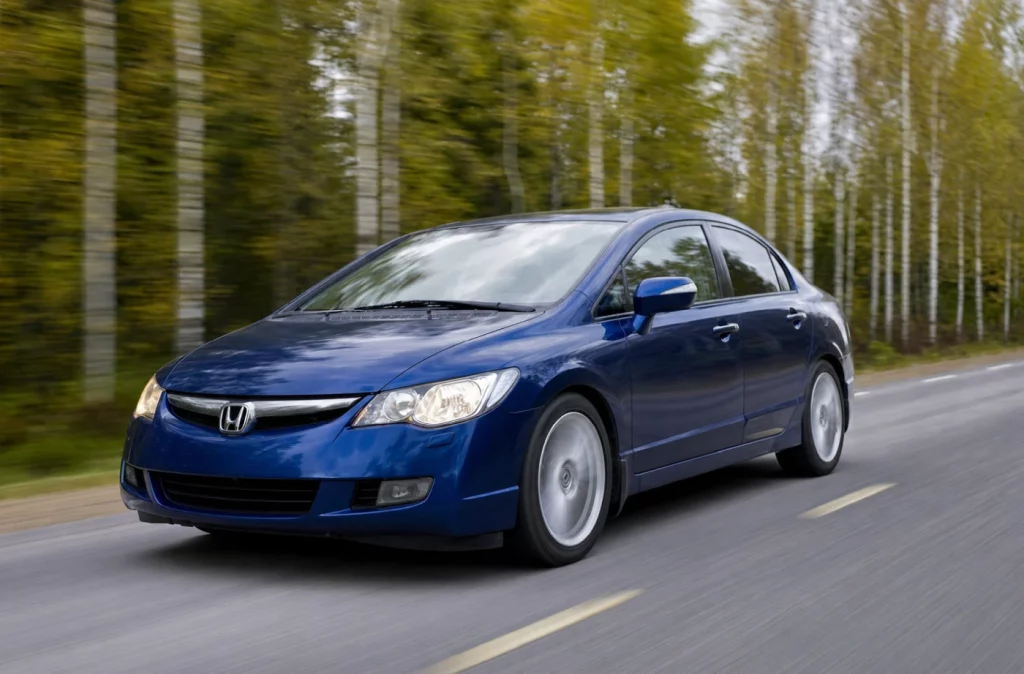
This article evaluates the 8th generation Civic’s NHTSA and IIHS crashworthiness data from a 2026 perspective, compares its standard safety equipment to the 11th generation, identifies the specific crash scenarios where it performs well and where it falls short, and provides a practical assessment for anyone considering an 8th gen Civic in 2026.
The Safety Equipment It Had — and What It Lacked
The 8th generation Civic was equipped with a generous set of standard safety features by 2006 standards. Viewed from 2026, that list is both impressive for its era and reveals the gaps.
Standard equipment (all trims, 2006):
- Advanced Compatibility Engineering (ACE) body structure — a Honda exclusive designed to improve crash compatibility between vehicles of different sizes by distributing frontal crash energy through upper and lower frame members
- Front and rear side curtain airbags with rollover deployment capability (head protection)
- Front seat-mounted side torso airbags with Occupant Position Detection System (OPDS) on the passenger side
- Active front head restraints (AHR) — mechanically linked to minimize whiplash in rear impacts
- 4-channel anti-lock braking system (ABS) with Electronic Brake-force Distribution (EBD)
- Driver and front passenger seat belt pretensioners with force limiters
- 3-point seat belts AT all five seating positions (center rear included — uncommon in the compact segment in 2006)
What was not standard (and matters in 2026):
- Electronic Stability Control (ESC) — standard only on 2007 Si, 2009 EX-L and Hybrid. Optional or unavailable on all other trims. ESC was not federally mandated in the US until the 2012 model year
- Backup camera — not available. Rear visibility is limited, particularly on the sedan
- Forward collision warning — not available on any 8th gen Civic
- Automatic emergency braking — not available
- Lane departure warning — not available
- Blind spot monitoring — not available
- Rear cross-traffic alert — not available
- Adaptive headlights — not available. All trims used halogen projector bulbs
The most significant operational gap is ESC. An 8th generation Civic without ESC loses the primary loss-of-control mitigation system that has been standard on every vehicle built since 2012. NHTSA estimated that ESC reduces single-vehicle crash risk by 34% for passenger cars (NHTSA, FMVSS 126 final rule). For 8th gen Civics without ESC, the car relies entirely on the driver’s ability to maintain control during emergency maneuvers.
NHTSA Scores — Protocol Change Makes the 2011 Model Look Worse Than It Is
The 8th generation’s NHTSA scores are split by a protocol change that makes direct comparison misleading.
2006–2010 models (pre-2011 NCAP protocol): The 2006 Civic 4-door with side airbags earned 5 out of 5 for frontal driver, frontal passenger, and rear passenger side impact. The side driver score was 4 out of 5 — the side curtain airbag provided head protection, but torso coverage from the seat-mounted side airbag was less comprehensive than later designs. Rollover resistance was not tested during this era — those model years have no NHTSA rollover rating. The coupe followed the same pattern (NHTSA NCAP).
These scores are high but were earned under a less demanding protocol. The pre-2011 side test used a lighter barrier and less stringent chest deflection criteria. Direct comparison to 2011+ Civics is not valid.
2011 model (post-2011 NCAP protocol): NHTSA introduced a tougher side impact barrier, more stringent chest deflection criteria, and added the rollover resistance test for 2011. The 2011 Civic 4-door scored 4 out of 5 overall with 3 out of 5 frontal, 3 out of 5 side, and 3 out of 5 rollover (NHTSA NCAP).
The 3/5 side score on the 2011 model is not evidence that the 2006–2010 cars are safer. It reflects a harder test. The 2011 Civic’s physical structure is identical to the 2006–2010 cars. The 2006–2010 cars would have earned similar scores under the same protocol.
IIHS Moderate Overlap Front — Still Competitive
The 8th generation Civic earned Good in the moderate overlap front test (40% offset at 40 mph). The rating applies to all 2006–2011 models, both sedan and coupe (IIHS, 2006 Civic ratings).
The specific intrusion measurements are informative for 2026 perspective. In the moderate overlap test (Test ID CEF0530), the 8th gen showed:
- Footrest intrusion: 9 cm
- Left toepan: 8 cm
- Center toepan: 9 cm
- Right toepan: 6 cm
- Brake pedal movement: 7 cm
- Instrument panel rearward: 2 cm (left and right)
- Steering column: 2 cm upward, −2 cm rearward (away from driver)
- A-Pillar rearward movement: 1 cm
For comparison, the 9th generation 2012 model improved footrest intrusion from 9 cm to 5 cm and brake pedal movement from 7 cm to 3 cm. The 8th generation’s footwell intrusion is roughly double the 9th generation’s in every measurement point, but both earned Good. The 8th generation’s moderate overlap performance is adequate for its Good rating — the occupant compartment held with manageable intrusion — but the footwell deformation is measurably worse than any subsequent Civic generation (IIHS, Test IDs CEF0530, VTF1212).
The 8th generation was never tested in the updated moderate overlap test (2024 criteria with rear passenger measurements), so a direct comparison to the 11th generation in the updated protocol is not available.
IIHS Side Impact — The Structural Weakness
The side impact test is where the 8th generation’s age shows most clearly. The overall rating is Good, but the structure and safety cage was rated Acceptable — not Good. This distinction matters because later generations earned Good structure ratings.
The sedan’s side impact measurements (Test ID CES0530):
- B-Pillar stopped 10.5 cm short of the driver seat centerline
- Driver head HIC-15: 476 (significantly higher than the 9th gen’s 284)
- Driver torso maximum deflection: 46 mm (higher than the 9th gen’s 38 mm)
- Driver torso deflection rate: 4.97 m/s
- Driver pelvis combined force: 5.0 kN
- Rear passenger head HIC-15: 294
- Rear passenger torso deflection: 38 mm
- Rear passenger pelvis combined force: 3.7 kN
The driver chest injury measures (46 mm deflection, 4.97 m/s deflection rate, 0.86 viscous criterion) are the weakest of any Civic generation tested on the original protocol. The IIHS side test interpretation notes that “rib fractures and a fracture of the pelvis would be possible in a crash of this severity” for the 8th generation coupe specifically (IIHS, archived 2006–2010 coupe rating). The sedan scores were better but still showed a 46 mm torso deflection — 8 mm higher than the 9th generation and 17 mm higher than the 10th generation.
The 8th generation coupe’s side impact performance was worse than the sedan’s. The archived IIHS coupe rating shows Acceptable overall (not Good), with Acceptable structure and Marginal driver torso — the only “good” ratings were for head/neck and pelvis/leg (IIHS, archived 2006–2010 Civic coupe rating).
In 2026 terms: in a side impact at the same severity, an 8th generation Civic driver absorbs approximately 40% more head acceleration (476 vs 284 HIC-15), 8 mm more chest deflection, and 0.5 kN more pelvic force than a 9th generation driver. The side curtain airbag protects the head well, but the B-pillar, door beams, and Rocker Panel are structurally less capable.
IIHS Small Overlap Front — The Biggest Unknown
The 8th generation Civic was never tested in the IIHS small overlap front crash (25% offset at 40 mph). The test did not exist when the car was designed, and no 8th gen Civic was ever tested after the protocol was introduced in 2012.
This is the most significant safety data gap for the 8th generation. The small overlap crash accounts for approximately 25% of serious frontal crash injuries (IIHS; AutoWeek, March 2013). In this crash mode, the vehicle’s main longitudinal frame members are not engaged — the wheel and suspension take the initial impact, and the hinge pillar and A-pillar carry the load.
There is no test data to confirm or deny the 8th generation’s small overlap protection. The ACE body structure was designed for moderate overlap compatibility (engaging both upper and lower frame members) rather than the extreme offset scenario of the small overlap test. The 8th gen has no secondary load path structure in the front Subframe — that was added with the ACE II body structure in 2013. The hinge pillar is not reinforced with the same high-strength steel as later generations.
The reasonable inference: the 8th generation would not perform well in the small overlap test. The 9th generation 2013 model, with its ACE II reinforcement, recorded 12 cm of hinge pillar intrusion while earning Good. An 8th gen Civic, lacking any of the ACE II secondary load paths, would likely show more intrusion. But without a test result, this remains an assumption.
In 2026, buying an 8th gen Civic means accepting an unknown small overlap protection level. The car has never been tested in the crash mode that causes a quarter of serious frontal injuries.
Roof Strength — Lowest of Any Civic Generation
The 8th generation Civic’s roof strength test was the first conducted by IIHS on this generation (the test was introduced in 2009). The 2010 Civic LX 4-door achieved a strength-to-weight ratio of 4.48, a peak force of 12,532 lbs, and a curb weight of 2,760 lbs (IIHS, 2010 Civic roof strength test).
Compared to later generations:
| Generation | SWR | Peak Force | Curb Weight | Improvement over 8th Gen |
|---|---|---|---|---|
| 8th (2006–2011) | 4.48 | 12,532 lbs | 2,760 lbs | — |
| 9th (2012–2015) | 5.85 | 15,665 lbs | 2,678 lbs | +30.6% in SWR, +25.0% in peak force |
| 10th sedan (2016–2021) | 5.78 | 15,829 lbs | 2,738 lbs | +29.0% in SWR, +26.3% in peak force |
| 11th (2022–2025) | 7.62 | 21,689 lbs | 2,845 lbs | +70.1% in SWR, +73.1% in peak force |
Source: IIHS roof strength test results for each generation.
The 4.48 SWR is Good (the threshold is 4.0), but it is the lowest SWR of any Civic generation tested. In a rollover crash, the 8th generation’s roof can support 12,532 lbs of peak force, compared to 21,689 lbs for the 11th generation — a 73% difference.
For a daily-driven car in 2026, this matters less than the small overlap gap because rollover crashes are statistically less common than frontal impacts. But for anyone buying an 8th gen Civic for a new driver — statistically the demographic most at risk for single-vehicle loss-of-control rollovers — the 4.48 SWR is a genuine structural limitation.
Head Restraints — One of the Few Areas Where the 8th Gen Holds Up
The 8th generation’s active head restraints earned Good in the IIHS rear impact test — the same rating earned by the 9th, 10th, and 11th generations. The backset was 28 mm, distance below top of head was 52 mm, head contact time was 62 ms, and max neck tension was 677 N. The AHR mechanical linkage system — where the occupant’s body pushes against the seatback, mechanically pushing the head restraint upward and forward — was effective then and remains effective today. The 8th gen Civic is no worse than a 2026 Civic in whiplash protection (IIHS, 2006 Civic head restraint test).
The 8th Gen vs 11th Gen — A Direct Safety Gap Assessment
| Safety Dimension | 8th Gen (2006–2011) | 11th Gen (2022–2025) | Gap Assessment |
|---|---|---|---|
| NHTSA overall (same protocol comparison) | N/A (different protocol) | 5/5 (29/30 pts) | Not directly comparable. 8th gen would likely score lower under current NCAP |
| IIHS small overlap driver | Not tested | Good (1 cm intrusion) | Major gap. 8th gen has no verified small overlap protection |
| IIHS small overlap passenger | Not tested | Good (0 cm intrusion) | Major gap |
| IIHS moderate overlap front | Good (9 cm footrest intrusion) | Good (updated test) | Both Good, but 8th gen footwell intrusion is substantial |
| IIHS side — structure | Acceptable | Good | Structural gap. 8th gen door beams and B-pillar are less capable |
| IIHS side — B-pillar clearance | 10.5 cm | 17.5 cm | 7 cm less survival space in side impact |
| IIHS roof strength (SWR) | 4.48 | 7.62 | 70% lower peak force capacity |
| ESC | Not standard (most trims) | Standard | Major gap on non-ESC 8th gen models |
| Automatic emergency braking | Not available | Standard (Superior-rated) | Not available at all on 8th gen |
| Forward collision warning | Not available | Standard | Not available |
| Backup camera | Not available | Standard | Not available |
| Side airbag coverage | Curtain + torso front, no rear side | 10 total including rear side | No rear side airbags on 8th gen |
| Airbag technology | Conventional front airbags | Donut driver, 3-chamber passenger | 11th gen designed to reduce brain rotation injury |
| Headlight performance | Not rated (halogen projector) | Acceptable (LED projector) | Night visibility limited on 8th gen |
Sources: IIHS vehicle ratings for 2006 and 2022 Civic. NHTSA NCAP. Honda Newsroom (2005, 2021).
The 2006 Top Safety Pick Gold — Context for 2026
The 8th generation Civic made history in December 2005 by becoming the first small car to earn IIHS Top Safety Pick Gold — the highest IIHS award available at the time. To earn it, the Civic needed Good in moderate overlap front, Good in side, and Good in head restraints. Only five vehicles in any segment achieved this designation in 2005 (Honda Newsroom, December 5, 2005).
In 2026, the Top Safety Pick Gold designation is obsolete. IIHS has replaced it with Top Safety Pick (requires Good in moderate overlap, Good in side, Good in roof strength, Acceptable+ headlights) and Top Safety Pick+ (adds Good or Acceptable in small overlap driver and passenger tests, Good or Acceptable headlights). The 8th gen Civic could not qualify for 2026 TSP because it lacks small overlap test results, roof strength was not part of the Gold criteria in 2005, and its headlights (halogen projectors) would not meet Acceptable thresholds.
The 2006 Gold award was meaningful at the time. In 2026, it means the 8th generation was a safe car for its era — not that it is safe by 2026 standards.
Which 8th Gen Models to Prioritize for Safety
If someone is buying an 8th generation Civic in 2026 and wants the safest configuration within that generation’s limits:
Prioritize the sedan over the coupe. The sedan’s side impact structure earned Good overall (structure Acceptable). The coupe’s side impact overall was Acceptable, with Marginal driver torso — statistically the worst crash test result of any 8th gen model.
Prioritize 2009+ models. Electronic Stability Control was introduced on the 2009 EX-L and Hybrid. The 2009+ EX-L and Hybrid models are the only 8th gen Civics with the single most important crash avoidance technology that the generation lacks. The 2007+ Si also has ESC.
Look for the EX or higher trim. LX and DX trims have the same crash structure as higher trims, but the EX and EX-L add standard side curtain airbags (standard across the generation — all trims had them). The practical difference is minimal for passive crash safety.
Understand what ESC looks like. ESC was dealer-optional on some 2006–2008 LX and EX trims but rarely ordered. A used 8th gen Civic without ESC is much more common than one with it. Verify the window sticker or check for the VSA button on the dashboard.
Avoid 2006–2008 models without ESC entirely for new drivers. The combination of no ESC, the weakest roof strength of any Civic generation (4.48 SWR), and the Acceptable side structure rating creates a safety profile that is significantly below modern standards for a driver with limited experience.
The Bottom Line on the 8th Gen Civic in 2026
The 8th generation Civic is not an unsafe car. Its ACE body structure, side curtain airbags, and active head restraints provide a baseline of protection that is substantially better than a car from the late 1990s or early 2000s. In a moderate overlap frontal crash or a rear impact, it offers protection comparable to a much newer vehicle.
The real safety deficits are three specific areas:
Small overlap frontal crashes. The 8th gen has never been tested, and the structure was not designed to manage this crash mode. This is the single biggest unknown. If the car hits a pole, tree, or the corner of another vehicle at the driver-side front corner, there is no test data predicting how well the occupant compartment will hold.
Side impact structure. The Acceptable structure rating and 10.5 cm B-pillar clearance are meaningfully worse than any later Civic generation. In a T-bone collision with a truck or SUV — the most dangerous real-world side impact scenario — the 8th gen provides less survival space than a 9th, 10th, or 11th generation Civic.
Crash avoidance. The absence of ESC (on most trims), AEB, FCW, and backup camera means the 8th gen relies entirely on the driver to avoid crashes rather than helping to prevent them. A 2026 Civic with standard Honda Sensing can brake automatically for a stopped car or pedestrian. An 8th gen Civic cannot.
For a budget-conscious buyer who drives defensively, understands the car’s limitations, and can find a 2009+ EX-L or Hybrid model with ESC, the 8th generation Civic is not a reckless choice — but it is a choice that requires understanding where the safety gaps are.
8th Gen Safety — Quick Reference:
☐ NHTSA: 2006–2010 models scored 5/5 front, 4/5 side driver under the pre-2011 protocol. 2011 model scored 4/5 overall, 3/5 front, 3/5 side, 3/5 rollover under the tougher protocol. Do not compare the two directly (NHTSA NCAP)
☐ IIHS moderate overlap: Good. Footrest intrusion 9 cm, left toepan 8 cm. Acceptable by 2006 standards, roughly double the footwell intrusion of the 9th generation (IIHS, Test ID CEF0530)
☐ IIHS side: Good overall, but structure Acceptable — not Good. Driver torso deflection 46 mm, head HIC-15 476. B-pillar clearance 10.5 cm. Rear passenger HIC-15 294 (IIHS, Test ID CES0530)
☐ IIHS side — coupe: Acceptable overall with Marginal driver torso — the worst IIHS side result of any Civic generation (IIHS, archived coupe rating 2006–2010)
☐ IIHS small overlap: Never tested — the biggest unknown. The ACE I body structure was not designed for this crash mode (IIHS protocol introduced 2012)
☐ IIHS roof strength: 4.48 SWR, 12,532 lbs peak. Lowest of any tested Civic generation. 73% less peak force capacity than the 11th generation (IIHS, 2010 Civic roof test)
☐ ESC: Not standard on most trims. Only 2007+ Si, 2009+ EX-L, and Hybrid have it. No ESC = no loss-of-control mitigation (NHTSA FMVSS 126; Honda specs by year)
☐ Crash avoidance: No FCW, no AEB, no backup camera. Relies entirely on the driver (Honda Newsroom, 2005)
☐ Airbags: 6 total — front, front seat-mounted side, side curtain. No rear seat side airbags. No head-cradling front airbag design (Honda Newsroom, 2005)
☐ Head restraints: Good — active head restraint technology is comparable to 2026 Civics in rear impact protection (IIHS, 2006 Civic)
☐ Best 8th gen safety configuration: 2009+ EX-L or Hybrid sedan (adds ESC). Avoid the coupe for side impact. Avoid 2006–2008 models without ESC for new drivers
☐ Verdict: Not an unsafe car by absolute measures, but has three real gaps — no small overlap data, Acceptable side structure, and minimal crash avoidance. Acceptable for a knowledgeable adult driver who understands these limits