

7th Gen Civic (2001–2005) Safety — The Gaps, the Tests, and the Verdict
The 7th generation Honda Civic (2001–2005) occupies an awkward position in the model’s safety history. It was the first Civic to offer side airbags as an option and the last Civic before Honda introduced the ACE body structure, side curtain airbags, and active head restraints in the 8th generation. By 2026, a 7th gen Civic is 21 to 25 years old — old enough that its structural design predates nearly every modern crash test protocol. The question is not whether a 2026 Civic is safer — it is. The question is whether a 7th gen Civic still provides adequate baseline protection, or whether the cumulative gaps across crash modes, equipment, and structural design make it genuinely unsafe by modern standards.
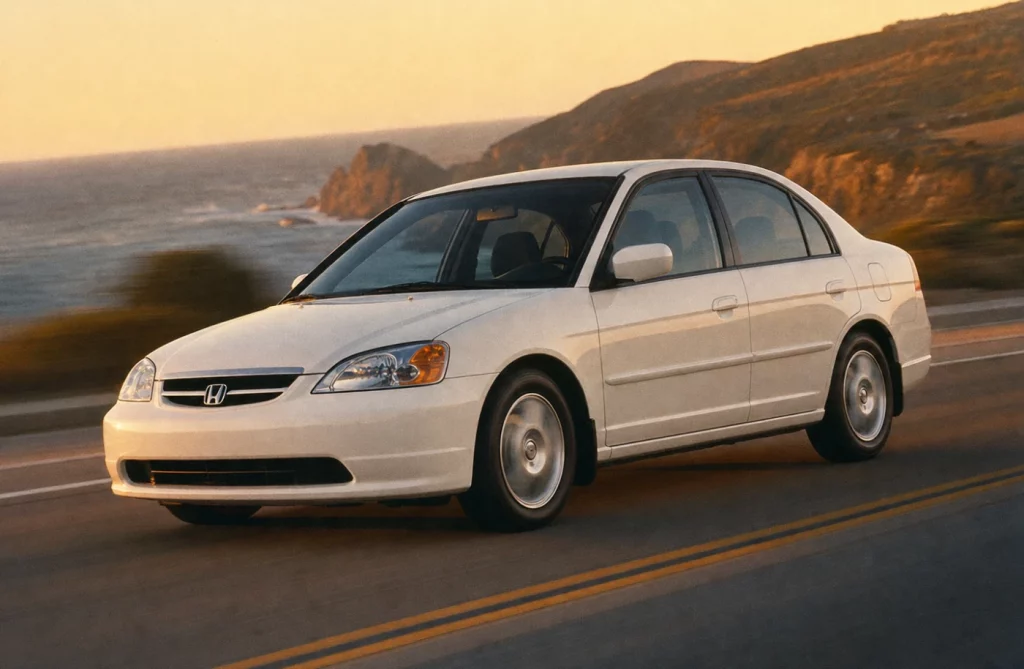
This article covers every available crash test result for the 7th generation Civic — IIHS moderate overlap and head restraint data, NHTSA scores under the pre-2011 protocol, and the specific structural and equipment gaps that define this generation’s safety profile in 2026.
The 7th Generation’s Standard Safety Equipment — and What Was Missing
The 2001 Civic was a clean-sheet redesign that moved the fuel tank from behind the rear seat to under the floor (mid-ship placement, a Honda safety innovation from the 1990s). Its standard safety equipment was competitive for 2001. By 2026, the gaps are substantial.
Standard safety equipment (all trims):
- Dual front airbags (second-generation, depowered for 2001–2005 to meet updated FMVSS requirements)
- 3-point seat belts AT all five seating positions
- Front seat belt pretensioners and force limiters
- Adjustable front head restraints (non-active, non-locking on early models)
- Side-impact door beams (steel beams inside each door)
- Antilock brakes (ABS) — standard on EX and higher trims, optional on LX, not available on DX
Optional or unavailable:
- Front seat-mounted side torso airbags — optional on EX and EX-L trims, not available on DX or LX. Side airbags were a $250 option in 2001
- Side curtain airbags — not available on any 7th gen Civic. This is the single most significant passive safety gap
- Electronic Stability Control — not available. ESC did not exist on any Honda product until the 2000s
- Active head restraints — not available. The 7th gen’s non-active adjustable head restraints are a generation behind the 8th gen’s AHR system
- Backup camera — not available
- Forward collision warning — not available
- Automatic emergency braking — not available
- Daytime running lights — not available on US-market Civics (standard in Canada)
The absence of side curtain airbags is the most important single gap. In a side impact, the 7th gen provides head protection only through the side glass and door beam. There is no curtain airbag to prevent head contact with the intruding barrier or window glass. The seat-mounted torso airbag (when equipped) provides chest protection for the front occupants, but rear passengers have only the door beam and seat belt.
IIHS Moderate Overlap Front — Surprisingly Good for a 2001 Design
The 7th generation Civic earned Good in the IIHS moderate overlap front test (40% offset at 40 mph). The test was conducted on a 2001 Civic LX 4-door and applies to all 2001–2005 models (IIHS, Test ID CF00031). The overall evaluation was Good with Good structure, Good head/neck, Good chest, Good leg/foot left, Good leg/foot right, and Good restraints and dummy kinematics.
The occupant compartment intrusion measurements:
| Intrusion Point | 7th Gen (2001–2005) | 8th Gen (2006–2011) | Difference |
|---|---|---|---|
| Footrest | 8 cm | 9 cm | 7th gen 1 cm better |
| Left toepan | 11 cm | 8 cm | 8th gen 3 cm better |
| Center toepan | 11 cm | 9 cm | 8th gen 2 cm better |
| Right toepan | 10 cm | 6 cm | 8th gen 4 cm better |
| Brake pedal | 8 cm | 7 cm | 8th gen 1 cm better |
| IP left rearward | 3 cm | 2 cm | 8th gen 1 cm better |
| Steering column upward | 1 cm | 2 cm | 7th gen 1 cm better |
| Steering column rearward | −1 cm | −2 cm | Both moved away from driver |
| A-pillar rearward | 0 cm | 1 cm | 7th gen 1 cm better |
Sources: IIHS, Test IDs CF00031 (2001 Civic), CEF0530 (2006 Civic).
The driver injury measures in the moderate overlap test tell a mixed story. The head HIC-15 was 468 — identical to the 8th generation’s 476 within measurement tolerance, but noticeably higher than the 9th generation’s unspecified value (which was lower). Chest maximum compression was 39 mm, comparable to later generations. Left femur force was 2.8 kN — higher than the 8th generation’s unspecified femur value but still within Good thresholds. Left foot acceleration was 126 g — a measure of the forces transmitted through the floorpan, which is substantially higher than modern designs (IIHS, Test ID CF00031).
The 7th generation’s moderate overlap front performance is genuinely impressive for a 2001 design. It earned the same Good rating as every subsequent Civic generation. The footwell intrusion on the left toepan (11 cm) is worse than the 8th generation (8 cm), but both are Good. The key difference is occupant positioning and restraint geometry — later generations control the dummy’s kinematics more predictably, particularly for out-of-position occupants and smaller-stature drivers.
IIHS Side Impact — Not Tested, and That Is the Real Problem
The 7th generation Civic was never tested by IIHS in the side impact crash test. The IIHS archive shows that side impact testing on the Civic began with the 2006 model year (IIHS, archived 2001–2005 Civic ratings page). This means there is zero IIHS-verified side impact protection data for the entire 7th generation run.
The absence of a test is itself informative. IIHS prioritized testing vehicles with side airbags as standard equipment starting in the mid-2000s. The 7th gen Civic, with optional side torso airbags and no side curtain airbags, was not prioritized because the test protocol at the time evaluated head protection as a separate metric. Cars without side curtain airbags generally scored Poor or Marginal in head protection.
The practical implication: the 7th generation Civic’s side impact protection is limited to its door beams, B-Pillar, and seat belt geometry. In a T-bone collision at modern speeds, a 7th gen Civic provides no airbag protection for the occupant’s head. The seat-mounted torso airbag (if equipped) protects the chest, but there is nothing between the occupant’s head and the intruding vehicle or barrier.
The 8th generation (2006–2011) provides a useful comparison. With standard side curtain airbags covering both rows, the 8th gen earned Good in the IIHS side test (structure Acceptable) with a B-pillar clearance of 10.5 cm. The 8th gen’s side curtain airbag was the primary reason it earned Good despite the Acceptable structure rating. The 7th gen, lacking that airbag, would almost certainly score worse on head protection regardless of its structural intrusion.
NHTSA side impact. NHTSA tested the 7th generation Civic under the pre-2011 side impact protocol. The NHTSA side scores for the 2001 Civic 4-door with side airbags show comparable protection levels to the 8th generation under the same protocol — 4 out of 5 for side driver, 5 out of 5 for side passenger. These scores are valid for the protocol used at the time, but the pre-2011 side test used a lighter moving barrier and less stringent chest deflection criteria than the current NHTSA protocol (NHTSA NCAP).
IIHS Head Restraints — Poor, and Tested
The 7th generation Civic’s head restraints were tested by IIHS and earned Poor — the only Civic generation to receive this rating. The 2005 Civic LX 4-door was the test vehicle, and the results apply to all 2001–2005 models (IIHS, 2005 Civic head restraint test).
The specific failure: the seat dynamic rating was Poor, geometry was Good. The seat allowed excessive head movement in a simulated rear impact. Backset was 62 mm (the distance between the occupant’s head and the head restraint — 28 mm on the 8th gen). Head contact time was 99 ms (62 ms on the 8th gen). Max neck shear force was 299 N, and max neck tension was 1,149 N — both significantly higher than the 8th generation’s 52 N and 677 N respectively.
The practical meaning: in a rear-end collision, a 7th generation Civic occupant is at substantially higher risk of whiplash injury than an occupant of any later Civic generation. The non-active, adjustable head restraints on the 7th gen do not lock into position behind the occupant’s head, and the seatback geometry allows greater head excursion before the restraint makes contact. The 8th generation’s active head restraints (AHR) were a generational leap in whiplash protection, and the 7th gen’s Poor rating is the direct result of Honda not having that technology yet.
Tests That Were Never Run — Small Overlap, Roof Strength, Headlights
Small overlap front. Not tested. The IIHS small overlap test did not exist until 2012. The 7th gen Civic’s frontal structure was not designed to manage a 25% offset crash. The ACE body structure — specifically designed to distribute crash energy across a wider front-end area — was introduced with the 8th generation in 2006. The 7th generation has no equivalent structure. There is no test data, but the structural inference is clear: the 7th gen would not perform well in a small overlap crash.
Roof strength. Not tested. IIHS began roof strength testing in 2009. The 7th gen Civic was never evaluated. Based on its body structure and steel content (lower grades and less high-strength steel than the 8th gen), the roof strength is expected to be lower than the 8th generation’s 4.48 SWR — and the 8th gen’s 4.48 is already the lowest of any tested Civic generation. A conservative estimate would place the 7th gen’s SWR in the 3.5–4.0 range, which would be Marginal or Poor under IIHS criteria.
Headlights. Not rated. IIHS headlight evaluations began in 2016. The 7th generation used halogen reflector headlights with performance typical of early 2000s standards — adequate low-beam reach by 2001 standards, poor by 2026 standards.
NHTSA Scores — Pre-2011 Protocol Context
NHTSA tested the 7th generation Civic under the pre-2011 New Car Assessment Program. The 2001 Civic 4-door with side airbags earned 4 out of 5 for driver frontal, 5 out of 5 for passenger frontal, 4 out of 5 for side driver, and 5 out of 5 for side passenger. Rollover resistance was not rated for models prior to 2011 (NHTSA NCAP).
These scores are within the range of the 8th generation under the same protocol. The 8th gen earned 5/5 front (both sides), 4/5 side driver, 5/5 side passenger — marginally better frontal protection but similar side. The difference is that the 8th gen’s 4/5 side driver was earned with a side curtain airbag that also provided head protection. The 7th gen’s 4/5 side driver was earned without a curtain airbag, relying on the seat-mounted torso bag and door beam.
Neither score is directly comparable to the post-2011 NHTSA protocol, which uses a heavier barrier, more stringent chest deflection criteria, and adds a rollover resistance rating.
The Structural Gap Between the 7th and 8th Generations
The 8th generation was a much larger safety leap over the 7th than any subsequent generation-to-generation change. The specific structural improvements demonstrate why:
| Safety Feature | 7th Gen (2001–2005) | 8th Gen (2006–2011) | Significance |
|---|---|---|---|
| ACE body structure | Not available | Standard (first gen ACE) | Dramatically improves frontal crash energy distribution and large-vehicle compatibility |
| Side curtain airbags | Not available | Standard (front and rear rows) | Provides head protection in side impacts — the single most important gap on the 7th gen |
| Front seat side torso airbags | Optional (EX trims) | Standard | Standard on 8th gen, optional on 7th |
| Active head restraints (AHR) | Not available | Standard | IIHS Good vs Poor in rear impact protection |
| IIHS side impact rating | Not tested (expected Poor head protection) | Good (structure Acceptable) | 8th gen provides documented side protection |
| IIHS head restraint rating | Poor | Good | 8th gen reduces whiplash risk dramatically |
| IIHS roof strength | Not tested (estimated ~3.5–4.0 SWR) | 4.48 SWR (Good) | 8th gen provides documented rollover protection |
| Three-point center rear belt | Standard | Standard | Both generations provide this — better than 6th gen lap belt |
| High-strength steel content | ~30–40% | ~50% | 8th gen has more extensive HSS in critical load paths |
| ABS availability | Standard EX+, optional LX, not on DX | Standard all trims | 8th gen gives every trim ABS braking |
| ESC (VSA) | Not available | Optional on Si, EX-L, Hybrid (2009+) | Limited availability on 8th gen, zero on 7th gen |
Sources: IIHS vehicle ratings for 2001 and 2006 Civic. Honda Newsroom (2005, 2006). Honda Techinfo body repair manuals.
The jump from the 7th to the 8th generation represents a larger safety improvement than from the 8th to the 9th, or from the 9th to the 10th. The ACE body structure, side curtain airbags, active head restraints, and higher high-strength steel content were all introduced simultaneously with the 2006 redesign. Anyone considering a 7th gen Civic in 2026 should understand that the 8th generation — which can be found for roughly the same used price — provides dramatically better crash protection across every dimension.
How a 7th Gen Civic Protects You in Specific Crash Scenarios
Frontal collision with a similar vehicle. Adequate. The Good moderate overlap rating applies here. The occupant compartment held with manageable intrusion. The depowered dual front airbags and seat belt pretensioners provide baseline protection comparable to a modern car in this specific crash mode.
Frontal collision with a larger vehicle (SUV or truck). Significantly worse than a modern Civic. The 7th gen has no ACE body structure, which means the front frame members do not engage the opposing vehicle’s primary load paths as effectively. The 7th gen is at a geometric disadvantage against a tall SUV front end, and the lack of ACE height-matched engagement increases the risk of underride or over-ride.
Side impact (T-bone). The biggest risk. No side curtain airbag means the occupant’s head is unprotected against the intruding structure or the striking vehicle. The door beam provides some chest/pelvis protection, but a side impact from a modern SUV or pickup at 30+ mph would likely cause severe head injury.
Rear impact. Higher whiplash risk than any later Civic. The Poor head restraint rating means neck injury is more likely in even a moderate rear collision.
Rollover. Unknown. No roof strength data exists. Based on structural design, the 7th gen’s roof is expected to be the weakest of any Civic generation, with an estimated SWR of 3.5–4.0. Combined with the absence of ESC on all trims, the rollover risk profile is poor.
Single-vehicle loss of control. No ESC. The driver has no electronic stability intervention to prevent a spin or slide. For an inexperienced driver or in adverse weather, this is a genuine safety risk.
Is a 20-Year-Old Civic Still Safe Enough?
The honest answer depends on who is driving it and what it is being used for.
For an experienced adult driver on familiar roads, in good weather, with defensive driving habits: The 7th gen Civic provides adequate frontal crash protection in a moderate overlap collision with a similar-sized vehicle. The driver understands that side impact protection is minimal, rear impact whiplash risk is higher than any other Civic, and the car has no electronic crash avoidance of any kind. A knowledgeable driver can mitigate some of the risk through driving behavior.
For a new driver, a young driver, or a driver who covers significant highway miles: The 7th gen Civic is not a safe choice by 2026 standards. The combination of no side curtain airbags, no roof strength data, no ESC, Poor head restraints, and no ACE body structure creates a safety profile that is substantially below what a modern compact car provides. A new driver — statistically the age group most likely to be in a crash — would be significantly safer in an 8th generation Civic (2006–2011) for roughly the same purchase price.
As a daily driver in 2026 traffic: The 7th gen Civic faces a higher-risk driving environment than when it was new. The average vehicle on the road in 2026 is larger, heavier, and taller than the average vehicle in 2001. The 7th gen Civic is at a compatibility disadvantage against SUVs and trucks that outweigh it by 3,000+ lbs. The ACE body structure, which addresses this exact compatibility problem, was not introduced until the 8th generation.
The hard truth: The 7th generation Civic is the first Civic generation where the cumulative safety gaps — no side curtain airbags, no ACE body, unknown roof strength, Poor head restraints, no ESC — add up to a genuinely marginal safety profile by 2026 standards. The 8th generation, which addressed every one of these gaps simultaneously, was a generational safety leap. The 7th gen is a safe car for its era, but its era ended 20 years ago.
7th Gen Safety — Quick Reference:
☐ IIHS moderate overlap front: Good — the 7th gen’s strongest result. Applies to all 2001–2005 sedans. Footrest 8 cm, left toepan 11 cm intrusion. Head HIC-15 468, chest compression 39 mm (IIHS, Test ID CF00031)
☐ IIHS side impact: Not tested. No side curtain airbags — the single biggest safety gap. Seat-mounted torso airbags were optional (EX trims only). Zero IIHS-verified side protection data exists for this generation (IIHS, archived 2001–2005 ratings)
☐ IIHS small overlap: Not tested — test did not exist. No ACE body structure. Would likely perform poorly based on structural design (IIHS protocol introduced 2012)
☐ IIHS roof strength: Not tested. Estimated SWR of 3.5–4.0 based on steel content and body design — would be Marginal or Poor. Lowest estimated roof strength of any Civic generation (IIHS roof test protocol began 2009)
☐ IIHS head restraints: Poor — only Civic generation with this rating. Backset 62 mm, head contact time 99 ms, max neck tension 1,149 N vs 8th gen’s 677 N. Significantly higher whiplash risk in rear impacts (IIHS, 2005 Civic head restraint test)
☐ NHTSA: 4/5 driver frontal, 5/5 passenger frontal, 4/5 side driver, 5/5 side passenger (pre-2011 protocol, with side airbags). Rollover not rated. Not comparable to post-2011 NHTSA scores (NHTSA NCAP)
☐ ACE body structure: Not available on any 7th gen Civic. Introduced with the 8th generation in 2006. This is the single most important structural upgrade that the 7th gen lacks (Honda Newsroom, 2005)
☐ ESC (VSA): Not available on any 7th gen Civic. No electronic stability control of any kind — the car has no loss-of-countermeasure beyond the driver’s reflexes (Honda specs by year)
☐ Side curtain airbags: Not available. Rear seat passengers have zero side airbag protection. Front passengers have head protection only when the optional seat-mounted torso bag is equipped (Honda, 2001 Civic specs)
☐ Airbag count (maximum): 4 (dual front + optional front side torso). Compare to 8th gen’s 6 (standard) and 11th gen’s 10 (standard)
☐ Frontal crash data gaps: No small overlap test. The 7th gen’s moderate overlap Good rating applies only to 40% offset, not the 25% offset that accounts for ~25% of serious frontal crash injuries (IIHS)
☐ 7th gen vs 8th gen: The safety gap between these two generations is larger than any subsequent gen-to-gen gap (8→9, 9→10, 10→11). The 8th gen is dramatically safer in every dimension and costs roughly the same on the used market (IIHS; Honda Newsroom, 2005, 2006)
☐ Verdict: The 7th gen Civic is marginal by 2026 safety standards. Adequate moderate overlap frontal protection, but no side curtain airbags, no ACE body, unknown roof strength, Poor whiplash protection, zero crash avoidance. Acceptable only for a knowledgeable adult driver who understands these limits. Not recommended for new drivers or families