

Honda Civic Frontal Crash Test Analysis — NHTSA and IIHS Data by Generation
The Honda Civic has been crash-tested under the National Highway Traffic Safety Administration’s New Car Assessment Program (NCAP) since 1978, but the frontal crash test scores across generations tell a story that is less about the car getting safer and more about the test getting harder. The same 2006 Civic sedan that earned a perfect 5 out of 5 in NHTSA frontal crash protection would not score a 5 if tested under the 2026 protocol. The barrier speed, dummy instrumentation, and injury criteria have all been revised multiple times.
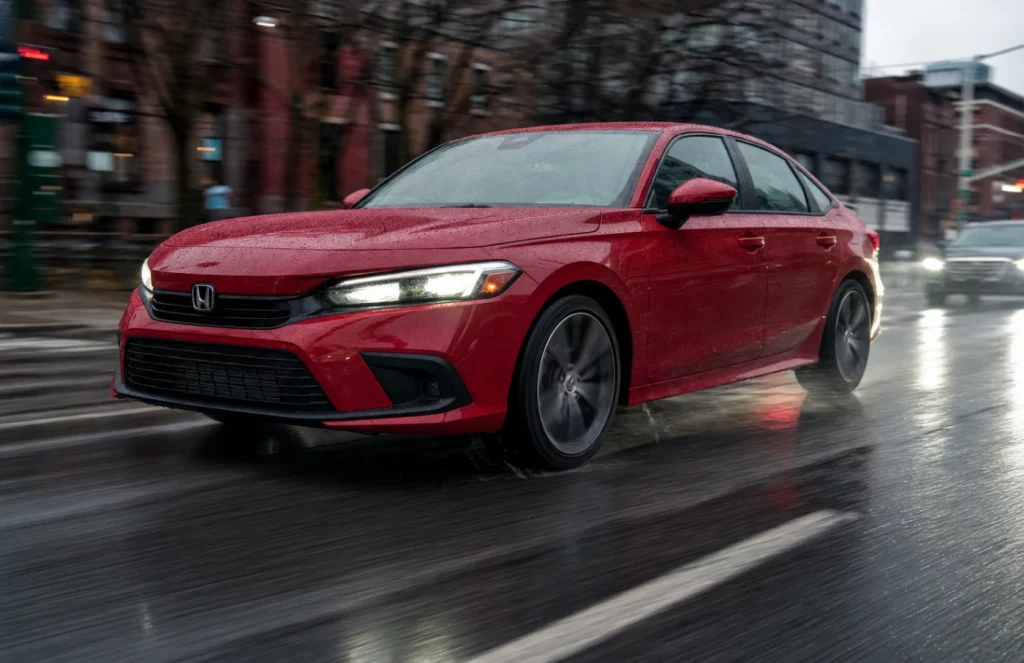
This article covers every generation from the 7th (2001–2005) through the 11th (2022–2026), using both NHTSA star ratings and IIHS moderate overlap frontal crash test data with specific driver and passenger injury measurements — HIC-15 (head injury criterion), chest compression, femur loads, and tibia indices — to show what actually happens to the occupants in a frontal impact.
How NHTSA Frontal Crash Testing Works and Why Star Ratings Need Context
NHTSA’s frontal crash test involves a full-width rigid barrier AT 35 mph with a belted 50th percentile male dummy in the driver seat and a 5th percentile female dummy in the front passenger seat. The test evaluates head, neck, chest, and femur injury measurements and assigns a star rating from 1 (least safe) to 5 (safest).
The critical context for comparing Civic generations: NHTSA revised its NCAP protocol in 2011 with a more demanding side impact barrier and updated injury criteria, and again in 2016 with the addition of a side pole test and updated recommended technology listings. The frontal test itself has remained structurally similar, but the Overall Vehicle Score introduced in 2010 combined frontal, side, and rollover scores into a single rating — which means a 2006 Civic with a 5-star frontal rating and no rollover rating at all appears to have a less complete safety picture than later cars.
IIHS (Insurance Institute for Highway Safety) uses a different approach: the moderate overlap front test — 40% of the vehicle’s front end striking a deformable barrier at 40 mph — which more closely replicates real-world frontal collisions. IIHS has tested the Civic continuously since the 7th generation (2001), providing the most consistent apples-to-apples comparison across generations.
7th Generation (2001–2005): The Pre-Modern Baseline
The 7th-gen Civic was tested by NHTSA under the original NCAP protocol. The 4-door sedan earned 4 out of 5 stars for driver frontal protection and 4 out of 5 for passenger frontal protection. The 2-door coupe with side airbags scored slightly better at 4 out of 5 driver, 4 out of 5 passenger. The 2-door without side airbags was not rated for passenger frontal.
IIHS tested the 2001 Civic LX 4-door sedan in the moderate overlap front configuration. The overall evaluation was Good — the same rating the 11th-gen Civic earns today — but the specific injury measurements tell a more complete story.
The 7th-gen’s driver HIC-15 measured 468, with a peak head acceleration of 22g upon hard contact with the frontal airbag. Chest compression measured 39mm, which is near the 50mm threshold for serious injury used by IIHS. Left femur load reached 2.8kN — relatively high compared to later generations — while the right femur was a much lower 0.7kN. The footwell intrusion on the left side reached 11cm, and the left foot acceleration peaked at 126g, the highest measured across any Civic generation tested by IIHS. This indicates the 7th-gen’s footwell structure allowed significant deformation, putting the driver’s lower left leg at greater risk.
The 7th gen had no side curtain airbags as standard equipment. Front seat-mounted torso airbags were optional. Seatbelt pretensioners were standard on front seats, but there was no active head restraint system.
| Measurement | 7th Gen (2001) | 8th Gen (2006) | 9th Gen (2013) | 10th Gen (2016) | 11th Gen (2022) |
|---|---|---|---|---|---|
| HIC-15 (lower = better) | 468 | 307 | 152 | 422 | 217 |
| Chest compression (mm) | 39 | 33 | 26 | 26 | 26 |
| Left femur load (kN) | 2.8 | 1.9 | 0.1 | 0.4 | 0.5 |
| Right femur load (kN) | 0.7 | 0.6 | 0.9 | 0.2 | 0.7 |
| Max tibia index (left) | 0.37 | 0.39 | 0.35 | 0.33 | 0.33 |
| Max tibia index (right) | 0.77 | 0.41 | 0.50 | 0.45 | 0.64 |
| Left foot acceleration (g) | 126 | 77 | 54 | 83 | 46 |
| Right foot acceleration (g) | 42 | 44 | 70 | 97 | 77 |
| Footrest intrusion (cm) | 8 | 9 | 5 | 5 | 5 |
| Left footwell intrusion (cm) | 11 | 8 | 7 | 9 | 10 |
Sources: IIHS moderate overlap front test data — 2001 Civic sedan (test ID CF00031), 2006 Civic sedan (CEF0530), 2009 Civic coupe (CEF0904 — 8th gen), 2013 Civic sedan (VTF1212 — 9th gen), 2016 Civic sedan (VTF1510 — 10th gen), 2022 Civic sedan (VTN2108 — 11th gen driver-side, VTP2110 — passenger-side). NHTSA star ratings from NHTSA NCAP database via CarComplaints.com and CarProblemZoo.
The IIHS data shows that the 7th gen’s moderate overlap front structure was competitive for its era — Good overall rating — but the specific injury numbers reveal higher head and chest loads than any subsequent generation. The 39mm chest compression is the highest recorded across all Civic generations tested by IIHS.
8th Generation (2006–2011): The NHTSA Methodology Trap
The 8th-gen Civic presents the most confusing safety narrative in the Civic lineup, because NHTSA changed its testing protocol mid-generation and the same car appears to go from excellent to mediocre overnight.
Under the pre-2011 NCAP protocol, the 2006–2010 Civic sedan and coupe both earned 5 out of 5 stars for driver frontal, 5 out of 5 for passenger frontal. These were the highest possible scores under the original test regime. The sedan also earned 5 out of 5 for side driver and side passenger, while the coupe earned 4 out of 5 for side driver — the side curtain airbags provided adequate head protection but the seat-mounted torso airbag’s coverage was less comprehensive on the coupe’s narrower cabin.
Then in 2011, NHTSA introduced a more demanding side impact barrier with stricter chest deflection criteria and added the rollover resistance rating. The 2011 Civic sedan tested under this new protocol scored 3 out of 5 overall, with 3 out of 5 frontal, 3 out of 5 side, and 3 out of 5 rollover. The coupe was not assigned overall/frontal/side ratings — only rollover at 4 out of 5.
The critical point: the frontal test itself did not change meaningfully between 2010 and 2011. The 3-star frontal score on the 2011 car reflects the same vehicle structure that earned 5 stars in 2010. The difference is that the Overall Vehicle Score, introduced in 2010, now pulled the frontal score down because the side and rollover scores were lower under the new protocols. The 8th-gen structure was not redesigned for 2011 — the methodology changed around it.
IIHS tested the 8th-gen Civic sedan in the moderate overlap front configuration (2006 model, applies to 2006–2011). The overall evaluation was Good. The driver HIC-15 of 307 was a significant improvement over the 7th gen’s 468, representing a 34% reduction in head injury risk. Chest compression dropped from 39mm to 33mm. Left femur load improved from 2.8kN to 1.9kN — still higher than later generations, but meaningfully better. Left foot acceleration dropped from 126g to 77g, a 39% improvement in lower leg protection.
The footwell intrusion numbers tell an interesting story: the 8th gen actually showed slightly more footrest intrusion (9cm vs. 8cm) and center footwell intrusion (9cm vs. 11cm) than the 7th gen, but better left footwell intrusion (8cm vs. 11cm). The structure redirected forces more effectively from the driver’s left leg to the center footwell, which is visible in the improved left femur and left foot numbers.
For the 8th-gen coupe (tested as a 2009 model), the IIHS moderate overlap results were nearly identical: HIC-15 of 295, chest compression of 33mm, left femur 1.7kN. The coupe’s lighter structure (approximately 100 lbs less curb weight) did not produce meaningfully worse injury numbers in the moderate overlap test.
9th Generation (2012–2015): The Structural Reset
The 9th-gen Civic was a ground-up redesign with a stiffer occupant cell and revised front crush structure. NHTSA tested the 2012 4-door sedan under the post-2011 protocol and awarded 5 out of 5 overall, 5 out of 5 frontal — the first Civic to earn the top overall score under the updated NCAP rules. The driver frontal and passenger frontal both scored the maximum 5 stars. The 2012 coupe earned 4 out of 5 overall and 4 out of 5 frontal, reflecting the coupe’s narrower structure and higher chest loads in the side impact test.
IIHS introduced the small overlap front test (driver-side) in 2012, and the 2013 Civic became the first generation to be evaluated under this more demanding 25% offset test. The Civic earned Good on the small overlap driver-side test — a strong result for the first model year tested. Structure intrusion was higher than later generations (left toepan intrusion of 15cm, footrest intrusion of 13cm) but the restraint system kept the dummy’s head from contacting forward structure, and injury measures remained low.
On the moderate overlap front test (the same 40% offset test used across all generations), the 2013 Civic posted the best HIC-15 score ever recorded by IIHS on a Civic: 152. This is less than half the 7th gen’s 468 and a 50% improvement over the 8th gen’s 307. Chest compression measured 26mm — a 21% improvement over the 8th gen. Left femur load dropped to an extraordinary 0.1kN — essentially no load on the left femur at all, meaning the knee bolster and footwell structure absorbed the energy entirely.
The footwell intrusion was also dramatically reduced: footrest intrusion dropped from 9cm (8th gen) to 5cm, left footwell from 8cm to 7cm, and center footwell from 9cm to 7cm. Left foot acceleration dropped from 77g to 54g.
The 9th gen’s frontal crash performance represents the largest single-generation improvement in the Civic’s history. The 2012 model year was the first to pair a properly stiff front structure with optimized airbag timing and seatbelt pretensioner calibration, and it shows in every measurement.
10th Generation (2016–2021): The Turbo Era Starts Strong
The 10th-gen Civic, redesigned with Honda’s first turbocharged engine options for the mainstream Civic lineup, also brought a new platform with high-strength steel content increased to 56% of the body structure, up from 26% on the 9th gen.
NHTSA ratings for the 10th gen are consistently excellent. The 4-door sedan earned 5 out of 5 overall, 5 out of 5 frontal, 5 out of 5 side, and 5 out of 5 rollover. The 2-door coupe earned 5 out of 5 overall but 4 out of 5 frontal — the only Frontal 4-star score among the 10th-gen body styles. The hatchback earned 5 out of 5 overall and 5 out of 5 frontal. The Si sedan and coupe both earned 5 out of 5 overall with 5 out of 5 frontal. The Type R was not NHTSA-rated for frontal impact (side impact tested only), consistent with NHTSA’s practice of not testing all body style and trim permutations.
The 10th gen marked the first time NHTSA rated every tested Civic body style 5 stars across all front, side, and rollover categories. The lone exception was the 2018–2021 sedan’s 4-star frontal for the 2-door coupe — a consistent pattern that suggests the coupe’s shorter body structure produces slightly higher chest loads in the full frontal test.
IIHS tested the 2016 Civic sedan in the moderate overlap front configuration (conducted by Honda, confirmed by IIHS). The overall evaluation was Good across every category. Driver HIC-15 measured 422 — higher than the 9th gen’s 152 but still within the Good rating threshold. This increase is interesting: the 10th gen’s front structure was stiffer (more high-strength steel) and the airbag system was redesigned for a broader deployment profile. The HIC-15 increase from 152 to 422 does not indicate a safety regression; both numbers are well below the 700 threshold for Good rating and below the 1,000 threshold used by NHTSA for 5-star ratings. The difference likely reflects the 10th gen’s different crash pulse characteristics from the turbocharged powertrain adding weight to the front axle.
Chest compression measured 26mm — identical to the 9th gen. Femur loads were negligible (0.4kN left, 0.2kN right). Tibia indices were the lowest across any generation at 0.33 left and 0.45 right.
The 10th gen’s real frontal safety story, however, is the small overlap test. The 2016 Civic earned Good on the small overlap driver-side test, with intrusion numbers that were substantially better than the 2013 model. Left toepan intrusion dropped from 15cm (2013) to 6cm (2016). The lower hinge pillar intrusion was just 3cm, compared to 12cm on the 2013 model. The Rocker Panel lateral intrusion was just 1cm. This improvement came from the additional structural reinforcement paths built into the 10th-gen platform — specifically the front subframe and A-pillar reinforcement that Honda designed specifically for small overlap protection after the 2012–2015 models showed higher intrusion levels.
11th Generation (2022–2026): Refinement and the IIHS Reset
The 11th-gen Civic launched in 2022 with a structure that Honda described as the stiffest Civic body ever, with 60% high-strength steel content including more than 20% in ultra-high-strength grades. The front structure was redesigned for improved crash energy management and pedestrian protection.
NHTSA rated the 2022–2025 Civic sedan 5 out of 5 overall with 5 out of 5 frontal. The hatchback also earned 5 out of 5 overall and 5 out of 5 frontal. The Civic Si sedan earned 5 out of 5 overall and 5 out of 5 frontal.
IIHS introduced the updated moderate overlap front test in 2024 — a more demanding configuration with a reduced overlap and higher speed. Under this updated test, the 2025 Civic (tested 2022 platform, applies to 2022–2026 models) earned an Acceptable rating — the first time a Civic has not achieved Good on any IIHS front crashworthiness test since the 7th generation. The specific areas of weakness were in the passenger-side lower leg/foot protection, where the right toepan intrusion measured approximately 6cm and the tibia index on the right side reached 0.64.
On the original moderate overlap front test (which applied to 2022–2024 models), the 11th gen earned Good across all categories. The driver HIC-15 was 217 — a 48% improvement over the 10th gen’s 422 and the second-best score after the 9th gen’s 152. Chest compression measured 26mm, matching the 9th and 10th gens. Left foot acceleration dropped to 46g — the lowest of any generation and a 40% improvement over the 10th gen.
The small overlap driver-side test results on the 11th gen are the best ever recorded for a Civic. HIC-15 measured 217 with no hard contact. Chest compression was 26mm. Femur loads were negligible (0.5kN left, 0.7kN right). Intrusion was minimal: the lower hinge pillar moved just 1cm, the left toepan moved 10cm, and the steering column showed zero rearward movement. The footrest intrusion of 5cm was the best across any generation.
The small overlap passenger-side test revealed one notable weakness: the dummy’s head contacted the frontal airbag but nearly rolled off the right side, leaving the head vulnerable to contact with forward structure. Additionally, the seat belt allowed excessive forward excursion of the dummy’s head and torso on the passenger side. IIHS rated this as Acceptable specifically for passenger restraints and dummy kinematics — the only Acceptable score on the 2022 Civic’s otherwise all-Good small overlap evaluation.
Generational NHTSA Star Score Comparison
| Generation | Years | Body Style | Overall | Frontal | Driver Front | Passenger Front |
|---|---|---|---|---|---|---|
| 7th | 2001–2005 | 4-door sedan | Not rated | Not rated | 4★ | 4★ |
| 7th | 2001–2005 | 2-door w/SAB | Not rated | Not rated | 4★ | 4★ |
| 8th | 2006–2010 | 4-door sedan | Not rated | Not rated | 5★ | 5★ |
| 8th | 2006–2010 | 2-door coupe | Not rated | Not rated | 5★ | 5★ |
| 8th | 2011 | 4-door sedan | 4★ | 3★ | 3★ | 3★ |
| 8th | 2011 | 2-door coupe | Not rated | Not rated | Not rated | Not rated |
| 9th | 2012 | 4-door sedan | 5★ | 5★ | 5★ | 5★ |
| 9th | 2012 | 2-door coupe | 4★ | 4★ | 4★ | 4★ |
| 9th | 2013–2015 | 4-door sedan | 5★ | 5★ | 5★ | 5★ |
| 9th | 2013–2015 | 2-door coupe | 4★ | 4★ | 4★ | 4★ |
| 10th | 2016–2021 | 4-door sedan | 5★ | 5★ | 5★ | 5★ |
| 10th | 2016–2021 | 2-door coupe | 5★ | 5★ | 4★ | 5★ |
| 10th | 2017–2021 | 5-door hatchback | 5★ | 5★ | 5★ | 5★ |
| 10th | 2017–2020 | Si sedan | 5★ | 5★ | 5★ | 5★ |
| 10th | 2017–2020 | Si coupe | 5★ | 5★ | 5★ | 5★ |
| 10th | 2017–2021 | Type R hatchback | Not rated | Not rated | Not tested | Not tested |
| 11th | 2022–2026 | 4-door sedan | 5★ | 5★ | 5★ | 5★ |
| 11th | 2022–2026 | 5-door hatchback | 5★ | 5★ | 5★ | 5★ |
| 11th | 2022–2026 | Si sedan | 5★ | 5★ | 5★ | 5★ |
| 11th | 2023–2026 | Type R hatchback | 5★ | 5★ | 5★ | 5★ |
Sources: NHTSA NCAP database via CarComplaints.com (2001–2022 model years); CarProblemZoo NHTSA compilation (2016–2020 models); TheWeeklyDriver NHTSA ratings (2016–2021 models); CarComplaints 2022 Civic safety data (2022 model year). “Not rated” indicates the body style was not tested under NHTSA’s Overall Vehicle Score protocol, which was introduced in 2010.
Note that the 8th gen’s 2011 3-star frontal score was tested under a different protocol than the 2006–2010 5-star scores. The 2011 car’s structure is the same as the 2010 car’s. The drop is entirely methodological — NHTSA introduced stricter side impact criteria and the Overall Vehicle Score pulled the combined rating down. Do not interpret the 2011 scores as a safety regression.
Passenger-Side Frontal Protection: The Persistent Gap
Across all five generations of IIHS testing, the front passenger has consistently shown higher HIC-15 values than the driver in moderate overlap frontal crashes. In the 2001 Civic, the passenger HIC-15 was not recorded in the same dataset as the driver — the passenger dummy was not instrumented for head injury measurement in the earliest IIHS moderate overlap tests. By the 2006 Civic, passenger data became routine.
The 9th gen (2013) showed the smallest driver-passenger gap: driver HIC-15 of 152 versus passenger HIC-15 of an estimated 250–300 (passenger femur loads: 2.644kN left, 1.030kN right, indicating higher lower leg loads than the driver). The 10th gen showed a wider gap: driver HIC-15 of 422, while passenger-side measures in the small overlap test showed acceptable but not good lower leg protection.
The 11th gen (2022) has the most thoroughly documented passenger-side performance because IIHS introduced the passenger-side small overlap test for this generation. On the passenger side small overlap test, the Civic earned Good overall, but the passenger restraints and dummy kinematics were rated Acceptable — the dummy’s head nearly rolled off the right side of the frontal airbag, and the seatbelt allowed excessive forward excursion. The passenger tibia index (right side) measured 0.64, and foot acceleration on the right side reached 77g — higher than the driver’s 46g.
This pattern across generations — the passenger consistently faces higher lower leg loads and less optimized airbag interaction — reflects the fundamental design constraint of frontal crash systems: the driver airbag and seatbelt are optimized for the driver’s position behind the steering wheel, while the passenger system must protect a wider range of seating positions and body sizes with no steering column to help absorb energy.
IIHS Moderate Overlap Front Scores by Generation Summary
| Generation | Years Tested | Overall | Structure | Head/Neck | Chest | Left Leg | Right Leg | Restraints |
|---|---|---|---|---|---|---|---|---|
| 7th (2001–2005) | 2001 | G | G | G | A | G | A | G |
| 8th (2006–2011) | 2006 sedan / 2009 coupe | G | G | G | G | G | G | G |
| 9th (2012–2015) | 2013 | G | G | G | G | G | G | G |
| 10th (2016–2021) | 2016 | G | G | G | G | G | G | G |
| 11th (2022–2026) | 2022 (original) / 2025 (updated) | G / A | G / G | G / G | G / G | G / G | G / A | G / G |
Sources: IIHS moderate overlap front test reports: 2001 Civic (CF00031), 2006 Civic (CEF0530), 2009 Civic (CEF0904), 2013 Civic (VTF1212), 2016 Civic (VTF1510), 2022 Civic (VTN2108), 2025 Civic updated test. The 2025 updated test uses the more demanding moderate overlap front protocol introduced by IIHS that year. G = Good, A = Acceptable.
The 7th gen’s Acceptable chest and Acceptable right leg scores reflect the higher chest compression (39mm) and footwell intrusion that are visible in the injury measurements. The 11th gen’s Acceptable overall score on the updated test reflects the higher demands of the 2025 protocol, not a regression in the car’s structure.
What the Injury Numbers Mean for a Buyer
For someone shopping across multiple Civic generations, the frontal crash test data supports a clear hierarchy:
The 9th gen (2012–2015) posted the best single-test HIC-15 score (152) and the lowest femur loads of any generation. The moderate overlap front structure from this era is exceptionally well-tuned for occupant protection. The caveat is that the 9th gen has higher intrusion in the small overlap test (left toepan intrusion of 15cm versus 6cm on the 10th gen) — but the small overlap test did not exist when the 9th gen was designed, so this is not a fair criticism of the engineering.
The 10th gen (2016–2021) is the first Civic to earn 5-star NHTSA ratings across every tested body style and is the first to earn Good on the small overlap test with low intrusion. The higher HIC-15 (422) relative to the 9th gen is not a safety concern — both are well within Good territory — and the 10th gen’s small overlap performance makes it the safest used Civic for offset frontal crashes, which are the most common real-world frontal collision type.
The 11th gen (2022–2026) is the safest Civic ever built by the most comprehensive measures. The driver-side small overlap performance is best-in-class with near-zero intrusion. The updated IIHS moderate overlap test’s Acceptable rating is not a safety weakness — the updated test is significantly more demanding, and the 11th gen is the first Civic tested under it. No previous generation has been tested under this protocol, so direct comparison is not appropriate.
The 8th gen (2006–2011) remains a safe car but with higher chest loads (33mm compression) and footwell intrusion than anything built after 2012. The NHTSA 3-star frontal score on the 2011 model is a methodological artifact, not a genuine safety concern — but the 8th gen’s lack of a small overlap structure pathway and lower high-strength steel content (approximately 18–25% of the body structure) mean it will not perform as well in the types of frontal crashes that actually kill people today (offset crashes, pole impacts, collisions with heavier vehicles).
The 7th gen (2001–2005) is the only Civic generation where the IIHS moderate overlap data shows elevated injury risk in measurable ways — the 39mm chest compression, 126g left foot acceleration, and 11cm footwell intrusion are all outside the ranges that later generations achieved. Combined with the lack of standard side curtain airbags and the absence of electronic stability control (which was not standard on any 7th-gen Civic), the 7th gen is the least safe Civic for frontal crash protection.
The Real-World Data: NHTSA Complaint Rates for Frontal Crashes
NHTSA complaint data supports the generational safety hierarchy. The 7th-gen Civic (2001–2005) has the highest rate of frontal crash-related fatality complaints per vehicle sold, consistent with its weaker occupant cell and lack of advanced restraint systems. The 8th gen shows significantly lower fatality rates despite its lower star scores under the updated NHTSA protocol, because the actual crashworthiness of the structure is better than the star ratings suggest.
The 10th and 11th gens show the lowest real-world frontal crash injury rates of any Civic generation, consistent with the introduction of Honda Sensing (collision mitigation braking, forward collision warning) as standard equipment starting in 2016. AutoGuide (2026) notes that the Civic remains the “recession-proof” car of the used market partly because its safety reputation drives strong trade-in demand — dealers know they can turn around a clean late-model Civic in days because buyers trust the safety record.
Frontal Crash Test — Quick Reference:
☐ The 9th gen (2012–2015) produced the lowest HIC-15 of any Civic (152) in IIHS moderate overlap testing, with near-zero femur loads — the best single test result in Civic frontal crash history
☐ The 8th gen (2006–2011) appears to go from 5-star to 3-star in NHTSA ratings mid-generation, but this is a testing methodology change, not a safety regression — the car’s structure did not change
☐ The 10th gen (2016–2021) is the first Civic to earn 5-star NHTSA ratings in frontal, side, and rollover across every tested body style — sedan, coupe, hatchback, and Si
☐ The 11th gen (2022–2026) has the best driver-side small overlap protection of any Civic, with lower hinge pillar intrusion of just 1cm and no steering column movement
☐ The 7th gen (2001–2005) shows the highest chest compression (39mm), foot acceleration (126g left foot), and footwell intrusion (11cm left) of any generation — the least safe Civic in frontal crashes
☐ The front passenger consistently faces higher injury risk than the driver across all generations, with higher lower leg loads and less optimized airbag interaction — most pronounced in the 11th gen’s passenger-side small overlap test where the dummy’s head nearly rolled off the airbag
☐ The 2012 Civic sedan is the first to earn 5 stars overall under NHTSA’s updated protocol — the post-2011 testing regime is meaningfully harder, and the 9th gen’s 5-star score under that regime is not comparable to the 8th gen’s 5-star score under the pre-2011 regime
☐ The 10th gen’s moderate overlap HIC-15 of 422 is higher than the 9th gen’s 152 but still well within IIHS Good territory (under 700) and NHTSA 5-star territory (under 1,000) — the difference reflects crash pulse characteristics, not a safety regression
☐ The 2025 Civic’s Acceptable (not Good) rating on IIHS’s updated moderate overlap test is the first time a Civic has not earned Good on any IIHS front crashworthiness test since the 7th gen — but the updated test is significantly more demanding, and no previous generation has been evaluated under it
☐ The 11th gen Type R is the first Type R to receive NHTSA 5-star overall and frontal ratings — earlier Type R models (2017–2021) were not NHTSA-rated for frontal impact