

9th Gen Civic (2012–2015) Safety — The Split Generation
The 9th generation Honda Civic (2012–2015) represents one of the most unusual safety stories in the model’s history — a generation that was redesigned from the ground up for 2012, then structurally re-engineered for 2013 after IIHS introduced a new test that exposed a critical weakness. The result is a generation split sharply into two distinctly different safety profiles: the 2012 model (no small overlap protection) and the 2013–2015 models (first compact car to earn IIHS Top Safety Pick+). The gap between the 8th generation (2006–2011) that preceded it and the 10th generation (2016–2021) that followed is equally revealing — each generation improved structural performance in measurable, documentable ways.
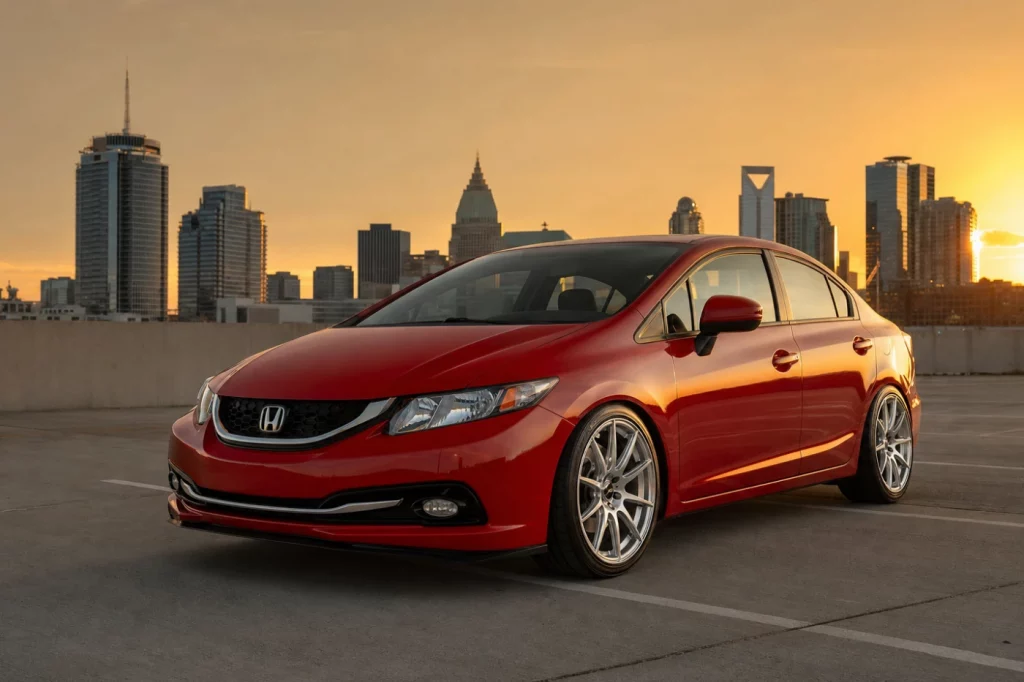
This article covers every available IIHS crashworthiness score for the 9th generation Civic, the structural improvements that drove the 2013–2015 models, the specific intrusion measurements from each test, and how the 9th gen compares to both the 8th and 10th generations.
The 2012 Model — A Ground-Up Redesign Without Small Overlap Engineering
The 2012 Civic was an all-new redesign with the first-generation ACE (Advanced Compatibility Engineering) body structure. It was IIHS tested in the moderate overlap front, side, roof strength, and head restraint tests — and scored Good in every one. It earned IIHS Top Safety Pick for the 2012 model year (Honda Newsroom, May 26, 2011).
The problem: IIHS introduced the small overlap front crash test in mid-2012, after the 2012 Civic was already in production. Honda had not engineered the 2012 model for this specific crash mode. The small overlap test was not administered on the 2012 Civic — not because it failed, but because the test protocol did not exist when the car was designed and no 2012 model was ever tested.
This means the 2012 Civic has a genuine safety data gap. Its moderate overlap and side performance are well-documented and excellent, but there is zero verified data on how it would perform in the 25% offset frontal crash that accounts for roughly 25% of serious frontal crash injuries (IIHS; AutoWeek, March 2013). Buyers considering a 2012 Civic should understand this limitation.
Moderate overlap front — 2012. The 2012 Civic LX 4-door scored Good with a measurable improvement in footwell intrusion control over the 8th generation. Footrest intrusion was 5 cm (down from 9 cm in the 8th gen), left toepan 7 cm (down from 8 cm), center 7 cm (down from 9 cm), right 5 cm (down from 6 cm), brake pedal 3 cm (down from 7 cm). The A-Pillar moved 1 cm rearward, identical to the 8th gen. Steering column moved −3 cm rearward (away from the driver) and −1 cm upward — a meaningful improvement over the 8th gen’s −2 cm rearward, +2 cm upward (IIHS, Test IDs CEF0530 for 8th gen; VTF1212 for 2012 Civic).
Side impact — 2012. The 9th generation’s side impact performance was the most improved area. The structure was upgraded from Acceptable (8th gen) to Good. The B-Pillar stopped 13.5 cm short of the driver seat centerline — 3 cm further from the driver than the 8th gen’s 10.5 cm (IIHS, Test IDs CES0530 for 8th gen; VTS1103 for 2012 Civic).
Driver head HIC-15 dropped to 284, a 40% reduction from the 8th generation’s 476. Torso maximum deflection was 38 mm (down from 46 mm). Driver pelvis combined force was 4.5 kN (down from 5.0 kN). These improvements reflect better side curtain airbag coverage and a stiffer B-pillar structure (IIHS, 2012 Civic technical measurements).
Roof strength — 2012. The 2012 Civic sedan achieved a strength-to-weight ratio of 5.85 with a peak force of 15,665 lbs AT a curb weight of 2,678 lbs. This was a 30.6% improvement over the 8th generation’s 4.48 SWR and a 2,300 lb increase in peak force capacity — a significant structural improvement that came from higher-strength steel content and improved roof arch design (IIHS, 2012 Civic roof strength test).
The 2013–2015 Models — ACE II and the Small Overlap Fix
After IIHS published its first round of small overlap results in 2012, showing most small cars performing poorly, Honda responded with structural changes for the 2013 model year. The 2013 Civic was technically a “minor model change” (mid-cycle refresh), but the structural modifications were extensive enough that Honda’s chief engineer in charge of collision safety, Chuck Thomas, described them as a coordinated response to IIHS research that Honda had been tracking since 2009 (CSMonitor.com, March 9, 2013; AutoWeek, March 7, 2013).
The ACE II body structure. The second-generation ACE body added about 26 lbs to the structure and was applied across the entire Civic family — sedan, coupe, Hybrid, and Si (AutoWeek, March 2013; PRNewswire, November 29, 2012). The changes included:
- Higher-strength materials in the cabin space — specific reinforcement of the front floor, side sill, A-pillar, upper wheel housing, and front bumper extension
- Secondary load paths designed to absorb crash energy when the main longitudinal frame members are not engaged (the fundamental challenge of small overlap crashes)
- 55 percent high-strength steel content in the body structure (PRNewswire, November 29, 2012)
- SmartVent side airbags and side curtain airbags with rollover sensor (PRNewswire, 2012)
Small overlap front — driver side. The 2013 Civic LX 4-door earned Good — the first compact car ever to achieve this rating in the new test. The intrusion measurements show the limits of the ACE II fix: hinge pillar intrusion was 12 cm, footrest intrusion was 13 cm, left toepan was 15 cm, and brake pedal moved 6 cm. Upper hinge pillar intrusion was 5 cm, upper dash 7 cm, lower instrument panel 6 cm, and steering column movement was 0 cm. The occupant compartment held, but the lower footwell deformed significantly — the 15 cm left toepan intrusion is the highest of any Civic generation in the small overlap test (IIHS, Test ID CEN1302).
The Good rating came from the restraint system controlling the dummy’s injury measures within acceptable thresholds despite the substantial cabin deformation. The HIC-15 was not published on the IIHS page for this specific test, but the overall Good rating applied to both sedan and coupe (IIHS, 2013 Civic rating; AutoWeek, March 7, 2013).
The passenger-side small overlap test was not conducted on any 9th generation Civic.
Side impact — 2013–2015. The side test was also re-run for the 2013 model year after the structural changes were applied. Results were similar to the 2012 model: Good overall, structure Good. B-pillar to seat centerline was 14.5 cm (marginally better than 2012’s 13.5 cm). The 2013 side test (VTS1216) recorded a driver HIC-15 of 402 — higher than the 2012 model’s 284, but still within Good thresholds. Torso maximum deflection was 40 mm, average deflection 35 mm, and maximum deflection rate was 3.65 m/s — all Good (IIHS, 2013 Civic side test technical measurements).
2015 model-year structural upgrade. For the 2015 model year, Honda introduced 1,500 MPa hot-stamped ultra-high-strength steel to the Civic body structure — the first use of this material grade in the 9th generation. The 1,500 MPa steel was applied to the front pillar upper stiffener, front inner upper pillar, front inside sill stiffener, and side sill reinforcement stiffener. Overall high-strength steel content reached 56%, including 25% in grades 780 MPa and above (Honda Techinfo, Body Repair Manual BBN01640).
This 2015 upgrade was not independently IIHS tested — the existing 2013 ratings carried forward. But the introduction of 1,500 MPa steel in the A-pillar and side sill represents a meaningful structural improvement over the 2013–2014 cars.
Head Restraints, Headlights, and Crash Avoidance
Head restraints. Both the 2012 and 2013–2015 models earned Good in the rear impact dynamic test. The 9th generation’s active head restraint system was essentially the same as the 8th generation’s and performed well (IIHS, 2012–2015 Civic ratings).
Headlights. IIHS did not begin headlight ratings until 2016. The 9th generation Civic was not rated for headlight performance. An apples-to-apples comparison with the 10th generation (Poor on most trims) is not available.
Front crash prevention. Forward Collision Warning was available only on the 2013–2015 Civic Hybrid and was not available on LX, EX, EX-L, or Si trims. The 2013–2014 Civic Hybrid with FCW qualified for Top Safety Pick+. The standard 2013–2014 Civic (without FCW) could not earn TSP+ because the + designation required forward collision warning starting in 2013. The 2015 standard Civic dropped to Top Safety Pick entirely because it lacked auto-brake (IIHS, 2013–2015 Civic ratings).
LATCH ease of use. Acceptable — consistent across the 9th generation and unchanged from the 8th gen.
Complete 8th vs 9th vs 10th Gen IIHS Scores Comparison
| Test | 8th Gen (2006–2011) | 9th Gen 2012 | 9th Gen 2013–2015 | 10th Gen (2016–2021) |
|---|---|---|---|---|
| Moderate overlap front | Good | Good | Good | Good |
| Small overlap driver | Not tested | Not tested | Good | Good |
| Small overlap passenger | Not tested | Not tested | Not tested | Good (2018+ sedan, 2020+ hatch) / Not tested (2016–17) |
| Side impact | Good (structure Acceptable) | Good (structure Good) | Good (structure Good) | Good (structure Good) |
| Roof strength (SWR) | 4.48 | 5.85 | 5.85 | 5.78 sedan / 4.82 coupe |
| Roof peak force | 12,532 lbs | 15,665 lbs | 15,665 lbs | 15,829 lbs sedan / 13,159 lbs coupe |
| Head restraints | Good | Good | Good | Good |
| Headlights | Not rated | Not rated | Not rated | Poor (most) / Good (late 2020+ Touring/Si) |
| Front crash prevention | Not rated | Not rated | FCW only (Hybrid) / Not available (other trims) | Superior (2019+ with standard Honda Sensing) |
| Top IIHS award | N/A | TSP | TSP+ (2013–14 Hybrid) / TSP+ (2013–14 LX/EX w/ FCW) / TSP (2015) | TSP+ (2016–2021 with Honda Sensing) |
Sources: IIHS vehicle ratings pages (iihs.org/ratings) for 2006, 2012, 2013, and 2016 Civic models. Honda Newsroom (2011). PRNewswire/Honda (November 29, 2012). CSMonitor.com (March 9, 2013). AutoWeek (March 7, 2013). Roof strength data from IIHS individual test pages.
Small Overlap Intrusion: The Critical Difference Between Generations
The small overlap front test is the single most discriminating safety metric across these three generations. The intrusion measurements tell the story:
| Intrusion Point | 8th Gen (2006–2011) | 9th Gen 2012 | 9th Gen 2013–2015 | 10th Gen (2016–2021) | 11th Gen (2022+) |
|---|---|---|---|---|---|
| Small overlap test result | Not tested | Not tested | Good (driver only) | Good (driver) / Good (passenger 2018+) | Good (combined) |
| Lower hinge pillar max | — | — | 12 cm | 3 cm | 1 cm |
| Footrest intrusion | — | — | 13 cm | Not published | Not published |
| Left toepan | — | — | 15 cm | Not published | Not published |
| Upper hinge pillar max | — | — | 5 cm | Not published | Not published |
| Steering column movement | — | — | 0 cm | Not published | Not published |
The 9th generation’s 12 cm hinge pillar intrusion is four times greater than the 10th generation’s 3 cm and twelve times greater than the 11th generation’s 1 cm. The 15 cm left toepan intrusion indicates significant footwell deformation. IIHS published these full intrusion measurements for the 2013 Civic (Test ID CEN1302) but only published the hinge pillar value for the 10th generation. Sources: IIHS vehicle ratings pages for each model year.
The takeaway: the 9th generation’s Good small overlap rating was earned primarily through effective airbag restraint geometry and occupant positioning, not through minimizing cabin intrusion. The structural deformation was substantially higher than later generations. A 10th or 11th generation Civic would maintain significantly more occupant survival space in the same crash.
Side Impact: Steady Improvement Across Three Generations
Side impact performance shows consistent improvement with each generation, driven by B-pillar reinforcement and better structural load paths:
| Side Impact Metric | 8th Gen (2006–2011) | 9th Gen 2012 | 9th Gen 2013–2015 | 10th Gen (2016–2021) |
|---|---|---|---|---|
| IIHS side overall | Good | Good | Good | Good |
| IIHS structure | Acceptable | Good | Good | Good |
| B-pillar to seat centerline | −10.5 cm | −13.5 cm | −14.5 cm | −18.5 cm |
| Driver head HIC-15 | 476 | 284 | 402 | Not published |
| Driver torso max deflection | 46 mm | 38 mm | 40 mm | Not published |
| Driver pelvis combined force | 5.0 kN | 4.5 kN | 3.6 kN | Not published |
| Rear passenger head HIC-15 | Not published | Not published | 337 (VTS1216) | Not published |
The structure rating improvement from Acceptable (8th gen) to Good (9th+ gen) is the most significant shift. The B-pillar clearance also increased steadily: 10.5 cm → 13.5 cm → 14.5 cm → 18.5 cm. Sources: IIHS technical measurements for each test ID (CES0530, VTS1103, VTS1216).
Roof Strength: The 9th Generation’s Unmatched Era
The 9th generation’s 5.85 SWR was a significant improvement over the 8th generation’s 4.48 and was not meaningfully surpassed until the 11th generation (7.62). The 10th generation sedan’s 5.78 SWR is essentially flat compared to the 9th generation, despite a generational platform change.
This means the 2012–2015 Civic has better rollover structural protection than the 2016–2021 sedan. The 4-door sedan roof is stronger than the 10th generation sedan and substantially stronger than the 10th generation coupe (4.82 SWR). For used-car buyers who prioritize rollover safety, the 9th generation sedan is structurally more capable than the 10th generation sedan in this specific metric.
The TSP+ Timeline — What It Means for Buyers
The Top Safety Pick+ designation evolved across the 9th generation’s run, and the award status does not perfectly align with structural safety:
2012 Civic: TSP. Small overlap not tested. No forward collision warning available. The TSP designation did not require either.
2013–2014 Civic Hybrid: TSP+. The Hybrid was the only trim with factory FCW, and the + designation required FCW starting in 2013. The standard LX, EX, and EX-L trims could achieve TSP+ only if the original buyer ordered the optional FCW system.
2013–2014 Civic without FCW: TSP. Same structure, same crash test scores, but no forward collision warning.
2015 Civic: TSP. Dropped to TSP across all trims because the + designation now required auto-brake, which the 2015 Civic did not have on any trim.
For crashworthiness alone (excluding crash avoidance), the 2013–2015 Civics are structurally identical. The TSP+ vs TSP distinction was driven by FCW availability, not structural safety.
How the 9th Gen Compares — The Practical Takeaways
8th gen (2006–2011) vs 9th gen (2012–2015): The 9th generation is meaningfully safer in every measured dimension. Roof strength is 31% higher. Side impact structure upgraded from Acceptable to Good. B-pillar clearance improved by 3–4 cm. The 9th gen’s moderate overlap footwell intrusion is roughly half the 8th gen’s. The only limitation is the absence of small overlap data for the 2012 model — but the 8th gen was never tested either.
9th gen (2013–2015) vs 10th gen (2016–2021): The 10th generation is clearly superior in small overlap crashworthiness (3 cm vs 12 cm hinge pillar intrusion), headlight performance (Good on late trims vs not rated), and front crash prevention standard equipment. But the 9th generation matches or exceeds the 10th generation in roof strength (5.85 vs 5.78 SWR) and side impact structural clearance (B-pillar within 4 cm). A used-car buyer should not automatically assume that a 10th gen Civic is structurally superior in every category.
The 2012 gap. The 2012 Civic’s absence of small overlap data makes it the most difficult 9th gen model to evaluate. There is no test result confirming or denying its small overlap performance. Based on the structural improvements Honda made for 2013 (ACE II, secondary load paths, reinforcement of the A-pillar, side sill, and front floor), it is reasonable to assume the 2012 model would have performed worse than the 2013–2015 cars in the small overlap test — but this is speculation, not data.
9th Gen Safety — Quick Reference:
☐ 8th gen (2006–2011): Good in all 4 tested IIHS areas. No small overlap data. Side structure Acceptable. Roof 4.48 SWR. Moderate overlap footwell intrusion 6–9 cm (IIHS, 2006 Civic)
☐ 9th gen 2012: Good in moderate overlap, side, roof (5.85 SWR). No small overlap data — test did not exist at design time. First gen ACE body. Moderate overlap footwell intrusion improved to 3–7 cm. B-pillar clearance 13.5 cm (IIHS, 2012 Civic)
☐ 9th gen 2013–2015: ACE II body structure — 26 lbs of added reinforcement. First compact car with Good small overlap driver (12 cm hinge pillar intrusion, 15 cm left toepan). Side B-pillar improved to 14.5 cm. Roof 5.85 SWR. Passenger small overlap not tested (IIHS, 2013 Civic; CSMonitor, 2013)
☐ 2015 structural upgrade: 1,500 MPa steel introduced in front pillar and side sill stiffeners. 56% HSS content (Honda Techinfo BBN01640)
☐ Small overlap intrusion ranking: 11th gen (1 cm) > 10th gen (3 cm) > 9th gen 2013–2015 (12 cm). The 9th gen’s Good rating relies heavily on airbag geometry rather than minimal cabin intrusion (IIHS)
☐ Roof strength ranking: 11th gen (7.62) > 9th gen (5.85) > 10th gen sedan (5.78) > 10th gen coupe (4.82) > 8th gen (4.48) (IIHS)
☐ Side impact B-pillar clearance: 10th gen (18.5 cm) > 9th gen 2013–2015 (14.5 cm) > 9th gen 2012 (13.5 cm) > 8th gen (10.5 cm) (IIHS)
☐ TSP+ status on 2013–2014 requires FCW — standard only on Hybrid, optional on other trims. 2015 models dropped to TSP due to no auto-brake (IIHS award criteria)
☐ 2012 Civic: no small overlap data. If you must buy a 9th gen, the 2013–2015 models have verified small overlap protection. The 2015 adds 1,500 MPa steel in key structural locations (IIHS; Honda Techinfo)
☐ For used buyers prioritizing side impact: 9th gen is a significant upgrade over 8th gen (structure Acceptable → Good). 10th gen adds 4 cm more B-pillar clearance. All three are Good-rated (IIHS)