

The Honda Civic’s IIHS crash test record spans four generations and twenty model years, from an era when small overlap front crashes were not even tested to today’s exhaustive battery of updated protocols. The story is not a straight line from weak to strong — the 8th gen earned Good ratings on the tests that existed AT the time, the early 9th gen faced a public failure that triggered an emergency structural redesign, and the 11th gen hit limitations on IIHS’s tougher updated tests despite earning the agency’s highest award. The full picture matters more for a used-car decision than any single score. Sources: IIHS vehicle ratings database (2006–2025 model years), Honda Newsroom small overlap press release (August 2013), PR Newswire 2013 Civic restyle announcement (November 2012), Honda Newsroom 2008 Civic specifications.
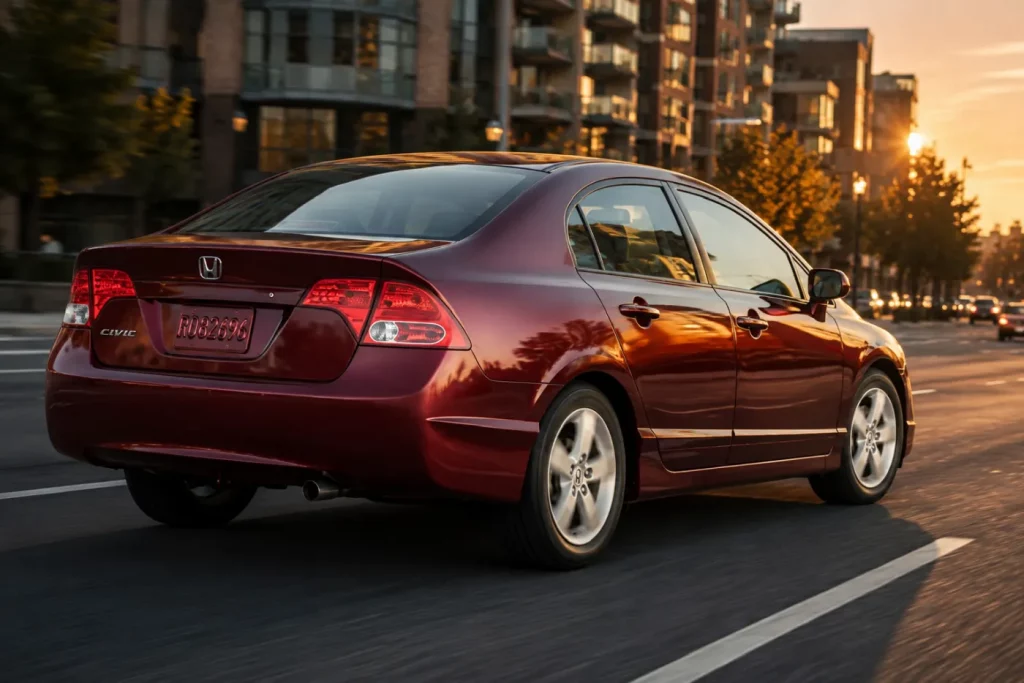
8th Generation (2006–2011) — Tested on the Old Protocol
The 8th gen Civic was tested under IIHS’s original moderate overlap front and side impact protocols. The test did not include a small overlap front crash — that test was introduced in 2012. It did not include a passenger-side small overlap — that came in 2019. It did not include headlight ratings or front crash prevention evaluations. The 8th gen scored Good across all four crashworthiness tests it faced: moderate overlap front, side impact, roof strength, and head restraints. Source: IIHS 2007–2011 Honda Civic 4-door sedan ratings.
The sedan earned Good on the moderate overlap front with no meaningful structural intrusion — footwell intrusion measured 9 cm at the footrest, and the A-Pillar moved only 1 cm rearward. The side impact test was more revealing: the structure was rated Acceptable rather than Good, meaning the B-pillar and side structure deformed more than ideal. The B-pillar stopped 10.5 cm short of the driver’s seat centerline — a solid result but not class-leading. The driver’s torso measurement (46 mm of deflection) was acceptable but not trivial. The 2-door coupe scored Acceptable on the same side test, reflecting less side structure without rear doors. Source: IIHS 2007 Civic 4-door sedan ratings, 2006 Civic 2-door coupe ratings.
Roof strength on the 8th gen was Good at a 4.48 strength-to-weight ratio — above the 4.0 threshold for Good but well below later generations. Head restraints and seats scored Good, with a dynamic test showing low neck forces. The 8th gen earned the IIHS Top Safety Pick award for model years 2006 through 2011, which was the highest award available at the time. Sources: IIHS 2006–2011 Civic ratings.
9th Generation (2012–2015) — The Small Overlap Wake-Up Call
The 9th gen Civic launched for 2012 and was Honda’s first attempt at the then-new IIHS small overlap front crash test. The results were not good. The 2012 model was not tested by IIHS at all in small overlap — the agency initially tested only the 2013 model after Honda submitted it. But the 2012 Civic’s structural shortcomings were widely known. Independent testing and forum analysis showed that the 2012 car had insufficient structure to handle a 25% offset frontal crash at 40 mph. Honda responded by re-engineering the front structure for the 2013 model year, adding reinforcements to the front frame rails, lower firewall, and A-pillar area. Source: IIHS 2013 Civic ratings (“The Honda Civic was re-engineered for the 2013 model year”), Honda Newsroom August 2013 press release.
The 2013 refresh paid off. The Civic became the first small car to earn a Good rating on the IIHS small overlap front test, and Honda made sure the press release reflected it. The 2013 through 2015 Civics scored Good on all crashworthiness tests: small overlap driver-side, moderate overlap front, side impact, roof strength (SWR 5.85), and head restraints. The small overlap had one sub-rating weak point — lower leg and foot protection rated Acceptable — but the overall result was Good. Side impact also showed driver torso protection at Acceptable rather than Good. Sources: IIHS 2013–2015 Civic ratings, Honda Newsroom “2013 Honda Civic Sedan and Coupe Models Remain Only Small Cars to Achieve Top IIHS Small Overlap Frontal Crash Ratings” (August 12, 2013).
Front crash prevention on the 9th gen was Basic — forward collision warning only, no automatic braking. This system was optional and only available on the Hybrid trim or as a stand-alone option. The 9th gen earned Top Safety Pick, but not Top Safety Pick+, because the + rating requires Good headlights and available front crash prevention with automatic braking — neither of which the 9th gen offered. Sources: IIHS 2013–2015 Civic ratings.
10th Generation (2016–2021) — Headlights Became the Weakness
The 10th gen Civic, redesigned for 2016, was a structural leap forward. The new global platform delivered small overlap driver-side protection at Good, moderate overlap front at Good, side impact at Good (structure included), roof strength at Good (SWR 5.78), and head restraints at Good. The passenger-side small overlap test was not part of IIHS’s protocol until 2019. When tested, the 10th gen (2019 and later models) earned Good on the passenger side as well. Sources: IIHS 2016 Civic ratings, 2019 Civic ratings.
The 10th gen’s defining IIHS story, however, was its headlights. The halogen reflector headlights on LX, EX, EX-T, and EX-L trims rated Poor — IIHS found that low beams provided fair to inadequate visibility on all road types, and high beams were only marginally better. The LED projector headlights on the Touring trim also rated Poor, primarily because IIHS detected excessive glare. This was the single weak point that prevented the 10th gen from earning a clean sweep. Sources: IIHS 2016 Civic headlight ratings.
Front crash prevention — the Honda Sensing suite — was optional on 2016 models and became standard on most trims by 2018. The vehicle-to-vehicle system earned a Superior rating, avoiding collisions in both 12 mph and 25 mph tests. LATCH ease of use was Acceptable. The 10th gen earned Top Safety Pick+ when equipped with Honda Sensing, making it one of the top-rated small cars of its generation despite the headlight failure. Sources: IIHS 2016–2021 Civic ratings.
11th Generation (2022–Present) — Top Safety Pick+ With Cracks in the Updated Tests
The 11th gen Civic was redesigned for 2022 and addressed nearly every weakness of the 10th gen. The headlights — halogen on LX, LED projector on higher trims — rated Good across the board, resolving the 10th gen’s biggest safety demerit. Small overlap front earned Good on both driver and passenger sides. The original moderate overlap front test was Good. Roof strength was Good. Head restraints were Good. Front crash prevention earned Superior for vehicle-to-vehicle and pedestrian daytime, and Advanced for pedestrian nighttime. Seat belt reminders and LATCH ease of use both rated Good. Sources: IIHS 2022–2025 Civic ratings.
The 11th gen earned Top Safety Pick+ for 2022 through 2025. But the newer, stricter IIHS protocols introduced in 2022 and 2023 exposed two specific weak points.
The updated moderate overlap front test — which adds a rear passenger dummy and measures rear passenger injury risk — rated Acceptable. The rear passenger restraints and dummy kinematics scored Marginal, meaning the rear seat occupant’s movement was not well-controlled in the crash. The front structure and driver protection remained Good across all measures. Source: IIHS 2023 Civic ratings.
The updated side impact test — which uses a heavier barrier (4,200 lbs vs. 3,300 lbs) traveling at a higher speed (37 mph vs. 31 mph) — rated Acceptable. The driver’s pelvis protection scored Marginal, and the structure was rated Acceptable rather than Good. Rear passenger protection held up better, with Good ratings across head, neck, torso, and pelvis. Source: IIHS 2023 Civic ratings.
Generation-by-Generation Comparison
| Test | 8th Gen (2006–2011) | 9th Gen (2012–2015) | 10th Gen (2016–2021) | 11th Gen (2022–2025) |
|---|---|---|---|---|
| Small overlap driver | Not tested | G (2013+) | G | G |
| Small overlap passenger | Not tested | Not tested | G (2019+) | G |
| Moderate overlap front | G | G | G | G / A (updated) |
| Side impact | G (sedan) / A (coupe) | G | G | A (updated) |
| Roof strength (SWR) | G (4.48) | G (5.85) | G (5.78) | G |
| Head restraints | G | G | G | G |
| Headlights | Not tested | Not tested | P | G |
| Front crash prevention | Not tested | Basic (FCW only) | Superior (optional) | Superior (standard) |
The Award Timeline — What Each Generation Earned
| Generation | Model Years | IIHS Award | Key Limitation |
|---|---|---|---|
| 8th gen | 2006–2011 | Top Safety Pick | No small overlap test existed. Coupe side impact A. |
| 9th gen | 2012–2015 | Top Safety Pick | Basic FCW only. No autobrake. 2012 model untested in small overlap. |
| 10th gen | 2016–2021 | Top Safety Pick+ | Headlights Poor on all trims. Passenger small overlap not tested until 2019. |
| 11th gen | 2022–2025 | Top Safety Pick+ | Updated moderate overlap A, updated side A. Rear passenger and pelvis weak points. |
What the IIHS Tests Do Not Tell You
IIHS ratings are comparative within a model year and test protocol. They do not measure how a 2007 Civic performs against a 2024 Civic in a real-world crash — the testing standards changed too much. A Good rating on the 8th gen means it performed well on tests designed for 2006, not that it would achieve the same result on today’s updated protocols. The 11th gen’s Acceptable rating on the updated side test likely means it provides better absolute occupant protection than the 8th gen’s Good rating on the original side test, because the updated test is substantially more demanding.
NHTSA data tells a complementary story. The 8th gen Civic had 4-star frontal crash ratings and 4-star side ratings from NHTSA. The 11th gen has 5-star overall ratings. The gap in real-world fatality risk between a 2006 Civic and a 2024 Civic is wider than the IIHS letter grades suggest — structural design, airbag technology, and electronic stability control all improved significantly across these generations. Sources: NHTSA 5-Star Safety Ratings database, IIHS ratings methodology documentation.
Quick Reference
☐ 8th gen (2006–2011): Good on all four original tests. Never tested on small overlap. Top Safety Pick for its era. Coupe side impact Acceptable, not Good.
☐ 9th gen (2012–2015): Avoid the 2012 model — it was never certified for small overlap. 2013–2015 models after the emergency structural refresh score Good on small overlap. Front crash prevention is Basic — FCW only, no automatic braking.
☐ 10th gen (2016–2021): First Civic with Top Safety Pick+. Excellent crashworthiness across all tests. Headlights are Poor on every trim — the single worst safety feature on an otherwise well-rated car.
☐ 11th gen (2022–2025): Best headlights of any Civic generation — Good across all trims. Standard Honda Sensing with Superior pedestrian AEB. The two Acceptable ratings (updated moderate overlap, updated side) reflect IIHS’s higher standards, not structural regression.
☐ The 9th gen’s 2013 emergency redesign was the most significant safety response in Civic history — Honda re-engineered the front structure specifically to pass the then-new small overlap test.
☐ Roof strength improved from 4.48 SWR (8th gen) to 5.85 (9th gen) — a 30% increase — then held steady through the 10th and 11th generations.
☐ Headlights went from untested (8th/9th gen) to Poor (10th gen) to Good (11th gen) — the biggest single safety improvement between generations.
☐ Front crash prevention went from nonexistent (8th gen) to Basic FCW-only (9th gen) to Superior with full AEB (10th/11th gen).
☐ The 11th gen’s weak points — rear passenger restraint in updated frontal test and driver pelvis in updated side test — are specific engineering challenges Honda could address in a mid-cycle refresh.
☐ IIHS ratings are not directly comparable across generations due to changing test protocols. A 2006 Civic with all Good ratings is not as safe as a 2024 Civic with some Acceptable ratings.
☐ For used buyers, the 2013–2015 9th gen and all 10th gen models represent significant safety upgrades over the 8th gen, primarily due to small overlap protection and electronic stability control improvements.
☐ For new buyers, the 11th gen is the safest Civic ever built by absolute crash performance, even where its updated-test scores are Acceptable rather than Good.