

What the Small Overlap Front Test Measures
The IIHS small overlap front crash test replicates a collision where only 25 percent of the vehicle’s front end — the driver-side corner — strikes a rigid barrier AT 40 mph. This type of crash bypasses the main longitudinal frame rails that manage energy in a full-width or moderate overlap collision, placing higher demand on the door pillars, hinge pillars, rocker panels, and floor structure. A poor result typically means the occupant compartment intrudes enough to risk leg, chest, or head injury. The test was introduced in 2012, so any Civic built before that model year was never evaluated under this protocol. Sources: IIHS small overlap front test protocol documentation, IIHS vehicle ratings pages for each Civic generation.
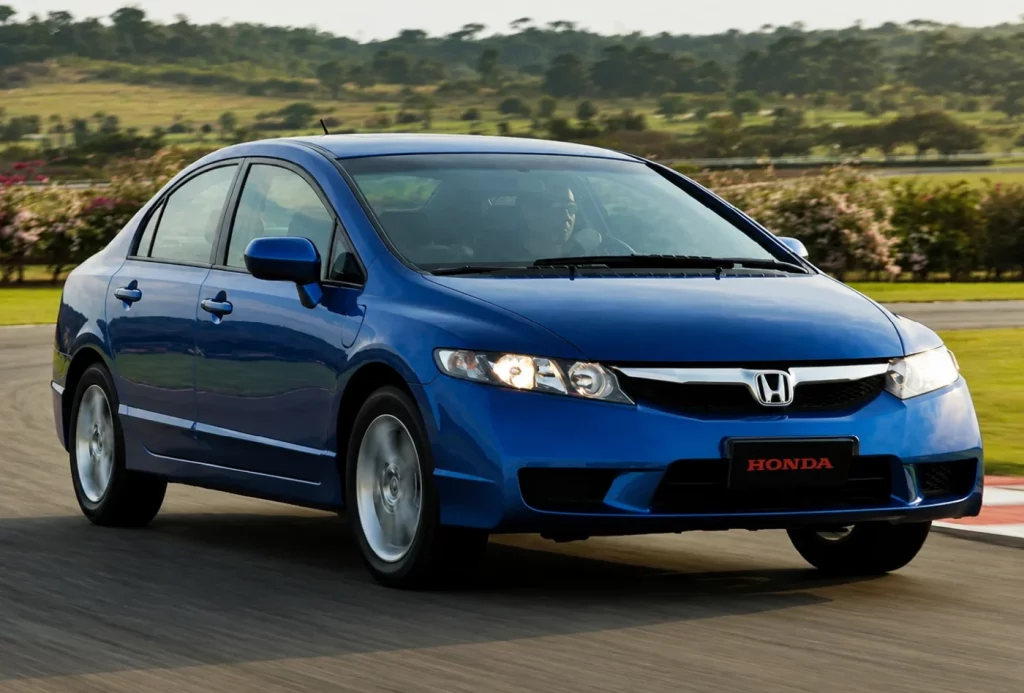
8th Generation (2006–2011) — Not Tested
The IIHS did not introduce the small overlap front test until 2012, several years after the 8th generation Civic ended production. No 2006 through 2011 Civic was ever evaluated under this protocol. The 8th gen received Good ratings in the moderate overlap front and side crash tests administered at the time, but there is no data on how its structure would perform in a 25 percent offset impact. Used buyers considering these years should be aware that small overlap crash protection was simply not part of the design requirements for that generation. Sources: IIHS vehicle ratings — 2008, 2009, 2010, 2011 Honda Civic 4-door sedan pages.
9th Generation (2012–2015) — A Story of Rapid Improvement
The 2012 Civic, a ground-up redesign for the 9th generation, was launched just before IIHS announced the small overlap test protocol. Honda did not engineer the 2012 model to pass it, and IIHS did not test it — the 2012 Civic’s ratings page lists only moderate overlap front, side, roof strength, and head restraints. It earned a Top Safety Pick for that year without small overlap evaluation. Sources: IIHS 2012 Honda Civic 4-door sedan ratings page.
After IIHS published initial small overlap results for other small cars in 2012, Honda made structural changes to the Civic for the 2013 model year. The company reinforced the front Subframe, door sills, hinge pillars, and the dash panel area to improve occupant compartment integrity in a small overlap impact. The 2013 Civic was the first small car tested by IIHS under the new protocol to earn a Good overall rating on the driver-side small overlap test, and it achieved the first Top Safety Pick+ award in the small car segment. The rating applied to the 2013 through 2015 sedan and coupe models without change. Sources: IIHS 2013 Honda Civic 4-door sedan ratings page, Honda Newsroom August 2013 press release “2013 Civic Sedan and Coupe Models Remain Only Small Cars to Achieve Top IIHS Small Overlap Frontal Crash Ratings,” PR Newswire March 2013 release.
Key structural measurements from the 2013 test (Test ID CEN1302): lower hinge pillar intrusion of 12 cm, footrest intrusion of 13 cm, left toepan intrusion of 15 cm. While the overall structure earned a Good rating, these intrusion numbers are notably higher than later generations, reflecting the first-year nature of the redesign. The head/neck and chest injury measures were Good, while lower leg/foot protection was rated Acceptable. Sources: IIHS technical measurements, 2013 Honda Civic LX 4-door small overlap test.
10th Generation (2016–2021) — Good Driver-Side, Passenger-Side Added Mid-Cycle
The 10th generation Civic, redesigned for 2016, was engineered from the ground up with small overlap protection in mind. The driver-side small overlap test resulted in a Good overall rating with significantly improved intrusion numbers compared to the 9th generation. Lower hinge pillar intrusion dropped to 3 cm (from 12 cm in 2013), footrest intrusion to 7 cm (from 13 cm), and left toepan intrusion to 6 cm (from 15 cm). The structure and safety cage earned a Good rating. Driver injury measures showed Acceptable results for head/neck and lower leg/foot, with Good scores for chest and hip/thigh. These ratings applied to the 2016 through 2021 sedan models and to the hatchback (introduced for the 2017 model year). Sources: IIHS 2017 Honda Civic 4-door sedan ratings page (tested vehicle 2016 Civic LX, rating applies 2016–21), IIHS technical measurements Test ID CEN1536.
The IIHS introduced the passenger-side small overlap front test in 2019. Honda added structure to the passenger-side front frame rail and hinge pillar area for the 2019 mid-cycle refresh. The 2019 Civic sedan and coupe both earned Good ratings on both driver-side and passenger-side small overlap tests. Notably, the 2019 coupe was tested separately from the sedan and also earned Good on both sides. Sources: IIHS 2019 Honda Civic 4-door sedan and 2-door coupe ratings pages.
The 2020 sedan’s passenger-side test showed Good overall with a right toepan intrusion of 12 cm — higher than the driver side but within Acceptable range. Passenger injury measures were all Good. The driver-side results remained unchanged from 2016 through 2021, applying to the full 10th generation run. Sources: IIHS 2020 Honda Civic 4-door sedan ratings page, passenger-side small overlap test results.
| Generation | Model Years | Driver-Side Rating | Passenger-Side Rating | Structure Intrusion (Low Hinge) | HIC-15 (Head) |
|---|---|---|---|---|---|
| 9th gen (early) | 2012 | Not tested | Not tested | N/A | N/A |
| 9th gen (updated) | 2013–2015 | Good | Not tested | 12 cm | 394 |
| 10th gen | 2016–2018 | Good | Not tested | 3 cm | N/A |
| 10th gen (refresh) | 2019–2021 | Good | Good | 3 cm / 5 cm (pass) | N/A |
| 11th gen | 2022–present | Good | Good | 1 cm / 0 cm (pass) | 217 |
11th Generation (2022–Present) — Best Small Overlap Performance Yet
The 11th generation Civic, launched for the 2022 model year, delivered the best small overlap results of any Civic tested by IIHS. The driver-side test showed near-zero structure intrusion: lower hinge pillar intrusion of 1 cm, footrest intrusion of 5 cm, and steering column movement of 0 cm. The head injury criterion (HIC-15) was 217 — significantly lower than the 9th generation’s 394 and well below the IIHS Good threshold of 700. All driver injury measures, including head/neck, chest, hip/thigh, and lower leg/foot, received Good ratings. Sources: IIHS 2022 Honda Civic 4-door sedan ratings page.
The passenger-side small overlap test also earned Good on structure and all passenger injury measures. The only noted issue was that the driver dummy’s head contacted the frontal airbag but nearly rolled off the right side, with the seat belt allowing excessive forward excursion. IIHS rated driver restraints and dummy kinematics as Acceptable in the passenger-side test configuration. Structure intrusion on the passenger side was exceptional — lower hinge pillar 0 cm, footrest 5 cm, right toepan 4 cm. Sources: IIHS 2022 Honda Civic 4-door sedan passenger-side small overlap test results.
The 11th gen Civic earned the IIHS Top Safety Pick+ award, the highest possible designation. It also was tested under the updated moderate overlap front and side crash protocols — the only Civic generation to face these more demanding evaluations — earning Acceptable on both. Earlier Civic generations were not subjected to these updated tests. Sources: IIHS 2022 Honda Civic 4-door sedan ratings page, TSP+ criteria.
What the Numbers Mean for Used Buyers
The small overlap front test results create clear tiers in the used Civic market. A 2012 Civic has no small overlap crash data at all — it was never tested and never reinforced for it. The 2013 through 2015 models were the first to earn a Good rating, but occupant compartment intrusion was substantial, with the hinge pillar moving 12 cm rearward and the footrest intruding 13 cm. While the dummy injury numbers were within acceptable limits, the cabin deformation in those cars is measurably greater than later generations.
The 10th generation (2016–2021) represents a major step forward, with intrusion numbers roughly one-quarter of the 9th generation’s levels. The 2016–2018 cars offer strong driver-side protection but lack IIHS data for passenger-side small overlap — not because they failed, but because IIHS did not test passenger-side on those model years. If passenger-side crash protection is a priority, the 2019 and later 10th gen models (which include the passenger-side structural reinforcements from the mid-cycle refresh) are a safer choice.
The 11th generation (2022–present) is the clear leader in small overlap protection. Intrusion is minimal, head injury numbers are roughly half the 9th gen’s, and the car also passes the newer, stricter moderate overlap and side crash tests that no earlier Civic faced. For a used buyer who prioritizes crash protection above all else, the 11th gen is the reference standard among Civics.
The coupe and hatchback body styles generally followed the same ratings as the sedan within each generation. The 2017–2021 hatchback ratings applied from the sedan’s 2016 test. The coupe was tested separately for 2019 and earned Good on both driver and passenger small overlap. The Type R shared the hatchback’s structure and the same ratings applied. Sources: IIHS 2019 Civic coupe ratings page, IIHS 2017 Civic sedan ratings page noting hatchback applicability.
Quick Reference
☐ 8th gen (2006–2011): Not tested on small overlap front. Test did not exist when these cars were built.
☐ 9th gen 2012: Not tested. No structural reinforcement for small overlap.
☐ 9th gen 2013–2015: Re-engineered for small overlap. Driver-side Good. First small car to earn IIHS TSP+. Notable intrusion levels at 12–15 cm range.
☐ 10th gen 2016–2018: Driver-side Good. Intrusion dropped to 3–7 cm range. Passenger-side not tested by IIHS.
☐ 10th gen 2019–2021: Mid-cycle refresh added passenger-side structure. Both driver and passenger Good. Applies to sedan, coupe, and hatchback.
☐ 11th gen 2022+: Both driver and passenger Good. Best intrusion numbers of any Civic generation (0–5 cm range). TSP+ award. Updated moderate overlap and side tests also passed.
☐ The 9th gen’s 2013–2015 cars are the oldest Civics with verified small overlap protection, but interior intrusion is significantly higher than 10th or 11th gen.
☐ The 11th gen is the only Civic tested under IIHS updated moderate overlap and side crash protocols, earning Acceptable on both.
☐ Passenger-side small overlap is only documented for 2019 and later model years. Earlier 10th gen cars may perform differently on the passenger side than the driver side.