

When most people buy a used car in the US, they look AT front crash cages or side-impact airbags. But statistically, your most common highway nightmare is getting slammed from behind while sitting at a red light. If that happens, your steering wheel nannies can’t help you. Your survival and ability to walk without a neck brace depend entirely on the mechanical engineering hiding inside your front seatback.
Let’s cut through the boring laboratory jargon about dummy acceleration metrics. This is the raw, garage-tested reality of how Honda’s Active Head Restraint (AHR) system evolved, why performance buyers got shafted in 2006, and how the Civic’s seats stack up across generations.
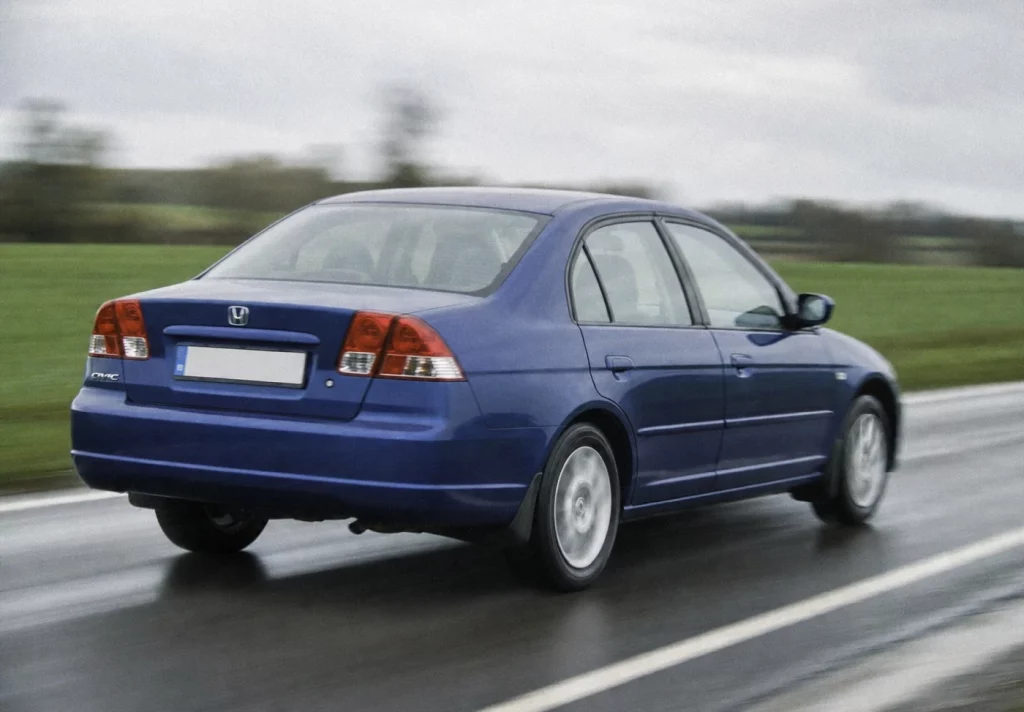
7th Gen (2001–2005) — The Static “Neck-Snapper” Era
The 7th Gen (ES1 sedan / EM2 coupe) was built before Honda got serious about low-speed rear-end dynamic engineering.
The Technology: Absolutely zero active mechanical parts. The seats are purely static metal frames padded with generic foam. Your neck is on its own.
The Problem: Whiplash protection depends 100% on whether the previous owner manually adjusted the headrest to the correct height. If you leave it down low — like most drivers do — a hard rear-end smash will cause your head to whip cleanly over the top of the pad, destroying your cervical spine soft tissue. It’s a whiplash trap waiting to happen.
IIHS Testing: Primitive. The IIHS only ran static geometry measurements (height and horizontal backset) back then. They never put the 7th Gen seats through a real dynamic sled test. If you daily-drive an old 7th Gen commuter, your neck is on its own. No nannies. No mercy.
Family Verdict: The 7th Gen is a budget car with budget neck protection. If you get rear-ended, hope your reflexes are good.
8th & 9th Gen (2006–2015) — The Mechanical Neck-Saver Revolution
The launch of the 8th Gen (FA5 sedan / FG2 coupe) changed everything with the introduction of Honda’s AHR (Active Head Restraint) system. This wasn’t an electronic sensor — it was a pure, brilliant mechanical linkage.
How the Magic Works: Tucked inside the seatback frame is a flat pressure plate. When a vehicle rams you from behind, your torso is violently forced backward into the seat. Your body weight crushes that pressure plate, which instantly pulls a mechanical lever that shoots the headrest 40 mm forward and 25 mm upward in just 30 milliseconds. It catches your skull before your neck can snap backward. It’s a mechanical neck-saver.
The IIHS Results: An unbroken run of flawless Good (G) ratings across both generations. The Civic obliterated competitors like the 2006 Corolla and Mazda3, which scored a mediocre Acceptable. Honda was playing chess while everyone else played checkers.
The Ominous Si Exception: Here is a brutal trap for used buyers: Honda did not put the AHR system into the 8th Gen Civic Si. Because the Si got stylized sports seats with a different internal frame, Honda skipped the safety levers. If you bought an 8th Gen Si for track days, you got premium bolsters but zero active whiplash protection. A base LX from the same year is safer for your neck than a Si. Think about that. Honda finally fixed this corporate laziness in the 9th Gen (FB6) by making AHR standard across the entire fleet.
The Winter Sluggishness: Watch out on pre-owned lots for TSB 13-041. On early 9th Gen models, the factory mechanical grease inside the seat frame thickens up in freezing winter weather, causing the AHR mechanism to stick or slow down when it needs to deploy. In the Rust Belt, test it on a cold morning.
Family Verdict: The 8th Gen sedan is a great safe daily — unless it’s a Si. The 9th Gen fixed the Si problem. Buy a 9th Gen for peace of mind.
10th Gen (2016–2021) — The Lightweight Good Streak
The 10th Gen (FC1 sedan / FK7 hatchback) dropped the Civic onto a completely brand-new modular compact platform.
The Weight Shave: Honda completely re-engineered the seat tracks and frames, dropping a massive 10% of weight off the seat skeleton. Lighter, but still safe.
The Safety Check: Despite pulling mass out of the cabin, the AHR mechanical link stayed identical in stroke length and sensitivity. It bagged a clean Good score across every single body style — sedan, coupe, and hatchback. The dynamic beatdown on the sled test still passed with flying colors.
The Type R Victory: Unlike the 8th Gen Si disaster, Honda did not skip the safety hardware on the track-bred FK8 Type R. The aggressive red microfiber racing buckets still contain the full mechanical AHR system under the skin, keeping your neck safe during high-speed track session spinouts. Honda finally learned their lesson.
The Foam Sag Issue: A common garage complaint on CivicX.com is that the driver-side lower seat bolster foam degrades prematurely on daily drivers, causing the seat to sag and mess up your static posture alignment. Not a safety issue, but annoying.
Family Verdict: The 10th Gen is universally safe for whiplash protection. Every trim, every body style, including the Type R. Buy with confidence.
11th Gen (2022–2026) — Reinforced Steel and the IIHS Vanishing Act
The 11th Gen (FE1 sedan / FL1 hatchback) features the toughest, most reinforced seat structures ever dropped into a compact car.
The Structural Upgrades: Honda added a heavy-duty steel cross-brace to the base of the front seats and jacked up total seatback structural strength by 15% over the 10th Gen. This stops the seat from collapsing or bending backward under massive loads when you get rammed by a heavy modern EV truck. Tank Mode activated.
The 2024+ Dashboard Disappearance: If you jump onto the official IIHS website today to look at a 2024, 2025, or 2026 Civic, you will notice something weird: the “Head Restraints & Seats” rating block is completely missing from the chart.
Don’t Panic: This does not mean the 11th Gen failed the test. In 2024, the IIHS streamlined its public dashboard. Because the 2024–2026 Civic carries over the exact same structural seat blueprint as the 2022–2023 models that earned top honors, they consolidated the score into the broader crashworthiness rating. The AHR tech is still there, and it’s still operating in Tank Mode.
Family Verdict: The 11th Gen is the safest Civic ever built for rear-impact protection. The seat structure is overbuilt, the AHR is proven, and the IIHS carryover rating is still valid. Buy the hatchback for removable headrests if you have kids.
| Civic Generation | Sled Test Result | Safety Tech Type | Si / Type R Coverage | Common Garage Flaw |
|---|---|---|---|---|
| 7th Gen (2001–05) | Not Tested | Manual / Primitive | No Active Tech | Soft frame, no levers |
| 8th Gen (2006–11) | Good (G) | Mechanical AHR | Screwed (Si has zero AHR) | Heater element failure |
| 9th Gen (2012–15) | Good (G) | Mechanical AHR | Full Fleet Coverage | Sticking levers in sub-zero cold |
| 10th Gen (2016–21) | Good (G) | Mechanical AHR | Full Type R Coverage | Driver-side bolster foam sag |
| 11th Gen (2022–26) | Good (G) | AHR + 15% Bracing | Full Si & FL5 Coverage | Heater control module bugs |
How the AHR System Works — The Mechanical Magic
Honda’s Active Head Restraint system is a 100% mechanical device built into the front seatback. No electronics. No fuses. No sensors to fail. Just pure physics.
When the occupant’s torso is pushed rearward into the seat during a rear-end collision, the pressure plate in the seatback moves rearward relative to the seat frame. This motion is transferred through a lever system that pushes the head restraint forward and upward. The total movement is approximately 40 mm forward and 25 mm upward, with the mechanism engaging within the first 30–50 milliseconds of the impact.
The benefit of the AHR system is measured in reduced neck injury criteria (NIC) values in dynamic tests. IIHS research has shown that active head restraints reduce the risk of whiplash injury by approximately 20–30% compared to fixed or manually adjusted restraints in the same geometry range. The key metric is time to head restraint contact — an AHR system reduces this by bringing the restraint physically closer to the head before the head accelerates rearward.
For the Civic buyer: The AHR system has been a consistent feature across the 8th through 11th generations. The mechanical linkage is identical in basic function across all four generations, with minor refinements to the pressure plate sensitivity and the stroke length. No model year or generation change removed the AHR system from the Civic — except the 8th Gen Si, which never had it.
Used Buyer Seat Cheat Sheet — 3 Hard Rules
Rule #1: The 8th Gen Si Warning. If you are cross-shopping old 8th Gen Civics as a cheap, safe daily driver for a high-traffic urban commute, skip the Si coupe or sedan. The absence of the AHR mechanism makes it a massive whiplash trap compared to a boring LX or EX model from the same year. A base 2006 LX is safer for your neck than a 2006 Si. Let that sink in.
Rule #2: The Mechanical Check. Honda’s AHR system is 100% mechanical — there are no pyrotechnic charges, fuses, or electronic sensors to go bad. It requires zero service maintenance. But on a test drive of an old 8th or 9th Gen, press your forearm hard into the center of the seatback. You should feel or see the head restraint naturally tilt forward and up. If it feels jammed or completely frozen, the internal linkage levers are twisted. Walk away or negotiate hard.
Rule #3: Trust the Carryover. If you are buying a 2024–2026 Civic, do not let the slick sales team tell you the car lacks a whiplash rating. The seat frames are physically identical to the 2022 models that crushed the IIHS dynamic sled runs with rock-bottom neck shear numbers. The rating disappeared from the dashboard, not from the car. It’s still a Good seat.
The Si Exception — Why Performance Buyers Got Screwed
Here’s the wildest part of the Civic whiplash safety timeline:
- 8th Gen Si (2006–2011): Zero AHR. No active head restraint. No mechanical neck-saver. Just premium bolsters and a false sense of security. A base LX from the same year is safer in a rear-end collision. Honda decided that Si buyers didn’t need neck protection. They were spectacularly wrong.
- 9th Gen Si (2012–2015): Honda finally fixed the problem. AHR became standard across the entire fleet, including the Si. No more safety tax for buying the fun car.
- 10th Gen Type R (2017–2021): Unlike the 8th Gen Si disaster, Honda did not skip the safety hardware on the FK8 Type R. The aggressive red microfiber racing buckets still contain the full mechanical AHR system under the skin. Honda learned from their mistake.
- 11th Gen Si and FL5 Type R (2022+): Full AHR with reinforced seat frames. The safest performance Civics ever built for rear-impact protection.
Quick Reference Checklist
☐ 7th Gen (2001–2005): No AHR. Static manual headrests. Never dynamically tested. Your neck is on its own. Budget pick, but know the risk.
☐ 8th Gen (2006–2011): AHR introduced. IIHS Good rating. BUT — Si trims have NO AHR. A base LX is safer than a Si. Massive used buyer trap.
☐ 9th Gen (2012–2015): AHR standard on all trims including Si. IIHS Good. Watch for TSB 13-041 — cold-weather sticking levers. Best used Civic for whiplash protection.
☐ 10th Gen (2016–2021): AHR standard on all trims including Type R. IIHS Good across sedan, coupe, hatchback. Foam sag on driver bolster is common but not a safety issue. Safe buy.
☐ 11th Gen (2022–2026): AHR with 15% stronger seatback structure. IIHS Good (2022–2023). 2024+ rating consolidated, but design unchanged. Tank Mode. Safest Civic ever for rear impacts.
☐ AHR Mechanism: Purely mechanical. No electronics. No maintenance. Works every time — unless the grease froze (9th Gen TSB).
☐ How to test AHR: Press forearm hard into seatback center. Headrest should tilt forward and up. If jammed, walk away.
☐ The 8th Gen Si is a whiplash trap. Avoid for daily driving in heavy traffic. Buy an LX or EX instead.
☐ Honda fixed the Si problem in 9th Gen. All 9th Gen+ Si models have AHR.
☐ FK8 and FL5 Type R: Both have full AHR. Honda learned from their 8th Gen mistake.
☐ IIHS rating disappeared from 2024+ dashboard, but the seat design is identical to the 2022 Good-rated car. Don’t let a dealer scare you.