

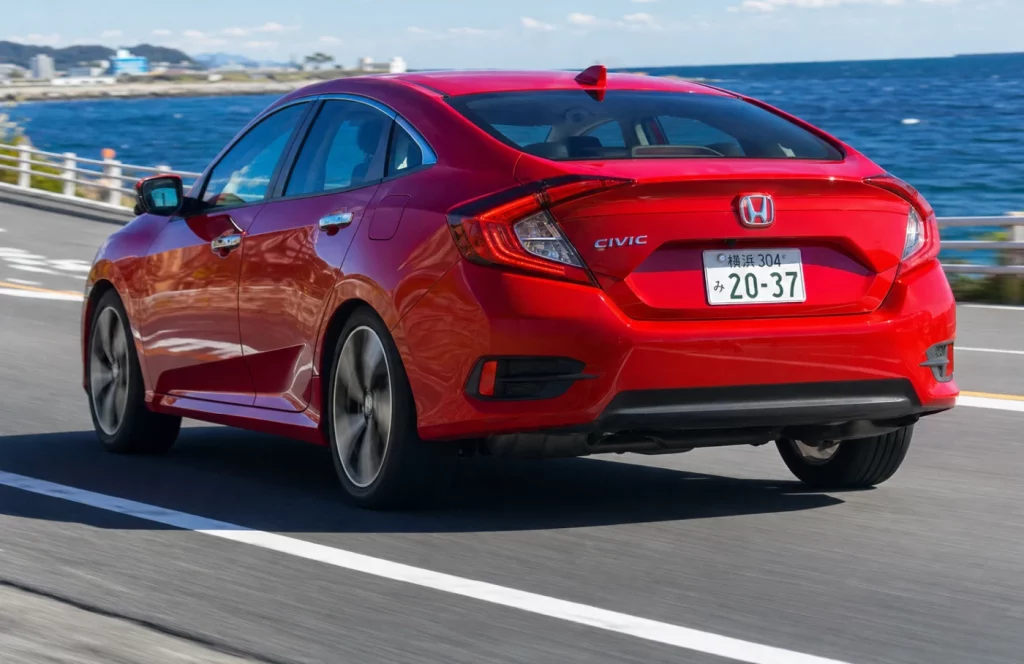
The 10th-generation Honda Civic (2016–2021) with the L15B7 1.5-liter turbocharged engine is one of the most tuned mass-market cars of its era. The reason is simple: Honda’s factory calibration left a substantial amount of performance on the table. The factory tune runs conservative boost targets — approximately 16.5 psi peak on the 1.5T non-Si — with deliberately slow throttle mapping and a knock control strategy that pulls timing aggressively under less-than-ideal conditions. A Stage 1 tune — a software-only flash using either a Hondata FlashPro or a KTuner device — addresses all of these without requiring any hardware changes. This guide covers exactly what a Stage 1 tune changes, what the tuning devices cost, what power gains are realistic, how the CVT vs manual transmission experience differs, and what the long-term reliability data actually shows. Sources: TSP Stage 1 product listing (Two Step Performance), CivicX tuning reliability project (1,671 tuned cars, data as of June 2026), Hondata technical documentation for L15 tuning, Honda-Tech and CivicX forum discussions, KTuner manufacturer documentation, Hardmotion comparison data.
What Is Stage 1, and What Does It Actually Change?
In the 10th-gen Civic 1.5T context, “Stage 1” means a software-only recalibration of the factory engine control unit. No hardware modifications. No intake. No downpipe. No intercooler. The stock turbo, stock exhaust, and stock fuel system remain untouched. The tuning device — either a Hondata FlashPro or a KTuner V1.2/V2 — connects to the OBD-II port, reads the factory ECU calibration, and overwrites it with a modified calibration.
The specific parameters changed by a Stage 1 tune include:
Boost targets. The factory tune peaks at approximately 16.5 psi on the non-Si 1.5T. A Stage 1 tune raises the peak boost target to 21–24 psi depending on the specific map and fuel quality. The Ktuner Starter 21 map targets 21 psi. The TSP Stage 1 tune targets approximately 23–24 psi on 93 octane fuel, with peak boost occurring in the midrange. The Hondata +6 psi basemap adds approximately 6 psi over the factory curve, resulting in a peak around 22–23 psi on premium fuel. Source: TSP product page dyno data, Hondata software documentation, KTuner basemap specifications.
Throttle response and pedal mapping. The factory throttle mapping has noticeable lag between pedal input and actual throttle opening — a complaint nearly universal among 10th-gen owners. A Stage 1 tune significantly sharpens throttle response. Multiple owners on CivicX describe the effect as “90% reduction in lag” and “like a completely different car.” The throttle becomes linear rather than delayed. Source: CivicX tuned owner reports, TSP product documentation.
Knock control strategy. The factory ECU uses a conservative knock control system that pulls ignition timing aggressively at elevated knock control values — Honda’s artificial knock control strategy. The Hondata technical documentation specifically notes: “The base Civic has artificial knock control. When this is disabled the base Civic (non Si) gains power due to more ignition above 5,250 RPM.” A Stage 1 tune typically recalibrates the knock control thresholds, allowing the engine to maintain more ignition timing under normal conditions while still protecting against actual detonation. Source: Hondata technical information page for L15 turbo tuning.
Turbo spool behavior. The factory calibration delays turbo response to meet fuel economy targets and reduce torque shock on the CVT. Stage 1 tunes advance the turbo spool timing, resulting in boost arriving earlier in the RPM range. Owners report noticeable improvement in low-RPM response — the car feels “awake” from 2,000 RPM rather than needing to wait past 2,500 RPM for boost to build. Source: CivicX owner reviews, TSP Stage 1 review thread.
Rev hang reduction (manual transmission). The factory calibration on manual-transmission Civics includes significant rev hang — the RPM drops slowly between shifts, which aids emissions but makes the driving experience feel sluggish. Stage 1 tunes reduce or eliminate rev hang, allowing faster, cleaner shifts. This is one of the most frequently cited improvements among 6MT owners. Source: CivicX manual transmission owner reports, Hondata software features.
On-the-fly map switching. Both KTuner and some Hondata configurations support multiple boost maps that can be switched without re-flashing. KTuner owners can switch between maps using the cruise control buttons on the steering wheel. The typical setup includes a low-boost eco MAP (16–17 psi), a mid-boost daily map (19–21 psi), and a full-power map (23–24 psi). This allows the owner to run a conservative tune for daily commuting and switch to max power for spirited driving without needing a laptop. Source: KTuner product documentation, CivicX map switching discussion.
Hondata FlashPro vs KTuner — Device Comparison
Two tuning platforms dominate the 10th-gen Civic 1.5T market. The choice between them depends on budget, feature preference, and whether you plan to use a specific off-the-shelf (OTS) tune or a custom tune from a specific tuner.
| Feature | Hondata FlashPro | KTuner V1.2 | KTuner V2 |
|---|---|---|---|
| Price (new) | $600–$790 | $449 | $649 |
| Built-in display | No (small LED indicator only) | No | 5-inch color touchscreen |
| On-the-fly map switching | No — requires laptop reflash | Yes (via cruise control buttons) | Yes (via touchscreen or cruise control) |
| Vehicle compatibility | Single vehicle per unit (must be unlocked/resold) | Unlockable — can be reused on different vehicles | Unlockable — can be reused on different vehicles |
| Real-time data monitoring | Laptop required | Android app (HondaHack) or laptop | Built-in touchscreen gauges |
| Flex fuel support | Yes (requires optional flex fuel kit) | Yes (requires optional flex fuel kit, not with TSP tune) | Yes (requires optional flex fuel kit, not with TSP tune) |
| Popular OTS tunes available | TSP Stage 1, Hondata basemaps, Phearable | KTuner basemaps, TSP Stage 1, Phearable 1.5/1.5R | KTuner basemaps, TSP Stage 1, Phearable 1.5/1.5R |
| Tuner preference (custom) | More common among 8th/9th gen/Type R tuners | Dominant on 1.5T non-Si and Si | Dominant on 1.5T non-Si and Si |
| Customer service reputation | Mixed (forum feedback) | Generally positive | Generally positive |
For the 1.5T non-Si specifically, KTuner has become the dominant platform. One frequently cited survey from CivicX suggests approximately 80% of tuned 10th-gen owners use KTuner. The V1.2 at $449 is the most affordable entry point, with the same core tuning capability as the $649 V2 — the difference is the built-in touchscreen display for real-time monitoring and map flashing without a laptop. The V1.2 requires a laptop to flash tunes and an Android device (via HondaHack APP) to display real-time data on the factory radio screen. Source: Hardmotion comparison, CivicX “KTuner Flash V2 vs Hondata FlashPro” discussion, Honda-Tech platform discussion, pricing from manufacturer websites as of 2025–2026.
The Honda-Tech forum observation from experienced owners and tuners holds: “It really comes down to your tuner’s preference and your budget. Some tuners feel more comfortable with Hondata and that’s perfectly fine. Both work well and both will get the job done.” For OTS (off-the-shelf) tunes, the difference is minimal. For custom tunes, choose the platform your tuner prefers. Source: Honda-Tech Ktuner or Hondata FlashPro thread, Derek Robinson (DRob/IMWTuned) commentary.
Power Gains — Real Dyno Numbers
The most commonly referenced Stage 1 off-the-shelf tune for the 1.5T non-Si is the TSP Stage 1 (Two Step Performance, developed by Derek Robinson). TSP published dyno results from a stock 2017 Civic EX-T 6MT with 71,000 miles on 93 octane fuel:
| Calibration | Peak WHP | Peak Torque (WTQ) | Peak Boost | Max Gain Over Stock (WHP) | Max Gain Over Stock (Torque) |
|---|---|---|---|---|---|
| Factory calibration | 187 whp | 200 lb-ft | ~16.5 psi | — | — |
| KTuner Starter 21 psi | 203 whp | 250 lb-ft | 21 psi | +16 whp | +50 lb-ft |
| TSP Stage 1 (93 octane) | 219 whp | 258 lb-ft | ~23–24 psi | +32 whp (+39 whp at 6,100 RPM) | +58 lb-ft (+63 lb-ft at 3,400 RPM) |
The real-world significance: the TSP Stage 1 tune produces +32 whp peak and +58 lb-ft peak over the factory calibration, with maximum gains of +39 whp AT 6,100 RPM and +63 lb-ft at 3,400 RPM on a manual-transmission car. These are wheel horsepower numbers — at the crank, the factory-rated 174 hp (non-Si) translates to approximately 187 whp stock, and the tuned output of 219 whp is roughly equivalent to 250–260 crank horsepower. Source: TSP product page dyno chart, TSP Stage 1 review thread on CivicX, Hondata L15 tuning technical page.
KTuner Starter 21 vs TSP Stage 1. The KTuner Starter 21 map is the included basemap that comes with the KTuner device at no additional cost. It provides a noticeable improvement — 16 whp and 50 lb-ft over stock — but is less refined than the paid TSP Stage 1 tune. CivicX owner feedback consistently describes the TSP Stage 1 as “blowing the KTuner Starter 21 out of the water” on both power and drivability. The TSP tune has a broader torque curve, smoother delivery, and better top-end pull above 5,000 RPM where the KTuner basemap tends to fizzle. Source: CivicX TSP Stage 1 hands-on review, user comparison posts.
CVT vs 6MT power delivery. The CVT version of the TSP Stage 1 tune has torque slightly reduced below 4,000 RPM compared to the manual version. TSP explicitly states: “The CVT version of the tune has slightly reduced torque below 4,000 RPM to avoid risking damage to the CVT.” Peak power numbers on a CVT-equipped car are typically lower than on a manual — CVT owners report approximately 205–210 whp on the TSP Stage 1, compared to 219 whp on the manual. The torque limitation is in the low-to-midrange; once past 4,000 RPM, the CVT tune delivers full power. Source: TSP product page, CivicX CVT dyno discussion, owner reports.
Fuel quality sensitivity. All Stage 1 tunes require premium fuel. On 91 octane — typical for California and other regions without access to 93 — the ECU will pull ignition timing as knock control rises, resulting in lower real-world power. CivicX owners on 91 octane report approximately 10–15 whp less than the published 93 octane numbers. The knock control value (K.Con) is a critical parameter visible on KTuner and Hondata datalogging screens — values above 0.70 indicate the ECU is pulling timing, and sustained values above 0.90 indicate conditions that may lead to engine damage. Source: CivicX owner reports, Hondata L15 tuning documentation, CivicX datalogging discussion.
Real-World Performance — 0-60 and Quarter Mile
Measured acceleration data for Stage 1 tuned 1.5T Civics is limited compared to dyno numbers, but owner reports and forum discussions provide useful estimates:
| Configuration | 0-60 mph (est.) | Quarter Mile (est.) | Notes |
|---|---|---|---|
| Stock 1.5T CVT | ~7.0–7.4 sec | ~15.3–15.7 sec | Factory calibration |
| Stock 1.5T 6MT | ~6.8–7.2 sec | ~15.1–15.5 sec | Factory calibration |
| Stage 1 (KTuner 21) CVT | ~6.2–6.5 sec | ~14.6–14.9 sec | KTuner Starter 21, 93 octane |
| Stage 1 (TSP/Phearable) CVT | ~5.8–6.2 sec | ~14.3–14.6 sec | 93 octane, optimal conditions |
| Stage 1 (TSP/Phearable) 6MT | ~5.6–6.0 sec | ~14.0–14.3 sec | 93 octane, good driver, no bolt-ons |
The improvement is approximately 1.0–1.5 seconds in the 0-60 sprint and 0.8–1.2 seconds in the quarter mile over the factory calibration. For context, a Stage 1 tuned non-Si 1.5T runs similar quarter-mile times to a stock 9th-gen Civic Si (approximately 14.2 seconds) and is quicker than a stock 10th-gen Civic Si from a dig, though the Si pulls ahead at higher speeds and handles significantly better. Source: CivicX tuned times discussion, Hondata dyno comparisons, 10th-gen Civic forum acceleration data.
Popular Off-the-Shelf (OTS) Stage 1 Tunes
Three OTS tunes dominate the 10th-gen 1.5T market. The choice depends on tuning platform and specific requirements:
KTuner Starter 21 (Dual Target 21). Included with every KTuner device at no extra cost. Two maps: a 16.5 psi low-boost map and a 21 psi high-boost map, switchable on the fly. Approximately 203 whp / 250 lb-ft on 93 octane. Good entry-level tune but noticeably less refined than paid options. The throttle mapping is improved over stock but still not as linear as the TSP or Phearable tunes. Best for: owners who want a noticeable improvement without the additional cost of a paid tune. Source: KTuner software documentation, CivicX multiple-comparison posts.
TSP Stage 1 (Two Step Performance / Derek Robinson). The most documented and widely recommended OTS tune for the 1.5T non-Si. Available for both KTuner and Hondata FlashPro. Approximately 219 whp / 258 lb-ft on 93 octane (manual). CVT version has torque reduced below 4,000 RPM. Three maps: a 16.5 psi economical map, a 20 psi mid-range map, and the full-power 23–24 psi map — switchable on the fly (KTuner) or requires reflash (Hondata FlashPro). Owners consistently describe it as “smooth,” “refined,” and “how the car should have come from the factory.” The CivicX Tuning Reliability Project lists TSP Stage 1 as the most popular OTS tune with 532 users as of June 2026. Pricing: approximately $250–$300 for the tune file when purchased separately, or included when purchasing a KTuner from TSP. Source: TSP product page, CivicX TSP Stage 1 review, CivicX tuning reliability thread.
Phearable 1.5R (John Vega / Phearable.net). A direct competitor to the TSP Stage 1, also developed by an experienced Honda tuner. Available for KTuner only. Three maps: Map 1 (gentle daily, approximately 18 psi), Map 2 (mid-power 20 psi), Map 3 (full-power 24 psi). Owners who have tried both TSP Stage 1 and Phearable 1.5R generally agree both are excellent, with the choice coming down to personal preference and specific driving feel. The Phearable 1.5R is sometimes described as more aggressive in the midrange. The CivicX reliability project lists 320 Phearable 1.5 users and growing. Pricing: approximately $250–$300 from Phearable.net. Source: CivicX Phearable 1.5R review thread, civicx tuning reliability project data, Phearable product page.
Hondata Basemaps (+6 psi, +9 psi). Included with the Hondata FlashPro. The +6 psi map adds approximately 6 psi over the factory curve. The +9 psi map adds 9 psi (primarily used with race gas or ethanol blends). These basemaps are less refined than the paid OTS tunes from TSP or Phearable — they are starting points intended for custom tuning rather than final daily-driver calibrations. Owners who use Hondata basemaps long-term generally report good results, but the consensus from the CivicX tuning community is that a paid OTS tune (TSP or Phearable) provides noticeably better drivability. Source: Hondata software documentation, CivicX Hondata discussion threads, Hondata user reports.
CVT vs Manual — Critical Differences for Stage 1 Tuning
The transmission choice fundamentally changes the Stage 1 experience and the torque limits that can be safely applied.
CVT considerations. The Honda CVT used in the 10th-gen 1.5T non-Si is a Chain-drive CVT rated for approximately 250–260 lb-ft of torque before reliability becomes a concern. All major OTS Stage 1 tunes for the CVT limit torque below 4,000 RPM specifically to protect the transmission. The TSP Stage 1 CVT tune, per TSP’s documentation, “has slightly reduced torque below 4,000 RPM to avoid risking damage to the CVT.” The Phearable 1.5R CVT tune similarly detunes low-RPM torque.
The TSP Stage 1 CVT torque limiter values as reported by one owner on CivicX: 3,500 RPM limited to 287 Nm (212 lb-ft), 4,000 RPM limited to 310 Nm (229 lb-ft), 4,500 RPM limited to 300 Nm (221 lb-ft), 5,000–7,000 RPM limited to 325 Nm (240 lb-ft). These are above what Honda considers safe (Hondata’s stated maximum of 250 Nm / 184 lb-ft) but within what the aftermarket tuning community considers acceptable for the CVT with proper maintenance. Source: CivicX TSP Stage 1 Hondata FlashPro tune thread (owner datalog analysis), CivicX CVT tuned longevity discussion.
CVT fluid maintenance becomes more critical with a Stage 1 tune. The recommended interval among experienced tuned CVT owners is every 20,000–25,000 miles for the CVT fluid (drain-and-fill, not flush). Some owners install an aftermarket CVT cooler for additional safety margin. Source: CivicX tuned CVT longevity thread, CivicX CVT fluid change recommendations.
Manual transmission considerations. The 6-speed manual in the 1.5T non-Si is generally robust at Stage 1 power levels. The clutch holds the increased torque without slipping on the factory clutch at 219 whp / 258 lb-ft. Most owners report the clutch holds fine at Stage 1 even with aggressive driving. The rev hang reduction from the tune makes the manual transmission significantly more pleasant to drive — cleaner shifts, faster throttle blips, and less hesitation between gears.
The 6-speed manual in the Si (different gearbox, stronger internals) also handles Stage 1 power without issues. Si-specific concerns at this level are minimal — the transmission and clutch are well within their design margins at approximately 230–250 whp (Si Stage 1). Source: CivicX manual transmission owner reports, CivicX tuning reliability project transmission failure data.
Reliability Data — What the Community Reports After Millions of Tuned Miles
The CivicX Tuning Reliability Project, maintained by user gtman, is the most comprehensive long-term reliability dataset for tuned 10th-gen Civics. As of June 14, 2026, the thread contains 1,671 submitted tuned cars with over 43 million combined tuned miles. The data is directly relevant to anyone considering a Stage 1 tune.
| Metric | Non-Si Sedan/Coupe | Non-Si Hatchback | Si | Type R |
|---|---|---|---|---|
| Tuned cars submitted | 293 (sedan/coupe) | 437 | 711 | 165 |
| Overall failure rate | 4.8% | 7.2% | 5.4% | 2.5% |
| Engine blown/seized rate | 2.1% | 3.7% | 2.0% | 2.4% |
| Head gasket failures (% of engine failures) | 33% | 33% | 52% | data limited |
| Rod failures (as % of engine failures) | 4 rods (19%) | 15 rods (79% of rod failures) | — | — |
| CVT failures total (all models) | 12 total (42% replaced under warranty) | |||
| Most common OTS tune (non-Si) | TSP Stage 1 — 532 users | |||
| OTS tune failure rate | 4.4% (8 OTS failures) | |||
| Custom tune failure rate | 10.0% (34 custom failures) | |||
| Flex fuel failure rate | 10.3% (25 of 242 flex fuel cars) | |||
The data points to several clear conclusions:
OTS Stage 1 tunes are the safest tuning option. Off-the-shelf tunes (TSP Stage 1, Phearable 1.5/1.5R, KTuner basemaps) have a 4.4% failure rate — significantly lower than custom tunes (10.0%) and flex fuel setups (10.3%). Within OTS tunes, the TSP Stage 1 has 532 users and remains the most popular. Source: CivicX tuning reliability project (gtman, data as of June 2026).
Hatchbacks are more failure-prone than sedans and coupes. The 1.5T hatchback (FK7/FK4) uses the L15B7 engine with weaker connecting rods than the sedan and coupe (L15B7 with 5PA rods vs hatchback 59B rods). 79% of all non-Si rod failures occurred in hatchback models. The overall hatchback failure rate is 7.2%, compared to 4.8% for sedans and coupes. Source: CivicX reliability project, hatchback rod failure analysis by gtman.
CVT failures are relatively rare but expensive. Only 12 CVT failures out of 569 CVT-equipped tuned cars (2.1% failure rate). Of those, 5 were replaced under warranty. The most common cause appears to be excessive torque from aggressive custom tunes or flex fuel setups combined with hard driving (track days, power braking, launches). The OTS tunes specifically designed for the CVT (torque-limited below 4,000 RPM) have a strong track record. Source: CivicX reliability project CVT Failure data, CivicX tuned CVT longevity discussion.
Head gasket failure is the most common engine issue. 33% of non-Si engine failures and 52% of Si engine failures are head gasket failures. The L15 engine has a coolant channel between each cylinder, leaving narrow gasket sealing area — a design characteristic that makes Head Gasket Failure more likely under high boost, especially as the engine ages and accumulates tuned miles. ARP head studs are recommended by many long-term tuned owners as a preventive measure. Source: CivicX reliability project head gasket failure analysis, owner reports (bbeem, bbeem’s analysis of gasket design).
Notable high-mileage success stories. Several tuned cars in the CivicX reliability project have exceeded 100,000 tuned miles. A 2016 EX-T CVT on Hondata +6 and later TSP Stage 1 reached 190,000 tuned miles (200,000 total) — with one CVT replacement at 25,000 miles and a Head Gasket at 185,000 miles. A 2017 Touring CVT on KTuner with TSP/Phearable tunes reached 175,000 tuned miles (223,000 total) with two head gasket replacements and original CVT still holding. A 2018 Civic Si on KTuner V1.2 with TSP Stage 1 reached approximately 130,000 tuned miles on the original clutch. Source: CivicX reliability project high-mileage owner entries.
Oil Dilution — The L15B7’s Known Issue and How Tuning Affects It
The 10th-gen Civic 1.5T has a well-documented Oil dilution problem, particularly in cold climates and on short-trip driving patterns. The direct-injection L15B7 engine can accumulate fuel in the oil pan when the engine does not reach full operating temperature for sufficient time, allowing fuel to bypass the piston rings during cold-start injection events.
The factory tune addresses oil dilution with specific injection timing strategies and cold-start behavior. A Stage 1 tune does not inherently make oil dilution worse — but it does not fix it either. The OTS tunes from TSP and Phearable maintain the factory cold-start enrichment strategies. The primary defense against oil dilution remains the same regardless of tuning: regular oil changes (every 3,000–5,000 miles for tuned cars, not the factory 7,500–10,000 mile interval) and ensuring the engine reaches full operating temperature on each drive. Owners in cold climates who take short trips (under 10–15 minutes) should check oil level and fuel odor regularly. Source: Honda service bulletins on L15 oil dilution, CivicX oil dilution discussion threads.
For tuned cars, more frequent oil changes are recommended regardless of dilution concerns — the increased cylinder pressure and higher operating temperatures accelerate oil breakdown. The CivicX tuned owner community standard is 3,000–5,000 mile oil change intervals for tuned 1.5T engines.
Warranty Implications
Tuning the ECU voids the factory powertrain warranty. The ECU stores a flash counter and calibration checksum — Honda dealers can detect a tune even if the ECU is reflashed to stock. The CivicX reliability project documents multiple cases where warranty claims were denied due to evidence of tuning, including CVT replacements (5 of 12 CVT failures were covered under warranty; 7 were denied due to tune detection). For owners still under the 5-year/60,000-mile powertrain warranty, the decision to tune is a decision to accept the cost of any future powertrain repairs out of pocket. Source: CivicX reliability project warranty claim data, Honda dealer diagnostic documentation.
Installation and Daily Use Experience
The installation process for a Stage 1 tune takes approximately 15–30 minutes for a first-time user. The KTuner device connects to the OBD-II port, reads the stock ECU calibration, saves a backup copy, and flashes the new calibration. The process is reversible: reflashing back to the factory calibration restores the car to stock.
Once installed, the daily driving experience changes immediately. Owners consistently report that the car feels “how it should have come from the factory.” The throttle lag that plagues the stock calibration disappears. The car pulls more strongly from lower RPMs, making highway merging and passing safer and more effortless. The CVT’s simulated “stepped” behavior in Sport mode feels more responsive. Fuel economy on a Stage 1 tune under normal driving conditions is approximately 1–3 mpg lower than stock — the difference is primarily from the heavier right foot that the tune encourages, not from the calibration itself. On steady highway cruising, fuel economy is nearly identical to stock because the ECU operates in closed-loop fueling at low load regardless of the tune. Source: CivicX owner reports, TSP Stage 1 long-term review thread, CivicX tuned fuel economy discussion.
Total Cost of a Stage 1 Setup
The entry cost varies by tuning platform and whether the tune file is included or purchased separately:
| Setup | Hardware Cost | Tune Cost | Total |
|---|---|---|---|
| KTuner V1.2 + KTuner basemaps | $449 | $0 (included) | $449 |
| KTuner V1.2 + TSP Stage 1 | $449 | $250–$300 | $699–$749 |
| KTuner V2 + TSP Stage 1 | $649 | $250–$300 | $899–$949 |
| Hondata FlashPro + TSP Stage 1 | $600–$790 | $250–$300 | $850–$1,090 |
| Hondata FlashPro + Hondata basemaps | $600–$790 | $0 (included) | $600–$790 |
| Used KTuner V1.2 + TSP Stage 1 | $300–$400 (used market) | $250–$300 | $550–$700 |
The KTuner V1.2 with TSP Stage 1 at approximately $699–$749 is the most commonly recommended entry-level setup. Used KTuner devices retain approximately 70–80% of their value and can be unlocked and resold, reducing the net cost if the owner later sells the car. Source: KTuner and TSP pricing as of 2025–2026, CivicX used tuning device market prices.
Summary
A Stage 1 tune transforms the 10th-gen Civic 1.5T from a laggy, restrained commuter into a responsive, genuinely quick car — without any hardware changes. The KTuner FlashPro is the more popular platform for the 1.5T, with 80% of tuned owners using it per CivicX survey data. The TSP Stage 1 tune is the most documented and tested OTS option, with 532 users in the reliability study and a 4.4% overall failure rate — the lowest across all tune types. The CVT handles Stage 1 power reliably with proper torque-limited tunes and regular fluid changes. The hatchback’s weaker connecting rods are a genuine concern for owners who plan to push beyond Stage 1, but at Stage 1 power levels on a quality OTS tune, the risk is manageable. The car’s stock calibration leaves significant performance on the table. A Stage 1 tune recovers most of it.
Stage 1 Tuning — Quick Reference:
☐ A Stage 1 tune is software-only — no hardware modifications required. It changes boost targets, throttle response, knock control strategy, turbo spool behavior, and (on manual cars) rev hang.
☐ The 10th-gen Civic 1.5T non-Si makes approximately 187 whp / 200 lb-ft stock. A TSP Stage 1 tune on 93 octane raises this to 219 whp / 258 lb-ft on the manual transmission — a gain of +32 whp and +58 lb-ft.
☐ CVT tunes have torque reduced below 4,000 RPM to protect the transmission. Peak power is approximately 205–210 whp on the CVT version of Stage 1 tunes.
☐ KTuner is the dominant tuning platform for the 1.5T (~80% of tuned owners). The V1.2 ($449) is the most affordable entry point. The V2 ($649) adds a built-in touchscreen. Hondata FlashPro ($600–$790) is the alternative.
☐ The most popular OTS Stage 1 tunes are TSP Stage 1 (532 users in reliability study) and Phearable 1.5R (320 users). Both require 93 octane fuel for full power. Both support on-the-fly map switching on KTuner.
☐ OTS Stage 1 tunes have a 4.4% overall failure rate across 1,671 tracked tuned cars — the safest tuning option. Custom tunes have a 10.0% failure rate. Flex fuel tunes have a 10.3% failure rate.
☐ Hatchback 1.5T engines use weaker connecting rods (59B rods) compared to sedans and coupes (5PA rods). 79% of all non-Si rod failures occurred in hatchbacks. Stage 1 power is generally safe; pushing beyond Stage 1 carries elevated risk on hatchbacks.
☐ Head Gasket failure is the most common L15 engine failure across all models. ARP head studs are recommended preventive upgrade for long-term tuned ownership, especially on cars that will be driven hard.
☐ CVT fluid should be changed every 20,000–25,000 miles on tuned cars. Engine oil should be changed every 3,000–5,000 miles.
☐ Tuning voids the factory powertrain warranty. Honda dealers can detect that the ECU has been flashed, even if reflashed to stock.
☐ Acceleration improvement: approximately 1.0–1.5 seconds faster 0-60 (from ~7.0 sec to ~5.8 sec for CVT, ~6.8 to ~5.6 for 6MT) with a Stage 1 tune on 93 octane.
☐ The KTuner V1.2 with TSP Stage 1 at approximately $699–$749 is the most recommended entry-level Stage 1 setup for the 10th-gen 1.5T Civic.