

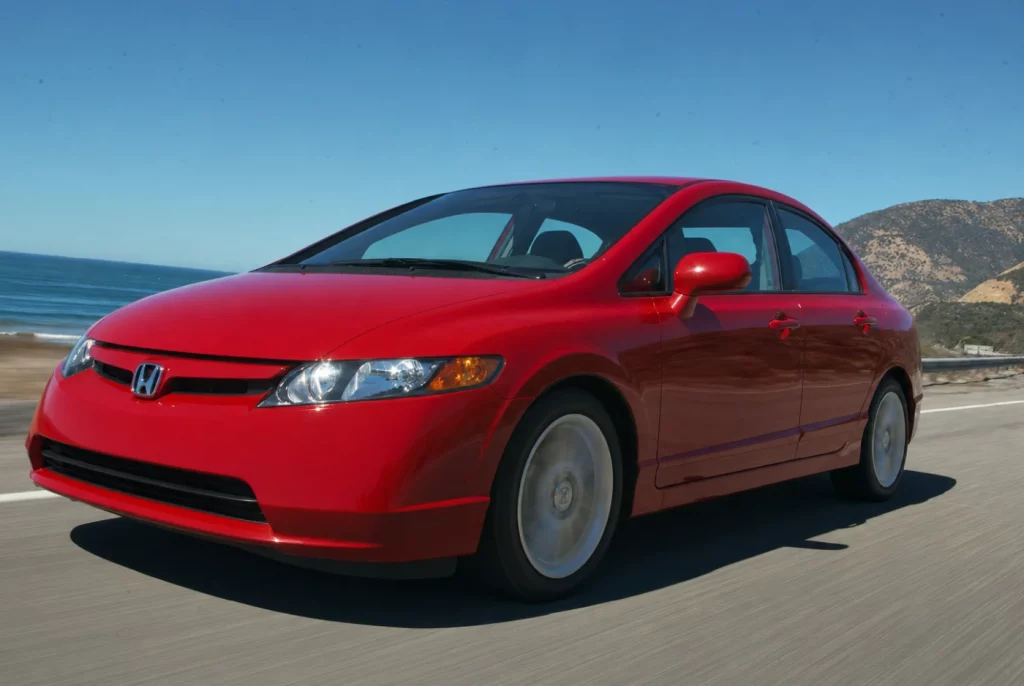
The 8th generation Honda Civic (2006–2011) uses four engine and transmission mounts to secure the powertrain and isolate cabin vibration. The passenger-side hydraulic mount is the most sophisticated and most load-bearing of the four, and it fails on a predictable schedule, typically between 60,000 and 120,000 miles. The result is a vibration pattern so consistent across the 8th gen population that it has become one of the generation’s defining complaints. Understanding which mount fails, why it fails, and what the correct repair sequence looks like prevents owners from replacing the wrong component and paying twice.
Quick Answer
On the 2006–2011 Civic, the most characteristic failure is the passenger-side hydraulic Engine Mount. When it loses hydraulic pressure or collapses, engine vibration transfers directly to the cabin. Typical symptoms include: severe vibration at idle (especially in Drive), vibration in the steering wheel and seat, clunk or thump during acceleration, clunk when shifting between Drive and Reverse, excessive engine movement visible under the hood, and fluid leakage or visible collapse of the mount itself. The hydraulic mount is the primary suspect for idle vibration; the torque rods (upper and lower) are the primary suspects for clunks during acceleration and deceleration. On high-mileage cars (80,000+ miles), replacing all four mounts simultaneously is strongly recommended because the remaining mounts have aged at the same rate.
The Four-Mount System: What Each Mount Does
The 8th gen Civic powertrain is secured by four mounting points, each with a distinct role in load management and vibration isolation. Misidentifying which mount has failed is the most common diagnostic error on this platform, because all four produce overlapping symptoms AT different stages of failure.
The passenger-side engine mount (also called the right-side or engine-side mount) is the primary vibration isolator. It is a hydraulic mount — filled with fluid rather than solid rubber — and carries the majority of the engine’s static weight on the right side. The hydraulic design allows it to absorb a wider range of vibration frequencies than a rubber mount, but it is also the first to fail because the fluid degrades and eventually leaks internally. OEM part number for the 1.8L automatic application is 50820-SNB-H01 (sedan) or 50820-SNA-H01 (coupe).
The driver-side transmission mount (left-side mount) is a solid rubber unit that supports the transmission on the opposite side of the powertrain. It fails less frequently than the passenger-side hydraulic mount but produces a similar vibration pattern when it does, particularly felt during gear engagement and disengagement.
The upper torque rod (dogbone mount) connects the top of the engine to the firewall and controls fore-aft engine movement under acceleration and braking. It is a rubber bushing unit. Failure produces a clunk on throttle application and release rather than idle vibration.
The lower torque rod connects the bottom of the engine/transmission assembly to the Subframe and controls the same fore-aft movement from below. It works in tandem with the upper torque rod.
Mounts perform different functions. The hydraulic mount primarily dampens vibration. The torque rods primarily limit engine rotation. A clunk and a vibration are different symptoms that point to different components.
Passenger-Side Hydraulic Mount — Why It Fails
The passenger-side hydraulic mount on the 8th gen Civic is a fluid-filled rubber assembly. Inside the mount, two fluid chambers are separated by a rubber diaphragm and connected by a small orifice. As the engine vibrates, fluid moves between the chambers through the orifice, dissipating vibration energy as heat. This design is significantly more effective than a solid rubber mount at isolating the low-frequency vibrations produced by a 4-cylinder engine at idle.
The failure mechanism is internal fluid loss. The rubber diaphragm separating the two chambers develops micro-tears over time from heat cycling and mechanical fatigue. Fluid migrates past the diaphragm, reducing the hydraulic damping effect. The mount does not leak externally in most cases — there is no visible fluid on the mount body or surrounding components. The failure is entirely internal, which is why visual inspection alone cannot confirm mount condition.
One of the most useful visual indicators: The metal bracket may sit abnormally low against the collapsed mount. Visual inspection alone often reveals the problem without disassembly.
The failure is temperature-sensitive. Cold hydraulic fluid is more viscous and moves more slowly through the orifice, which means a failing mount produces its worst vibration when the engine is cold. Owners consistently report that the vibration is severe on cold starts and in reverse (which torques the engine forward, compressing the mount further), and diminishes or disappears once the engine reaches operating temperature and the fluid warms. This temperature-dependent pattern is the clearest diagnostic indicator that the passenger-side hydraulic mount is the source.
Symptoms of a Bad Motor Mount — Complete List
| Symptom | Likely Cause | When It Occurs |
|---|---|---|
| Vibration at idle | Hydraulic / passenger mount | Idle, especially in Drive |
| Vibration in Drive but not Neutral | Mount failure (classic sign) | Stopped in Drive, gear engaged |
| Vibration in steering wheel / seat | Mount vibration transfer | Idle or low-speed |
| Clunk on acceleration | Torque mount (upper) | From stop, 1st–2nd shift |
| Clunk on deceleration | Torque mount | Throttle lift |
| Clunk in Reverse | Torque mount / mount movement | Shifting to Reverse |
| Thump when shifting D/R | Mount movement | Engaging transmission |
| Engine rocks excessively | Failed mount (any) | Under load, shifting |
| Fluid leaking from mount | Hydraulic mount (external leak) | Visible fluid on mount body |
| Buzzing through steering wheel | Mount vibration transfer | At speed, under load |
| A/C makes vibration worse | Weak mount (increased load) | A/C on, idle |
Vibration at Idle — Mount or Engine Problem?
This is one of the most important diagnostic distinctions. Not every vibration needs a mount replacement.
More suspicious of a bad mount:
- Engine otherwise runs normally
- No check engine light
- RPM is relatively stable (no fluctuations)
- Vibration is strongest in Drive
- Vibration decreases in Neutral or Park
- Vibration is worse when cold and improves when warm
More suspicious of an engine problem:
- Unstable or fluctuating RPM
- Misfire codes (P030X)
- Check engine light is on
- Rough combustion
- Vacuum or fuel system issues
- Vibration is present in all gears, including Neutral and Park
If there is a check engine light with misfire codes, diagnose the engine separately. A bad mount does not cause misfires, but it can make a misfire feel more noticeable.
Vibration in Drive but Not Neutral — The Classic Sign
This is one of the best diagnostic indicators for a failing mount:
- Park: Relatively smooth
- Neutral: Relatively smooth
- Drive (stopped): Strong vibration
This pattern points directly to the passenger-side hydraulic mount. When the transmission is in Drive, the engine is under load and torque is applied to the mounts. A weak hydraulic mount cannot isolate this load, and vibration transfers to the cabin.
However, this is not an absolute test. The load from the transmission in Drive changes the engine’s operating characteristics slightly. But as a practical diagnostic tool, the D/N/P vibration comparison is one of the quickest ways to confirm a mount issue.
One owner reported a 2006 Civic with approximately 115,000 miles that developed noise traced to the right upper fluid-filled mount — a perfect example of the mileage range where this failure typically appears.
Clunk When Accelerating — The Torque Mount Symptom
If the car clunks, thumps, or jerks during acceleration from a stop, the upper torque rod (dogbone mount) is the primary suspect. This mount limits engine rotation under load. When the rubber bushing in the torque rod wears or collapses, the engine twists excessively during acceleration, and the mount takes up the movement with a clunk.
Clunk when shifting into Reverse is another classic torque mount symptom. The engine rotates in the opposite direction when Reverse is engaged, and a worn torque rod allows excessive movement, producing a clunk or thump.
Go-Parts documentation specifically identifies clunk/thump during acceleration, deceleration, and shifting between Drive and Reverse as characteristic symptoms of torque mount failure.
Engine Movement Test — Simple Visual Diagnostic
This is a safe, effective diagnostic test that requires a helper:
- Park the vehicle on level ground with the Parking Brake firmly engaged
- Open the Hood and observe the engine
- Have a helper briefly shift from Park to Reverse, then to Drive, then back to Park
- Watch for excessive engine movement — a healthy engine moves slightly, a failed mount allows significant rocking or lurching
Warning: Do not perform aggressive brake-torque tests. A simple visual observation of engine movement during gear engagement is sufficient for diagnosis. Aggressive testing can stress already damaged mounts and other drivetrain components.
Visual Inspection — Checking the Passenger Mount
The passenger-side hydraulic mount is visible from above with the hood open. Look for:
- Cracked or collapsed rubber
- Fluid leakage (though most failures are internal, external leaks sometimes occur)
- Abnormal gap between the upper and lower bump stops
- Metal-to-metal contact (indicates complete collapse)
- Distorted mount body
The mount has two metal bump stops — one attached to the engine bracket (upper) and one attached to the body bracket (lower). On a healthy mount, there is a visible gap of approximately 12–15mm between these two stops. On a failed mount, the gap has closed to less than 5mm or the stops are in contact.
This is one of those repairs where a photo of a good mount vs a failed mount is worth more than 500 words of text. The visual difference is unmistakable once you know what to look for.
How to Tell Which Mount Failed
| Mount | Typical Symptoms | Visual Check |
|---|---|---|
| Passenger hydraulic mount | Idle vibration, worse in Drive, temperature-dependent | Bump stops touching or gap < 5mm |
| Upper torque rod | Clunk on acceleration, clunk on deceleration, clunk in Reverse | Visible bushing collapse or cracking at torque rod ends |
| Lower torque rod | Clunk from below, wheel hop under hard acceleration | Bushing visibly collapsed, engine rocks excessively |
| Driver-side transmission mount | Vibration in seat and floor, regardless of temperature | Visible rubber cracking or separation on trans mount body |
Multiple mounts can fail simultaneously. Do not assume only one mount is bad. On a car with 100,000+ miles, all four mounts have aged at the same rate.
Why Replacing One Mount May Not Fix the Problem
The most common repair mistake on 8th gen Civic motor mount jobs is replacing only the passenger-side hydraulic mount and leaving the remaining three mounts in place. This approach fails for two reasons.
First, the driver-side transmission mount and both torque rods age at the same rate as the hydraulic mount. On a car with 80,000–120,000 miles, all four mounts have been subjected to the same heat cycling, load, and time. Replacing one new mount into a system where the other three are degraded means the new mount absorbs disproportionate load, accelerating its own wear.
Second, the vibration and clunk symptoms from a partially failed torque rod or transmission mount are masked by the more severe hydraulic mount failure. Once the hydraulic mount is replaced, the previously masked symptoms from the other mounts become apparent, and the owner returns for a second repair.
Forum documentation from 8thcivic.com consistently shows owners who replaced all four mounts simultaneously reporting complete resolution of vibration and clunk complaints, while owners who replaced only the hydraulic mount frequently returned within 10,000–20,000 miles for additional mount work. The incremental labor cost of replacing all four mounts at the same time is minimal compared to the cost of a second disassembly job.
Can a Bad Mount Cause Transmission Problems?
It can create symptoms that feel like a transmission problem.
Examples:
- Harsh engagement when shifting into Drive or Reverse
- Clunk or thump during gear changes
- Drivetrain shock or jerk during acceleration
However, a bad mount does not turn a working transmission into a failing one. It can exaggerate normal drivetrain movement, making it feel like the transmission is binding or slipping. If the transmission shifts smoothly once the car is moving and only clunks during engagement, mounts are a more likely cause than internal transmission failure.
Can a Bad Mount Cause Misfires or Check Engine Light?
No — not directly. A bad mount does not cause misfires. However, severe vibration from a failed mount can feel like a misfire to the driver. The difference is simple:
- A bad mount: the engine runs smoothly, but the cabin vibrates
- A misfire: the engine itself runs rough, with fluctuating RPM
If there is a check engine light with P030X (misfire) codes, diagnose the engine separately. Do not assume the mount is the cause.
A/C Makes the Vibration Worse — What It Means
When the A/C compressor engages, it increases the load on the engine. A weak mount that was barely managing idle vibration may become noticeably worse with the A/C on. This is a useful symptom for two reasons:
- It confirms the vibration is related to engine load and mounts
- It helps differentiate mount vibration from other causes (e.g., an imbalance in the engine itself would be present regardless of A/C load)
However, this is not a definitive test. Some engine-related vibrations also worsen with A/C load. But as a practical diagnostic indicator, A/C-related vibration intensification often points to mounts.
1.8L R18 vs Civic Si — Different Part Numbers
The R18 Civic (2006–2011 DX/LX/EX) and the Civic Si (K20Z3) have different mount layouts and different part numbers. Do not mix them in a replacement procedure.
For the R18 passenger-side mount, common part numbers include:
- 50820-SNA-P01 (varies by model year and body style)
For the upper torque rod on R18 models:
- 50880-SNA-A82
Always verify the part number by VIN before ordering. Civic differences by engine, body style, and transmission are significant. A mount for a coupe may not fit a sedan, and an automatic mount is different from a manual mount.
Civic Hybrid — Separate Configuration
The Civic Hybrid has a different drivetrain and different mount configuration. Do not use R18 mount part numbers for the Hybrid. The Hybrid’s powertrain layout, weight, and mount design are different. Verify the correct part number using the VIN and a Honda parts catalog before ordering.
OEM vs Aftermarket — Which to Choose
For the passenger-side hydraulic mount, OEM is strongly preferred.
The hydraulic mount requires precise fluid volume, orifice sizing, and diaphragm durometer to function correctly. Aftermarket hydraulic mounts from budget suppliers frequently use incorrect fluid volumes or stiffer diaphragm materials, resulting in either inadequate vibration isolation (the mount feels like a solid rubber unit) or premature failure within 20,000–30,000 miles. Multiple forum members documented aftermarket hydraulic mounts failing within two years of installation, while OEM replacements on the same cars lasted 60,000–80,000 miles before showing symptoms again.
For the torque rods and transmission mount, quality aftermarket rubber units are acceptable alternatives. These are simpler rubber bushing designs where the primary variable is durometer (hardness). Stiffer aftermarket torque rod Bushings improve throttle response and reduce wheel hop but increase cabin vibration at idle. The Hasport rear mount is specifically noted in 8th gen forums as a good balance between stiffness and NVH isolation for owners who want improved shift feel without the harshness of fully solid mounts.
Solid aftermarket mounts (from Innovative Mounts, Hasport, or similar) can eliminate the hydraulic failure mode entirely by replacing the fluid-filled mount with a solid rubber or polyurethane unit. However, they transmit more vibration to the cabin than the OEM hydraulic unit. Owners who prioritize longevity and do not mind slightly increased cabin vibration at idle report satisfaction with this approach. Owners who want the OEM noise and vibration character should use the genuine Honda hydraulic mount.
Should You Replace All Mounts?
Not automatically — but with conditions.
If one mount is visibly collapsed, diagnose the others before assuming only one is bad. On a high-mileage car (80,000+ miles), replacing all four mounts is usually the smartest approach because:
- All mounts have aged at the same rate
- Replacing only one often leads to a return visit within 20,000 miles
- Labor overlap makes replacing all four at once more cost-effective
However, there is no need to replace a functioning mount just because one has failed. If the torque rods are clearly in good condition and the transmission mount shows no signs of wear, replacing only the hydraulic mount is acceptable. The key is to inspect all mounts thoroughly before making a decision.
How to Replace the Passenger-Side Mount — DIY Overview
The passenger-side hydraulic mount is accessible from above with basic hand tools and a floor jack to support the engine. The procedure requires:
- Support the engine under the Oil Pan with a jack and a piece of wood
- Remove the mount bracket bolts
- Lower the engine slightly to create clearance for mount removal
- Remove the collapsed mount
- Inspect the bracket and mounting points for damage
- Install the new mount
- Torque fasteners to Honda specification
- Lower the engine support
- Recheck for vibration
Critical: Never remove a load-bearing mount without properly supporting the engine. If the engine drops, it can damage the oil pan, exhaust components, wiring harnesses, and other drivetrain components.
Warning — Don’t Support the Engine Incorrectly
- ❌ Do not work under a vehicle supported only by a jack
- ❌ Do not suddenly raise or lower the engine
- ❌ Do not place load on the wrong part of the oil pan
- ❌ Do not work without jack stands if raising the vehicle
- ❌ Do not rely on the floor jack alone to hold the engine weight while removing mounts
Always use a suitable engine support bar or a floor jack with a wood block placed under a structural point (not the oil pan drain plug area). For DIY safety, this is more important than another block of text about symptoms.
Upper Torque Rod Replacement
The upper torque rod is the simplest mount replacement on the 8th gen Civic. It is visible from above and secured by three bolts. Replacing it takes approximately 30 minutes with basic hand tools. This mount is directly associated with:
- “Civic clunk when accelerating”
- “Civic engine rocks”
- “Civic thump when shifting”
If the car clunks during acceleration but idles smoothly, the upper torque rod is the first component to inspect. Replacing it alone is a low-cost, low-effort job that often resolves the clunk complaint.
Repair Cost Summary
| Mount | OEM Part Cost | Aftermarket Cost | Labor (shop) |
|---|---|---|---|
| Passenger-side hydraulic mount | $315–$330 | $80–$150 | $150–$250 |
| Driver-side transmission mount | $97–$206 | $40–$80 | $150–$300 |
| Upper torque rod | $130–$299 | $40–$80 | $80–$150 |
| Lower torque rod | $72–$134 | $35–$70 | $80–$150 |
| All four mounts (OEM parts, installed) | $700–$900 parts | $200–$380 parts | $400–$700 total labor |
| All four mounts (dealer, total installed) | $1,200–$1,800 | — | Dealer labor at $100–$150/hr |
How Long Can You Drive With a Bad Mount?
You may be able to drive short-term, but do not ignore it.
A collapsed mount:
- Increases engine movement
- Puts additional stress on other mounts and drivetrain components
- Vibration and clunk will worsen over time
- Can cause damage to exhaust components, hoses, wiring, and other attached parts
Repair guidance for the 8th Gen Civic specifically notes that a failed mount should be addressed promptly to avoid secondary damage to other components. If the mount has completely collapsed (metal-to-metal contact), replace it as soon as practical.
Used Civic Buyer Inspection Checklist
If you are looking at an 8th gen Civic for purchase, use this checklist to evaluate the mounts:
- At idle — check for vibration in the steering wheel, seat, and floor
- In Drive (foot on brake) — check if vibration intensifies significantly
- In Neutral — check if vibration decreases (if it does, mounts are suspect)
- Reverse engagement — check for clunk or thump
- Acceleration from stop — listen for clunk or thump
- Deceleration / throttle lift — listen for clunk or thump
- With hood open — observe engine movement during gear engagement
- Visual inspection — check passenger mount for collapse or leakage
- Underbody — inspect torque rods for bushing collapse or cracking
On a 100K+ mile Civic, mounts should be considered an inspection item. Not because they are guaranteed to be broken, but because age, thermal cycles, and engine vibration make rubber components wear items. If the car has no mount service history and shows any vibration symptom, budget for mount replacement.
Diagnostic Flowchart
Common Mistakes
- ❌ Replacing only the upper torque mount when the hydraulic mount has collapsed
- ❌ Assuming every vibration is a mount — misfires and engine problems produce similar symptoms
- ❌ Ignoring engine misfire codes (P030X) — a bad mount does not cause misfires
- ❌ Installing the cheapest solid aftermarket mount — increases cabin vibration
- ❌ Supporting the engine incorrectly during mount replacement — can damage the oil pan
- ❌ Buying the wrong mount for Si, Hybrid, or R18 — part numbers are different
- ❌ Replacing all four mounts without diagnosing which ones are actually bad
- ❌ Ignoring fluid leakage from the hydraulic mount — external leaks are less common but do occur
Final Verdict
The passenger-side hydraulic mount is the first component to inspect when an 8th Gen Civic develops strong idle vibration, especially in Drive. A clunk during acceleration or gear changes points more strongly toward the torque mounts.
Do not diagnose the entire problem from one symptom. Inspect the passenger hydraulic mount, upper/lower torque rods, and transmission mount as a system. On high-mileage cars, replacing all four mounts simultaneously is strongly recommended because the remaining mounts have aged at the same rate and will fail soon after the hydraulic mount is replaced.
For the hydraulic mount, OEM is strongly preferred over budget aftermarket. For the torque rods, quality aftermarket units are acceptable. Solid rubber aftermarket mounts eliminate the hydraulic failure mode entirely but increase cabin vibration at idle. Choose based on your priority: OEM for comfort, aftermarket solid for longevity with slightly more NVH.
The mount problem is not a reason to avoid buying an 8th gen Civic. It is a predictable, maintenance-related issue with a clear repair path. A car that has had all four mounts replaced with OEM parts at 80,000–120,000 miles will feel like a different vehicle — the idle will be smooth, the clunks will be gone, and the powertrain will feel solid and composed.
FAQ
What are the symptoms of a bad motor mount on an 8th Gen Civic?
Vibration at idle (especially in Drive), clunk on acceleration or deceleration, clunk when shifting into Reverse, excessive engine movement, and visible collapse or fluid leakage from the passenger-side mount.
Why does my 8th Gen Civic shake at idle?
The most common cause is a failed passenger-side hydraulic engine mount. As the mount loses hydraulic pressure, vibration transfers to the cabin. This is typically worse when the car is cold and improves as it warms up.
Why does my Civic vibrate in Drive but not Neutral?
This is a classic sign of a failing passenger-side hydraulic mount. When the transmission is in Drive, the engine is under load, and a weak mount cannot isolate the vibration. In Neutral, there is no load, and the vibration decreases or disappears.
Why does my Civic clunk when accelerating?
A clunk during acceleration from a stop is typically caused by a worn upper torque rod (dogbone mount). The torque rod limits engine rotation, and when its bushing wears, the engine twists excessively and produces a clunk.
Why does my Civic clunk when shifting into Reverse?
The engine rotates in the opposite direction when Reverse is engaged. A worn torque rod allows excessive movement, producing a clunk or thump when shifting into Reverse.
Which 8th Gen Civic motor mount fails most often?
The passenger-side hydraulic mount is the most common failure point on the 8th gen Civic. It is the primary vibration isolator and carries the majority of the engine’s weight on the right side.
What is the passenger-side hydraulic mount?
It is a fluid-filled rubber mount on the right side of the engine bay. It contains two fluid chambers separated by a rubber diaphragm, which dissipates engine vibration as heat. When the diaphragm fails, the mount loses its vibration-damping ability.
How do I know if my Civic motor mount is collapsed?
Check the bump stop gap on the passenger-side mount. A healthy mount has a 12–15mm gap between the upper and lower bump stops. A collapsed mount will have a gap of less than 5mm or the stops will be touching.
Can a bad motor mount cause vibration?
Yes — this is the primary symptom. A failed hydraulic mount allows engine vibration to transfer directly to the cabin through the chassis. The vibration is typically felt in the steering wheel, seat, and floor.
Can a bad motor mount cause a clunk?
Yes — a worn torque rod causes a clunk during acceleration, deceleration, or gear engagement as the engine moves excessively within the mount.
Can I drive with a bad Civic motor mount?
Short-term, yes — but do not ignore it. A collapsed mount increases stress on other mounts, exhaust components, hoses, and wiring. Replace it as soon as practical to avoid secondary damage.
Should I replace all four Civic motor mounts?
On high-mileage cars (80,000+ miles), yes — it is strongly recommended. All four mounts age at the same rate, and replacing only one often leads to a return visit within 20,000 miles for additional mount work.
OEM vs aftermarket Civic motor mounts — which is better?
For the passenger-side hydraulic mount, OEM is strongly preferred. Aftermarket hydraulic mounts have documented early failure rates due to incorrect fluid volume or durometer. For the torque rods, quality aftermarket units are acceptable.
How much does an 8th Gen Civic motor mount replacement cost?
Single passenger-side mount: $315–$330 (OEM) + $150–$250 labor. All four mounts: $700–$900 parts + $400–$700 labor at an independent shop. Dealer replacement for all four: $1,200–$1,800.
Is the Civic Si motor mount the same as the R18 mount?
No — the Si (K20Z3) and R18 (1.8L) use different mounts with different part numbers. Always verify the part number by VIN before ordering.
☐ Passenger-side hydraulic mount is the most common failure point — inspect first for idle vibration
☐ Check bump stop gap — less than 5mm or touching = collapsed mount
☐ Vibration worse in Drive than Neutral = classic mount failure sign
☐ Clunk on acceleration/deceleration = torque rod (dogbone) mount failure
☐ Clunk in Reverse = torque rod or mount movement
☐ On 100K+ mile cars, replace all four mounts simultaneously — all have aged at the same rate
☐ OEM hydraulic mount is strongly preferred over aftermarket — aftermarket units fail early
☐ Solid aftermarket mounts eliminate hydraulic failure but increase cabin vibration
☐ R18 and Si mounts have different part numbers — verify by VIN before ordering
☐ Hybrid mounts are different from R18 — do not use R18 parts on a Hybrid
☐ Always support the engine correctly before removing any mount — engine will drop
☐ A bad mount does not cause misfires or check engine light — diagnose engine separately if CEL is on
☐ A/C load can make a weak mount more noticeable — useful diagnostic clue
☐ Torque specifications: upper torque rod 47 ft·lb; lower torque rod 65–69 ft·lb; front mount bracket 54 ft·lb
☐ If clunk persists after hydraulic mount replacement, inspect upper and lower torque rods