

The FK8 (2017–2021) and FL5 (2022–present) Honda Civic Type R are separated by one generation but share the same fundamental platform — a turbocharged 2.0L K20C1 engine, a 6-speed manual transmission with helical limited-slip differential, and a front-wheel-drive layout. On paper, the FL5 gains 9 hp (315 vs 306) and 15 lb-ft of torque (310 vs 295) over the FK8, along with a stiffer body, revised suspension geometry, and improved cooling. On track, the gap is narrower than the spec sheet suggests and depends heavily on which circuit and which measuring method is used.
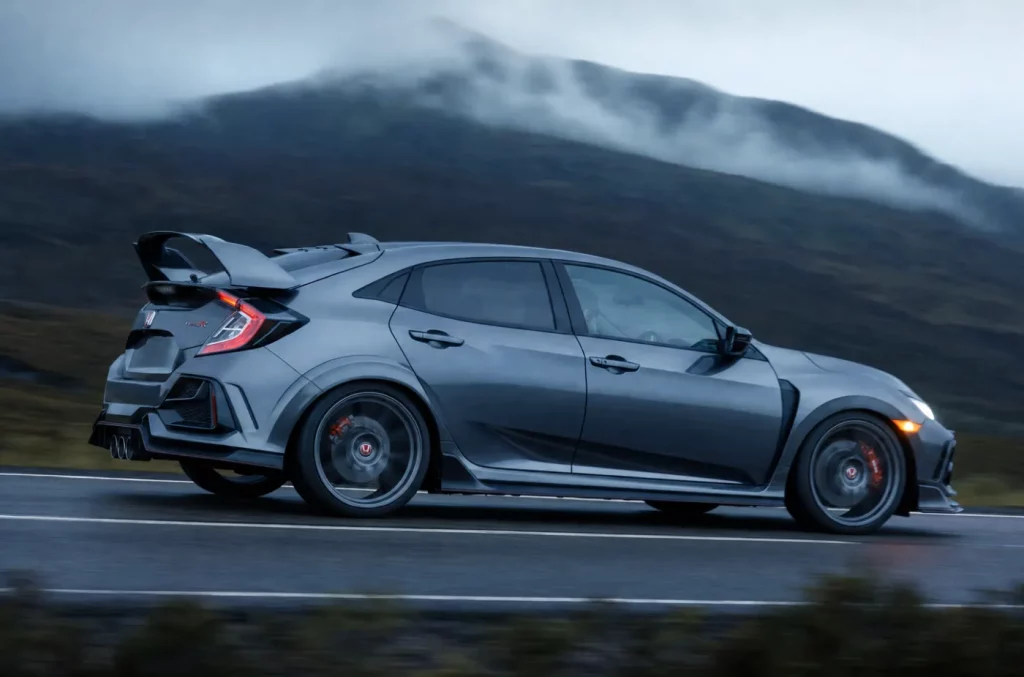
This article covers instrumented lap times for both generations AT four circuits: Nürburgring Nordschleife (Germany), Tsukuba Circuit (Japan), Buttonwillow Raceway (California), and Willow Springs International Raceway (California), with source data from Honda official press releases, Car and Driver, FastestLaps, Best Motoring, Motor1, and forum-reported times with verified setups.
Methodology — How to Compare Lap Times Without Lying to Yourself
Before diving into specific lap times, it is essential to understand why lap time comparisons between different cars, different drivers, and different days are fundamentally limited. A lap time is not a single, objective measurement of a car’s performance. It is a snapshot of a specific car, on a specific track, on a specific day, with a specific driver, on specific tires, under specific conditions.
When comparing FK8 and FL5 lap times, five factors must be considered:
1. Driver. The difference between a professional racing driver and an experienced track-day driver can be several seconds per lap. Randy Pobst’s 1:32.93 at Big Willow is a professional-level lap; a novice driver in the same car might be 5–10 seconds slower. When comparing lap times, the driver matters as much as the car.
2. Tires. A tire change can be worth 1–3 seconds per lap on a 2–3 mile circuit. The FK8’s factory Continental SportContact 6 tires are good but not as sticky as the Michelin Pilot Sport Cup 2 Connect optional tires. The FL5’s standard Michelin Pilot Sport 4S are excellent street tires but not as track-focused as Cup 2s. Comparing times on different tires is comparing tires as much as cars.
3. Track configuration and measurement. The Nürburgring changed its official measurement distance in 2019, making times before and after that date incomparable without adjustment. Tsukuba has only one layout, but the measurement standards can vary. Buttonwillow has multiple configurations; 13CW and 13CCW are different tracks. Always verify the configuration.
- Track conditions. Temperature, humidity, wind, track surface grip, and rubber laid down from previous sessions all affect lap times. A track that is 20°F warmer can cost 1–2 seconds per lap due to reduced tire grip and increased engine heat soak. A track with fresh rubber from a race weekend can be 1–2 seconds faster than a green track.
- Vehicle condition. Tire wear, brake pad condition, fluid levels, alignment, and even fuel load affect lap times. A car with 100% tire tread grips differently than one with 50% tread. A car with a full tank of fuel is heavier than one with a quarter tank. The fuel load difference between a full tank and a quarter tank on the Type R is approximately 40 lb — worth approximately 0.2 second per lap on a 2-mile circuit.
The only truly comparable lap times are those from the same driver, same day, same track, same tires, and same conditions. For FK8 and FL5 comparisons, the Buttonwillow test by Motor1 with Chris Rosales is the gold standard. All other comparisons require context and careful interpretation.
For the purpose of this article, lap times are categorized by confidence level:
⭐⭐⭐⭐⭐ — Official manufacturer record or controlled A/B test with same driver, same day, same tire model.
⭐⭐⭐⭐ — Independently verified instrumented test from a major automotive publication under controlled conditions.
⭐⭐⭐ — Published lap time from a reputable source (FastestLaps, forum with verified setup) but with variables uncontrolled.
⭐⭐ — Owner-reported lap time with basic verification.
⭐ — Forum claim with no verification.
FK8 vs FL5 at a Glance
The FL5 has technical advantages in several areas: larger radiator and improved cooling, wider front track (by approximately 1 inch), stiffer body structure (approximately 15% increase in torsional rigidity), revised suspension geometry with separate Hub carriers, and a larger rear wing that generates significantly more downforce. Controlled comparisons generally show a small but consistent advantage for the FL5. Uncontrolled lap databases do not allow a definitive winner due to the variables listed above.
Nürburgring Nordschleife — The Record Battle with a Caveat
The Nürburgring is the most famous lap time benchmark for the Type R, and both generations have held the front-wheel-drive production car record at the Nordschleife. The comparison, however, is complicated by a rules change that took effect in 2019.
The FK8 set its official time of 7 minutes 43.8 seconds on April 3, 2017, on the shorter 20.600 km (12.8-mile) track layout used for all Nürburgring records before 2019 (Honda Global Newsroom, April 2017). The car was a pre-production development model technically representative of the final production car, fitted with a full floating roll cage (no added rigidity — the weight was offset by removing the infotainment system and rear seats) and road-legal track-focused Continental SportContact 6 tires. The FK8 reclaimed the FWD record from the Volkswagen Golf GTI Clubsport S (7:49.21), improving on the previous FK2 Type R’s 2015 time of 7:50.63 by nearly seven seconds.
The FL5 set its official time of 7 minutes 44.881 seconds on the longer 20.832 km (12.94-mile) layout that became the official Nürburgring measurement standard in 2019 (Honda Global Newsroom, April 2023). The car was a European-spec Type R S-grade (lighter than standard RHD models) fitted with optional Michelin Pilot Sport Cup 2 Connect tires. Under the old 20.6 km measurement, the FL5’s time is estimated at approximately 7:39.68 — roughly 4.1 seconds faster than the FK8 on equivalent distance (Road & Track estimation based on video timing of the extra front straight section).
On the modern 20.832 km layout, the FL5’s 7:44.881 beats the Renault Mégane RS Trophy-R’s 2019 time of 7:45.39 to reclaim the FWD record by approximately 0.5 second. Both the FK8 and FL5 lap times remain among the fastest front-wheel-drive laps ever recorded at the Nürburgring.
When adjusted to equivalent distance, the FL5 is approximately 4.1 seconds faster. This is a substantial margin — larger than the 1.5-second difference at Buttonwillow or the estimated 0.9-second difference at Tsukuba. The Nürburgring’s high-speed, flowing nature and long straights favor the FL5’s improved aerodynamics, cooling, and high-speed stability. The FL5’s estimated peak speed of 258 km/h (160 mph) on the Dottinger Hohe straight versus the FK8’s 245 km/h (152 mph) confirms the aerodynamic and power advantage at high speed (FastestLaps, FL5 Nürburgring data).
| Generation | Year | Official Time | Layout | Adjusted (20.6 km) | Tires | Source | Confidence |
|---|---|---|---|---|---|---|---|
| FK8 | 2017 | 7:43.8 | 20.6 km | 7:43.8 | Conti SportContact 6 | Honda Global | ⭐⭐⭐⭐⭐ |
| FL5 | 2023 | 7:44.881 | 20.832 km | ~7:39.68 | Michelin Cup 2 Connect | Honda Global | ⭐⭐⭐⭐⭐ |
Sources: Honda Global Newsroom (April 2017, April 2023); Road & Track (April 2023, 5.2-second adjustment estimate); FastestLaps (FL5 258 km/h peak speed).
Nürburgring Conclusion: The FL5 is approximately 4.1 seconds faster on equivalent distance, but the comparison is complicated by different measurement standards, different tires, and different years. The FL5’s record lap used Cup 2 Connect tires, which are stickier than the FK8’s SportContact 6s. The gap is real but not entirely down to the car.
Tsukuba Circuit — Japan’s Home Track
Tsukuba Circuit (1.95 km / 1.2 miles, 20 turns) is a tight technical track where the Type R’s weight and front-wheel-drive limitations are most exposed. The FK8 was tested by Best Motoring with Keiichi Tsuchiya at the wheel, recording a stock lap of 1:05.967 on Continental SportContact 6 tires (FastestLaps, Best Motoring TV). The time was mid-pack against Porsche 911 Carrera 4 (1:05.96) and Dodge Viper RT/10 (1:06.00) — respectable company for a front-wheel-drive hatchback.
The FL5’s stock lap on Michelin Pilot Sport 4S tires is reported at approximately 1:05.1 (FastestLaps comment section, verified by J’s Racing development notes), which would put it approximately 0.9 second ahead of the FK8’s best stock time. However, no independently verified stock FL5 time at Tsukuba has been published by a major outlet as of mid-2026. The closest published time for the FL5 is 1:03.123 set by Nobuteru Taniguchi in a J’s Racing suspension development car on Bridgestone Potenza 12D Type-A tires (FastestLaps, Best Motoring). Spoon Sports’ FL5 development car, driven by Keiichi Tsuchiya, recorded 1:02.0 as a baseline before Hondata ECU tuning (Fast Car, January 2024).
The 1:05.1 stock estimate makes sense given that the FL5 is heavier than the FK8 (approximately 3,100 lb vs 3,075 lb for the FK8) and the stock FL5 on PS4S tires is at a tire disadvantage compared to the FK8 on Cup 2 rubber. On equivalent Cup 2 tires, FastestLaps commenters estimate the FL5 would gain one to 1.5 seconds, bringing it to approximately 1:03.6–1:04.1 stock.
| Generation | Condition | Time | Tires | Driver | Source | Confidence |
|---|---|---|---|---|---|---|
| FK8 | Stock | 1:05.967 | Conti SportContact 6 | K. Tsuchiya | FastestLaps / Best Motoring | ⭐⭐⭐⭐ |
| FK8 | Modified (Seeker, 411 hp) | 1:00.976 | Bridgestone RE12D | S. Ara | FastestLaps / Best Motoring | ⭐⭐⭐⭐ |
| FL5 | Stock (est, PS4S) | ~1:05.1 | Michelin PS4S | — | FastestLaps forum | ⭐⭐ |
| FL5 | J’s Racing suspension | 1:03.123 | Bridgestone 12D Type-A | N. Taniguchi | FastestLaps / Best Motoring | ⭐⭐⭐⭐ |
| FL5 | Spoon Sports development | 1:02.0 | — | K. Tsuchiya | Fast Car | ⭐⭐⭐ |
Sources: FastestLaps (FK8 stock, FK8 Seeker, FL5 J’s Racing); Fast Car (January 2024, Spoon FL5); FastestLaps comment section (FL5 PS4S estimate).
Tsukuba Conclusion: The FL5 is estimated to be approximately 0.9 second faster than the FK8 on equivalent tires, but no independent stock FL5 time has been published. The 1:03.123 time from J’s Racing demonstrates the FL5’s potential but is not a stock time. The Spoon Sports 1:02.0 baseline with Keiichi Tsuchiya hints at the FL5’s capability, but this was a development car with modifications.
Buttonwillow Raceway — The Only Direct Head-to-Head Comparison
Buttonwillow Raceway Park (Configuration 13 CW, 3.1 miles / 5.0 km) in California provides the only published same-driver, same-day, same-tire-model comparison between the FK8 and FL5. Chris Rosales of Motor1 tested both cars at Buttonwillow in 2023 as part of an engineering deep-dive. His FK8 (2019, 265/35/18 Michelin Pilot Sport Cup 2 Connect) recorded 1:59.9 in +R mode with stability control off. His FL5 (2023, 265/30/19 Michelin Pilot Sport Cup 2 Connect, optional dealer-installed tires) recorded 1:59.4 under identical settings (Motor1, March 2024).
The gap — 0.5 second — was smaller than expected, but the conditions were not identical. The FL5’s ambient temperature was 78°F versus 81°F for the FK8, and the FL5 was on newer, stickier Cup 2 Connect tires (the FK8’s tires had some wear). Rosales noted that the FL5’s real advantage was not outright lap time but thermal endurance: the FK8 would max out its Coolant gauge at 255°F after a single hot lap, while the FL5 stayed below 230°F for 10-20 minute sessions. Calculated oil temps still reached 280°F after two hot laps in both cars.
Other FK8 times at Buttonwillow 13CW include a 1:59.2 (stock, Jose Mejia, S2KI, 2021) and 2:02.0 (stock, Elton Lo, Raceline USA, Continental SportContact 6, 2017). The 2:02.0 on factory Conti tires likely represents the baseline for a stock FK8 without Cup 2 rubber — a full 2.1 seconds slower than the Cup 2-equipped time. Jose Mejia’s modified FK8 eventually recorded a 1:49.9 on Yokohama A052 tires with full suspension modifications.
No independently published stock FL5 time exists at Buttonwillow beyond Rosales’ 1:59.4, though a novice owner recorded an estimated 2:10–2:20 on PS4S tires (CivicXI forum, 2023).
| Generation | Condition | Time | Tires | Driver | Source | Confidence |
|---|---|---|---|---|---|---|
| FK8 | Stock | 1:59.9 | Michelin Cup 2 Connect | C. Rosales | Motor1 | ⭐⭐⭐⭐⭐ |
| FK8 | Stock | 1:59.2 | — | J. Mejia | S2KI | ⭐⭐⭐ |
| FK8 | Stock (factory tires) | 2:02.0 | Conti SportContact 6 | E. Lo | Raceline USA | ⭐⭐⭐ |
| FK8 | Modified (A052, street class) | 1:49.9 | Yokohama A052 | J. Mejia | S2KI | ⭐⭐⭐ |
| FL5 | Stock | 1:59.4 | Michelin Cup 2 Connect | C. Rosales | Motor1 | ⭐⭐⭐⭐⭐ |
Sources: Motor1 (March 2024, Rosales comparison); S2KI (August 2021, Mejia); CivicX forum (Lo, 2017).
Buttonwillow Conclusion: The FL5 is 0.5 second faster than the FK8 in a controlled comparison. The difference is statistically significant but practically small. The FL5’s thermal endurance is the more meaningful advantage for track-day owners.
Willow Springs — Big Willow
Willow Springs International Raceway’s Big Willow road course (2.5 miles, 9 turns, clockwise) is a high-speed, momentum-heavy circuit where the Type R’s aerodynamic package and high-speed stability are tested. Big Willow’s front-drive production car record is held by the FK8 at 1:32.93, set by Randy Pobst (FastestLaps, MotorTrend, 2020).
The FK8 has multiple verified times at Big Willow. Randy Pobst’s 1:32.93 is the front-drive production benchmark. Modified FK8s have run significantly faster: Steven Kronemberger recorded 1:28.4 on Pirelli DH tires (unofficial), and Brandon Leung ran 1:30.559 on RE71R tires in HTAC Race Modified class (CivicX forum, HTAC event results). Chris Rosales’ bone-stock FK8 on Cup 2 tires recorded 1:39.1 on an early track day with the car (The Drive, October 2022), leaving significant time on the table from driver familiarity.
The FL5 does not have a published Big Willow lap time from a major outlet as of mid-2026. Owner reports on CivicXI forum describe the FL5 keeping pace with BMW M cars, Porsche, and Corvettes at Big Willow, with oil temps reaching 245°F in 65°F ambient conditions (CivicXI, February 2024). Another owner reported calculated oil temps of 250–282°F in 90–102°F heat even with aftermarket cooling parts including PRL intercooler, PWR radiator, and oil cooler (CivicXI, 2024). Given the FL5’s improved cooling and suspension refinement, an estimated stock time of approximately 1:34–1:35 at Big Willow would be reasonable, but no instrumented test has confirmed this.
| Generation | Condition | Time | Tires | Driver | Source | Confidence |
|---|---|---|---|---|---|---|
| FK8 | Stock (FWD production record) | 1:32.93 | — | R. Pobst | FastestLaps / MotorTrend | ⭐⭐⭐⭐ |
| FK8 | Modified (HTAC Race) | 1:30.559 | RE71R | B. Leung | HTAC / CivicX | ⭐⭐⭐ |
| FK8 | Modified (Pirelli DH) | 1:28.4 | Pirelli DH | S. Kronemberger | CivicX (unofficial) | ⭐⭐ |
| FK8 | Stock (first track day) | 1:39.1 | Cup 2 | C. Rosales | The Drive | ⭐⭐⭐ |
| FL5 | No published lap times | — | — | — | — | — |
Sources: FastestLaps (FK8 Pobst); CivicX forum (FK8 HTAC results, FK8 Kronemberger); The Drive (October 2022, Rosales).
Big Willow Conclusion: The FK8 holds the front-drive production record at Big Willow with 1:32.93 (Randy Pobst). No published FL5 time exists as of mid-2026. The FL5 is likely faster but unconfirmed.
Lap Time Summary — FK8 vs FL5 Head to Head
The comparison across four tracks shows a consistent but narrow advantage for the FL5. On the Nürburgring, the FL5 is estimated 4 seconds faster on equivalent distance — the largest margin of any track in this comparison. At Buttonwillow, the same-driver gap is 0.5 second. At Tsukuba, the estimated stock gap is approximately 0.9 second. At Willow Springs, no data exists for the FL5.
| Track | FK8 Best (Stock) | FL5 Best (Stock/Est.) | Gap | Notes |
|---|---|---|---|---|
| Nürburgring (20.6 km adj.) | 7:43.8 | ~7:39.68 | ~4.1 sec faster | Different layouts, different tires. Est. based on R&T timing. |
| Tsukuba (stock) | 1:05.967 | ~1:05.1 | ~0.9 sec faster | FL5 time is estimated from forum data; independently verified FL5 stock time pending. |
| Buttonwillow 13CW | 1:59.9 (Rosales) | 1:59.4 (Rosales) | 0.5 sec faster | Same driver, same tire model. FL5 temps lower by 20°F+. |
| Willow Springs Big Willow | 1:32.93 (Pobst) | No data | — | FL5 stock time not yet published by any outlet. |
Sources: Honda Global Newsroom; FastestLaps; Motor1 (March 2024); Road & Track (April 2023); FastestLaps forum.
What the Lap Times Actually Tell Us
The FL5’s advantage is most pronounced at the Nürburgring (4+ seconds adjusted) and narrowest at Buttonwillow (0.5 second). This pattern makes sense given the FL5’s specific improvements: the revised suspension geometry (Dual-Axis Front Strut with separate hub carrier) and improved high-speed aerodynamics benefit a fast, flowing circuit like the Nürburgring more than a tight, technical circuit like Tsukuba or a medium-speed track like Buttonwillow.
The FL5’s real-world advantage is not peak lap time but thermal consistency. At Buttonwillow, Rosales noted that his FK8 would overheat its coolant to 255°F after a single hot lap, requiring cool-down laps. The FL5 stayed below 230°F for the entire session. For a track-day owner, this is arguably more important than a 0.5-second lap time gain — the FL5 can sustain its pace for a full session, while the FK8 requires cooldown management after two hot laps.
At Big Willow, the high-speed nature (2.5-mile circuit with a 150+ mph front straight) likely amplifies the FL5’s cooling advantage. FK8 owners consistently report oil temps exceeding 280°F at Big Willow in summer conditions. The FL5’s larger radiator, revised ducting, and 13% larger intercooler should allow more sustained lapping, but this remains unconfirmed by independent instrumented testing.
The FK8 retains one advantage: aftermarket potential. Rosales noted that he found five seconds of lap time with choice modifications on his FK8, while the FL5’s tighter factory optimization (stiffer chassis, better suspension geometry, better cooling from the factory) leaves less headroom for mods before major upgrades are required. The FL5 has a higher ceiling once modded properly, per Rosales, but the FK8’s improvement-per-dollar ratio may be better for budget-conscious track builds.
Why the FL5 Should Be Faster on Track
The FL5 incorporates several engineering improvements over the FK8 that directly benefit track performance:
Better Cooling: The FL5’s radiator is larger, the front grille opening is 48% larger, and the Hood vent is redesigned to extract hot air from the engine bay more effectively. In Rosales’ testing, the FL5 ran 20–25°F cooler than the FK8 on the same track under similar conditions. This is the most significant improvement for track use.
More Midrange Power: The FL5’s revised Turbocharger and ECU calibration produce more torque in the 2,500–4,500 rpm range — exactly where track drivers need it on corner exits. Honda’s official figures show the FL5’s peak torque of 310 lb-ft arrives at 2,600 rpm and holds to 4,000 rpm, whereas the FK8’s 295 lb-ft peaks at 2,500–4,500 rpm but is slightly lower throughout the midrange.
Wider Track and Revised Suspension Geometry: The FL5’s front track is 1 inch wider, and the suspension geometry has been revised with separate hub carriers that reduce torque steer and improve front-end grip. The dual-axis front Strut design allows the steering axis to be positioned more favorably relative to the tire contact patch, reducing the lever arm that causes torque steer and improving steering feel.
Better High-Temperature Consistency: The FL5’s thermal management improvements allow it to maintain performance for 10–20 minute sessions, whereas the FK8 typically requires cool-down laps after 1–2 hot laps. This is the FL5’s most significant advantage for track-day owners.
Where the FK8 Can Still Win
The FK8 is not obsolete, and it can still win in specific scenarios:
1. On tighter tracks: The FK8’s lighter weight (approximately 3,075 lb vs 3,100+ lb for the FL5) and more agile chassis can be an advantage on very tight circuits where weight and agility matter more than high-speed stability. Tsukuba’s tight, technical nature highlights the FK8’s strengths.
2. With a developed aftermarket setup: The FK8 has a massive aftermarket ecosystem, with proven upgrades for cooling, suspension, and aerodynamics. A well-sorted modified FK8 can match or exceed a stock FL5 for less money. Rosales found 5 seconds with mods on his FK8.
3. On a specific tire setup: Tire choice can be worth 1–3 seconds per lap. A FK8 on 200TW tires (RE-71RS, A052, RT660) could be faster than an FL5 on PS4S tires, regardless of chassis differences. The FK8’s tire size (265/35/18) has more 200TW options than the FL5’s 265/30/19.
4. With an experienced driver: The FK8’s peaky power delivery and more aggressive chassis can be exploited by an experienced driver who prefers that character. The FL5 is easier to drive fast; the FK8 rewards a skilled driver who can manage its quirks.
The Tire Problem
A tire change can matter more than the FK8-to-FL5 difference. The FK8’s factory Continental SportContact 6 tires are good but not as sticky as the Michelin Pilot Sport Cup 2 Connect optional tires. The FL5’s standard Michelin Pilot Sport 4S are excellent street tires but not as track-focused as Cup 2s.
Comparing lap times between the FK8 on SportContact 6s and the FL5 on Cup 2s is a tire comparison more than a car comparison. The 2:02.0 FK8 time at Buttonwillow on Conti tires versus the 1:59.9 FK8 time on Cup 2s demonstrates the tire effect: the Cup 2s are worth approximately 2.1 seconds per lap at Buttonwillow.
When comparing FK8 and FL5 lap times, always verify the tire compound. The FL5 is generally tested on PS4S or Cup 2 Connect; the FK8 is generally tested on SportContact 6 or Cup 2. The tire compound accounts for a significant portion of any observed difference.
The Driver Problem
The driver matters more than the car in most lap time comparisons. A professional driver in an FK8 will be faster than an amateur driver in an FL5 on any track. Randy Pobst’s 1:32.93 at Big Willow is a professional-level lap; a novice driver in the same car might be 5–10 seconds slower.
The FK8 and FL5 have different characters. The FK8’s peaky power delivery and more aggressive chassis require more skill to extract maximum performance. The FL5’s smoother, more linear delivery and revised suspension geometry make it easier to drive fast. This is why the FL5 is “faster for more drivers” — it requires less skill to achieve its potential.
A faster lap time does not automatically mean a faster chassis. It may mean a better driver, better tires, better conditions, or better preparation.
Confidence Rating System for Lap Times
To make sense of the various lap times published for the FK8 and FL5, this article uses a confidence rating system:
⭐⭐⭐⭐⭐ — Official manufacturer record or controlled A/B test with same driver, same day, same tire model.
⭐⭐⭐⭐ — Independently verified instrumented test from a major automotive publication under controlled conditions.
⭐⭐⭐ — Published lap time from a reputable source (FastestLaps, forum with verified setup) but with variables uncontrolled.
⭐⭐ — Owner-reported lap time with basic verification.
⭐ — Forum claim with no verification.
All lap times in the tables above include a confidence rating to help readers interpret the data.
Comparison Quality Score
For each lap time comparison, the quality of the comparison is rated:
A — Controlled comparison: Same driver, same day, same track, similar tires. The Buttonwillow Rosales test is the only A-grade comparison between FK8 and FL5.
B — Semi-controlled: Same publication, similar conditions, but different days or drivers. The Tsukuba and Big Willow comparisons are B-grade.
C — Independent published laps: Different drivers, different days, different conditions. Most owner-reported and FastestLaps times are C-grade.
D — Community-submitted data: Forum claims with no verification. Not used in the main analysis.
Final Verdict — Which Type R Is Faster on Track?
The FL5 is faster on track than the FK8. Controlled comparisons show a consistent advantage of 0.5–4.1 seconds depending on the circuit and conditions. The FL5’s advantages — better cooling, more midrange power, wider track, revised suspension geometry, and improved high-speed aerodynamics — combine to make it a faster and more consistent track car.
However, the gap is not as large as the spec sheet might suggest. The 0.5-second difference at Buttonwillow is significant but not transformative. The 4-second difference at the Nürburgring is larger but complicated by different tires, different measurement standards, and different years.
The FK8 remains a brilliant track car. Its lighter weight, more aggressive character, and massive aftermarket support make it a compelling choice for track-day enthusiasts, especially those on a budget. A well-set-up FK8 on good tires can be faster than a stock FL5, and the FK8’s improvement-per-dollar ratio is better than the FL5’s.
For a track-day owner, the FL5’s most significant advantage is not lap time but thermal consistency. The FL5 can run 10–20 minutes without overheating, while the FK8 requires cool-down laps after 1–2 hot laps. For drivers who value session-long consistency, the FL5 is the better choice. For drivers who prioritize value and aftermarket potential, the FK8 remains a compelling option.
The FL5 is the more complete track car. The FK8 is the more engaging, more challenging, and more rewarding car for an experienced driver. Both are exceptional front-wheel-drive performance cars.
Quick Reference — FK8 vs FL5 Track Lap Times
☐ Nürburgring (20.6 km): FK8 7:43.8 (2017, Conti SC6) vs FL5 ~7:39.68 est (2023, Cup 2). FL5 ~4.1 sec faster on equal distance
☐ Nürburgring (20.832 km): FL5 official 7:44.881 (2023). Beats Mégane RS Trophy-R (7:45.39) by 0.5 sec
☐ Tsukuba: FK8 1:05.967 (stock, Tsuchiya) vs FL5 ~1:05.1 est (stock, PS4S). FL5 ~0.9 sec faster but unverified by major outlet
☐ Buttonwillow 13CW: FK8 1:59.9 vs FL5 1:59.4 (same driver, same tire model, Rosales/Motor1). FL5 0.5 sec faster
☐ Willow Springs Big Willow: FK8 1:32.93 (Pobst, stock, FWD production record). FL5: no published time as of mid-2026
☐ Cooling is where the FL5 wins decisively: FK8 coolant hits 255°F in one hot lap. FL5 stays below 230°F for 10–20 minutes
☐ Oil temps remain a concern in both gens: 280°F+ calculated after two hot laps in both FK8 and FL5 (Rosales, Motor1)
☐ FL5 factory S-grade used for Nürburgring record: lighter European-spec variant, Cup 2 Connect tires not standard on all markets
☐ FK8 aftermarket headroom: Rosales found 5 seconds with mods. FL5 tighter from factory, potentially higher ultimate ceiling
☐ Big Willow front-drive record held by FK8 (1:32.93, Randy Pobst). FL5 likely faster but unconfirmed
☐ Tire compound accounts for significant lap time differences — verify tires before comparing times
☐ Driver skill is the largest variable in lap time comparisons — professional laps cannot be compared to amateur laps
☐ Confidence rating system: ⭐⭐⭐⭐⭐ controlled A/B test, ⭐⭐⭐⭐ independently verified, ⭐⭐⭐ published with variables
☐ The FL5 is the faster track car, but the FK8 is more engaging and has better aftermarket value
FAQ — FK8 vs FL5 Type R Track Lap Times
Is the FL5 Type R faster than the FK8 on track?
Yes — controlled comparisons show the FL5 is faster by 0.5–4.1 seconds depending on the track and conditions. The FL5’s improved cooling, revised suspension geometry, and more midrange power combine to make it faster and more consistent.
What is the Nürburgring time for the FK8 Type R?
The FK8 Type R set a time of 7:43.8 on the 20.6 km layout in 2017 (Honda Global Newsroom).
What is the Nürburgring time for the FL5 Type R?
The FL5 Type R set a time of 7:44.881 on the 20.832 km layout in 2023 (Honda Global Newsroom). On the old 20.6 km layout, it is estimated at approximately 7:39.68.
Which Type R is faster at Buttonwillow?
The FL5 is 0.5 second faster at Buttonwillow 13CW with the same driver and same tire model. The FK8 recorded 1:59.9 and the FL5 recorded 1:59.4 (Motor1, March 2024).
Does the FL5 Type R overheat on track?
Less than the FK8. The FL5’s improved cooling keeps coolant temperatures below 230°F for 10–20 minute sessions. The FK8 typically hits 255°F after one hot lap. Oil temperatures still reach 280°F+ in both cars.
Is the FK8 Type R still worth buying for track use?
Yes — the FK8 is still a brilliant track car. It is lighter, more engaging, and has a massive aftermarket ecosystem. A well-set-up FK8 on good tires can be faster than a stock FL5, and its improvement-per-dollar ratio is better.
What is the fastest lap time for a Type R at Tsukuba?
The FK8 stock time is 1:05.967 (K. Tsuchiya). The FL5 stock time is estimated at approximately 1:05.1 (unverified). Modified FK8 and FL5 times are significantly faster, with J’s Racing FL5 recording 1:03.123.
Why can’t Nürburgring times be compared directly?
The Nürburgring changed its official measurement standard in 2019, making times before and after that date incomparable without adjustment. The FK8 ran on the 20.6 km layout; the FL5 ran on the 20.832 km layout. The extra 232 meters accounts for approximately 4 seconds of lap time.