

For decades, the hot hatch segment has been defined by a single question: how much performance can you pack into a practical, everyday car? The Honda Civic Type R and the Volkswagen Golf R represent two very different answers to that question. Both have 2.0-liter turbocharged engines. Both make over 300 horsepower. Both are practical hatchbacks that can carry four people and their luggage. But the way they deliver performance could not be more different.
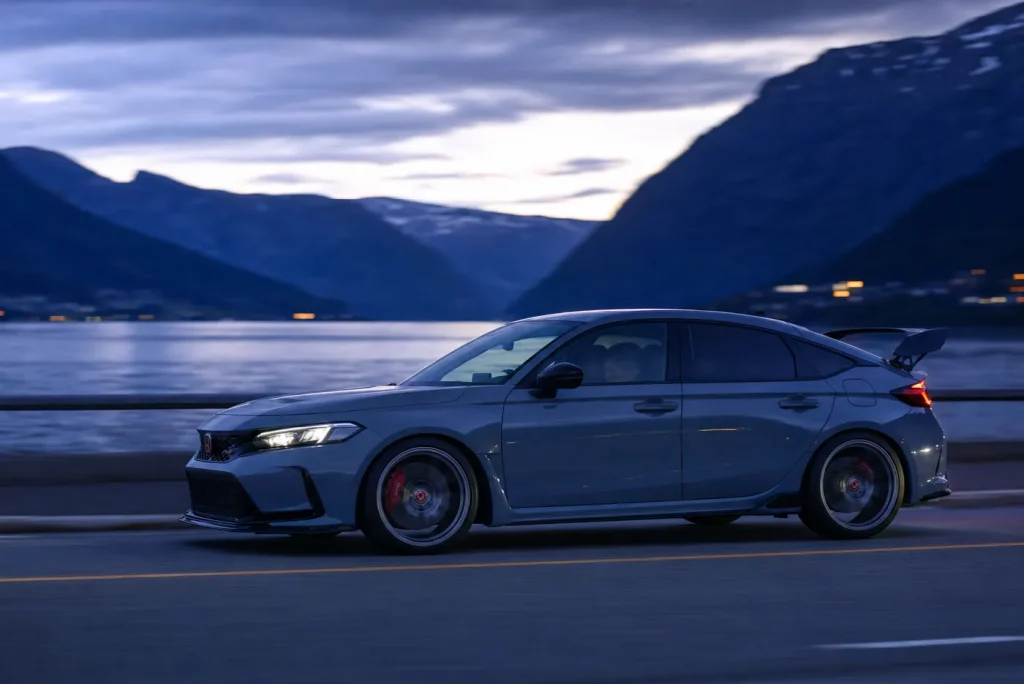
The Civic Type R FL5 arrives with 315 horsepower and 310 lb-ft of torque from the K20C1, driving only the front wheels through a helical limited-slip differential and a six-speed manual transmission. It is a car built for engagement, for involvement, for the driver who wants to feel every shift, every corner, every ounce of grip. The Golf R Mk8 counters with 328 horsepower and 280 lb-ft (DSG version) from the EA888 Gen 4, routed through all four wheels via the 4Motion system and a seven-speed DSG dual-clutch transmission. It is a car built for capability, for speed, for the driver who wants to go fast in any condition without thinking about it.
This is not a debate about which car is objectively better. It is a debate about what you value more: engagement or versatility, involvement or ease, the experience of driving or the convenience of speed.
The Civic Type R is the more rewarding driver’s car — sharper steering, better manual transmission, and superior track precision. The Golf R is the better all-rounder — AWD traction, DSG speed, and daily comfort. The Type R sacrifices convenience for involvement; the Golf R sacrifices some involvement for capability. Choose based on whether you prioritize driving experience or everyday usability.
Two Different Answers to the Same Question
On paper, these cars look like natural rivals. Both have 2.0-liter turbocharged four-cylinders. Both make around 300 horsepower. Both are practical hatchbacks that can carry four people and their luggage. Both are roughly the same price — around $45,000 to $50,000 in the current market.
But the engineering philosophy behind each car is completely different. The Civic Type R is built around mechanical engagement. Honda’s engineers spent years perfecting the front axle, the steering feel, the shift action, and the chassis dynamics. The Golf R is built around capability. Volkswagen’s engineers focused on all-weather traction, launch control, DSG speed, and daily comfort.
The Type R sacrifices convenience for involvement. The Golf R sacrifices some involvement for capability.
| Specification | Honda Civic Type R FL5 | Volkswagen Golf R Mk8 |
|---|---|---|
| Engine | K20C1 2.0L turbo I4 | EA888 Gen 4 2.0L turbo I4 |
| Horsepower | 315 hp @ 6,500 rpm | 328 hp @ 5,600–6,500 rpm |
| Torque | 310 lb-ft @ 2,600–4,000 rpm | 280 lb-ft (DSG: 295 lb-ft) @ 1,800–5,600 rpm |
| Drivetrain | Front-wheel drive | All-wheel drive (4Motion + torque-vectoring rear diff) |
| Transmission | 6-speed manual | 7-speed DSG (no manual in US for 2025+) |
| LSD | Helical | Torque-vectoring rear differential |
| Curb weight | ~3,183 lb | ~3,329 lb |
| 0-60 mph (tested) | 4.9 sec (Car and Driver) | 4.1 sec (Car and Driver) |
| Quarter mile | 13.2–13.4 sec @ 110-112 mph | 12.5 sec @ 113 mph |
| Skidpad grip | ~1.02 g | ~0.98 g |
The Drivetrain Decision: Manual FWD vs DSG AWD
This is the central question of the comparison. The Civic Type R sends 315 horsepower through the front wheels alone, controlled by a six-speed manual transmission with a helical limited-slip differential. The Golf R sends 328 horsepower through all four wheels, controlled by a seven-speed DSG dual-clutch transmission with a torque-vectoring rear differential.
The Type R demands involvement. You manage the clutch, you select the gears, you modulate the throttle, and you work the LSD to maximize grip. Every fast acceleration requires your active participation. If you don’t get the launch right, it’s your fault. If you miss a shift, it’s your mistake. The car rewards skill and punishes laziness.
The Golf R offers ease. You press the accelerator, the DSG selects the optimal gear, the AWD system distributes torque, and the car handles the rest. Launch control does the work for you. The car makes speed easy. It doesn’t ask you to be a perfect driver — it just goes fast.
The Golf R makes speed easy. The Type R makes speed rewarding.
Daily Traffic: Which One Do You Actually Want on Monday Morning?
This is where the Golf R earns its reputation as the ultimate daily driver. The seven-speed DSG is effortless in stop-and-go traffic. The adaptive dampers in Comfort mode soak up road imperfections. The AWD system provides confidence in any weather. The cabin is quieter, more insulated, and more premium. MotorTrend characterizes the Golf R as one of the most versatile hot hatches — fast enough for track days, comfortable enough for commuting, and practical enough for everyday life.
The Type R is surprisingly usable for a car with its performance. Car and Driver calls the Type R both a track-day weapon and a surprisingly practical daily driver. The adaptive dampers in Comfort mode make the ride livable, and the hatchback body provides ample cargo space. But the Type R asks more of you. There’s more road noise, more vibration, more mechanical communication. The manual transmission requires effort in traffic. The aggressive styling attracts attention.
The Type R is the car you want on a weekend back road. The Golf R is the car you want on a Monday morning commute.
- More road noise
- Manual transmission only
- Aggressive styling
- More mechanical feel
- Rewards effort
- Quieter cabin
- DSG effortless in traffic
- AWD confidence
- Premium interior
- Makes speed easy
The 7-Speed DSG vs Honda’s 6-Speed Manual
This is one of the most important differences between the two cars, and it’s not just about preference — it’s about the entire driving experience.
The Golf R’s DSG is a technical marvel. Shifts are instantaneous, launch control is brutal, and the transmission always keeps the engine in the optimal powerband. On the track, the DSG allows you to focus entirely on braking points, turn-in, and racing lines. Car and Driver notes that the DSG holds the engine in the right range and lets the driver concentrate on the racing line without worrying about shifting.
But the Type R’s manual transmission is something else entirely. The lightweight flywheel makes the engine rev quickly. The short, precise shifter slots into gears with mechanical satisfaction. The rev-match system makes downshifts seamless. And the clutch engagement is perfectly calibrated for feel. It’s one of the best manual transmissions in any car, AT any price.
The DSG is faster. The manual is more rewarding. The DSG is more convenient. The manual is more engaging.
Straight-Line Performance: The Golf R Doesn’t Give You Time to Think
From a standing start, the Golf R is brutally quick. The AWD system and DSG launch control combine to produce acceleration that feels like teleportation. In testing, the 2025 Golf R hit 60 mph in 4.1 seconds — a time that puts it in proper sports car territory. The quarter mile comes up in 12.5 seconds at 113 mph. The Golf R doesn’t give you time to think. It just goes.
The Type R is fast, but it’s fast in a different way. The front-wheel-drive launch requires technique — too much throttle and the tires spin, too little and you lose time. Car and Driver recorded 4.9 seconds to 60 mph for the FL5 Type R, which is quick but not Golf R quick. The quarter mile comes up in 13.2 to 13.4 seconds at 110 to 112 mph.
But the Type R was never designed to win drag races. It was designed to win corners. The trap speed is nearly identical to the Golf R, which tells you that the Type R makes similar power once it’s moving. The difference is in how that power is delivered.
The Golf R wins the launch. The Type R fights back when the road starts turning.
Steering: This Is Where the Honda Changes the Conversation
This is one of the most important differences between the two cars. The Golf R’s steering is fast, precise, and effective. The car goes where you point it, and the quick ratio makes it feel responsive. But modern reviews regularly note the Golf R’s steering lacks feedback. MotorTrend highlights the light and somewhat distant steering feel as one of the Golf R’s main drawbacks compared to the Civic Type R.
The Type R’s steering is more communicative, more natural, and gives you more information about what the front tires are doing. MotorTrend considers the FL5’s steering one of its defining strengths, calling it practically benchmark-grade for the segment.
The Golf R tells you where the car is going. The Type R tells you what the road is doing.
FWD vs AWD: Which One Is Actually More Fun?
This is a crucial question, and the answer is not as simple as saying AWD is always more fun. The Golf R’s AWD system makes the car faster, more secure, and more weather-proof. The torque-vectoring rear differential can actively send power to the outside rear wheel in corners, reducing understeer and even allowing controlled oversteer in Drift mode. It’s a sophisticated system that adds capability.
The Type R’s front-wheel drive forces the driver to work with weight transfer, be precise with the throttle, and trust the LSD. The result is a more connected experience. You feel the front tires loading up, you feel the LSD distributing torque, and you feel the car pulling itself through the corner. It’s more work, but it’s also more rewarding.
AWD makes the Golf R faster. FWD makes the Type R more engaging.
The Corner Exit Test
This is a real-world scenario that reveals the character of each car. You brake, turn in, and open the throttle on the exit of a corner.
In the Golf R, you open the throttle early and the AWD system handles the rest. The car accelerates hard, the torque-vectoring rear differential manages the power distribution, and you’re on to the next corner. It’s fast and efficient.
In the Type R, you need to be precise. You need to load the front axle properly, choose the right moment to open the throttle, and trust the LSD to put the power down. When you get it right, the car pulls itself toward the exit with a sensation that feels like being sucked through the corner. It’s more difficult, but it’s also more emotionally satisfying.
The Golf R rewards confidence. The Type R rewards technique.
Track Day: Which One Can You Drive Harder?
This is where the Type R shows its true strengths. On a dry track, the Type R’s steering feedback, chassis precision, manual transmission, and dual-axis front suspension work together to create a driving experience that’s hard to beat. Honda also improved cooling on the FL5 with a larger radiator and better brake cooling, making it more consistent during sustained track use.
The Golf R is also seriously capable on track. The AWD traction, torque-vectoring rear differential, DSG, and adaptive dampers make it a fast and predictable track car. In the 2026 Car and Driver Lightning Lap test, the Golf R lapped VIR in 3:03.7, improving on the previous generation’s time by 0.6 seconds.
But the difference is in the experience. The Golf R is easier to drive fast. The Type R is more satisfying to drive fast. The Golf R lets you focus on the track. The Type R makes you feel like you’re part of the machine.
Can the Golf R Actually Be a Drift Car?
This is an interesting and somewhat unexpected feature of the current Golf R. The torque-vectoring rear differential and Drift mode allow the car to oversteer in a controlled, predictable way. MotorTrend described the Golf R’s ability to change attitude with the throttle as a fun and surprising addition to its repertoire.
But Drift mode is a bonus, not a reason to buy the car. It’s a clever party trick that adds personality to an already capable platform. It’s not the same as driving a rear-wheel-drive car, but it’s a reminder that the Golf R can be playful when you want it to be.
The Ride Quality Surprise
Many people assume the Golf R destroys the Type R in ride quality. The reality is more nuanced. The Golf R’s adaptive dampers give it a wide operating range — soft enough for commuting, firm enough for aggressive driving. It’s a genuine advantage for daily use.
But the Type R also has adaptive dampers with Comfort, Sport, and +R modes. MotorTrend notes that even the Type R remains surprisingly livable for daily driving, thanks to the different damper settings. The gap is smaller than people expect.
The Golf R is more comfortable. But the Type R isn’t uncomfortable. The difference is one of degree, not kind.
| Aspect | Honda Civic Type R FL5 | Volkswagen Golf R Mk8 |
|---|---|---|
| Ride quality (Comfort mode) | Livable, but firm | Softer, more compliant |
| Cabin noise | More road noise | Quieter, better insulated |
| Seat comfort (daily) | Aggressive bolsters, firm | More adjustable, softer |
| Interior quality | Sporty, but harder plastics | More premium materials |
| Visibility | Good, low beltline | Good, more upright |
Interior: Racing Cockpit vs Premium Hatch
This is an important difference for daily usability. The Civic Type R’s interior is dramatic, with red seats, red trim, an aluminum shift knob, and a purposeful, focused layout. You constantly feel like you’re driving a Type R. The seats are aggressive — excellent for track days, but they require a bit of gymnastics to get in and out of every day.
The Golf R’s interior is more restrained, more premium, and less theatrical. The materials are nicer, the fit and finish is tighter, and the overall feeling is more mature. The Golf R is easier to live with daily — easier to take clients, easier to arrive at work, easier to use every day. MotorTrend notes the more premium character of the Golf R’s interior, even if some of the touch-sensitive controls still frustrate owners.
Do you want a cockpit or a cabin? The Type R is a cockpit. The Golf R is a cabin.
The One-Car Garage Test
Imagine you can only have one car. It needs to commute to work, carry people, handle snow, drive on the highway, and occasionally go to the track.
The Golf R is probably the better one-car solution. AWD, DSG, comfort, premium interior, and all-weather capability make it the more versatile choice. It does everything well.
The Type R is probably the better one-car enthusiast solution. If you truly enjoy shifting, steering, and the mechanical connection to the road, the Type R offers something the Golf R cannot replicate.
The Golf R is the better car for almost everything. The Type R is the better car for the one thing enthusiasts care about most: driving.
The Attention Factor
This is a detail that often goes overlooked, but it matters. The Civic Type R attracts attention. The aggressive wing, the red seats, the wide body, the Type R styling — you cannot stay invisible in this car. That’s a positive for some buyers and a negative for others.
The Golf R can look almost like a standard Golf. It’s subtle, understated, and easy to ignore. For buyers who want performance without the attention, the Golf R is the clear choice.
The Type R arrives. The Golf R blends in.
Winter Test: Where the Golf R Wins Easily
This is one area where there’s no debate. The Golf R’s AWD system makes it dramatically more capable in snow, ice, and wet conditions. The 4Motion system with torque-vectoring rear differential provides confidence that the Type R’s front-wheel-drive setup simply cannot match.
The Type R is a seasonal car for many owners. The Golf R is a year-round daily driver. If you live in an area with significant winter weather, the Golf R has a massive practical advantage.
Ownership Personality
Instead of a standard pros and cons list, consider this approach.
Buy the Civic Type R if you want the best manual transmission experience, maximum steering feel, dry-road precision, track involvement, and a car with real character that makes every drive feel special.
Buy the Golf R if you want brutal acceleration, all-weather usability, DSG convenience, a premium daily experience, and a car that can do everything well without demanding your constant attention.
Verdict: Which Generation Wins?
The conclusion should be nuanced. Here’s how it breaks down.
| Category | Winner |
|---|---|
| 0–60 mph | Golf R |
| Quarter mile | Golf R |
| Manual transmission | Type R |
| Daily commuting | Golf R |
| Winter driving | Golf R |
| Steering feel | Type R |
| Driver engagement | Type R |
| Interior refinement | Golf R |
| Track involvement | Type R |
| All-weather capability | Golf R |
| One-car garage | Golf R |
| Enthusiast’s choice | Type R |
Final Thought
The Golf R is the better car for almost everything. The Civic Type R may be the better car for the one thing enthusiasts care about most: driving.
The Golf R makes a fast life easy. The Type R makes driving a fast life memorable.
The Golf R is the car you buy when you want to go fast without thinking about it. It’s comfortable, capable, and brutally quick. It handles winter, traffic, and road trips with ease. It’s the mature choice, the practical choice, the one-car solution.
The Type R is the car you buy when you want to feel something every time you drive. The steering communicates, the transmission engages, the chassis rewards precision. It’s less practical, less refined, and less versatile. But it’s more involving, more exciting, and more memorable.
The Golf R is the better car. The Type R is the more interesting one.
FAQ — Civic Type R vs Golf R
Which is faster, the Civic Type R or the Golf R?
In a straight line, the Golf R is significantly faster from a standing start due to AWD traction and DSG. Car and Driver recorded 4.1 seconds to 60 mph for the Golf R versus 4.9 seconds for the Type R. In rolling acceleration, the gap narrows considerably, with both cars trapping similar speeds in the quarter mile (110-113 mph). On a dry track, the Type R is generally faster due to superior chassis dynamics and cornering grip.
Which car has the better manual transmission?
The Civic Type R has the better manual transmission. The shift action is more precise, the engagement is more mechanical, and the rev-match system is seamless. The Golf R no longer offers a manual transmission in the US market for 2025+ models, making the Type R the only choice for enthusiasts who insist on three pedals.
Is the Golf R better in winter?
Yes — the Golf R’s 4Motion AWD system makes it significantly better in snow, ice, and wet conditions. The Type R is front-wheel-drive only, which limits its all-weather capability. For buyers in northern states, the Golf R has a massive practical advantage.
Which car has better steering feel?
The Civic Type R has better steering feel. It’s more communicative, more natural, and provides more feedback about what the front tires are doing. The Golf R’s steering is fast and precise but lacks the Type R’s level of engagement and information.
Which car is more practical as a daily driver?
The Golf R is more practical as a daily driver. It has a quieter cabin, more comfortable seats, AWD for all-weather confidence, and a more premium interior. The DSG makes traffic effortless. The Type R is still usable daily but requires more compromises in comfort and refinement.
Which car is better for track days?
The Civic Type R is generally better for track days, especially on dry pavement. It has superior steering feel, better chassis precision, a more engaging manual transmission, and better cooling for sustained track use. The Golf R is also capable on track but feels heavier and less communicative at the limit.
Which car is more fun to drive?
Both are extremely fun, but in different ways. The Civic Type R is more fun for enthusiasts who value mechanical engagement, steering feel, and the satisfaction of perfectly executed shifts. The Golf R is more fun for drivers who value brutal acceleration, all-weather capability, and the convenience of DSG. Choose based on whether you prefer involvement or ease.
Does the Golf R have a DSG or manual transmission?
For the 2025 model year and beyond in the US market, the Golf R is available exclusively with a seven-speed DSG dual-clutch transmission. The manual transmission has been discontinued for the US Golf R. The Civic Type R remains exclusively a six-speed manual.
Should I buy a Civic Type R or Golf R?
Buy the Civic Type R if you prioritize driving engagement, steering feel, manual transmission involvement, and track-day capability above all else. Buy the Golf R if you need all-weather capability, daily comfort, DSG convenience, and a more premium interior experience. Both are excellent — choose based on your priorities.
Which car has better resale value?
Both hold their value well, but the Civic Type R has historically had stronger resale value due to limited production and strong enthusiast demand. The Golf R also holds value well, but the Type R’s manual transmission and track-focused reputation give it an edge in the used market.