

For years, the hot hatch segment in America had a clear hierarchy. The Honda Civic Type R sat at the top — a front-wheel-drive masterpiece that rewrote the rules of what was possible with two driven wheels. Then Toyota did something unexpected. They brought back the Corolla nameplate with a rally-bred, all-wheel-drive three-cylinder monster that promised to challenge the Type R’s dominance in ways no other competitor could.
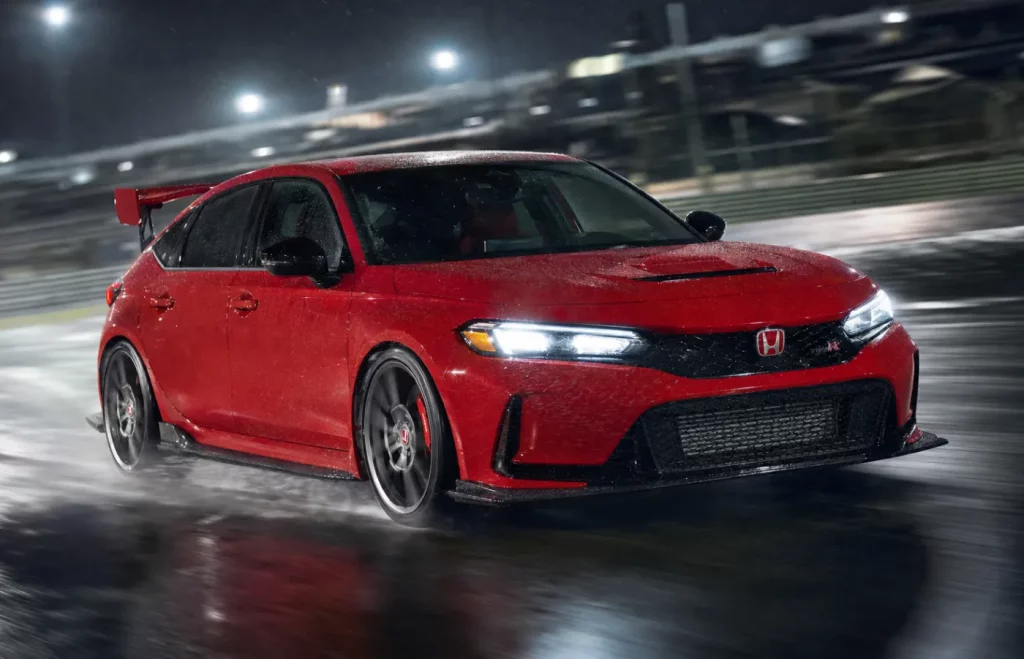
The Toyota GR Corolla arrived with the G16E-GTS — a 1.6-liter turbocharged three-cylinder producing 300 horsepower and 273 lb-ft of torque (295 lb-ft in Morizo spec), routed through the GR-Four all-wheel-drive system. The Honda Civic Type R FL5 counters with the K20C1 — a 2.0-liter turbocharged four-cylinder producing 315 horsepower and 310 lb-ft, driving only the front wheels through a helical limited-slip differential and Honda’s sophisticated dual-axis front suspension.
On paper, they look like natural rivals. Similar power. Similar price. Similar segment. But the way these cars deliver performance could not be more different. This isn’t just a comparison of spec sheets — it’s a battle between two fundamentally different philosophies of how to make a fast car.
The Civic Type R is the better track car on dry pavement — more precise, faster on most circuits, with superior steering and a more refined manual transmission. The GR Corolla is the better all-weather performer — AWD traction transforms launches, wet roads, and snowy conditions. The Type R solves traction with engineering; the GR Corolla solves it with four driven wheels. Choose based on your climate and driving priorities.
The Most Interesting Hot Hatch Battle Isn’t About Horsepower
On paper, these cars look nearly identical. The Civic Type R makes 315 horsepower and 310 lb-ft of torque from a 2.0-liter turbocharged inline-four. The GR Corolla makes 300 horsepower and 273 lb-ft (295 lb-ft in Morizo spec) from a 1.6-liter turbocharged three-cylinder. Both are available with a six-speed manual transmission. Both are roughly the same price.
But the numbers don’t tell the real story. The Civic Type R sends all its power to the front wheels. The GR Corolla sends power to all four wheels through the GR-Four system. This single difference changes everything about how these cars accelerate, corner, and behave on different surfaces.
The Civic Type R solves traction with engineering. The GR Corolla solves it with four driven wheels. And that difference defines the entire driving experience.
| Specification | Honda Civic Type R FL5 | Toyota GR Corolla |
|---|---|---|
| Engine | K20C1 2.0L turbo I4 | G16E-GTS 1.6L turbo I3 |
| Horsepower | 315 hp @ 6,500 rpm | 300 hp @ 6,500 rpm |
| Torque | 310 lb-ft @ 2,600–4,000 rpm | 273–295 lb-ft @ 3,000–5,500 rpm |
| Drivetrain | Front-wheel drive | All-wheel drive (GR-Four) |
| Transmission | 6-speed manual | 6-speed manual / 8-speed automatic |
| LSD | Helical | Front & rear Torsen (Circuit/Morizo) |
| Curb weight | ~3,183 lb | ~3,285 lb (Circuit) |
| Wheelbase | 107.7 inches | 103.9 inches |
| Tire size | 265/30R19 | 235/40R18 (Circuit/Morizo) |
| Skidpad grip | ~1.02 g | ~0.97–0.99 g |
The Architecture War: Why FWD vs AWD Changes Everything
This is the central question of the comparison. The Civic Type R sends 315 horsepower through the front wheels alone. Those wheels must simultaneously turn, transmit torque, brake, and fight for grip. It sounds like a recipe for understeer and torque steer.
But Honda spent years perfecting the front axle. The dual-axis front suspension separates the steering axis from the drive axis, virtually eliminating torque steer. The helical limited-slip differential distributes torque between the front wheels to maximize grip. The suspension geometry is tuned to keep the front tires planted under hard acceleration. The result is a front-wheel-drive car that drives like it has no business being this capable.
The GR Corolla takes a different approach. Toyota’s GR-Four system can send torque to the rear wheels when needed, providing traction that no front-wheel-drive car can match. The system offers three modes — 60:40 for normal driving, 50:50 for balanced grip, and 30:70 for a more rear-biased, playful character.
Honda perfects the front axle. Toyota distributes the workload. Both approaches work. They just work very differently.
Launches: Where AWD Finally Makes Sense
This is where the GR Corolla earns its victory. From a standing start, all-wheel drive is a massive advantage.
The GR Corolla can launch aggressively without worrying about wheelspin. The AWD system distributes torque to all four wheels, allowing the car to put down power immediately. In independent testing, Car and Driver recorded 4.9 seconds to 60 mph for the manual GR Corolla. The Civic Type R matched that time in some tests, but the difference in how they achieve it is night and day.
The Type R requires careful throttle modulation to avoid overwhelming the front tires. Even with 265-mm Michelin Pilot Sport 4S tires, launching a 315-hp front-wheel-drive car is a delicate operation. Too much throttle and the tires spin. Too little and you lose time. The ECU intervenes to manage wheelspin, which can make the launch feel somewhat artificial.
From a dig, the GR Corolla wins the traction argument. The AWD system allows for consistent, repeatable launches regardless of surface conditions. But once both cars are moving, the advantage becomes less obvious.
- Requires precise throttle control
- ECU manages wheelspin
- 265mm tires help grip
- 0-60: ~5.3-5.4 seconds
- Challenging in wet conditions
- AWD distributes torque instantly
- No wheelspin concerns
- Consistent launches
- 0-60: ~4.7-4.9 seconds
- Excellent in any weather
Rolling Acceleration: Where the Type R Fights Back
Most people focus on 0-60 times. But in real-world driving, rolling acceleration matters just as much — 30-50, 50-70, 60-100 mph pulls are what you actually use on the highway.
This is where the Civic Type R fights back. The larger 2.0-liter engine produces more horsepower and torque than the GR Corolla’s 1.6-liter three-cylinder. The Type R makes 315 horsepower and 310 lb-ft, compared to the GR Corolla’s 300 horsepower and 273-295 lb-ft. The difference doesn’t sound huge, but it’s noticeable.
The GR Corolla’s 1.6-liter three-cylinder requires higher revs to make its power. Car and Driver notes that the G16E-GTS likes to live above 4,000 rpm, where it delivers its best performance. Below that, the engine feels less urgent. The Type R’s K20C1, by contrast, has a broader, more accessible torque curve that makes it feel stronger in everyday driving.
In a 60-100 mph pull, the Type R’s higher horsepower and better power-to-weight ratio give it a clear advantage. The GR Corolla’s AWD system, which is such an asset from a standing start, becomes extra weight once the car is already moving. The Type R traps higher in the quarter mile — around 110-112 mph compared to the GR Corolla’s 101-103 mph — which tells you everything about where each car’s strength lies.
The GR Corolla attacks the launch. The Type R attacks the next 100 mph.
Corner Entry: Which One Feels More Precise?
This is where the comparison gets interesting. Many assume that all-wheel drive automatically means better cornering. That assumption is wrong.
The Civic Type R’s front end is brutally precise. The dual-axis suspension, the LSD, the suspension geometry, the tire width — everything works together to create a car that turns in with aggression and holds its line without drama. In testing, the FL5 recorded approximately 1.02 g on the skidpad, underlining the level of mechanical grip available from the front axle.
You can brake very late, turn in aggressively, and trust the front tires to hold. The steering provides exceptional feedback, and the chassis communicates clearly. It’s a car that rewards confidence and precision.
The GR Corolla feels different. It’s more compact, more playful, and more responsive to throttle inputs. The AWD system allows you to adjust the car’s attitude mid-corner using the throttle. In Track mode with a rear-biased torque split, the GR Corolla can rotate on throttle in a way that the Type R cannot match.
MotorTrend described the GR Corolla’s chassis as intuitive and confidence-inspiring, allowing the driver to quickly feel comfortable AT the limit. The car communicates its intentions clearly, even if it lacks the Type R’s ultimate front-end precision.
The Type R delivers precision. The GR Corolla delivers agility. Both are excellent. They just approach cornering differently.
Mid-Corner: The Unexpected Advantage of FWD
In a properly set-up front-wheel-drive car, there’s a moment mid-corner that AWD cars can’t replicate. You brake, load the front axle, turn in, and gradually open the throttle. The LSD distributes torque, and the car pulls itself toward the exit. It’s a sensation that feels like the car is being sucked through the corner.
The Civic Type R does this brilliantly. The front end grips, the rear follows obediently, and the car tracks precisely where you aim it. The LSD works seamlessly, and the suspension geometry keeps the front tires planted. It’s a car that rewards smooth, deliberate inputs.
The GR Corolla offers more adjustability. With the ability to change torque distribution on the fly, you can make the car more neutral, more rear-biased, or more stable. In Track mode, the AWD system can make the car feel livelier and allow more rotation when using the throttle. It’s a different experience — more versatile, but also less focused.
The Honda follows your steering. The Toyota reacts to your throttle. This is one of the best central ideas of the article — the Type R is a car you point; the GR Corolla is a car you manage with the pedal.
Corner Exit: This Is Where the AWD Myth Gets Tested
Conventional wisdom says AWD always destroys FWD on corner exit. On wet roads or loose surfaces, that’s often true. But on dry asphalt with good tires, the difference is much more complicated.
The GR Corolla allows you to get on the throttle earlier. The AWD system transforms that power into forward motion without overwhelming the rear tires. You can be more aggressive with the throttle pedal and trust the car to handle it.
The Type R requires more precision. You need to be smoother, more gradual, and more careful with the throttle. But the Type R’s front suspension geometry and LSD are so good that the car doesn’t just spin its tires helplessly on corner exit. It puts the power down — provided you’re smooth enough.
This is why 315 horsepower through the front wheels works better than the theory suggests. Honda’s engineering is so advanced that the Type R doesn’t feel like it’s struggling for grip. It feels like it was designed to maximize every ounce of traction available.
| Cornering Aspect | Civic Type R FL5 | Toyota GR Corolla |
|---|---|---|
| Corner entry precision | Exceptional — dual-axis suspension and LSD | Good — AWD helps stability |
| Mid-corner adjustability | Limited — follows steering inputs | High — throttle changes attitude |
| Corner exit traction (dry) | Excellent with smooth throttle | Excellent — can use more throttle earlier |
| Corner exit traction (wet) | Challenging — FWD struggles | Superior — AWD puts power down |
| Skidpad grip | ~1.02 g | ~0.97–0.99 g |
| Feel | Precision instrument | Playful weapon |
Wet Roads, Snow and Bad Weather: No Contest
This is where the GR Corolla wins without argument. The AWD system transforms the car in poor conditions.
In rain, the GR Corolla’s GR-Four system provides confidence that no front-wheel-drive car can match. You can accelerate harder, corner faster, and brake later without worrying about losing traction. The car feels planted and secure.
In snow, the advantage is even more dramatic. AWD with winter tires makes the GR Corolla a legitimate year-round performance car. It’s not a garage queen that only comes out in summer — it’s a car you can drive every day, in any weather.
The Type R, for all its brilliance on dry pavement, struggles in poor conditions. The front wheels are doing all the work, and when grip is limited, that becomes a real limitation. You can drive the Type R in the rain, but you need to be much more careful with the throttle and much more aware of the car’s limits.
The Type R is brilliant despite being FWD. The GR Corolla is brilliant because it can use AWD. This simple distinction defines much of the ownership experience.
| Condition | Civic Type R | GR Corolla |
|---|---|---|
| Dry pavement | Superior — better grip, better steering, better precision | Very good — AWD helps but weight hurts |
| Wet roads | Manageable — requires care | Clear winner — AWD transforms the car |
| Snow / ice | Seasonal — for many owners | Year-round — daily driver in any weather |
The Engine Personality Test: Four Cylinders vs Three
This should be a substantial section because the engines are so different.
The Civic Type R’s K20C1 is a 2.0-liter turbocharged inline-four. It produces 315 horsepower and 310 lb-ft of torque. It’s smooth, powerful, and refined. The power delivery is linear for a turbo engine, with a broad torque curve that makes the car feel responsive across the rev range. It’s a familiar, traditional engine character that Honda enthusiasts have come to love.
The GR Corolla’s G16E-GTS is a 1.6-liter turbocharged three-cylinder. It produces 300 horsepower and up to 295 lb-ft of torque. It’s one of the most extreme production three-cylinder engines ever built. And it feels like it.
The three-cylinder is rougher, louder, and more characterful. It has a distinctive thrum that no four-cylinder can replicate. The turbo noises are more pronounced. The engine feels more eager, more angry, and less refined. It’s not a smooth engine — it’s a hairy-chested engine that makes you feel like you’re driving something special.
Do you want refinement or weirdness? And in this case, “weirdness” isn’t a negative. The GR Corolla’s three-cylinder is part of its charm. It’s a conversation starter, a character piece, a reminder that Toyota built something truly unusual.
The Type R’s engine is the more polished tool. The GR Corolla’s engine is the more memorable experience.
Sound: Which One Actually Feels More Special?
This is a subjective section, but it matters to enthusiasts.
The Civic Type R’s engine sounds powerful but not especially distinctive. The K20C1 has a purposeful, mechanical note, but it’s not the kind of engine that makes you want to roll down the windows just to hear it. Car and Driver notes that the active exhaust and tuning are aimed at creating a more pronounced sound at high rpm, but the overall character is relatively subdued compared to the GR Corolla.
The GR Corolla’s three-cylinder is much more vocal. The turbo spool is audible, the blow-off noises are pronounced, and the exhaust note has a distinctive thrum that no four-cylinder can match. It may not sound as refined or expensive, but it sounds more interesting.
Odd often equals memorable. The GR Corolla’s engine sound is part of its personality. The Type R’s engine sound is competent but not memorable.
Manual Transmission: Honda vs Toyota
This is a critical enthusiast comparison. Both cars offer a six-speed manual transmission, but they’re not equal.
The Civic Type R’s manual transmission is one of the best in the business. The shift action is precise, the gates are perfectly spaced, and the engagement is mechanical and satisfying. The rev-match system works seamlessly, and the lightweight flywheel makes the engine responsive. Car and Driver singled out the Type R’s manual transmission as one of the car’s strongest attributes.
The GR Corolla’s manual transmission is also good. It has rev matching, a short throw, and a reasonably crisp feel. But it doesn’t have quite the same precision as the Honda. The shifts are slightly less tactile, the engagement is slightly less satisfying, and the overall feel is slightly less polished.
The Honda sets the standard. The Toyota is close, but not quite at the same level.
The Track-Day Problem: Traction vs Consistency
This is where the comparison gets interesting for track-day enthusiasts. The Type R and GR Corolla offer different strengths.
The GR Corolla’s AWD system provides immense traction. You can get on the throttle earlier, corner with more confidence, and use the car’s grip to push hard. But there’s a catch. In the 2026 Car and Driver Lightning Lap test, the GR Corolla displayed an AWD System Overheated warning, after which the system reportedly shifted to 2WD mode. This happened under specific test conditions and serves as a useful reminder that AWD systems have thermal limits under sustained hard use.
The Civic Type R, by contrast, has a simpler drivetrain that’s less prone to overheating. Honda increased the radiator size and improved brake cooling on the FL5, making it more consistent on track. The front-end precision is legendary, and the car can string together lap after lap without significant degradation.
Would you rather manage four driven wheels or master two? The Type R’s simpler approach is ultimately more consistent on dry pavement. The GR Corolla’s more complex system offers more traction but also more potential for thermal issues.
| Track-Day Aspect | Civic Type R FL5 | Toyota GR Corolla |
|---|---|---|
| Traction on corner exit | Very good with smooth driving | Excellent — AWD helps |
| Thermal consistency | Excellent — revised cooling | Mixed — AWD can overheat |
| Front-end precision | Legendary | Very good |
| Brake longevity | Good — improved cooling | Good |
| Lap-time consistency | Excellent | Variable — depends on temperatures |
| Track-day workload | Manageable | More complex |
The Weight Problem
All-wheel drive isn’t free. The GR Corolla carries extra hardware — the rear differential, the AWD coupling, the additional driveshafts — that adds weight. In MotorTrend’s comparison, the GR Corolla was approximately 100 pounds heavier than the Type R in the specific configurations tested.
This is important. AWD gives you traction, but it also adds weight, complexity, and mechanical drag. The Type R shows how far you can go if you optimize a single driven axle rather than adding a second one.
The Type R’s weight disadvantage to the GR Corolla is actually an advantage for the Honda. Lighter cars handle better, brake better, and feel more agile. The Type R’s engineering focus on the front axle means it doesn’t need AWD to deliver exceptional performance.
Daily Driving: The Bigger Car vs the Smaller Weapon
This is a significant real-world difference. The Type R is larger, more spacious, and more practical for daily use.
The Civic Type R has more cargo room, a more spacious back seat, and a more mature interior. Car and Driver called the Type R both a track-day weapon and a surprisingly practical daily driver. It’s a car you could actually live with every day.
The GR Corolla is smaller, more compact, and easier to park. It feels like a little rally weapon. But the interior is less premium, with Car and Driver directly noting the relatively cheap-feeling materials. The back seat is tighter, the cargo area is smaller, and the overall refinement is lower.
The Type R is the better daily driver if you need space and practicality. The GR Corolla is the better daily driver if you prioritize compact size and all-weather capability.
The Personality Test
Instead of another dry table, consider this approach.
Choose the Civic Type R if you want the best manual transmission, if you drive mostly on dry pavement, if you care about steering precision, if you do serious track days, and if you want one car that can be fast and practical.
Choose the GR Corolla if you want AWD, if you drive in winter conditions, if you want something smaller and more playful, if you like rally-inspired cars, and if you want the throttle to influence the chassis behavior.
Verdict: Which Generation Wins?
The conclusion should be nuanced. Here’s how it breaks down.
| Category | Winner | Why |
|---|---|---|
| Best Launch | GR Corolla | AWD transforms standing starts. No wheelspin, consistent performance. |
| Best Steering | Civic Type R | Precise, communicative, confidence-inspiring. |
| Best Manual Transmission | Civic Type R | Benchmark-quality shift action, perfect gates. |
| Best Bad-Weather Performance | GR Corolla | No contest — AWD usable year-round in any conditions. |
| Best Dry-Road Precision | Civic Type R | Unmatched front-end grip, exceptional cornering stability. |
| Most Playful Car | GR Corolla | AWD allows throttle-induced rotation. More adjustable. |
| Best Track Tool | Civic Type R | More consistent, better cooling, superior lap times. |
| Most Interesting Powertrain | GR Corolla | 300 hp from a 1.6L three-cylinder is bonkers. |
Final Thought
The GR Corolla uses all four wheels to make speed easier. The Civic Type R proves that two wheels can still be enough when the chassis is engineered brilliantly.
The Toyota gives you more traction. The Honda gives you more precision.
The GR Corolla is the car for people who want a rally-inspired machine that can be driven hard in any weather, any time of year. The Civic Type R is the car for people who want the ultimate front-wheel-drive track tool — a car that rewards skill and precision with lap times that defy its drivetrain layout.
Both are extraordinary cars. They just serve different masters and different driving preferences.
FAQ — Civic Type R vs GR Corolla
Which is faster, the Civic Type R or the GR Corolla?
It depends on the conditions. From a standing start, the GR Corolla’s AWD gives it an advantage — 0-60 times are roughly 4.7-4.9 seconds versus 5.3-5.4 for the Type R. In rolling acceleration and quarter-mile trap speed, the Type R is faster (110-112 mph vs 101-103 mph). On a dry track, the Type R is generally faster due to better chassis precision and higher cornering grip.
Which car has the better manual transmission?
The Civic Type R has the better manual transmission. The shift action is more precise, the gates are better spaced, and the engagement is more satisfying. The GR Corolla’s manual is good, but the Type R sets the benchmark in this segment.
Is the GR Corolla better in winter?
Yes — the GR Corolla’s AWD system makes it significantly better in snow, ice, and wet conditions. The Type R is a seasonal car for many owners; the GR Corolla can be driven year-round with appropriate tires.
Which car has the better steering feel?
The Civic Type R has better steering feel. It’s more precise, more communicative, and more confidence-inspiring. The GR Corolla’s steering is good but lacks the Type R’s ultimate precision.
Which car is more practical as a daily driver?
The Civic Type R is more practical. It has more cargo space, a more spacious back seat, and a more refined interior. The GR Corolla is smaller and less practical but easier to park and more maneuverable.
Does the GR Corolla overheat on track?
Under sustained hard track use, the GR Corolla’s AWD system can overheat. In the 2026 Car and Driver Lightning Lap test, an AWD System Overheated warning appeared, after which the system shifted to 2WD mode. The Type R has better thermal management for track use.
Which car is more fun to drive?
Both are extremely fun, but in different ways. The GR Corolla is more playful and adjustable, with AWD allowing throttle-induced rotation. The Type R is more precise and focused, rewarding smooth driving with incredible cornering performance. Choose based on whether you prefer playfulness or precision.
Which car has the better engine?
The Type R’s K20C1 is smoother, more refined, and more powerful. The GR Corolla’s G16E-GTS is more characterful, more unusual, and more memorable. The Type R has the better engine for performance; the GR Corolla has the more interesting engine for enthusiasts.
Should I buy a Civic Type R or GR Corolla?
Buy the Civic Type R if you want the ultimate front-wheel-drive track tool with the best manual transmission, superior steering, and more daily practicality. Buy the GR Corolla if you want AWD, year-round usability, a more playful chassis, and a more interesting engine. Both are excellent — choose based on your climate and driving priorities.
Which car has better resale value?
Both hold their value exceptionally well. The Type R has a longer track record of strong resale value, but the GR Corolla is also holding value well due to limited production and strong enthusiast demand. The Type R may have a slight edge due to its established reputation.